

Podcast Episode #147: How to Prioritize and Make Decisions

Listen or Watch this episode on:

About This Episode

If you have ADHD, then you struggle to prioritize and make decisions. In this episode, we’ll work on accepting our ADHD brains and begin to develop the skill of turning UP the volume on what’s important and turning DOWN the volume on what’s not as important. And of course, we’ll chat about how to even decide what’s important in the first place. 

Visit [www.ihaveadhd.com](https://ihaveadhd.com) for more resources

Hang out with me on Instagram @i.have.adhd.podcast

See Privacy Policy at [https://art19.com/privacy](https://art19.com/privacy) and California Privacy Notice at [https://art19.com/privacy#do-not-sell-my-info](https://art19.com/privacy#do-not-sell-my-info).
Episode Transcript

This episode is sponsored by CURE Hydration. All right, I’m going to be real with you. Drinking water is boring. My ADHD brain is like, wait, we have to do this again? Like every day, multiple times. What in the world? And because I’m running from meetings to coaching calls to kid chaos, staying hydrated is not something I’m naturally good at. It’s not something I naturally think about. That’s why I’ve been obsessed with Cure hydration packs lately. CURE is a plant based hydrating electrolyte mix with no added sugar, only 25 calories, and it actually tastes good. The watermelon and berry pomegranate have been on repeat for me. I’m actually like really running low on those flavors, which is so sad. They’re refreshing without being too sweet or artificial. It feels like my water finally has a little bit of personality, which I enjoy. I really do. What I love most is that CURE uses a science backed formula that hydrates as effectively as an IV drip. So when I’m scrambling through my day forgetting my water again, CURE helps me to catch up fast. I throw a few packs in my bag and it makes drinking enough water simple, which for my ADHD brain is basically a miracle. So staying hydrated isn’t just about water. You also need electrolytes. And that’s why I love Cure. It’s clean, tastes great, and it actually works. And bonus, CURE is FSA HSA approved. So you can use those funds to stay hydrated. The smart way for I have ADHD podcast listeners, you can get 20% off your first order@curehydration.com I have ADHD with the code I have ADHD. And if you get a post purchase survey, make sure to tell them that you heard about Cure right here on the podcast. It really does help to support the show. Don’t just drink more water, upgrade it with cure. Welcome to the I have ADHD podcast where it’s all about education, encouragement and coaching for adults with adhd. I’m your host Kristin Carter and I have adhd. Let’s chat about the frustrations, humor and challenges of adulting relationships, working and achieving with this neurodevelopmental disorder. I’ll help you understand your unique brain, unlock your potential and move from point A to point B. Hey, what’s up? This is Kristen Carter and you are listening to the I have ADHD podcast, episode number 147. I am medicated, I am caffeinated and I am ready to roll. Hello, how are you? How are you? How are you? It is so, so good to be here with you. It is a February day. It’s actually a Friday. I’m recording on my day off because I didn’t. I didn’t get my stuff done this week. I just didn’t get it all done. The Carter family is moving, as I’ve told you before. And I’ve got to say that the level of stress that this is adding to my life, even though it’s a good thing, it’s still a very heavy level of stress. I saw my therapist yesterday and she told me that on like, the life Stressors scale, which I guess is a thing, moving is at the top, which I didn’t realize. So I did some Googling. And a survey of a thousand Americans found that the most stressful event in life is moving. Again, I had no idea. So the survey was conducted by one poll, and IT found that 45% of respondents said that moving is by far the most stressful event in life, followed by going through a breakup or divorce and then getting married after that. So, anyway, I’m completely surprised. I think it’s a little bit wild. I thought that since we were so excited to move and we’ve been so privileged to be able to build our own home, that I wouldn’t consider it to be stressful. Isn’t that adorable? It’s so cute. It’s so cute. Sweet little. Six months ago, Kristen Carter thought like, oh, this won’t be stressful. It’s going to be great because this is a choice that we’re making and we want to make it. But I feel as though I’ve been carrying around like a boulder on my back. And honestly, it’s really been slowing me down, which is why today I’m recording this podcast late. I’m getting it to my editor late. And that’s okay. I’ve decided to share a Focus class with you instead of writing a whole solo show. And I think it’s going to actually work out better because this class is good. Now, if I did have the capacity to write a solo show, it would be called I hate Valentine’s Day. That’s what it would be called. Like, literally, that is what the episode was going to be about. I hate Valentine’s Day. I forgot to send in Valentine’s with my elementary school student son, and hot dang, it was a recipe for shame. Oh, my gosh. So if any of you parents of elementary school kids also struggle with the extra stuff like Valentine’s Day or Hat day or freaking book character Day, I see you, and I am with you. I can send my kid to school on the daily, you know, with his homework done. We have a routine for that. That is a set thing that we do every night. He’s in the routine. It’s not a big deal. So he shows up to school every day, pretty much clean, pretty much fed, homework done, snack packed. Like, we’ve got our routine. But whenever there is this event that is outside of the routine, my brain does not cooperate, and it is so freaking frustrating. Oh, my gosh. So anyway, I’m with you. I see you. I’m with you. I get it. I hope that you see me and that you’re with me too, because I just need a little bit of community of suffering with this. I feel like, you know, the only parent in my friend group who struggles with this, the only parent in my kid’s school who struggles with this. And I know I’m not the only one, but it feels very isolating when, like, your kid is the kid that shows up to the Valentine’s party without Valentines. Oh, my gosh. All right. So anyway, I was gonna do a whole episode on that, but I was so depleted this week that I just didn’t have the capacity to write it. So I think today’s episode will actually be even more valuable to you because this class is fire, and I taught it a couple weeks ago in my ADHD coaching program called Focused, and it’s on how to prioritize and make decisions. This is one of the main executive functions that we struggle with. We have deficiencies as ADHDers in our executive functioning, and prioritizing, planning, and making decisions is one of them. So it’s a skill that we need to develop, and we are going to talk about all of that in today’s episode. Now, if you love this class and you are ready for more of my support, I want to invite you to come join me in my coaching program, Focused. It’s where I spend nearly all of my time and energy, and I would love to welcome you in, take you by the hand and offer you the support and guidance that you’re looking for. You can go to ihaveadhd.com focused to learn more. That’s ihaveadht.com focused. All right, now, please enjoy this class on how to prioritize and make decisions. So glad to be here with you. Today. We are going to talk about prioritizing and making decisions, which I think are very, very, very closely related, which is why I lumped them together into the same topic. And I can tell it’s an important topic to all of you because there are already 56 people here. Y’ all are like, oh my gosh, help me, please. So I totally understand and relate. And so today we’re going to be walking through what does it mean to prioritize? We’re going to be talking about. I want to hear from you what you’re struggling to prioritize. And we’re going to talk about decision making. Decision making is such an important component of surviving life, thriving in life, not just for adhders, but for everyone. But I think for adhders, we have collected a lot of evidence that we make bad decisions. And so I think that building our self trust, building our ability to trust ourselves with decision making is huge. Right? So I would love to hear from you. What are the things that you are struggling to prioritize? Like, where does that struggle come in for you? Is it choosing what to prioritize? Is it staying focused on what you have already decided is the priority? Like, what is it for you guys that you feel is the most prominent pain point when it comes to prioritizing? Kara says choosing. I struggle to prioritize the important but boring things. I don’t think I make bad decisions, but I have real difficulty making decisions. Okay, everything seems important. Choosing. Yeah, you guys are saying like choosing. And then once you have chosen, like staying with that choice, there are too many options. Deciding what order to do things in, trusting myself that I’m doing the right thing. You guys are all speaking my language. So the first thing that I want to say is that there is a reason why ADHD years specifically struggle to prioritize. And I think that understanding this is going to be helpful in your own acceptance of yourself and in your self coaching. So the reason why we struggle to prioritize is because our brain does not easily naturally put things into priority order the way that neurotypical brain does. Okay, so what happens? What ends up happening is instead of our brain being able to organize things into an order that makes sense just naturally, what happens is everything kind of holds the same importance, the same weight in our minds. Okay, so it’s really important that you know this. It’s almost like if all of your tasks were speaking to you. It’s almost like each task, each dream, each desire has the same volume level. So it’s all kind of just like yelling at you at the same volume. Instead of the most important and urgent one is the loudest one. And then, you know, as the priorities go down, the volume Goes down. Does that make sense? So everything, instead of being ordered in your brain in a succession from top to bottom, those of you listening to the replay are not seeing my hand motions here, but, like, in progression of what’s most important and then next, and then next, and then next in this, like, top to bottom thing instead, our order of importance is, like, horizontal. And it’s all kind of at the same volume level. It’s all kind of talking to us, screaming at us at the same volume. Meaning that we have to learn and develop this skill of turning down the volume on the things that don’t matter as much and turning up the volume on the things that matter most to us. Are you tracking with me? Do you understand why this is more difficult for you than for a neurotypical human? Okay, So I want you to really embrace, embody, accept this is harder for me than it is for other people. Like, that needs to be like, where we start today. This is harder for you than it is for maybe your partner, your spouse, even, like, your kids, your co workers. It is harder for you. And I want you, in hearing me say that, in understanding that this is a deficit in your executive function, I want you to begin to give yourself a little bit of compassion. You deserve some compassion. When it comes to the difficulty surrounding prioritization, you deserve some care. You deserve a hug. You deserve, like all of us now, how many 82 people standing in a room together holding hands and being like, listen, this is hard. Nick just said it feels like I should be doing better. And I want to offer to you that, like, no, you shouldn’t. You shouldn’t be doing better. You should be doing what you’re doing. And you’ll be learning and growing. And as you learn and grow, you will do better. But there’s no should involved here, no should. You should be struggling. This should be hard. If you knew exactly how to prioritize, if you naturally did this well every day, you wouldn’t have adhd. Okay? This is a deficit in our executive functioning. And so the ability to plan and prioritize is one of the main executive functions that we struggle with. Okay, so we’re going to talk about, okay, now what? But I think the baseline needs to be everything is screaming at you from the same volume. Your brain doesn’t organize priorities in a vertical. Like, this is most important. And then down the list way, it prioritizes in a horizontal fashion, meaning everything is at the same volume, Everything is at the same level. Everything feels at the same importance. Knowing that, understanding that about Your brain needs to be the first step. That’s like. That’s where we need to start because we need to take out the layer of drama around. I should be doing this. This shouldn’t be so hard. I should be farther along. That just adds an unnecessary layer of drama that now we’ve already got something that’s hard and that we struggle with, and now we’re just going to, like, layer things on top of it to make it easier, even harder. So, yes, we have this baseline struggle that we have, and it is real and it is valid and it is significant. But let’s not make it harder by adding layers of drama on top of it. Are you with me? Do you understand what I’m saying? It’s like being mad about being mad. It’s like judging yourself for judging. It’s like, we don’t need all of these extra layers. Let’s just cut through the drama trauma and understand, like, this is something that’s really hard. This done. Like, it’s hard. We can put that in the situation line. Okay. We can put in the situation line. My ability to prioritize is deficient. That is a fact. If you have adhd, that’s a fact. Now, the rest of your thought, emotion, actions result. All of that is on. That’s on you. That’s your choice. It’s not your choice. That situation line, not your choice. That situation line is what it is. It is a fact. However, as we move down that steer map, you get to decide then, how do I want to handle this? How do I think about this? How do I want to engage with myself in all of this? It is not your fault, sweetheart. It’s not your fault. This is a fact of having adhd. You are going to struggle to prioritize. Period. End of subject. Done. Adding in the layers of shame, adding in the layers of judgment, adding in the layers of resisting reality. That is not helpful. So here’s what I mean by resisting reality. Resisting reality is, I wish it wasn’t this way. I wish I didn’t. Why does it have to be this way? I wish it wasn’t this way. That is a lot of energy, a lot of mental and emotional energy going toward resisting the truth, resisting the reality of what is. So let’s just take 20 seconds together and just breathe into the reality in which we all struggle to prioritize. This is an outworking of the way that our ADHD brains are set up. The deficiency in prioritization and planning is something that we all struggle with because it is an Executive function carried in the frontal lobe of the brain, which is deficient. Okay, this is where we’re all starting from. And so we. And by we, I mean you can start to peel back the layers of shame and self judgment that you might have around it and just notice when you’re judging yourself for being yourself. Hear me? Notice when you’re judging yourself for being yourself. If you’re judging yourself for your deficiency in prioritizing, then you’re judging yourself for being yourself. Okay? This is one of the things that we struggle with. That’s a lot of time wasted judging yourself for being yourself. Such a waste of time. Why not put that energy into accepting yourself? Accepting yourself also takes work. Accepting yourself is also hard, and it’s a lot more productive. Okay, this is big. This is big, big, big. A couple things that I want to note here. When we struggle to prioritize, we like to tell ourselves two things. Either I don’t know or I’m confused. Let me know if that resonates with you. When you are struggling to prioritize, when you’re struggling to decide, when you’re struggling to say, this is my priority, then the things that your brain will usually tell you are, I don’t know and. Or I’m confused. Oh, yeah, and Nick brought up something good too. Like, I’ll just get to this later. I need more time to think about it. Right? So there’s an I don’t know, there’s an I’m confused. And then there’s also this tendency to delay the decision. So this is one of the big reasons why we procrastinate. And so if you have access to the procrastination workbook, which is one of my favorite workbooks, I spend a huge amount of time on decision making in the workbook, in the how to stop procrastinating workbook. Because it is one of the main reasons why we procrastinate. We tell ourselves we don’t know. We tell ourselves we’re confused. We tell ourselves why. Just need more time. More time. Need to figure it out. I need to think about this more. Okay. All right. The truth of the matter is that you and I only have a limited capacity by which we can prioritize something. This is just a human limitation. We cannot prioritize everything. Sorry, I feel like I’m having to say a lot of things that you do not want to hear. Humans, just by nature of being human, have a limited capacity. We cannot be friends with all of the people. We cannot choose all of the businesses to focus on. We all do prioritize in some capacities, right? And we’re like, yeah, I’ve got to make a decision here. But what that means is that there is a loss. And I think that we need to honor that loss. If I only choose one goal, that means that I have to let go of all of these other things and there’s loss with that. There could be a feeling of sadness, of like despondency. What is it for you guys? What comes up for you when you decide to focus and prioritize on the one thing? So, for example, when I decided to go all in on ADHD coaching and focus only on you and only on like growing this ADHD community, there was a loss. I already had a company that I was leading and Barb brings up guilt and that was something that I felt. I felt like, I felt loss. I felt like, what if there was a lot of what if involved? What if this is the wrong decision? Yeah, fear. Jenny brings up fear. And also I, I felt like, guilty. Like I have to, I have to let go of seven part time employees. I have to not focus on helping the people in my community so that I can focus on helping people all over the world. Okay? So there’s definitely. Who said it? Somebody said fomo. And there’s definitely this like fear of missing out when it comes to prioritizing. And I want you to know that is normal. If you’re feeling it, it’s normal. The right way to feel is the right way to feel. Okay? It’s exactly right. The problem is when we feel FOMO and then we’re like, I can’t make a decision because I’m feeling fomo, so clearly I can’t choose anything. Right. Or I can’t make a decision because I’m feeling fear. And if I’m feeling fear, then I can’t choose anything. And so I just won’t choose who’s with me. You got it? So I want you to understand that when you are deciding, when you are prioritizing, when you’re looking at even just your day and you’re saying, what do I want to get done today? There’s going to be. If you choose three things to get done, there’s going to be 20 things that you’re not going to get done. And you will feel a sense of loss. Okay. You will also feel a sense of fear. What if this is the wrong thing? Right. And then there may be a sense of guilt. Well, if I do this thing, that means I don’t get this thing done. And so I feel guilty for not getting this thing done. So if you’re feeling loss, guilt, and fear, you’re doing it right. That means you are prioritizing. That means you are choosing. That means you are deciding. I want you to understand that wanting to do it all and delaying all of your decisions because you can’t do it all is a form of living in fantasy and not reality. Like I told you that there are a lot of things that were going to be said today that might be hard to hear, and that is one of them. If you are trying to do it all, telling yourself, you should be able to have all the goals, you should be able to prioritize all the things you should be able to have, you know, your main job and your side hustle and like, all of the different things you should be able to if you are unwilling to prioritize. That is a form of living in fantasy and resisting reality. Because reality is that humans have a limited capacity. Reality is that humans have to decide what is important to them and they have to choose. They have to narrow down their decision, and they have to let go of things that maybe they’d be good at. Right? A lot of you are good at a lot of things. But what we do is we say, well, I’m good at this, I’m good at this. I’m good at this, I’m good at this. I should do it all. No, you should pick one or two and go for it. For me, podcasting, coaching, that’s it. That’s it. Now, other people might have more capacity because I also have three children that I’m trying to, like, invest in, and, like, my capacity is more limited than everyone’s. But I want you to know that I am extremely narrow in my focus, even though I am, like, great at a lot of things. And I think you’re probably great at a lot of things, too. I’m just going to sit here for a second because I think it’s really, really, really important. Humans have a limited capacity. So prioritizing is making this decision to live in. In reality and not in the fantasy of, like, oh, I can do it all. That’s no problem. I’ll just get it all done. Our brains often, instead of just embracing the reality of, I need to decide and there’s going to be loss, it feels like a loss, which is actually how it should feel. There should be a loss. There should be like, oh, I guess I’m not going to be able to do that other thing. And I have this, like, maybe A sinking feeling of sadness or of guilt or whatever. You fill in the blank our brains want to tell us or keep us spinning. Spin, spin, spin, spin, spin in I think I can do it all. I don’t know which one to choose. I’m just going to be confused, or I’m just going to delay this decision. And so what I want to offer to you today is let’s make a choice. And that just might be, like, in the morning, what are the things that are the most important to me before I get out the door? So I used to be someone, and I’ve shared this a lot, who felt like, she should have a morning routine. She should be working out, she should be doing daily devotions, she should be meditating. All of these things that I’ve been told, whether inadvertently, you know, just by, like, seeing people’s Instagram posts or, like, actually listen to podcasts where they’re like, these are the things that highly successful people do. The problem with that is I am a human with a limited capacity. And so I have narrowed down, for example, the things that I do before I leave the house to a very basic couple things, right? I mean, snuggle on the couch with my kids, drink a cup of coffee. I don’t even have food on that list. Like, look good, Walk out the door looking good. Those are the things. If I can do those three things before I leave the house in the morning, perfect. If I also have time, like, today I had time and capacity to, like, walk around and tidy up. Amazing. If I have capacity to, like, eat something, great. If not, I’m going to stop and get something to eat. Nick, you are hilarious. He says, you mean you don’t wake up looking like that? Okay, funny side note story. Just because, you know, we all have ADHD and, like, we enjoy a good side trail. This morning, my husband’s leaving. We go to the same office building to work. So we each rent an office in an office building. And he leaves the house, and I am in my bathrobe with, like, my mom messy bun. And I’m like, I’ll see you in an hour, and the transformation will be complete. And then I always come into the office, and I, like, show him that I’m fully dressed, hair and makeup on, and he’s like, wow, transformation. I’m like, it’s amazing what a little hair makeup can do. But honestly, like, knowing what you want and need to do before you leave the house, or knowing what you want and need to do before you end the day and prioritizing Those things most that is so important, you have a limited capacity as a human. When you tell yourself you don’t know. When you tell yourself you’re confused, it’s just your brain’s way of keeping you safe and trying to avoid the feeling of loss of the things that you have to say no to, the feeling of fear of choosing the wrong thing, and the feeling of maybe, like, some guilt or shame around the things that you’re not able to do. So your brain is just trying to keep you in confusion. It’s trying to keep you in the spin to avoid those feelings. Okay, take a breath. The next thing I want to talk about is a lot of you are delaying your decisions and delaying choosing because you think that there is a right and a wrong. And a lot of you are adding morality into your choices. What is the right thing to do? And you’re thinking or like, your brain is kind of, like, unconsciously operating in a way where there’s, like, where it believes that there is a clear right and a clear wrong, and you just need more information before you can decide so that you can make the right decision. Shay just reminded me of something that I’ve said many times. There’s no right or wrong decision. The only wrong decision is indecision. The only wrong decision is not deciding. Okay. A decision will give you momentum. A decision is a step in a direction. And so when you decide to prioritize one thing or two things or three things, what that will give you is more information. And then you can tweak and say, oh, I thought this was the right decision, but now I actually know this isn’t the direction that I want to go. I want to shift gears. It gives you way more information. What we’re trying to do when we moralize a decision like that, like, I don’t know what the right decision is, I want you to catch yourself saying that. Okay. I want you to catch yourself saying, I don’t know what the right decision is, or, I want to make the right decision. And then I want you to question, is this decision about murdering someone? Is this decision about cheating on my spouse? Is this decision about stealing money? Is this decision about kicking a puppy? If the decision doesn’t have to do with murdering someone, cheating on your spouse, I forget what the third one is. Or kicking a puppy. There’s no right or wrong here. Oh, stealing. Thank you, Edward. But, like, really, I want you to understand that you can take morality out of most of your decisions, and you can just decide it’s the right decision. Because I’ve decided it’s the right decision. Going all in on this business versus my other company was not the right decision. It did work out for me beautifully. But I could have also made the other decision work. I could have made the other business work. I could have been a very happy and successful person with the other business. Okay? Because I believe in my ability to create. Well, period to create. But I also feel very committed to my ability to like take ownership over how I’m feeling and what I’m thinking and how I’m showing up in the world. And so I can do that in this company, I can do that in another company. If this whole thing burned to the ground, I could go work at McDonald’s and do it there too. Okay. And that’s the kind of confidence and self trust that I want to invite you to begin to develop for yourself. And somebody just, Jason just pointed out this decision is right for me. Huge. It’s very important that making decisions and prioritizing, you’re bringing a framework. Who am I wanting to prioritize? Why am I wanting to prioritize that person? Sometimes we do prioritize other people over ourselves and that’s a beautiful self sacrificing thing. That’s lovely. And that’s something that we can do intentionally. But I don’t want you to do it automatically and I don’t want you to do it without intention. If you are automatically prioritizing other people over yourself out of this need to please and kind of manipulate people into liking you, that’s when it’s a problem. Okay. Does that make sense? If you choose to prioritize certain people at certain times sacrificially because you want to, because you love them. Amazing. Do it. Like when we think about the things, the kinds of priorities that we make throughout the day, the kinds of things, decisions that come up as we have to prioritize, like what to eat or who to spend time with, what to watch on tv, what to read, where to work, whether or not to start a business, what to focus on for the next hour. Should we quit our job or not? I have to clean my house. Where am I supposed to start? What do I even start with? Should I go to grad school? Should I not go to grad school? I’m in Target. What should I buy? What do I need? All of those are not moral decisions. Those are just very basic. You get to choose, you get to decide, you get to do what you think is best. And this is where self trust comes in. And I Think so many of us are operating out of a very shaky foundation because we haven’t yet developed self trust. And listen my friends, I get it. I totally get it. And so I want you to know that developing self trust is something that is a process that happens over time where you are, number one, willing to accept yourself for who you are. Number two, willing to look at the good that you’ve done and not just the bad. Number three, willing to have your own back even when something doesn’t work out well. Okay. Huge, huge, huge. A lot of times when we are struggling to prioritize it’s because we don’t want to make a decision. And we don’t want to make the decision because we haven’t yet figured out is this thing going to work out perfectly or is it not? So I don’t want to prioritize the wrong things so I will just not prioritize at all. Right? And what we’re really trying to figure out is will this make me happy or will it not make me happy? And what’s happening when we do that is we’re putting our happiness, our contentment, our okayness outside of ourselves and we’re not taking responsibility for it. So even if I don’t complete my work for today, I have the capacity to be okay because my okayness is not attached to me getting it done. You with me. So a lot of you are attaching your priorities to your self worth. You’re attaching the things that you are deciding whether or not to prioritize to your feeling confident, feeling okay. But I want you to understand that being okay is a you thing. It has nothing to do with your decisions, nothing to do with your priorities. It all comes back to self worth. Yeah Lee, for sure. And self concept, what you think and feel about you. And one of the main reasons why we don’t prioritize, first of all it’s all screaming at us at one time. We have a defense efficient executive functioning. This is a clear symptom and outworking of adhd. Okay, so like first of all, that’s for sure, it’s just like all screaming at us. But while it is all screaming at us, we’re also resisting choosing and deciding because we have attached our happiness, our feeling confident, our self trust. We’ve attached that to these priorities, to the decisions. And so if it works out well, then I feel good. If it does not work out well, then I feel bad. That’s no way to live, my friends. You will be on a roller coaster for the rest of Your life. Which is why the Self concept workbook, I know we mention it all the time, but it is the foundation for making progress in this program. Because understanding that your the way that you think and feel about yourself, if you can keep that steady no matter what’s going on around you, no matter what you’ve decided, then you will be willing to prioritize, you will be willing to make decisions, you will be willing to move forward and have momentum. Maggie says, but wait, I love roller coasters. So funny. Yeah. And I think adhd, honestly, we enjoy the highs and lows. As much as we might want to not admit it, we do enjoy, like a high and a low. Right. And so the roller coaster is kind of addicting. That drama is a little bit addicting, which is why we also have classes on self sabotage all the time. Right. Because when things are going really well, we often like to sabotage it. Okay, we’re getting off topic. Let’s move on. You don’t get to know if it’s going to work out in advance. Okay. So the decision to simply choose priorities, feel the loss of not having the capacity to do everything, feel the fear of maybe this isn’t the right thing that is going to be present. And we don’t get to know in advance whether or not this is going to work out perfectly. We just don’t get to know. That’s. That’s a huge part of being human. And that’s why we feel fear. That’s why our brain offers fear to us all the time. Okay, I’m going to answer a couple questions and I’m going to wrap it up a little bit. Okay. Tamika asks, what if we are afraid to forget the stuff we deprioritize for right now, I completely understand. So one of the things that we do as ADHD ers is we try to keep everything at the forefront of our mind so that we don’t forget anything and let ourselves let things go, let things slip, let things fall between the cracks. Right. And so what I would say here is when you have made decisions to prioritize certain things, there will be things that need to be put on the back burner. I would really encourage you to figure out a system. And this is not usually what I say. I don’t usually use the word system, but figure out a way to remember and then trust that that is going to work. So, for example, when I’m in the middle of doing something and I have a thought like, oh, I need to get this other thing done, I will just Pop up the iPhone which I’m getting a new phone finally. Do you know this phone is 4 years old? That is unheard of. It has lasted me so long. Anyway, I will have Siri remind me so I’ll be like, remind me to schedule doctor’s appointment for owen today at 3:00pm Done. And then I trust that that reminder is going to pop up at 3pm so I don’t have to think about it now. Okay. Post it notes, whiteboard, calendar, reminders, popping it onto. So I’ll also, I use Google Calendar for just scheduling and I also put my tasks on there. Like I time block my tasks and so if in the middle of something I like, oh, I have this thing that I need to get done, I will sometimes also just pop it onto my calendar for tomorrow or for later. So that is a very real thing where we as ADHDers have so much evidence that things do fall through the cracks if we’re not thinking about it at every moment of every day. And so we have to develop this backup system that will let us put the non urgent tasks on there and we have to begin to tweak it and experiment with it and then develop the trust that it’s going to remind me. So now I know like Siri reminds me when I tell her to remind me. I do have to make sure I set the reminder correctly. So I’ll do it. Oh my gosh. Who said that? Eva. Yes. It’s like externalizing your brain. You need this other brain over here so that you can have your focus and attention on the priority. Knowing that like, okay, in an hour, in five hours tomorrow I’m going to be reminded of this other thing. Okay, Kate asks if ADHDers are known to be impulsive, isn’t there more to this that they can impulsively choose the wrong thing? Okay, so Kate, again there’s this underlying belief here that there is a wrong thing. Do you see that? And so I just want to point that out. So let’s say that I impulsively decide to do X instead of Y. When I catch myself doing X, I do not tell myself, oh my gosh, I can’t believe you did this. Look at what you’re doing. You did the wrong thing. You did the wrong thing. You did the wrong thing. Instead I say, oh, you’re doing X instead of Y. Let’s hop over to Y because we’ve decided that Y is our priority. Did that make sense? Again, I just want to challenge this belief that there is a wrong decision. If you go through your life believing that you have the ability to make a lot of wrong decisions. You’re going to be real scared and you’re going to be real mean to yourself. Hear me, hear me real clear. If you go through your life believing that a wrong decision is possible for you, then you’re going to go through your life feeling very afraid. Because what if you choose the wrong thing and you’re going to go through your life not being very kind to yourself because you’re going to judge yourself. Oh, you did the wrong thing again. I can’t believe it. Right. Instead, there are just decisions. Sometimes we’re doing decisions that move us toward our goal and sometimes we make decisions that steer us away from our goal. That doesn’t make it wrong. It’s just there. It’s just you existing within time and space and there is nothing wrong about you. You’re a human being. You are breathing. That means that you are worthy and lovable. Susie says, sometimes I am making a list and then I just decide to do the quick test and get it done. But then I get distracted from making priorities. Should I not do the quick thing and get it done so I can cross it off? Well, Susie, I think you answered your own question here. Our brain wants to do the quick tasks, especially the easy tasks because they’re the path of least resistance. But if you can look at your list and say, what do I know needs to be done today no matter what and do those three things first and have those things totally done and then you can move into the quick tasks, you will be so much more set up and moving toward your goal more quickly. Ok? Do you hear me? You got it. So what you want to do is you want to make that list and then ask yourself what actually needs to be done today. I had this come up today for me. I have got a lot on my plate this morning and trying to figure out what is the most important thing it really does come down to. What would I be really sad about if I didn’t get it done today? What would my coworkers be really sad about if I didn’t get it done today? What would my partner be really sad about if I didn’t get it done today? What would I lay in bed at night tonight and wish that I had gotten done? What’s the one thing from this list that I’m going to regret not doing? Is it checking email? Probably not. Right. Any advice on how to correct the problem? Just careful there of how we’re thinking about it. Any advice on how to correct. Doing lower priority tasks. To feel busy. Good. To avoid doing the actual things we need to do. Yes. I have a podcast coming out tomorrow with Dr. Russell Ramsey, who’s one of the first people to develop the concept of procrastivity. And that’s exactly what you’re referring to, Edward, is choosing the lesser priority tasks that feel easier, that you can get done, that you know you’re good at, that you’re like, oh, I know exactly how to do that. Choosing those instead of the, like, doing your taxes instead of, like, the big things that you need to prioritize. Right. Like starting your business. What are the 27 steps that I need to do in order to start my business? Like, well, I’d really rather just, like, check off. Like, I’ve checked my email and I’ve checked Slack and all these other things rather than doing the hard work of starting my business. The advice here is to just notice. So, first of all, ask yourself, what is the thing that you want to get done today? What would you regret not doing today? What. What does your team need from you today? What is the one thing that would change everything if I got it done today? Right. Like set that priority. And then notice your tendency to want to resist doing that priority task. And notice that it’s usually because it’s just darn hard. It’s just hard. Making ourselves do the things is hard. It’s supposed to be. It’s not easy. It’s supposed to be hard. And so knowing that your brain is going to want to choose these easier, lesser priorities tasks because they’re, they’re, you know, kind of important, they do need to get done eventually. They’re not the things that, that they’re going to move the needle forward today. But sure, it needs to be done eventually. Our brain is always going to want to do those things. Your brain is. My brain is. My brain does that every single day. And if I made that a problem, I would be in drama and in emotional turmoil every single day. Instead of making it a problem, I just notice it and I pull myself back to the priority. Oh, look at what’s happening over here. Look at what she doing. She’s in her Instagram DMs chatting with people as if that’s her priority right now. It is clearly not the priority. It’s adorable. I see what you’re doing here, Kristen Carter, but we need to get back to writing this email series. And like, this is facts. This is actually what’s happening to me today. I have an email series that needs to be tweaked. It needs to be. There’s a couple emails written. There’s a couple emails that I still need to write. Like, I’ve got a lot of deep work that needs to happen, and it’s hard. It’s really hard. All right. Ricky says impulsive thoughts to do tasks immediately. Why does. Why does even inefficient multitasking feel more productive than one thing at a time? Yeah. What’s the answer to that, Ricky? So she continues. I don’t need to clean the dog’s bowl during this meeting right now. Why do I think that that would be a good use of my time? Just sit and pay attention to this. Well, you know, sometimes when we’re in, like, you are passively consuming content right now. When I’m doing that, I am usually multitasking because I like to stay busy. Yeah. So, like, when I’m listening to coaching calls in my coaches membership, I’m usually cleaning, doing dishes, that kind of thing. Because I’m passively consuming and then I’m, like, thinking about it. Right. So, like, unless you’re taking notes, which might be a way to keep yourself engaged. If you think that’s more useful. Unless you’re taking notes. Yeah. Do whatever the question is, though. Like, if you. So, Ricky, I just coached you last week, and I know that you have a goal to grow your business, your doggy treats business. So if that is your actual priority, then determining what does massive action look like? What does passive action look like? Your brain is always going to want to keep you in passive action. That’s the procrastivity. Those are the lower priority items that feel really good when you accomplish them, but they’re not moving you forward. They’re not moving you toward your end goal. So if your end goal is to sell doggy treats and make a living from that, then your cleaning the dog bowl is not helpful. Right. You hear it? Do you really hear it? So those passive actions where it’s like, oh, this isn’t actually moving me toward my end goal. So Nick says I need to choose an end goal. I love that. That might be a great thing for all of you to do. So my end goal is to help as many adults with ADHD as possible. Done. I used to have a money goal. I reached that money goal, and now it’s just like, okay, now it’s not about money anymore. I mean, it wasn’t about money last month either. It was about helping as many people. But I mean, the goal that I was, like, keeping in my Head, right? So it’s like, what is your end goal? My end goal? Help as many adults with ADHD as possible. How do I do that? I make offers. How do I do that? I write emails, I create Instagram posts. I go live on Instagram. What is your end goal? And you can think about that as far as, like, for the next hour, what is my end goal for the day? What is my end goal for the week? What do I really. What’s the goal this week? You can think about it for the month. You can think about it for the year. I want to grow this membership to 700 people in 2022. That’s the goal. End goal. Done. So like, that is. That’s the main overarching goal that I have now. I’m going to base my priorities after that overarching goal, right? So if I want to get want to help as many ADHDers as possible, I want to have 700 people enrolled in Focus by the end of the year. Then I break that down. Okay, how many monthly do we need? Right, okay, now, now that I know how many monthly we need, how do we do that? So what matters for me today? You see how you can take like a zoomed out and then get it smaller and smaller and smaller. Did I answer all of your questions? I think so. All right, Heart ya. See ya. If you’re being treated for your adhd, but you still don’t feel like you’re reaching your potential, you’ve got to join Focus. It’s my monthly coaching membership where I teach you how to tame your wild thoughts and create the life that you’ve always wanted. No matter what season of life you’re in or where you are in in the world, Focused is for you. All materials and call recordings are stored in the site for you to access at your convenience. Go to ihaveadhd.com focused for all the info.

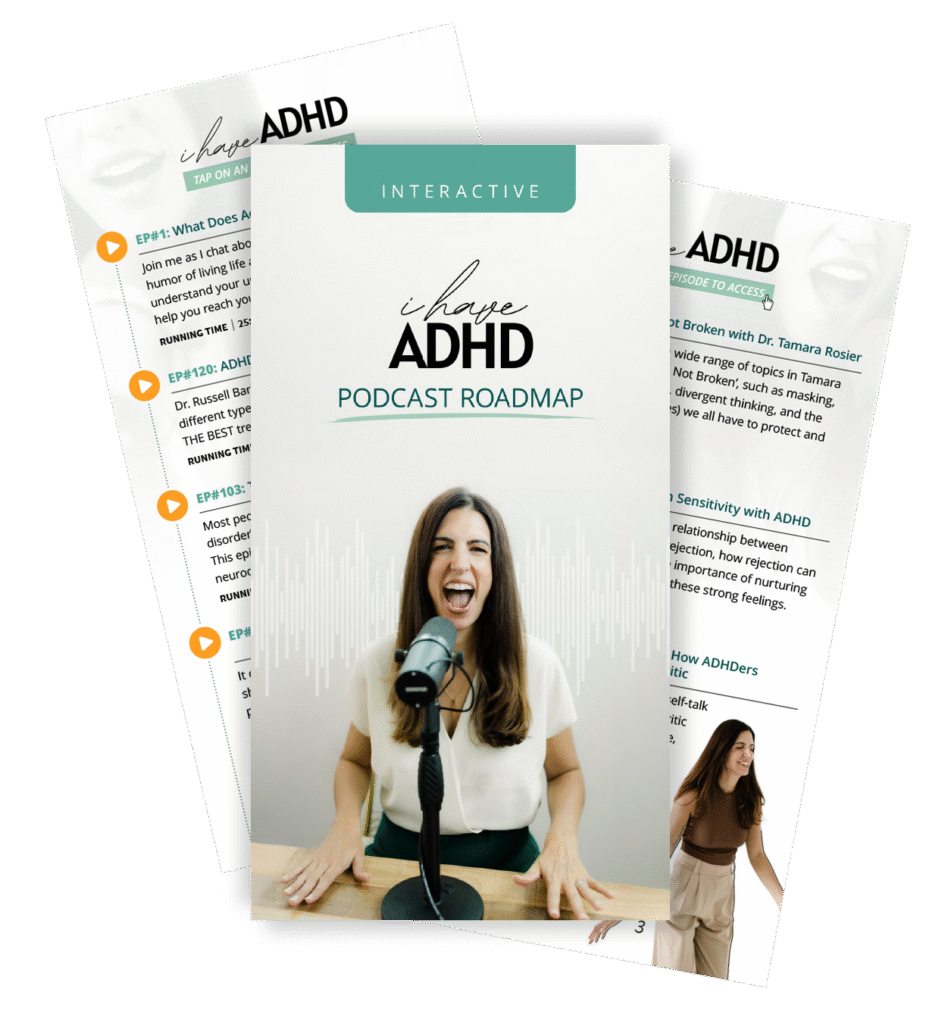
Get The Best of the podcast now with our Podcast Roadmap.

This is a clear and easy podcast roadmap so that you can know for SURE that you’re hearing the very best of the I Have ADHD podcast.

Related Episodes

Kristen Carder

Episode #408: I Surveyed Over 2,100 Adults with ADHD—Here’s What Broke My Heart

Kristen Carder

Episode #406: No Meds, No Shame. Here’s How I’d Support My ADHD Without an Rx

Jenna Free

Episode #404: There’s No Rush: Getting Out of Fight-or-Flight with Jenna Free

Stop Struggling Alone.
Start Thriving With FOCUSED.

A proven coaching program designed specifically for adults with ADHD who want to gain clarity, build confidence, and take control of their lives.

Join a community of hundreds of ADHDers

Learning About My Brain...

Changed Everything

Hi, I’m Kristen Carder—ADHD expert, podcast host, and certified coach who’s been exactly where you are. Diagnosed at 21, I spent years cycling through planners, courses, and systems that never quite worked. Everything changed when I discovered the power of understanding my ADHD brain and the transformative impact of community support.

Now, after 15+ years of research and experience, I’ve helped thousands of adults with ADHD thrive. I’m here to show you how understanding your brain can transform your life, just like it did for mine.

ADHD Tips That Actually Make Sense

Follow @i.have.adhd.podcast and join our Instagram community for daily strategies, relatable content, and real talk about ADHD