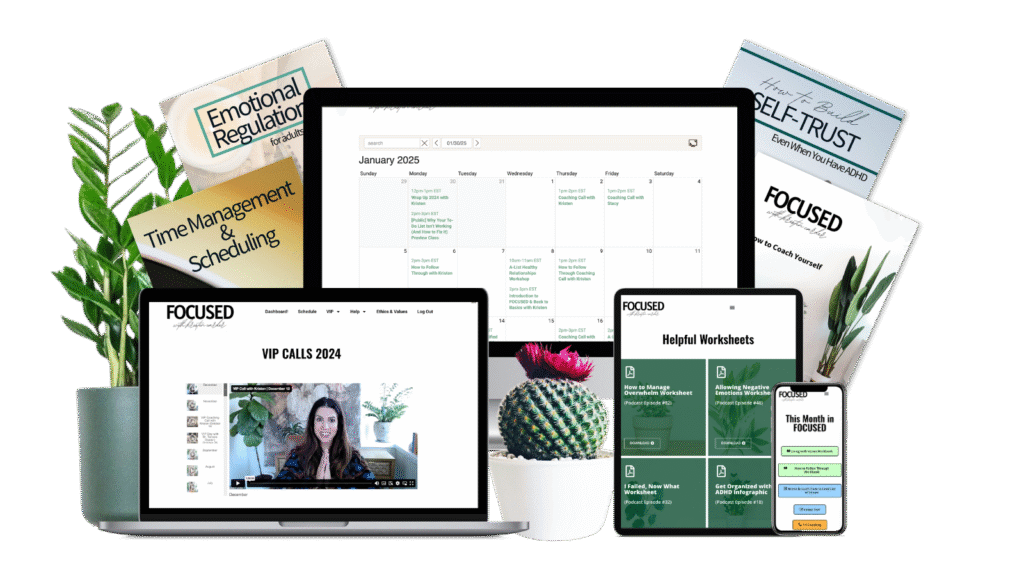
This episode is sponsored by Cure Hydration. All right, I’m going to be real with you. Drinking water is boring. My ADHD brain is like, wait, we have to do this again? Like every day, multiple times. What in the world? And because I’m running from meetings to coaching calls to kid chaos, staying hydrated is not something I’m naturally good at. It’s not something I naturally think about. That’s why I’ve been obsessed with Cure hydration packs lately. Cure is a plant based hydrating electrolyte mix with no added sugar, only 25 calories, and it actually tastes good. The watermelon and berry pomegranate have been on repeat for me. I’m actually like really running low on those flavors, which is so sad. They’re refreshing without being too sweet or artificial. It feels like my water finally has a little bit of personality, which I enjoy. I really do. What I love most is that CURE uses a science backed formula that hydrates as effectively as an IV drip. So when I’m scrambling through my day forgetting my water again, Cure helps me to catch up fast. I throw a few packs in my bag and it makes drinking enough water simple. Which for my ADHD brain is basically a miracle. So staying hydrated isn’t just about water. You also need electrolytes. And that’s why I love Cure. It’s clean, tastes great, and it actually works. And bonus, Cure is FSA HSA approved so you can use those funds to stay hydrated. The smart way for I have ADHD podcast listeners. You can get 20% off your first order@curehydration.com ihaveadhd with the code ihaveadhd. And if you get a post purchase survey, make sure to tell them that you heard about Cure right here on the podcast. It really does help to support the show. Don’t just drink more water. Also upgrade it with cure. Parlez tout francais? Hablas espanol par l’? Italiano? If you’ve used Babbel, you would Babbel’s conversation based techniques teaches you useful words and phrases to get you speaking quickly about the things you actually talk about in the real world. With lessons handcrafted by over 200 language experts and voiced by real native speakers, Babbel is like having a private tutor in your pocket. Start speaking with Babbel today. Get up to 55% off your Babbel subscription right now at babbel.com wandery spelled B-A-B-B-E-L.com wondery rules and restrictions may apply. Welcome to the I have ADHD podcast where it’s all about education, encouragement and coaching for adults with adhd. I’m your host, Kristin Carter, and I have adhd. Let’s chat about the frustrations, humor and challenges of adulting relationships, working and achieving with this neurodevelopmental disorder. I’ll help you understand your unique brain, unlock your potential, and move from point A to point B. Hey, what’s up? This is Kristin Carter and you’re listening to the I have ADHD podcast. I am medicated, I am caffeinated, and I am ready to roll. Are you medicated and caffeinated, my friend? I hope that you are because let me tell you, gosh, it makes a huge difference. I know that medication is a amazing privilege. I am so thankful not all of us have access to it. I hope, I hope and pray, pray that you do. And also, not all of our bodies are able to tolerate medication. I have come across several people, even clients, who have tried all sorts of medications and they are not able to tolerate any kind of medication. I read in Dr. Barclay’s book once, Taking Charge of Adult ADHD, that about 10% of people who try ADHD medication are not able to tolerate it. That means 90% of us are, which is amazing. However, for the 10% of you that haven’t been able to tolerate medication or don’t have access to it, I am sending you a huge, huge hug and hoping and praying that you are able to do things that help you to cope, help you to handle your adhd, because my goodness, it is not easy. In the last couple months, we have had several additional diagnoses come into our family, and I’m not going to give specific details about who, but we are a family of five, my husband and I, and then we have three boys. And in the last couple months we’ve added in two additional ADHD diagnoses and a diagnosis of obsessive Compulsive Disorder, ocd, which was really fascinating and maybe we’ll do an episode on it as we move forward. But I actually, actually didn’t know much about OCD before we got this diagnosis and I am still learning about it. But I will say that I had suspected autism spectrum disorder for this person for a while and it’s fascinating now to read through the symptoms of OCD and to understand this human in my life who has OCD and see, see how you know from my layperson’s point of view, behaviors that looked a little bit like autism spectrum disorder. Are actually 100% related to just right OCD. So there’s actually a couple subtypes of OCD. I know this podcast is not about OCD, it’s about ADHD. But the reason why I’m talking about it is because those of us who are diagnosed with ADHD often have other diagnoses, cousin diagnoses, comorbid disorders. And so this human in my life has an ADHD diagnosis combined with a just right OCD diagnosis. And it’s just fascinating for me as I explore it and learn about it. So I don’t know if your gut right now is like, oh, that’s interesting and you’re having a little nudge. I just invite you to do some googling and maybe talk with a medical professional because I am really looking forward to helping this person, giving them all sorts of support and relief that they really, really deserve. And you know what? You deserve that too. You deserve support and relief as well. So, random intro, but I thought it was important. Okay, moving on. This episode is going to be a doozy. It is a doozy of an episode. And by doozy, I mean it was actually really painful for me to compile my thoughts, write them down and record because we’re Talking about the 10 main things that have shifted for me personally in the last three years. So this episode is just like a behind the scenes of Kristen Carter’s journey. And if that’s interesting to you, great. And if it’s not, no problem. We’ve got hundred other episodes that you can choose from, but I thought it would be helpful to share with you some of the behind the scenes shifts that I have made in my life in the last three years. So, as you know, I was diagnosed and medicated for adhd at age 21, which was amazing, and I’m so grateful for that. But pills do not teach skills. So when I joined my coaches coaching program and combined that with my ADHD treatment protocol, that’s when my life began to get transformative results beyond what I ever imagined. I don’t even recognize myself anymore. So today I’m going to describe to you who I used to be and who I am now. I’m going to take you through 10 specific shifts that I’ve made in my life, and I want to showcase for you how different I’ve become and how different a human can look in such a short period of time. Like just three years. So age 37 to 40, like, that’s not a long time. You know, it’s so interesting because we want things to go fast, which I do touch on in one of the points that I make today. We want things to go really fast, and we think, like, it’s not going fast enough. It’s not going fast enough. But looking back on the last three years, it’s like, that was really fast. In the span of my entire 40 years on the planet, three years is a very small drop in the bucket. And for those of you who are good at math, you can do the percentage calculation right now, but I do not know what percentage that is. But it’s small. It’s a small percentage, right? So if it’s possible for me, it’s possible for you. Which leads me to an ad break. That’s right, my friends, an ad break. Because podcasting isn’t easy and it isn’t free. This episode is sponsored by Focused. Hey, listen, if this podcast has changed your life, you’ve got to check out Focused. Focused is my ADHD coaching program where we take the concepts that I dabble in on the podcast and we go deep, we study them, we apply them to our lives, and we make huge changes. I’m a qualified, certified, experienced life coach who has hundreds of clients and thousands of coaching hours under her belt. Focus is the perfect complement to an ADHD treatment protocol. So if you’re being treated for your adhd, but you feel like there’s still something holding you back, I want you to know that it’s possible for you to take control of your life. So go to ihaveadhd.com focused to learn more. Oh, my loves, thank you for enduring. Thank you for enduring that obscene ad break. Let us get on with the show. Here are 10 shifts that I’ve made in my life in the last three years that made me a completely different human. First, the person that I used to be would explode at people often, and then I would blame them for it. Man, not easy. I understand now that this was a coping mechanism. The explosion was my unregulated emotions, my inability to process emotion in real time, which, as you know, ADHD affects. But then that blame made me feel powerful, and I actually needed that because I didn’t yet know how to be and feel powerful on my own. Number two, the person that I used to be ignored her basic needs. She wouldn’t eat when she was hungry, drink when thirsty, or sleep when she was tired. She would tell her things like she was fine and she would dismiss her own needs constantly. She wouldn’t even buy some simple things like, I don’t know, a new eyeliner or a new broom because she told herself she didn’t need them. Ultimately, what was going on is that she didn’t believe that she deserved to care for herself. She didn’t believe that she was inherently worthy of care and nurture. I know now that every human deserves to take care of themselves in ways that are most impactful to them. Every human deserves to replace lost or broken items and they don’t have to make do with what they have. I know now that every human deserves to eat when hungry, drink when thirsty, sleep when tired, and grab a hug from someone that they love when they’re lonely. Number three, the person that I used to be never had enough money. She didn’t have enough money to pay her bills. She didn’t have enough money to replace lost or broken items. She didn’t have enough money to buy what she wanted or needed to make her life comfortable. That version of me would borrow money a lot, like as far back as middle school and high school, when I would borrow lunch money or money for snacks at school, because I just didn’t have what I needed for myself as recently as just years ago. Even when I borrowed money from my parents to heat my house for the winter, which is totally, totally fine, but it’s just really different than where I am now. Not having enough money felt so powerless. It felt scarce. I constantly felt defeated and frustrated and I was confused. Like, why is this happening? Why does this keep happening to me? And I didn’t know how to get out of it, But I’m no longer confused. I know now that there is abundance everywhere. And not having enough money is a stage state of mind and body, not always a state of financial status. That genuine mind, body, state of abundance that, oh gosh, I am working on every single day, it does inevitably overflow into material wealth and being able to provide for your needs. Number four, the person that I used to be never had enough time. She was rushed, impatient, and constantly agitated. She was always, always, always working from a time deficit. And I want you to see how closely related money scarcity and time scarcity was for me. At least for me, I suspect for everyone. But at least for me, it was very closely connected. When I operated from scarcity, I never had enough time. I felt powerless, and I was confused about why it was happening. And now I operate from time abundance and I always, always, always have enough time for what I have to do and for what I want to do. Even when things get screwed up like they did for me this week, oh my gosh, I believe I have Enough time. I do feel abundant. I make it happen. And when I start to spiral out in scarcity, I know exactly how to get myself back back into abundance. If this is totally wigging you out and you’re like, what? I get it. I totally get it. I used to be 100% in time and money scarcity. And the evidence all around me was that I didn’t have enough. That was my circumstance. There was not enough. And yet, as I’ve developed a mindset of money and time abundance, it has overflown and into actual having of money and time. It is crazy. Okay, the person that I used to be explained herself a lot. She constantly felt misunderstood and she worried about how other people experienced her. She felt broken. She assumed everything was her fault, and she wanted to mend every single interaction that she had with all of the humans in her life. She spent a lot of time engaging in comment sections of social media and writing post conversation emails to friends and family explaining and re explaining her point of view. And I know now that the way I show up in the world is perfectly okay. Not perfect, but okay. And I understand that people’s experience of me has more to do with them than it does with me. So when I feel the urge to explain myself, and I do, I feel it a lot. But when I feel that urge, I gently remind myself that I’m okay. I’m an imperfect human who exists in the world, no explanation needed. Number six, the person. Oh, this is a good one. The person that I used to be saw morality in every single decision from where to go to college, to who to marry, to what to eat. I thought there was black and white or right and wrong. The results of this was that I agonized over even small decisions. Because, listen, if there’s a right and wrong, I don’t want to pick the wrong thing. So I’d better research, talk to people about it, stress about it for days or weeks or years. Gosh, not fun. A huge, huge, huge waste of time. And also another result of this morality thinking is that I judge myself and other people all the time. I judged what we did, I judged our choices. And I would often put myself in a position where I felt like I had the upper hand, that I was making the right choice and other people were making the wrong choice. And it really separated me from being in community, from being in relationship with people. And listen, I’m over it. I don’t want to do it anymore. I still feel the tug toward it. Of course, we’re all human. We have this human condition, right? But I’m just over it. I still believe in absolute right and wrong, sure. But I know now that right and wrong, black and white, it only applies to very few important things. This has given me so much freedom to double down on the absolute truth as it pertains to me and my faith, which is a Christian faith, but to embrace gray area as it pertains to like 99.9% of the choices that I encounter during my day. And listen up my friends. I experience so much more peace. I can sleep at night. I used to wake up in the middle of the night and like think about choices that other people were making and get angry and trigger myself and not be able to go back to sleep. And that’s over. It’s all over. I have peace. It’s lovely. Number seven. The person that I used to be wasn’t nice to herself. I had this way of talking to myself that was really demeaning and unkind. When I would make a mistake, I would berate myself and sometimes spend hours assaulting myself and indulging in all kinds of self judgment and regret. And I know now that my inner monologue matters. I deserve to be spoken to kindly, forgiven and treated with respect. Sidebar Here. So do you. Okay, moving on. I no longer allow myself to be a jerk to myself. You know what? It feels so good. My experience of the world and of life. It just feels so much better. I have much less negative emotion because I like to to be with me. Because I’m not a jerk. To me, I know that I’m going to take care of myself when I fail or mess up, which of course I do because I am human. I know that I’m safe to be with myself. And it is so relieving. Number eight. The person that I used to be was a liar. This one is intensely hard for me to talk about, openly talk about vulnerability. But it is true. It’s so much easier to be a liar than it is to be a truth teller, don’t you think? When I was a kid or an adolescent, I would cheat here or there on papers or on projects. I would tell small lies to cover up bad behavior. When I became an adult, I mostly stopped doing those things. But here’s what I still did. I pretended a lot. I pretended to like people that I didn’t like. I pretended to like activities that I didn’t like. I pretended not to be hurt when I was hurt. I pretended that I didn’t need help. When I did need help, I didn’t tell the truth about what I wanted in certain situations because I was afraid that someone wouldn’t like me or would yell at me. And I’ve realized that I don’t want to be a liar anymore. I don’t want to pretend anymore. And, you know, it may not be obvious to you because I show up here for 30 minutes or an hour a week and give my full self to you as much as I am capable. But I am still even recording this podcast today, thinking, what if they hate me? What if they don’t like this? What if I’m saying something impulsive or annoying? And it’s really hard to just show up and speak words that feel truthful. It’s a lot easier to just pretend that you’re someone that you’re not, right? To try to appease everyone, to try to make everyone happy. That feels much more comfortable and easy. But I’m in this, like, unraveling phase in my life of becoming someone who actually shows up in every aspect of my life, fully and authentically and with all of the truth, not just parts of the truth that make the other person feel good, which I am an expert at doing, by the way. I am an expert at giving the parts of the truth that make the other person feel good. What that does is that denies the rest of the truth, right? It highlights the parts that make someone feel good and it denies the parts that still need to be said or exposed or even just like, felt. So this has been a journey, and I am not done with this journey. This is still a journey. I’m kind of in the middle of it, but I am becoming much more grounded in myself and who I am and much safer within myself to tell the truth and take care of myself, even when that truth doesn’t land well with other people. And for that, I am really thankful. That was a tough one. Okay, let’s move on. The person that I used to be. Oh, my goodness. The person that I used to be was really impatient. I wanted to change everything in my life, and I wanted it to happen fast, and I wanted it to happen immediately. I understand now that that was for two reasons. So the previous version of myself didn’t love now. She was agitated and frustrated and powerless and confused, and she just didn’t love reality. She didn’t love the now. So whatever version of reality that I was in, I didn’t like it. I wanted it to be different. We’re going to talk about that more in a minute. But secondly, she also didn’t believe in the inevitability of good things coming. So she felt really urgently that the change needed to happen immediately. So she would constantly self sabotage. Hear me on this. I would constantly self sabotage. I would stop doing a useful thing or a good thing just because it was taking longer than I thought it should be taking, right? So I’ve since developed the skill of Loving what Is, which is a great book by Byron, Katie. A little bit problematic here and there, but if you can take the good and leave the bad. It was a life changing book for me and I’ve done a lot of work on embracing whatever reality I find myself in. My goodness, it is so much easier to exist as a human in the world. So much easier. And I’ve also developed a huge amount of trust with myself. I know that good is coming and hard is coming too, because good and hard are a part of life, right? But the good, the change, the transformation, the evolvement, it doesn’t have to happen now. I can be patient and I can wait and I can let the change happen slowly because it’s inevitable. It’s happening, it’s coming. It’s no big deal. If it happens today or tomorrow or next week or next year, it’s not really a big deal because I am already knowing that it’s inevitable, it’s definitely happening. And that takes the urgency out of being desperate for it to happen right now. That really helps me to stop sabotaging myself. Number 10. The last shift that I want to talk about today is a really important one. The person that I used to be thought that she and the world should be different. This is maybe the most important shift that I’ve made on my journey. I used to think that I should be different. Other people should be different, the president should be different, life should be different. My husband and my kids should be different. I mean, I had an extensive list of who should be different and how they should be different. And you know what? I was miserable. I was constantly agitated and angry. I was never content for more than a couple minutes or hours or maybe once in a while for a day or two, but not very long. I was living in a constant state, state of resistance. What I know now is that should is the most painful and toxic word in my vocabulary. And I am much kinder, happier person without it. I have a hard and fast rule about shoulds. They suck. Every time I think someone should be different than they are, I cause myself a tremendous amount of pain. Every time I think of I should be different than I am, I cause myself a tremendous amount of suffering. Every time I think that life should be different than it is, I cause myself a tremendous amount of pain and suffering. You know what? I don’t love being in pain. So I’ve decided to stop the shoulds. And I’ve really never been happier. And this is a tricky journey. The should thing is a tricky journey. A lot of us have shoulds deeply embedd into kind of like the fabric of who we are. But if you can begin to unravel that, if you can begin to be kinder to yourself and drop the shoulds and then start accepting reality, it is so much easier to live as a human being on this planet. Now, little caveat here. Trauma happens. Abuse happens. And abuse and trauma should never happen. Okay? So I want you to know that I understand that a lot of things have happened to you that really shouldn’t have happened. And that’s unfair. And yet there is this dance, there is this very delicate way of processing those things through a lens of where we’re at now and how you want to see them, which I really encourage you, if you are someone who suffered trauma or abuse, to be speaking with a therapist about, if you’re able to do that. I highly, highly, highly, highly recommend it, my loves. What I will say is that in my journey, I am able to name harm and tell the truth and let go of most of the shoulds. And even if you’re willing to let go of a third or half of the shoulds that you’re holding onto, it will change your life. It will. Now, I want to say in all of this, like, these are shifts that I’ve made that have nothing to do with my ADHD symptoms, right? Like, I am still impulsive, distracted, sometimes restless. I still have trouble regulating my emotions. I’m still 100% time blind. I for sure still struggle to resist, you know, short term pleasure in exchange for long term reward. I still have a sucky working memory. I still have trouble with self reflection. I’m not great with organization or task initiation and task completion. All of these ADHD symptoms are still there, they’re still present. But let me tell you, they are so much less pronounced. I don’t know if that’s the right way to say it. They’re far less loud because of these other shifts that I’ve been making. And the combination of, you know, a medical treatment plan that works for me and my brain and my body, plus the added amazing privilege, luxury bonus of being able to work with coaches, has really changed my life and my therapist too. Gosh I love her. So that’s where we’re at today, my loves. I want you to know that it is wild to look back, see these shifts that I’ve made, and know that I’m able to even make greater shifts. So in three years at the age of 43, what is that podcast episode going to be like? What 10 shifts will I have made then? And I encourage you to do some self reflection. In the last, you know, months or years, what shifts have you made? How have you evolved? How are you growing? What positive things do you see in your life? Are you still growing up? Because I am. I see myself through the lens of really becoming an adult. And I, again, I’m 40 years old. I feel like I am just becoming a grounded adult. And it’s never too late to do that. Never too late to become a grounded adult. All right, that’s all I have for you today. Have an amazing week. I’ll talk to you next week. See ya. If you’re being treated for your adhd, but you still don’t feel like you’re reaching your potential, you feel got to join Focused. It’s my monthly coaching membership where I teach you how to tame your wild thoughts and create the life that you’ve always wanted. No matter what season of life you’re in or where you are in the world, Focused is for you. All materials and call recordings are stored in the site for you to access at your convenience. Go to ihaveadhd.com focused for all the info.