

Podcast Episode #131: Should You Disclose Your ADHD Diagnosis

Listen or Watch this episode on:

About This Episode

Today we’re going to dive deep into a question that I get asked a lot: “Should I tell people that I have ADHD?” The truth is, only you can decide…and I am here to help you make a decision that feels aligned with who you are and what you want. 

Visit www.ihaveadhd.com for more resources

Hang out with me on Instagram @i.have.adhd.podcast

See Privacy Policy at [https://art19.com/privacy](https://art19.com/privacy) and California Privacy Notice at [https://art19.com/privacy#do-not-sell-my-info](https://art19.com/privacy#do-not-sell-my-info).

Episode Transcript

This episode is sponsored by Cure Hydration. You know that moment for me, it’s around like 2 or 3pm when my ADHD brain just decides we’re done for the day. We’re done here. The afternoon slump hits, the lights go off upstairs and suddenly answering an email or doing basically anything feels like climbing a mountain. That’s when I reach for Cure Energy. It’s a clean plant based energy drink mix made with 100 milligrams of natural caffeine and electrolytes so I get the focus and hydration boost I need without jitters, without a crash and without that like I drink battery acid vi that some of the energy drinks have. The peach tea and acai berry flavors are my current go tos. Crisp, refreshing and they don’t taste fake, y’. All. They don’t taste fake. I’ll drink one before recording a session or when I need to get help through like that afternoon drag. And honestly I. I drink it anytime. My brain just needs to cooperate. What’s wild is that Cure Energy is only 25 calories and has zero added sugar. It actually helps me stay hydrated while giving me energy. Okay, I love coffee, but coffee could never Staying hydrated isn’t just about water. You also need electrolytes. And that’s why I love CUR Cure. It’s clean, it tastes great and it actually works. And remember, Cure is FSA HSA approved which is amazing. You can use that money to pay for cure and for I have ADHD listeners, you can get 20% off your first order@curehydration.com I have ADHD with the code I have ADHD. And if you do get a post purchase survey, make sure to tell them that you heard about Cure right here on the podcast. It really helps to support the show. Don’t just drink more, upgrade it right? Vrbo’s Last Minute deals make chasing fresh mountain powder incredibly easy. With thousands of homes close to the slopes, you can get epic pow freshies, first tracks and more. Find Last minute deals with the Last Minute filter on the app. Book a private vacation rental now@vrbo.com. Welcome to the I have ADHD podcast where it’s all about education, encouragement and coaching for adults with adhd. I’m your host Kristin Carter and I have adhd. Let’s chat about the frustrations, humor and challenges of adulting, relationships, working and achieving with this neurodevelopmental disorder. I’ll help you understand your unique brain, unlock your potential and move from point A to point B. Hey, what’s up. This is Kristin Carter, and you’re listening to The I have ADHD podcast, episode number 131. I am medicated. I am. I’m actually not medicated. Just reminded me of my medication in my pocket because I hadn’t eaten before I left the house. This is so good that I had to say I medicated. So it reminded me. Just one moment, please. All right, we’re going to try that again. I am medicated. Officially. I am caffeinated, and I’m ready to roll. I’m really happy to be here with you today. It is a beautiful day in the neighborhood, and you guys just know how much the weather affects me. I just feel like a million bucks when it’s nice and it’s sunny. I’ve been so affected by the weather for my whole life, and I think most of my family members experience it as well. Sometime I’ll have to do a ton of research and we can do an episode on ADHD and seasonal affect disorder, because I wonder if there’s a correlation between ADHD and sad, SAD Seasonal affect disorder. I actually, for the first time ever, just purchased a daylight lamp, which is supposed to mimic sunshine. I thought I could use it here in my office for a little bit each day, maybe actually in place of my ring light, which gives me a headache. So hopefully it’ll be like a pretty light. And pretty as in, like, the light it gives off makes me look good on zoom, you know what I’m saying? So, yeah, hopefully, because, listen, it’s November already. How did that happen? It’s gonna be dark and cold for so long in Pennsylvania. So I’m prepping. I feel like I’m like doomsday prepping. Like, gather the supplies. The end is near. Winter is coming. No offense to any of you that are doomsday preppers, because, listen, it takes all kinds of people to make the world go round. You know what I mean? Okay, so I want to take a quick second and say thank you so much to those of you who have been rating and reviewing the podcast recently. There’s been a huge influx of really kind reviews and a spike in ratings. I’m just so grateful. I know that you have adhd, Right? So that means that these so called easy tasks are actually really, really hard. In the amount of executive functioning involved in going to the Apple podcast app, finding my podcast scrol down to the review area, and then composing coherent sentences, I just. I know it’s a lot. I recognize it, I validate it. And I don’t take it for granted. The love letters that you guys send me in that way are just so beautiful and I can’t thank you enough. Thank you, thank you, thank you. So today we’re going to chat about how to decide whether or not to disclose your diagnosis to friends, family, new relationships, your work, whatever. And I’m gonna do my best here. Like, I’m really gonna put in significant time and effort into helping you make that decision because I know that it is effing hard. Like, I get this question all the time. Should I tell my new boyfriend? Should I tell my boss? Should I tell my parents? I know that this is a really difficult decision to make and I am here to, to help you. But first, you know what time it is, guys, right? It’s ad break time. Do you know what a life coach is? A life coach is someone who helps you achieve your goals. Like a personal trainer for your life, a life coach is a guide who holds your hand along the way as you take baby step after baby step to accomplish the things that you want to accomplish. I. A life coach is someone who’s been trained to look at situations with non judgmental neutrality and offer helpful suggestions that maybe you’ve never seen or considered before. And guess what? I mean, like, guess what? I am a life coach. If you’re being treated for your ADHD and maybe you’ve even done some work in therapy and you want to add to your scaffolding of support, you’ve got to join my group coaching program, Focused. Focused is where functional adults with ADHD surround each other with encouragement and support. And I lead the way with innovative and creative solutions to fully accepting yourself, mastering your ADHD brain, and creating the life that you’ve always wanted. Go to ihaveadhd.com focused to learn more. And I hope to see you in our community today. Like, you should just join us today. Come say hi. I can’t wait to see you there. Okay, so speaking of focus, within our community, we have hundreds of folks in varying stages of their ADHD journeys. We accept people who have yet to be diagnosed and those who are self diagnosed. And so we often see like a celebration post in our community that, you know, someone’s like, I got my diagnosis. And everyone’s like, yay. And then soon after that, there’s this question, should I share my diagnosis with the people around me? I get asked this question a lot, even through Instagram and email. And I’m guessing that since the question gets asked a lot, you have probably wrestled with this question. Or maybe you are currently wrestling with this question as well. Should you share your diagnosis? Who should you share it with? Should you tell your parents? Should you tell your boss, your co workers? Who needs to know this information? Who should you disclose it to? So I want to back up just a little bit. Let’s just back up a second. I think it’s important to first point out that we all have different feelings about being diagnosed. There’s an array of options when it comes to responses to getting a diagnosis. Some people are super relieved and feel 100% validated and almost excited because their symptoms were not character flaws. Right? So you’re able to be like, amazing. There’s a reason why I’ve been struggling. The reason is adhd. And if you’re in this camp, I can see that maybe you would be more prone to want to shout your diagnosis from the rooftops because in your mind it’s extremely validating. But for others of you, maybe the diagnosis came with a hefty dose of shame or regret or realization of time, quote, unquote lost or some other negative emotion. And so if that’s you, it’s unlikely that you might want to tell many people because it’s probably really painful. So I just want to take a second here to say that your reaction and your response to being diagnosed with ADHD is unique to you and it’s completely valid. It’s totally 100% valid. And your reaction to it will likely inform how you decide to proceed with telling people or choosing not to tell people. And guess what? You don’t need to tell a single soul. Nobody. I mean, that’s just the truth. No one is entitled to know this information about you. It’s your own personal business. It’s your private medical and mental health information. You don’t have to tell anybody. I want you to take a deep breath, like, really just breathe in and let it out. Take a deep breath with me right now and really lean into that truth. No one deserves to know. It’s your information and you get to choose what you’d like to do with that information that belongs to you. And it’s really important that I communicate this right off the bat. I don’t know what you should do. I don’t know who you should tell. This is why I always feel really uncomfortable when people ask me this question, like, should I tell so and so about my diagnosis? Because the truth is, is I don’t know. No one knows. I have no idea whether or not you should tell anyone. I really want you to keep in mind as we move forward with this episode, that, yes, I am very, like, loud and proud with my diagnosis, obviously, but my life’s work is supporting adults with adhd. My life’s work is centered around people knowing that I have adhd. So my situation is very unique. And because of that, I am definitely not the person to tell you what to do here. So, number one, an ADHD diagnosis is information that belongs to you. Number two, you’re not obligated to tell anyone about it. Number three, I don’t know if you should tell people. That decision is yours alone. But if you are going back and forth and wondering if you should tell people, what I can do is help you make a decision that feels really good to you. That’s literally what I do all day long, every day as a coach is I help people to make empowered decisions that feel good to them. I have no idea what the right decision is for that person. It’s not my job to know, but I can help you form criteria for decisions so that you can feel better about making a choice that feels really aligned with you. All right, so here is some info on decisions that I think will help you to decide what to do. So the first step is to take morality out of this decision. I’ve talked a lot about this in previous episodes, but let’s just do a really quick refresher. A lot of us unknowingly try to infuse morality into decisions that have no business being moral. We try to figure out what the right decision is as if there’s a right decision. We really like things to be neat and tidy and black and white, and we want to know if we’re doing a good job or a bad job. So if we can figure out what the right decision is and do that, then we know we’re golden. We know we’re doing the quote, unquote, right thing, or at least that’s what we think. But there’s no right or wrong when it comes to a choice like whether or not to share your diagnosis. It’s not moral. There’s no rule book here. The Bible doesn’t have one thing to say about it. There’s no law about it. There’s nowhere that we can, like, look up that information. Should I tell my mom about my ADHD diagnosis? Right. That we just don’t know. And side note here, this is the case for 99% of the decisions that we face in our lives. Unless your decision is like, should I embezzle this money or should I murder this human? Most decisions are not moral. So we can just take that out of it. We can stop making it be so complicated and we can just decide, okay, so we’ve established that the decision of whether or not to disclose your diagnosis with your boss or your family or whoever, or maybe it’s whomever, I’m not really sure, is not a moral decision. There’s no right or wrong here. There’s no black or white. This is a 100% personal decision. And it’s a decision that’s unique to you and probably unique to each individual that you’re considering sharing the information with. Now, it’s important to understand that when we ask ourselves, what should I do? Or what’s the right decision? What we’re really trying to figure out is what is the outcome going to be right? We’re defining a right decision or a wrong decision based based on the outcome of that decision. As in, will this work out in a way where I feel really good, or will this work out in a way that I feel really bad? So we’re like, if it works out really good, then I’m going to call it the right decision. If it works out and I feel really bad, then I’m going to call it the wrong decision. But here’s the annoying part about being a human in the world. We don’t get to know if it will work out in advance ever. With, like, anything, Right? We don’t get to know. I wish we did. It would be so much easier and better if we did. But we don’t get to know that in advance. So when you stay in indecision or when you try to decide whether this is going to be the right decision or the wrong decision, you’re really just trying to figure out something that is not actually figureoutable. You have no idea how your new boyfriend is going to react to you telling him that you have adhd. Right? So if you’re defining good decision as boyfriend will be accepting and supportive and bad decision as boyfriend is dismissive and invalidating, well, we just don’t get to know if it’s a right decision or a wrong decision until you actually tell him. And we see his reaction, right? We gauge his reaction, and then we look backwards and we label the decision as a good decision or a bad decision. All right, are you following me here? Because I know we’re kind of like in meta territory, but I think you can handle it. So I want to point out here that this completely 100% gives our power away to someone outside of us. It puts the weight of the decision being right or wrong onto the person who we’re telling, rather than allowing us to hold the weight of the decision within us. It’s a really powerless position to be in because we’re not the ones who get to control the rightness or the wrongness of the decision, which is likely why we spend so much time in confusion, spinning out, ruminating, trying to decide what to do, because we’re feeling so powerless and so out of control. Is this resonating with you? Are you with me here? So my suggestion is to stop considering potential outcomes just for a moment, since they’re out of our control anyway, and start defining your reasons for the decision. What are the reasons that you have for disclosing your diagnosis to this particular person? Seriously? Make a list. Not a list of potential outcomes, which, again, we can’t control, but a list of reasons why you want to disclose your diagnosis to this person. And then make a list of reasons why you wouldn’t want to disclose your diagnosis to this person. And then compare that list. Which set of reasons do you like better? So I’ll give you an example to illustrate what I’m talking about. This is completely hypothetical, but I think it might resonate. Let’s say you’re diagnosed with ADHD and now you’re wondering whether or not to disclose this information to your employer. And you’ve gone back and forth, you’ve imagined all of the possible scenarios, but you just can’t seem to make a decision. So here’s my advice. Number one, take all morality out of it. There’s not a right or a wrong. There’s no rulebook. It’s just not a moral decision. Number two, understand that you’re not obligated to tell anyone about your diagnosis. Number three, really, really, really understand that their reaction is 100% unpredictable and out of your control. Number four, make a list of reasons why you would want to tell them so. That list might sound like, I want to tell my employer that I’ve diagnosed with ADHD so that I can ask for accommodations, or I want to tell them so that I can ask with help with deadlines and accountability, or I want to tell them so that I can stand up for myself when, you know, I make silly mistakes. All right, so we have our list of pros. Now make a list of reasons why you don’t want to tell them so. That list might sound like, I don’t want to tell them because I’m afraid of what they’ll say. I don’t want to tell them because I’m afraid that they won’t give me, like, the good projects. They’ll kind of ice me out of the fun stuff at work. I don’t want to tell them because I’m afraid I’ll get fired. Now look at the prose list. Is it realistic? Go through each one. Look at the cons list. Can you solve for any of those cons? Maybe there’s an easy explanation or solution to some of those objections. And now decide which list you like better. Again, we’re considering the list of reasons. Which list carries more weight? Now, if it were me, and this was my completely hypothetical list, one thing I would notice is that the cons list is of full. Full of fear. And I don’t like making decisions from a place of fear. I don’t love those reasons, but I do love the idea of standing up for myself, asking for support. And so if this totally fake list were my list, I’d go with the pros because I like those reasons a whole lot better. The skill of defining your reasons for doing something or not doing something, and then really liking your reasons and decisions, deciding on purpose, which group of reasons that you like best is so powerful because that allows you to have your own back no matter what the outcome of the decision is. So let’s say, hypothetically speaking, that you decide to disclose to your boss that you have adhd, and he is really rude and really dismissive about it. That doesn’t mean it was the wrong decision. It doesn’t mean that you shouldn’t have told him. It just means that he’s rude. Right, because we are not basing the rightness or the wrongness of our decisions based on the outcome of, like, how someone treats us. We’re basing it on whether or not we like our reasons. So I like my reasons for telling him. I’m still going to be asking for accommodations. I’m still going to be making sure that I have help with deadlines. I’m still gonna be standing up for myself. And so, yes, he was rude, and yes, this was uncomfortable, but it was still a good decision. All right, the last thing that I wanna discuss with you today is the concept of safe people versus unsafe people. Now, this is a term that my therapist has been using, and I’ve been reading about it more and more. I see it lot from therapists and psychologists. They use this type of language, safe and unsafe, to describe people. And just to be clear, I’m not a therapist, right? But I am a life coach. And this stuff is very, very interesting to Me and I think the conversation of safe people is relevant to our discussion today. When considering telling someone about your ADHD diagnosis, it’s super important that you know right off the bat whether this person is a safe person or an unsafe person. And I’m not talking about physical safety, I’m talking about emotional safety. Here are some characteristics of safe people. Safe people listen first. They validate. They help you grow. They don’t tell you how you should feel or should think. They are patient. They don’t judge. They don’t take your struggles personally. They keep their word. Their goal isn’t to fix you. They can empathize with you and they assert their own needs and boundaries. So my last piece of advice of whether or not to disclose your diagnosis to the individual is I encourage you to first identify this person that you’re considering telling as a safe person or an unsafe person. If you want to tell the person and you like your reasons and the person is safe, green light. Go, go for it. Go ahead and tell them. Even if they handle it poorly in a moment, in that moment right in the conversation, you can repair the relationship because they are a safe person. However, if you want to tell the person and you like your reasons, but you’ve identified that this person is not a safe person, yellow light. Caution. This doesn’t mean that you don’t tell them necessarily, but it does mean that you should expect them to react to this information as an unsafe person. So a really interesting article from psychology today called 10 Traits of Unsafe People and I’m going to read just a list from that article. It’s fascinating. Unsafe people do not like to admit their weaknesses. Unsafe people are defensive. Unsafe people are self righteous instead of humble. Unsafe people apologize without changing their behavior. Unsafe people avoid facing their issues. Unsafe people flatter you instead of talking to you. Unsafe people demand trust instead of earning it. Unsafe people lie. Unsafe people don’t grow. So it’s important to identify is the person I’m telling safe? Do I like my reasons for telling them? If all of that checks out, go for it. But if the person is unsafe, if you know they’re defensive, if you know they want to, you know, tell you what to do with your life. If you know that they’re self righteous and not humble, then blah blah blah. If you know all of that, it doesn’t mean necessarily that you don’t tell them. It just means that you are clear that you’re expecting their reaction to be that of an unsafe person. And so they might not react. Great. But that doesn’t mean that it’s a bad decision to tell them. Right? Because if you really like your reasons, you still might choose to tell them. If you tell an unsafe person, they’re going to react as an unsafe person, and that’s okay. You may still choose to tell them, but be alerted to the fact that they will likely not be empathetic, understanding and open minded. So let’s review a criteria for making this decision. Should you disclose your diagnosis? Number one, know that there is no right or wrong involved here. This is not a moral decision. It’s unique to you. It’s unique to your situation. It’s unique to other, each. Each individual human that you are deciding whether or not to tell. Number two, understand that no one deserves, quote, unquote, to be told. You’re not obligated to tell anyone. This is your information to keep to yourself if you would like to. Number three, realize that their reaction is 100% unpredictable and out of your control. And that doesn’t mean that it’s a good, good decision or a bad decision. Their reaction does not indicate whether or not it was a good or bad decision. Number four, make a list of reasons of why you want to tell them. Number five, make a list of reasons why you don’t want to tell them. Number six, evaluate your list. Like, really look at it with clarity. Is the prose list realistic? Go through each one. Then look at the cons. See if you can solve for any of those consultants. Maybe there’s an easy explanation. Maybe there’s solutions to some of those objections. Number seven, decide which set of reasons you like better. Decide which set of reasons feels most aligned with you and your values and what you want. Number eight. Then lastly, identify whether this person is a safe person or an unsafe person and expect them to react as such. If it’s a safe person, green light. Go for it. If it’s an unsafe person, proceed with caution. All right. I hope this was so helpful to you. I hope that you feel empowered. I hope you have clarity, and I hope that you are able to make decisions that feel really aligned with you and your values and what you want out of your life. Have an amazing week. I’m going to see you next time. Bye. A few years ago, I went looking for help. I wanted to find someone to teach me how to feel better about myself and to help me improve my organization, productivity, time management, emotional regulation, you know, all the things that we adults with ADHD struggle with. I couldn’t find anything, so I researched and I studied and I hired coaches and I figured it out. Then I created Focused for your. Focused is my monthly coaching membership where I teach educated professional adults how to accept their ADHD brain and hijack their ability to get stuff done. Hundreds of people from all over the world are already benefiting from this program, and I’m confident that you will too. Go to ihaveadhd.com focused for all the details.

Related Episodes

Kristen Carder

Episode #390: Two Steps Forward, Three Steps Back (Why You Keep Self-Sabotaging and How to Finally Stop)

Kristen Carder

Episode #388: Money. Let’s Finally Deal With It.

Kristen Carder

Episode #386: A Very ADHD Episode: Deep Feelings and Random Reels

Stop Struggling Alone.
Start Thriving With FOCUSED.

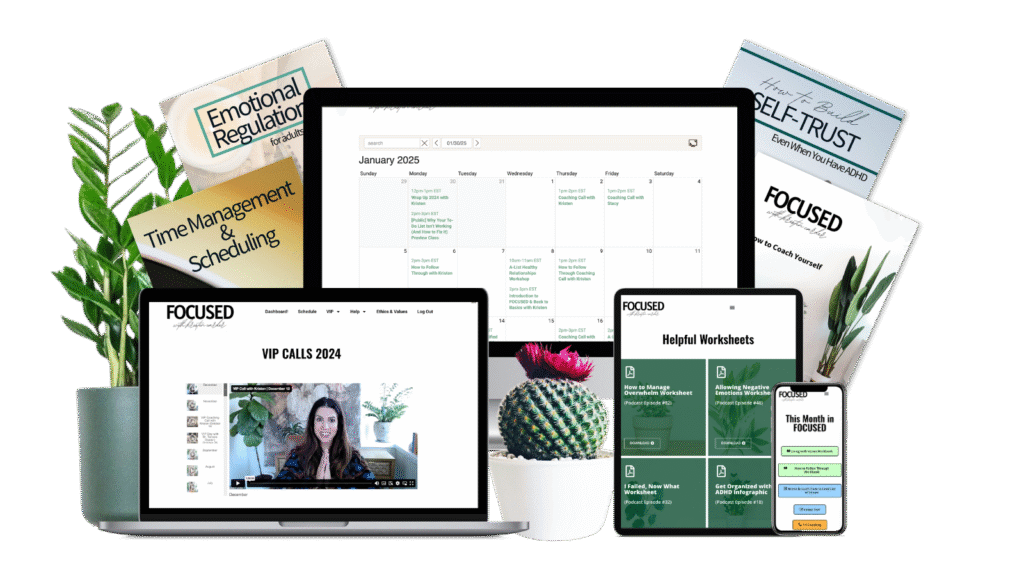
A proven coaching program designed specifically for adults with ADHD who want to gain clarity, build confidence, and take control of their lives.

Join a community of hundreds of ADHDers

Learning About My Brain...

Changed Everything

Hi, I’m Kristen Carder—ADHD expert, podcast host, and certified coach who’s been exactly where you are. Diagnosed at 21, I spent years cycling through planners, courses, and systems that never quite worked. Everything changed when I discovered the power of understanding my ADHD brain and the transformative impact of community support.

Now, after 15+ years of research and experience, I’ve helped thousands of adults with ADHD thrive. I’m here to show you how understanding your brain can transform your life, just like it did for mine.

ADHD Tips That Actually Make Sense

Follow @i.have.adhd.podcast and join our Instagram community for daily strategies, relatable content, and real talk about ADHD

Click here to sign up for the FREE Class with Kristen on Wednesday, 4/1: Too Much & Not Enough: Why ADHD Adults Feel “In Trouble” in Relationships

  • 00Days
  • 00Hrs
  • 00Min
  • 00Sec