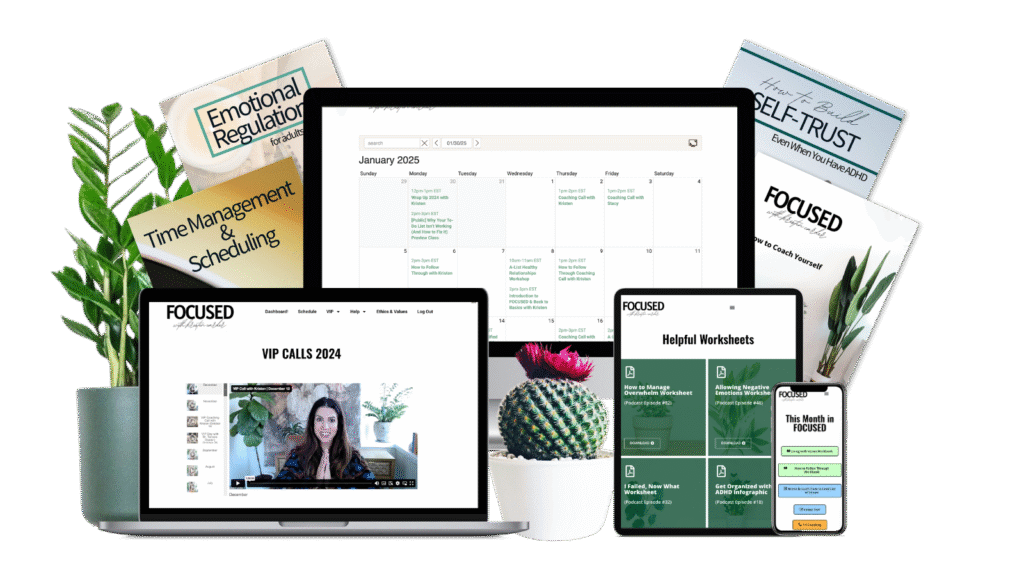


This episode is sponsored by CURE Hydration. All right, I’m going to be real with you. Drinking water is boring. My ADHD brain is like, wait, we have to do this again? Like every day, multiple times. What in the world? And because I’m running from meetings to coaching calls to kid chaos, staying hydrated is not something I’m naturally good at. It’s not something I naturally think about. That’s why I’ve been obsessed with Cure hydration packs lately. Cure is a plant based hydrating electrolyte mix with no added sugar, only 25 calories, and it actually tastes good. The watermelon and berry pomegranate have been on repeat for me. I’m actually like really running low on those flavors, which is so sad. They’re refreshing without being too sweet or artificial. It feels like my water finally has a little bit of personality, which I enjoy. I really do. What I love most is that CURE uses a science backed formula that hydrates as effectively as an IV drip. So when I’m scrambling through my day forgetting my water again, CURE helps me to catch up fast. I throw a few packs in my bag and it makes drinking enough water simple. Which for my ADHD brain is basically a miracle. So staying hydrated isn’t just about water. You also need electrolytes. And that’s why I love cure. It’s clean, tastes great, and it actually works. And bonus, CURE is FSA HSA approved so you can use those funds to stay hydrated. The smart way for I have ADHD Podcast listeners. You can get 20% off your first order@curehydration.com ihaveadhd with the code ihaveadhd and if you get a post purchase survey, make sure to tell them that you heard about Cure right here on the podcast. It really does help to support the show. Don’t just drink more water, Upgrade it with cure with stays under $250 a night. VRBO makes it easy to celebrate sweater weather. You could book a cabin, stay with leaf views for days, or a brownstone in a city where festivals are just a walk away. Or a lakeside home with a fire pit for cozy nights with friends. Or if you’re not a sweater person, we can call it Corduroy weather. More flexible and with stays under $250 a night, you can book a home that suits your exact needs. Book now@vrbo.com. Welcome to the I have ADHD podcast where it’s all about education, encouragement and coaching for adults with adhd. I’m your host Kristen Carter and I have adhd. Let’s chat about the frustrations, humor and challenges of adulting relationships, working and achieving with this neurodevelopmental disorder. I’ll help you understand your unique brain, unlock your potential, and move from point A to point B. Hey, what’s up? This is Kristin Carter and you are listening to The I have ADHD podcast, episode number 71. I am medicated, I am caffeinated, and I am ready to roll. Today we’re talking about success intolerance, which is something that I believe will totally blow your mind, especially if you find yourself in a cycle of making progress and then going back to your old ways. This podcast is for you. I feel like I have been in agony over the last nine months learning how to tolerate success. I know that might sound ridiculous, but success is extremely uncomfortable and I’ve noticed myself wanting to self sabotage in so many ways. Since I recognize it’s happening, I’ve been able to steadily make forward progress and I’m going to teach you how to do the same. One of the things that is so important to me as I cultivate a community within my focused coaching membership is that we are constantly sharing our own successes and cheering one another on in focused success is normal. And we’re constantly sharing our wins and the things that we’re doing right so that we build our tolerance for success. That’s right. You’re gonna have to learn how to tolerate success. I want you to think about how used you are to failing. You are so, so used to failing. I want you to think about how you’ve identified for years as being lazy or unorganized, unproductive, a mess, always late, bad with money for so long. Your brain is 100% used to thinking that you’re doing it wrong. So when you start to do it right, your brain gets confused. It’s like, wait, I’m lazy. Just because I had one productive day doesn’t mean I’m productive. I’m lazy. Today I was productive, but tomorrow I’ll be lazy again. And your brain will literally sabotage your success because it doesn’t like to be in conflict with itself. Hear me. Your brain doesn’t like to be in conflict with itself. So if you’ve always identified as a person who’s doing it wrong and then you start to show evidence for doing it right, this will be uncomfortable for your brain, which is so weird, I know that. But there will be cognitive dissonance, and cognitive dissonance feels terrible in your body. It feels like something’s Gone wrong. It’s like, it feels horrible. It feels horrible. So if you’ve always identified as a person who’s late and you start showing up on time, your brain freaks out. How can a person who’s always late show up on time? I must fix this problem. And then you self sabotage so that you can start proving your own belief correct again. Right? I’m always late. I never show up on time. So this is why our work on identity and self concept is so freaking important. This is why I want all of you to join focused and to take full advantage of that free bonus course that’s available to you as soon as you sign up. Because changing your self concept is the only way to actually make sustainable change in your life. You have to identify as a successful person in order to comfortably tolerate success. You have to identify as an organized person in order to consistently be organized. You have to identify as a rich person in order to keep money around and not get rid of it all the time. Hi. Okay, so let me give you an example. You’re used to having a certain amount of money in your bank account. It’s the amount that you’re comfortable seeing, and that is called a set point. Okay? So we all have like a weight set point, a happiness set point, and a money set point. There might also be other set points in other areas. I’m not sure, but these are the ones that I’m aware of. Okay, so for my husband and I, our like money set point in our checking account used to be like right around $1,000. Okay. So if it went below that number, we’d kind of panic and do whatever we needed to do to get it back up. If it went above that money. No, if it went above that number, we’d spend it. Right. We’d get rid of it until it went down to about 1,000. So for 12 years, this is how we lived our financial lives. We hovered right around $1,000 no matter what. We always kind of landed back at that spot. And then a few years ago, we noticed that and we consciously made an effort to increase that set point. So we wanted to get it to 5,000. And it felt so weird. My brain was like, excuse me, what is all of this money doing just like sitting there? We should totally do something with it. It was really hard for me to just keep that money in the account and not spend it or use it to pay off debt or whatever because it just felt uncomfortable. I had to work on changing my identity. I had to work on becoming the person who just naturally had $5,000 sitting in her checking account. Right? In the last year, as my coaching practice has grown, the monthly revenue has made me want to puke, you guys. You’d think it feels amazing to make tens of thousands of dollars in your business every month, but it doesn’t. It feels horrible at first. And truthfully, every time I increase that revenue significantly, I have to tolerate a ton of discomfort. Now I remember the first month that I experienced this feeling. It was February 2020. It was so profound. I can tell you the exact month that’s saying something, right? It was new and it was weird and it was uncomfortable. And that feeling, oh my gosh, I hated it so much. But because I had a good coach, I was very aware of the concept of success intolerance. And so I had to coach myself every day to just sit with the discomfort of success. Focused was working. People were signing up. The people who did sign up were loving it and giving me tons of compliments. You would think that I would just like, feel amazing all of the time, but I didn’t. I wanted to run and hide. I wanted to sabotage it so that I didn’t have to show up. I wanted to refund everyone and go back to my old life. And I told my husband that on the daily and he would just laugh and like, be like, I really hope you’re not serious. But I would just be like, this is so uncomfortable. I don’t know if I can do this. I think I should just like, refund everybody. I don’t know if I can do it. Because success is uncomfortable doing what you said you’re going to do. Often uncomfortable. We expect it to feel good, but it doesn’t. When the results that we see don’t fully align with our self concept, which is just the thoughts that we have about ourselves, there’s cognitive dissonance. Our brains freak out and it feels gross. So this is why, or one of the reasons why we are continually going back to failing. We identify as a failure. We’re super used to it. We’re comfortable. When we start seeing success, it feels weird. We’re just like, what’s going on? This is not normal. And we sabotage it so that our results align with our beliefs. This is exactly why in focused and with my private coaching clients, we spend all of our time talking about our beliefs. Because if you don’t improve your belief about yourself, you will never sustainably improve your results. Because your brain, it won’t be able to tolerate the cognitive dissonance of a hot mess showing up on time and getting good results for herself. Right, because hot messes should show up as hot messes. And if they don’t, then something’s wrong. At least from our brain’s perspectives. So I want you to think about this. A lot of us with ADHD are actually more comfortable failing and doing it wrong than we are succeeding and doing it right. I wonder, is that you? We are so used to failing. It doesn’t feel good. But it does feel familiar. And our brains love familiar. We’re used to having to work really, really hard in order to get by. Way harder than other people. That doesn’t feel good, but it does feel familiar. We’re used to waiting until the last minute and then cramming and then totally burning ourselves out. Doesn’t feel good, but it does feel familiar. We’ve been there over and over and over. We’re used to being confused and scattered and not taking decisive action. That doesn’t feel good, but it’s what we’re used to. It feels familiar. And remember, our brains love familiar. For a lot of us, success is uncharted territory. That does not feel good and it does not feel familiar. It’s like, scary. Our brains are like danger. You could die. Look out. What’s so hilarious is that the danger is like being productive, showing up to work on time, not picking up your phone 5 million times a day. Right? But it is uncharted territory for us. I really want you to recognize it. There are the things that we’ve done over and over and over and over to produce bad results for ourselves. Now, we don’t love that, but we know in that scenario, A plus B equals C. We know exactly what’s going to happen. But then there’s this other side, this success side. This like, I’ve never been here before. What would it be like if I created a good result for myself or if my business took off or if I created a million dollars? What would that be like? And that’s uncharted territory. And it feels weird. We also do this with relationships. We’re used to having relationships that, you know, go a certain way. We’re used to showing up a certain way in our relationships. We’re used to having bad relationships. Maybe when we start dating somebody or we get in a friendship with someone who is genuinely caring, kind, self sacrificing, good, amazing, we don’t know what to do with it. We sabotage it. We’re like, no, no, no. You’re not supposed to treat me good, you’re supposed to treat me bad. Don’t you remember that? It’s because the result is not aligning with the belief that we have about ourselves, our brains, like the familiar. And it will go to work to sabotage anything that’s not familiar. Now this is big for me. As you know, I used to own a tutoring business and it was only ever moderately successful. Okay. In my estimation, that’s my opinion. Now, I believed during that time that it was very difficult to get clients. And I have a ton of evidence to prove that. I believe that I had to constantly convince people that they needed my services. And I have a ton of evidence to prove that. And even now when I think about it, it just feels hard. Like, wow, I can’t believe I did that for 10 years. Seriously, like, why did I do that for 10 years? I’m not sure. Okay? But in contrast, once I decided to go all in with life coaching, I’ve been totally overwhelmed with the demand for my services. You would think that I’d be celebrating and feeling amazing 100% of the time, but I don’t. Now don’t get me wrong, of course I’m happy that what I’m offering to the world is helping and that people are loving it. But. But I notice that this is also really uncomfortable for me. I have to continually work on my self concept so that I don’t self sabotage and turn clients away. Now this looks like forgetting to respond to emails or not having a process for a waiting list or ignoring my Instagram DMs or questions that I might get about the Focus program. I’m developing a self concept that includes that I’m a coach who’s in high demand. I have a full one on one practice with a waiting list. I have hundreds of clients in Focused. I am the person to lead this community of professional adults with adhd. I love being in high demand. I’m willing to be in high demand, but that’s work for me to believe. That does not come easily. I have to work at that. And I’m still working on it. I’m not totally there yet. I’m used to having to go out and find clients for my tutoring business. I’m comfortable with it being hard. I’m not sure how to be in my body right now. Right. It’s just like weird. I literally have to change my entire identity. Until I do, I will always feel uncomfortable with the level of demand that I’m in. It’s totally fine. It’s really important that I see it so that I don’t self sabotage and Ruin everything, right? It’s the same with money. The numbers that I see coming into my accounts, they make me want to throw up. And I’m not joking. It feels gross in my body, okay? So I have to sit with that discomfort. Like I just have to sit with that discomfort. I’m doing it right now, which is so amazing, right? I see it, I practice tolerating it and feeling it in my body and then I just go about my day. I don’t allow myself to take action from that discomfort. Because when we take action from the discomfort of success and tolerance, that’s when we self sabotage. Now, no one tells you this stuff, right? People, parents, coaches, society, they tell you to go out, be successful, be productive, make a lot of money. But they don’t tell you that when you do, you’re actually going to feel terrible 50% of the time. Of course there’s good. You have to practice allowing those good emotions. Are you used to feeling proud? Are you used to feeling satisfied? Are you used to feeling accomplished? If not, then those emotions will not naturally come. When the success comes, you’ll still feel like a failure because you’re just used to feeling like a failure, right? We think that when we have whatever it is that we’ve been wanting, life will be 100% good. But it’s not, I promise you. It’s still 50 50. If you’re not familiar with the concept of 50 50, go check out episode 47. I talk all about it. It’s one of the things that’s changed my life. It’s one of the concepts that I continually go back to. It’s very, very helpful. So here’s your takeaway for today. Here’s what I have to say. Be on the lookout for the discomfort that comes with success. All of us have a set point, a level at which we are comfortable. It might not feel good to be at that set point. Like, of course you’re going to have the negative feelings that come from having a low set point. But it is familiar. And our brains love familiar. So when we start creating results that are outside of our set point, outside of what’s familiar to us, our brains go into cognitive dissonance. And if we’re not aware of it, we will automatically sabotage our successes so that our brains are no longer in that cognitive dissonance. Remember, our brains always want our results to match our beliefs. And when they don’t, our brains think something’s gone wrong. So allow yourself to observe and feel and tolerate the discomfort that comes with doing things right. The discomfort that comes along with recognition, compliments, success, money, stability in your relationship and things working out. Open up to it, develop the capacity to feel it so that you can continue to create the positive results for yourself. Now, I don’t know if I’m overdoing it, but I want to give one more example, one more illustration so that we can really hit this home. I want you to think about your body and I want you to think about the thoughts that you have about your body. Now, a lot of people who lose a significant amount of weight will get to their goal weight and then feel a lot of discomfort. Why? Question mark. Because they’re still identifying with their old body. Their old body was their set point. It was their identity. It may not have been super comfortable, but it was familiar, right? They haven’t spent the time to change their self concept, to change their beliefs, to change their thoughts, to identify with the new body. And so what often happens is that they’ll gain the weight back. This allows them to get back to their set point, to get back to their old, comfortable, familiar identity. Now, this can even happen when you’ve only lost maybe £10. I’ve seen this happen. People start to notice, and you’re not used to being on the receiving end of compliments, maybe from certain people, and they start complimenting you and you freak out, right? Even without realizing it, you self sabotage, which in this case looks like binging or overeating or quitting your exercise program, whatever, whatever habits you were instilling to get you the result, you’re now sabotaging. And you accidentally forget to eat healthy or buy the healthy food. And all of a sudden, before you know it, you’re back to your set point or your comfortable identity. Now, I have no idea where this is showing up in your life, but I bet that if you looked for it, you could find it. Where are you doing this to yourself? Is it at work? Is it with your money? Is it with your productivity or showing up on time? Where has success intolerance bitten you in the butt? For me, I see it, I recognize it, and I know that nothing’s gone wrong. And that’s the big thing. Like, when I feel uncomfortable because of how well things are going, I’m just like, yeah, this is just success intolerance. There’s no problem. I don’t need to take any action from this discomfort. I can just be with it. I can just let it be here in my body. I can process it. And in a couple days it’s gonna go away. And of course it’ll be back again. Next time I reach another big goal, I’m just like, oh, this is my success intolerance. I allow myself to feel that discomfort and I keep going about my business. What I’m realizing is that every time I make a big positive change or I reach a goal that I thought was like, really hard, I experience this discomfort. I experience this intolerance of success every time. And now I just kind of expect it. And I really do a lot of work on my self concept and my identity. If you need help with this, I really would love to extend the invitation for you to join Focused today. First of all, it’s an amazing program. You will love it. It’s so, so good. But secondly, you’ll immediately get access to the Self Concept and Identity workbook, four classes, the whole course that I’ve taught recently on the subject. And you can get to work changing your identity from someone who’s a failure to someone who’s a success. And allow yourself to tolerate the discomfort of it along the way. And if you’re already in focus, I want you to be very, very wary of this success intolerance. It’s very sneaky. You would not expect it. And so I want you to start looking out for it. Notice that as you make progress, you continually want to revert back to your old ways. What if that’s not because you’re inconsistent? What if it’s just because you’re not comfortable with being a success? You haven’t fully identified as a success? The more progress you make, the more work you’ll have to do on your own self concept, on who you are. It’s a constant process. You’ll never grow out of it, neither will I. So let’s do the work together. I will see you next week. Bye. If you’re being treated for your adhd, but you still don’t feel like you’re reaching your potential, you’ve got to join Focused. It’s my monthly coaching membership where I teach you how to tame your wild thoughts and create the life that you’ve always wanted. No matter what season of life you’re in or where you are in the world, Focust is for you. All materials and call recordings are stored in the site for you to access at your convenience. Go to ihaveadhd.com focused for all the info.