

Podcast Episode #45: ADHD + Setting [Realistic] Goals

Listen or Watch this episode on:

About This Episode

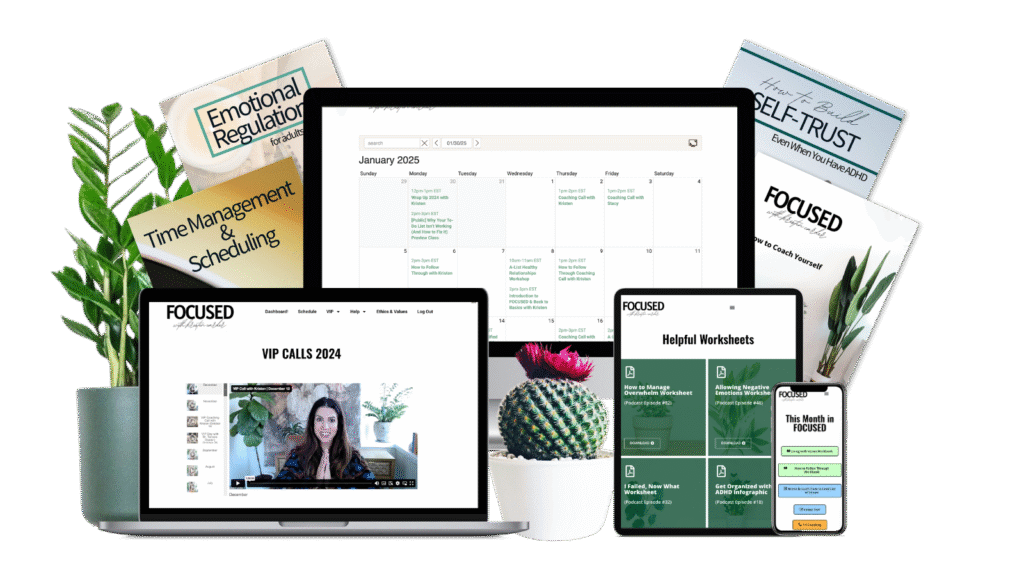
If you’re being treated for ADHD and still don’t feel like you’re reaching your potential, I want you to join Focused. It’s my monthly coaching membership where I teach you how to tame your wild thoughts and create the life that you’ve always wanted. Workbooks + Coaching Calls + Community. It’s awesome. Go to www.ihaveadhd.com/focused for more information.

See Privacy Policy at [https://art19.com/privacy](https://art19.com/privacy) and California Privacy Notice at [https://art19.com/privacy#do-not-sell-my-info](https://art19.com/privacy#do-not-sell-my-info).

Episode Transcript

This episode is sponsored by Cure Hydration. You know that moment for me, it’s around like 2 or 3pm when my ADHD brain just decides, we’re done for the day. We’re done here. The afternoon slump hits, the lights go off upstairs and suddenly answering an email or doing basically anything feels like climbing a mountain. That’s when I reach for Cure Energy. It’s a clean plant based energy drink mix made with 100 milligrams of natural caffeine and electrolytes. So I get the focus and hydration boost I need without jitters, without a crash and without that like I drink battery acid. Vi vibe that some of the energy drinks have. The peach tea and akai berry flavors are my current go to’s crisp, refreshing. And they don’t taste fake, y’. All. They don’t taste fake. I’ll drink one before recording a session or when I need to get help through like that afternoon drag. And honestly, I. I drink it anytime. My brain just needs to cooperate. What’s wild is that Cure Energy is only 25 calories and has zero added sugar. It actually helps me stay hydrated while giving me energy. Okay, I love coffee, but coffee could never. Staying hydrated isn’t just about water. You also need electrolytes. And that’s why I love Cure. It’s clean, it tastes great, and it actually works. And remember, Cure is FSA HSA approved, which is amazing. You can use that money to pay for cure and for I have ADHD listeners. You can get 20% off your first order@curehydration.com I have ADHD with the code. I have ADHD. And if you do get a post purchase survey, make sure to tell them that you heard about Cure right here on the podcast. It really helps to support the show. Don’t just drink more, upgrade it with Cure. Guys, thanks for helping me carry my Christmas tree. Zoe, this thing weighs a ton. Drewski, live with your legs, man. Santa. Santa, did you get my letter? He’s talking to you, Bridges. I’m not. Of course he did. Right, Santa, you know my elf Drew here, he handles the nice list. And elf, I’m six’ three. What everyone wants is iPhone 17 and at T Mobile, you can get it on them. That center stage front camera is amazing for group selfies. Right, Mrs. Claus? I’m Mrs. Claus. Claus much younger sister. And AT T Mobile, there’s no trade in needed when you switch, so you can keep your old phone or give it as a gift. And the best part, you can make the switch to T Mobile from your phone in just 15 minutes. Nice. My side of the tree is slipping. Kimber the holidays are better. AT T Mobile switch in just 15 minutes and get iPhone 17 on us with no trade in needed. And now T Mobile is available in US cellular stores. 3 for monthly bill credits for well qualified customers plus tax and $35 device connection charge credits and imbalance too. If you pay off earlier, cancel financing agreement. 256 gates $830 eligible for in a new line $100 plus a month plan with auto payments, taxes and fees required. Check out 15 minutes or less per line. Visit t mobile.com. Welcome to the I have ADHD Podcast where it’s all about education, encouragement and coaching for adults with adhd. I’m your host Kristin Carter and I have adhd. Let’s chat about the frustration, humor and challenges of adulting, relationships, working and achieving with this neurodevelopmental disorder. I’ll help you understand your unique brain, unlock your potential and move from point A to point B. Hey, what’s up? This is Kristin Carter and you are listening to the I have ADHD podcast, episode number 45. How are you my friend? I’m so glad that you decided to tune in and listen today. I love hanging out with you. I love it, love it, love it. I really do. Before we get started on our topic of the day, which happens to be setting realistic goals, I can’t wait to talk about this because I really think that every single single one of us who has ADHD struggles to set and keep realistic goals. It’s going to be a great episode. But before we get started, I want to shout out one of my clients in focused. This client is someone who shows up almost every single time we have a live call, which is very unique because most people are not showing up to all the live calls, which is totally, totally fine. All of the calls are recorded. They’re stored in the site. You can learn so much from watching someone else be coached. Sometimes you can learn more and get more transformation from watching someone else’s brain be coached than from being coached yourself. So it’s for sure not a requirement to show up on all the live calls, but this client does and her name is Tasha. So shout out to Tasha. So I coached Tasha last week on this issue that she was having that I think that you can probably relate to. She had a yoga class a weekly that she has to prepare for and because it’s something that she really cares a lot about, her brain wanted to focus only on this yoga class, preparing for it, making sure that it’s perfect, making sure that all of her ducks are in a row, so to speak. I don’t even know what that means. What does that even mean, to have your ducks in a row? It’s something my mom says, and I don’t know what it means. Anyway, so her brain was tricking her into thinking that she needed to spend hours and hours and hours preparing for it. And what was happening was that she wasn’t getting anything else done. And so we coached on fear of failure and time management and on just allowing yourself to learn by doing and not feeling like you have to show up perfectly. And so a week later, this is what she posted in our Share your WINS channel in the community. She says, guys, I was asked at the last minute to sub for a yoga class. So I had about 45 minutes to prepare instead of the whole day or more than that that I usually take. And I taught it and it was fine. It was just fine. And I learned a lot for next time and I’m happy that it wasn’t perfect and I survived. I think now that I’m making a conscious effort to spend less time planning yoga classes, I can spend more time just practicing for fun for myself with no other goal other than to mess around. I’m hoping it’s going to spark more creativity, playfulness, and acceptance so I can see that I can have fun without being perfect. Tasha, awesome job. I love it. I love it because it’s so true. How many of us struggle with perfectionism? We struggle to just go about the normal business of our days because our brains are kind of stuck in this thought loop of having to perfect something and improve it. Improve it, improve it until we move on. I actually had this experience today. I’m finishing up the March workbook. I actually finished it today. Thank God it is done, done, done. It’s no joke having to write these workbooks every month, but I am not complaining. It is a privilege. Anyway, I had to do the COVID for it today and I just found myself thinking, what are they going to think about this? Are they going to like it? Are they not going to like it? Maybe I should tweak this. Maybe I should tweak this. Maybe I should try a different picture. Is this too feminine? Is this too masculine? Is this too. Too busy? Is this too, like. Is this actually picture. Is this picture going to, like, stress them out? It was like a traffic scene. I actually didn’t choose that one, btw. But anyway, and I noticed my Desire to continue to want to improve it. Improve it. And it was because I’m afraid of failure. Just like Tasha, just like all of you, we are all the same. We’re all the same. And even though, like, we can evolve and we can grow and we can make improvements, for sure. Absolutely. We’re still gonna come back to the same fundamental things in our lives. We want to be perfect. It’s hard to accept that we can’t be perfect. It sure is a lot more fun, though, when we practice that acceptance. And so I set a time limit for myself today, and I was like, you have another 20 minutes, and then we are shutting it down. And I got it done. It was not a problem. Not a problem. So great job, Tasha. I absolutely love being your coach. All right, guys, today we’re gonna talk about setting realistic goals. Now, this is another tricky, sneaky, sneaky thing that our brains do. When we are faced with our goals, our brains get very overwhelmed and confused. And when we have a big goal in mind. Now, last week, we talked about time management and time blindness and how, as adults with adhd. Wow. There it is. There it is. Can’t talk. As adults with adhd, we struggle to manage our behavior across time. So we struggle to do a little bit. A little bit. A little bit. So that we’re achieving the goal long term. And this is where proper goal setting is so crucial. So I want you to think about that big goal that you have in mind. Maybe it’s running a marathon or writing a book or losing 50 pounds. Maybe you want to make $100,000 or start a YouTube channel or create something amazing. Maybe you are super creative and you want to quilt or design an app or something like that. Okay? So it’s like the big goal. So what we often will do is we tell ourselves, I have to work on my book. I have to work on my book. I have to work on my book. I want to write a book. I want to write a book. And we just kind of see spin out in the big goal, or we think, I want to run a marathon. The marathon’s coming up. It’s in June. Marathon is in June. Marathon is in June. And our brains, it’s like we come up against this brick wall. And the brick wall is this huge goal that we do not actually know how to accomplish. And the reason why we don’t know how to accomplish it is because we totally suck at managing our behavior across time to achieve a. Okay, so what I want to encourage you to do is take the big goal that you have whatever it is, and break it down into the smallest steps possible. So let’s say that your goal is to run a marathon. Now, I have a client in Focused. Her name is Andrea. Hi, Andrea. She is going to be running a marathon in December. Okay, so let’s just say that’s you. You want to run a marathon. It’s 26.2 miles. Hang on. I’m going to Google what it is, you know, outside of America. Okay, so for those of you using the metric system, 42.16 kilometers. Okay? So we have almost a year, about 10 months to make sure that we are in shape and ready to run 26.2 miles, 42 kilometers. Okay, now when you think of that goal. I need to run a marathon. I need to run a marathon. The marathon’s coming up. It’s in December. First of all, your brain is thinking that is really far away. And I don’t really care about it. Which is what we talked about last week, right? We don’t care about things that are not important right this second. We don’t care or it’s very hard to make ourselves care about the things that are way in the future. But let’s just say that you are able to make yourself care and you’re like, no, I’m going to do this. I’m totally going to do this. And the goal is run a marathon. What that means is you need to break that marathon down into the very easiest, smallest, most doable steps possible. So what I encouraged Andrea to do was break down that marathon goal into half mile segments. Now I am not in shape at all. You guys know this about me, but if I had to run a half mile today, I could totally do it. So if I can do it, I think anybody can probably run a half a mile. So if we break down our marathon goal into half mile segments, what does that do for our brain now instead of our brain spinning out in confusion, instead of there being a huge brick wall blocking us from taking action because it’s way too hard. Your brain for sure does not know how to run a marathon today, but it could definitely figure out how to run a half a mile. And. And so putting run a half a mile on your schedule for today and doing it no matter what comes up and doing that day after day after day until half mile is easy. And then we do a mile until a mile is easy. And then we do a mile and a half until a mile and a half is easy. You get the point, right? So we continue to do that. In small increments so that your brain does not get confused. Now, you can apply this to any goal that you have. So when I was just starting out as a life coach, I was like, okay, I want to be a life coach. How do I get clients? And instead of thinking I want to have a full practice with a waiting list, which is what I have now, I would think, what do I need to do to get one client today? Like, how could I go get one client? And then my brain would offer me a ton of suggestions. So when I would think, I really want to be a life coach who has a full practice and a waiting list, my brain would spin out in confusion. Well, I don’t know how to do that. I mean, that’s just impossible. There’s no way I’m going to get there. I can’t do that. That’s. It’s just too much. And then I would sit on the couch and scroll Instagram. But when I started asking myself the question, what could I do today to get just one client? How could I just get one client today? How do I need to show up? Who do I need to serve? Who should I email? How should I show up on Instagram and Facebook? Who should I connect with? How should I go about getting one client? I had a ton of answers, because that’s a lot easier than just magically manifesting a full client load with a waiting list. Okay, so here’s another way we can look at it. I have another client who is trying to start a business so that she can create $1,000 additional income a month on top of her nine to five. So what she wants to do is buy, like, vintage stuff and sell it. Okay. And that sounds amazing, right? Awesome. Just buy it and sell it. Except when it comes to doing it, her brain, of course, was getting stuck on, like, well, I’m not sure how. I don’t really know how to do it. How do I do? I need a website. I probably need a logo. I’m going to need to create an Instagram account. I should probably learn Poshmark, like, all of this, like, nitty gritty stuff that we get stuck in. Right? And I’m sure that you do this too, because I do it as well. We all do this. When we have the big goal, which is like, okay, $1,000 extra a month on top of my nine to five. And we kind of let our brain spin out on the big goal, Then it starts to be confused and it starts to tell us, like, yeah, we don’t really know how to do that? I’m not sure. And so what we worked on is, hey, why don’t you just ask yourself every day, how could I make 20 bucks today? Isn’t that so simple? Like, I think any of you probably looking around your house or your apartment like, you could make 20 bucks by selling your stuff today, right? And so that all of a sudden just made it so much simpler. Like, how can I make 20 extra bucks today? Easy, let’s go for it. I want you to apply this to your own goals. What is that big thing that you’ve always wished that you could do? What is that big thing that you keep thinking, man, if I could just get that done, it would be so awesome. What is that thing that’s kind of hanging over your head? Your contribution that you want to make to the world that you’re just kind of waiting to do because you’re not sure how? I want you to break it down into half mile increments. Take it from the marathon and put it into half mile increments. Take it from the. I want to create $1,000 extra a month and put it into. Okay, I’m just going to create 20 bucks today. How could you do that for yourself and for your own goal? You’ll know your goal is the right size when you know exactly how to do it. Okay? So like I said, anybody, pretty much anybody, could go out and run a half a mile. And so if your goal is to run a marathon, break it down into the very, very, very simplest, easiest piece and then go do that. Now, what’s so funny is that your brain will probably say, well, it’s not even worth it to do that, right? Like when you want to make a thousand dollars and I say, okay, well, let’s just start with 20. Your brain is immediately going to say, well, that’s stupid. I don’t want to do that. That’s not even worth it. What’s the point? That seems like it’s pointless, right? But what’s so hysterical is that if you just showed up and created $20 for yourself every single day. Hold on, I’m gonna have to pause and use my calculator. Okay, so in a month, you’d already have 620 bucks, which is a lot more than you have now. So maybe it’s not the thousand dollars that you want to make, but it sure is close. It’s a lot closer than what you have right now. So if you train yourself to do those little increments day after day, they’re going to make a huge difference. $620 is a lot closer to $1,000 than zero is. Right. And so once Kelly gets into the habit and is super confident that she can create $20 a day, then we’ll say, okay, now let’s create $30 a day. And if she creates $30 a day, then she’ll have $900 in a month. Well, that’s pretty awesome. And then we’ll go to 40. If she can create 30, she can for sure create 40. Right? And so, like, you just take it up incrementally. So once you can run a half mile and you can make yourself do it, like, you actually put your shoes on and you walk outside of your house, no matter what the weather is, and you run a half mile, then you can increase it and make it a whole mile, right? Then you’re running a mile. Then after you are able to do that consistently, then you increase it. So what we try to do is we try to say, okay, I’m gonna write 50 pages in my book today when we haven’t even practiced writing one. Why not write one page and see how that goes? Why not deal with the discomfort and all of the brain drama that’s gonna come from that one tiny, little, simple task? Okay? And what’s gonna happen? I guarantee it. I know this will happen. So I want you to predict it, like, I want you to notice it, and then be like, oh, my gosh, Kristen told me this is gonna happen, and it is happening. Your brain is gonna be like, why would I even bother to sit down and write one page? That’s not enough. And so it tricks you. It actually tricks you into not doing anything at all, because it is a sneaky, sneaky little brain. So what I want to offer to you is take your big goal, whatever it is, whatever contribution you want to make in the world, and whittle it down into the smallest steps possible. The most understandable. Like, you absolutely know how to do that and put those tiny little steps on your calendar and then become the person who follows through and does the thing. In a couple weeks or maybe next week, I’m not sure, but very soon, we’ll have a podcast episode coming out about becoming the person who. Which is a very interesting concept that I’ve been applying to my own life, and I can’t wait to share that with you. But for now, look at your big goal. Understand that right now, your brain is probably spinning out in confusion and overwhelm. Break that big goal down into very small, doable steps. Put each one of those steps on your calendar and then follow through. And don’t listen to the inside insidious little thought that says this isn’t worth it. We really should not even bother to write one page or run a half a mile or try to create $20 right? Those thoughts will come, so anticipate it and then tell your brain that it’s adorable and cute, but you’re not going to listen to it. And be the person who follows through through on those little tiny goals so that you can evolve into someone who is able to manage their behavior across time in order to reach a goal. This has been so fun. Thanks for hanging out with me today. If you’re being treated for your ADHD but you still don’t feel like you’re reaching your potential, you’ve got to join Focused. It’s my monthly coaching membership where I teach you how to tame your wild thoughts and create the life that you’ve always wanted. No matter what season of life you’re in or where you are in the world, Focused is for you. All materials and call recordings are stored in the site for you to access at your convenience. Go to ihaveadhd.com focused for all the info.

Related Episodes

Kristen Carder

Episode 418: Tired of Feeling Tired? How to Rest When You Have ADHD

Kristen Carder

Episode #416: ADHD and Money: In This Economy?!

Lindsay Gibson

Episode #414 Good Enough Parenting: What NOT to Do (with Dr. Lindsay Gibson)

Stop Struggling Alone.
Start Thriving With FOCUSED.

A proven coaching program designed specifically for adults with ADHD who want to gain clarity, build confidence, and take control of their lives.

Join a community of hundreds of ADHDers

Learning About My Brain...

Changed Everything

Hi, I’m Kristen Carder—ADHD expert, podcast host, and certified coach who’s been exactly where you are. Diagnosed at 21, I spent years cycling through planners, courses, and systems that never quite worked. Everything changed when I discovered the power of understanding my ADHD brain and the transformative impact of community support.

Now, after 15+ years of research and experience, I’ve helped thousands of adults with ADHD thrive. I’m here to show you how understanding your brain can transform your life, just like it did for mine.

ADHD Tips That Actually Make Sense

Follow @i.have.adhd.podcast and join our Instagram community for daily strategies, relatable content, and real talk about ADHD