


Kristen Carder 0:05
Welcome to the I Have ADHD podcast, where it’s all about education, encouragement, and coaching for adults with ADHD. I’m your host, Kristin Carter, and I have ADHD. Let’s chat about the frustrations, humor, and challenges of adulting relationships working and achieving with this neurodevelopmental disorder. I’ll help you understand your unique brain, unlock your potential, and move from point A to point B. Hey, what’s up? This is Kristen Carter, and you’ve tuned into the I Have ADHD podcast. I am medicated, caffeinated, regulated, and ready to roll. What’s up? Get in here, come on in. I’m so glad that you pressed play on this podcast. I know you have literally 1000s of options when it comes to podcasts, maybe millions by this point, and you press play on this one. Thank you. Adore you. Glad you’re here. Welcome. If you are just exploring ADHD, and maybe like recently diagnosed, or trying to figure out if you have ADHD, and you’re just like you’re figuring it all out. I want to remind you, if you, or let you know for the first time, if you’ve never heard me say this, that I have a free resource for you called 10 Things I Wish My Doctor Told Me When I Was Diagnosed with ADHD. You can find that at I Have adhd.com/ten things. It is comprehensive. It is very useful.
And listen, when I was diagnosed. I was handed a prescription, and I was just like sent on my merry way. No one told me anything about ADHD, and now there is so much more information available. I mean, that was over 20 years ago. Now, of course, there is more information available, but I wanted to create a resource for you where you can have everything in one spot, 10 things that I wish my doctor had told me when I was initially diagnosed. So, again, you can get that at I have adhd.com/ten things. And what we’re talking about today is rest, and y’all, it’s summer. It is summertime. It is the resting time of year, but I’m curious, when the last time was that you truly rested, not scrolled, not zoned out, not collapsed from exhaustion, but actually rested. This can be so hard for us. It can be so hard. Rest can feel surprisingly complicated for those of us with ADHD. Today, I’m sharing a class that I taught in my Focused Membership, so I have a.. I’m a coach. You might not know that about me. I have multiple certifications as a life coach, and it is the greatest privilege of my life. Besides parenting my three beautiful boys, being a coach for adults with ADHD is the greatest privilege that I’ve. I’ve ever been able to have, I’m I am obsessed with it. I love it so much. And in my coaching program, I show up several times a week, including a coaching call and a class, and this is a class that I taught on how to rest, and we talk about why we carry guilt, why we struggle with boundaries, why our brains resist slowing down. We’re unpacking the barriers that keep us from resting and exploring why guilt shows up so strongly when it comes to ADHD years resting. I think you’re going to find this class really, really useful, and I, I just want you to get a feel for the vibe. It is different than a typical podcast episode where I’m just talking, talking, talking at you. You’re going to notice that I ask a lot of questions, and I really encourage you to take a minute, a second, a moment to answer the questions that I ask, because in these classes it is an amazing time for self-reflection, and people with ADHD significantly struggle with self-reflection. You may or may not know that self-reflection is one of our executive functions that are weak.
It’s a weak executive function for many of us with ADHD, and so to have a class like this, where you’re being prompted to think and respond and really reflect on what’s true for you, can be extremely, extremely useful and helpful in your evolvement, because you’re listening to this podcast because you want to evolve, you want to become more skilled, you want to become someone who is more in tune with yourself and more like honest and realistic and living the life that you want to have, and answering reflective questions is a huge way to do it. You may want to journal, but, like, if that feels complicated, don’t do it. You can be in your car, out for a run, walking the dog, it doesn’t matter. You can absolutely answer these questions on the go, but I know that is going to help you. To create a life where rest is something that you feel like you can really grab on to, that you feel entitled to in a very good and healthy way, because rest is not something that you have to earn. I want you to repeat after me: rest isn’t something that I have to earn. Okay, and that is the theme of this entire class. I hope you enjoy it. I hope it is transformative. Let’s go ahead and dive in. Okay, today we’re going to talk about how to rest, and I’m just curious, what your relationship is with rest. Let’s kind of do a little check in and get a pulse on your relationship with the concept or the actual act of rest, what does that feel like to you? What comes up for you? Elka says, “What is that? Tamara says, “I’m a dismissive avoidant. Rebecca says, “As someone who’s chronically ill, it’s a non-negotiable, and sometimes my body forces me to, yep, Laura. I don’t know how, when I’m not busy with one kind of work, I get busy with another kind. Yep, I’m very good at physically resting, not great at mental rest. I have a great relationship with sleep. Rest is more ambiguous concept in my mind. Feels like I deny the need to rest until it comes up and grabs me by the throat and insists on it. I like the idea of it. I keep looking for something that I need to do, and then I get nervous that there’s something that I forgot. Yeah, guilt ridden. We’re going to talk about guilt today, JD, because I think that’s probably a very common experience for most. I just woke up from eight hours of sleep, and still feel exhausted. Yeah, I rest, but I don’t know if it’s restful. I think after several iterations of this call with you, I’m starting to get it, but I still find it very hard to rest without numbing, which doesn’t feel restful. We’re also going to talk about that today. Blaze, yeah, Amy says actual rest versus distraction, avoiding and vegging or numbing. Yep, yep, yep. Oh, that’s beautiful. I’m learning to embrace Sabbath and rest without guilt. Love that certain types of rest are hard. Yes, Carmen. Hi, Carmen. Speaking of emotionally immature parents, does anyone feel the need to pop up and look productive when someone else sees you resting. This is a question from Rebecca. And I wonder what y’all think. Blaze says yes. Maggie says yes. Steve says yes. He says yes. iPhone Zoom, I’m not sure who you are, but iPhone Zoom says yes. Okay, yes. Literally always. Why do y’all think that is? Let’s do a little self-reflection here. Why do y’all think it is that when someone walks into the room, or maybe the garage door opens, that you’re like, “Oh my gosh, I can’t be just laying here like a blob, I need to go do something. David says, “Childhood trauma, like everything else. I don’t know, David. I wish there was a sexier answer. Yeah, lazy shaming from childhood. I was taught that if someone was working or doing something, I should get up and assist. Granted, my mom was the Energizer Bunny. I’m not worthy if I’m not performing. I have such a fear of being judged as lazy. The work never ends. It’s a form of masking shame prior trauma from being judged. Yep, saving the farm mentality. Yep, yep.
Kelly says, I shared duplex with my parents, and I’ve worked through so much trauma around this. I am a work in progress. That’s beautiful. It’s beautiful, Kelly. Hyperactive and shaming parents. Yep. Okay, this is huge. I just, I think that it’s really important to keep that impulse in mind as we’re going through this class today and having this conversation, because if you continue to be aware of your impulses, your urges, your tendencies that may not be serving you, this is the number one way to make a change, right. It’s interesting, because prior to doing any self-development work, maybe you didn’t even begin to notice, maybe you didn’t even notice that that was your impulse. It was just so automatic. It’s been ingrained in you, perhaps since childhood. For those of you who don’t identify with it in childhood, it’s possible that you had a partner, a roommate, a friend who shamed you when you rested, and we’re like, what are you doing? You’re so lazy. Why aren’t you helping me, etc. etc. Right? So, it doesn’t necessarily have to come from childhood, although most oftentimes it does. So, let’s just first all agree on a definition of rest. What does it mean to rest? So, if you’ve been in focused for nine months, you have access to the how to rest course. It’s in tier four. It’s a great little course. I was just going through it in preparation for this call, and I was like, “Dang, girl, you did a good job. Like, I stand 10 toes down on this workbook that I wrote years ago. It’s a really good course. So, in my opinion. And this is just an opinion, you can create your own definition, but I have one here for you, if you’d like. In my opinion, rest is a state of mind and emotion wherein we are neutral, calm, and at ease, neutral, calm, and at ease. It’s a state of mind and emotion, it’s not a location, like it’s not, I’m in Cancun or I’m in Italy, because we all know that we have been on vacation or been at the beach or even had a day off, and it doesn’t matter where we are, we can still be really hyperactive, we can still be not resting. Okay, rest is the white space in our brains and our bodies that allow us to replenish our energy, creativity, and emotional capacity. Rest may be physical, it may look like physical exertion or physical immobility, like I’m just I’m laying down on the couch like a potato, or it might be I’m going for a hike.
Okay, it’s not the point. So, if you’re like hyperactive and you’re, you’re like, rest is my worst nightmare. Like, I would hate to have to be forced to take a nap. No problem, you do not have to. Rest is a relaxed state of mind and emotion during the activity. You can go to the gym, and it can be restful to a certain extent, because it’s your happy place. Your mind is totally just like at ease. There’s white space. Okay, I’m going to just say it again. Rest is a state of mind and emotion where we’re neutral, calm, and at ease. It’s the white space in our brain and in our body that allows us to replenish our energy, creativity, and emotional capacity. It may look like physical exertion. I’m going to go kayaking, I’m going to go fly fishing, I’m going to go play hockey. That can be extremely restful, or it can look like I’m going to take a nap. I’m going to lay in the hammock. I’m going to read a book. It’s not the point whether or not you’re moving or not moving. The point is that you’re relaxed, that your mind and body are relaxed, mind and emotional capacity. Yeah, Thomas says I feel most at rest when I’m fixing something. I love that. Now let’s talk about what rest is not, because a lot of us, myself included, spend time numbing out, avoiding, and escaping, and we call it rest, but it’s not actually restful. Do you concur? Does this make sense? Are you like, okay, yes.
All right, so there are times when I pick up my phone and I scroll Instagram, and it’s very restful because it is just my mind and body are relaxed, and I’m not using it as an avoidance or an escape tactic. Okay, so it can be hard to tell the difference. In my opinion, the difference is, does the activity give you a net positive or a net negative at the end of the activity? Maybe it is scrolling, maybe it is like social media or gardening or something like that, is your brain and body in a net positive space or a net negative space? So, when we’re using, let’s say, a screen, it can be restful. I don’t want to say it’s not, because it absolutely can be. But are we using that screen to avoid, or escape, or numb? That’s when it’s really not restful at all. Okay, you get to define what rest looks like, but it does take a lot of self-reflection to figure out, am I just avoiding or am I resting? And again, we can look at, am I trying to escape? That’s a great question to ask, am I trying to escape, and we can also look at, am I getting a net positive or a net negative. Sometimes a nap is 100% net positive, and other times it’s not. And you know the difference, you do. You don’t love that you know the difference, but you do. You do avoid escape numb. Yeah, well, Harry says I do this with audiobooks. I listen while I do a puzzle on my phone. That sounds lovely. Sometimes it’s transformative because the book rocks. Other times I’m in total avoidance. Yeah, okay. So this is a perfect segue. I read what you said, Celeste. Celeste says, yeah, figuring this out feels hard because there’s always something to do, something that I feel like I should be doing. In my opinion, thank you for saying that. In my opinion, I think this is our biggest barrier to rest, because many of us have grown up being taught that rest is a reward. Anyone, rest is a reward. You get to rest when you’re done all of your stuff. You get to rest when you’ve done all of your chores, and you’ve done all of your homework, and you’ve been to.. it’s a reward. And I want to just say, no, not true. Rest is not a reward. Rest is a human right. Yeah, our parents got it wrong, and that’s okay. We still love them, they’re great, some of them, but they got this wrong. Rest is not a reward, rest is a human right, it’s a necessity. Does it usually make sense to rest when you know, like, if you just rested all day, every day, would that be productive and helpful to your life. No, of course not. You’re never going to get everything done. Can you guys write this down and stitch it on a pillow or tattoo it on your forehead? You’re never going to get everything done. It’s not a thing. Getting everything done is not.. it’s not a thing. That’s not something that happens. Has anyone ever gotten it all done? Have you ever gotten everything done, even if you don’t like, have a job outside the home?
Let’s say you’re a stay-at-home parent. Have you ever gotten everything done? That’s not a thing. Can we sit with that for a second? Like, how do you feel when you hear me say that? Dana says, I need a recording of you saying that, Kristen, to listen on repeat all day long. Guess what, Dana, you’ve got one. This will be in the podcast tomorrow at the very latest. You have a recording of me saying you’re never going to get everything done, so stop trying. And here’s the thing, Maggie says, then that means I have to decide what actually needs to get done. Yeah, Elite says, as a stay-at-home parent who also works from home part time, I’m laughing to keep from crying. Nothing ever gets done, exactly. There’s just so much, and that doesn’t mean you failed or that you’re doing it wrong. It just means that you’re a grown person. Like, welcome to being a grown-up. Now, you may have a job with very specific responsibilities and deadlines and things that need to be accomplished on certain days.
Great, but you’ve got eight hours, or however long you’re contracted to work, to work on that. And when your time is up, you’re done. You’ve worked on it as much as possible, and now we go home. We don’t think about it again. Yeah, and listen, maybe this shows you that, like, the expectation at work is just not realistic. I agreed to do this within an eight hour period. Turns out it’s not realistic. How can we tweak this? How can we? How should I? What’s my next step? Here, I’m gonna need to take a couple things off my plate. So, since you’re never going to get everything done, rest needs to be a decision for me. I rest per the clock, so I do most of the things in my life by the clock, and here’s what I mean, by that, I work from 10am until 3pm Those are my working hours. And in the last year, I’ve also been writing for five to six hours on a Friday and writing for five to six hours on a Saturday. Those are my working hours, but once those working hours are complete, then I do other things by the clock, so from 3pm to 7pm is kid time, it’s mom time, it’s second shift, I call it second shift, I’m driving kids around, I’m making dinner, I’m making sure everybody has what they need, I’m doing the errands, I’m doing all the stuff right at 7pm your girl’s done, I’m all done, I’m gonna start resting, that means comfy clothes, that means putzing around or puttering around the house, in the garden, watering my plants, reading a book, going on my phone, watching a cult documentary. That’s my dude. Now telling us, well, what if you’re not actually working during that time? You may need some better boundaries with yourself to make sure that you’re working during that time. I will tell you, once I stopped giving myself the option to work after three, sometimes four, but usually not four.
Once I stopped giving myself the option, there was a lot more urgency to get stuff done during the day, lot more urgency, because working after hours was no longer an option that I gave to myself. Some of y’all need some tighter boundaries internally with yourself. When do you do all of the meal prep, housework, etc. I’m constantly trying to do work in the same space. Yeah, I have very much separated my work life and home life. I don’t do any home stuff during the work day, so I’m extremely boundaried in that way, because with my ADHD brain, I can’t be multitasking in that way. I can’t be distracted by dishes or laundry or a task for the kids. I don’t do it during my work day. I mean, sometimes, like I’m talking once a month, something urgent comes up, you know, like a prescription for my son needs to be refilled, and the pharmacy doesn’t open until I start work, that kind of thing, but that’s very, very rare. So I’m wondering, if you’re thinking about boundaries right now, do your boundaries need to be a little bit more firm regarding your time? Sounds like you figured out how to unlock robot mode. I wouldn’t say that. I mean, I still do a fair amount of procrastinating within. My own work day, but I am lucky that a lot of my work includes meetings, so when I have to show up for a meeting, there’s no procrastination that I can do. I have to be on. Does that make sense? So I figured out, like, a version of work that works really well for me, but I do a ton of procrastinating, but I give myself time to procrastinate. So, for example, on the days that I record my podcast, I know that I’m going to stare at the screen for an hour, I know I’m going to stare at the wall for another hour, I know that I’m probably going to go on my phone just to regulate myself. So, instead of being like, oh, I can record two podcasts in two hours, because all it takes is an hour to record a podcast, I give myself six hours. Does that make sense?
So, I build in procrastination time into my workday, because I know myself, I know me, because they’re talking about boundaries, which is great self boundaries, but that freaks me out. I need to figure out how to have lots of meetings in my work day, but I don’t need them since I don’t have employees. Okay. Interesting, interesting. Yeah, something for me to improve is being realistic about time to avoid the last minute unprepared frenzy. Yeah, yep, yep, that requires planning ahead, though. Yeah, you’re right, it does require some planning ahead. It takes a little bit of self-reflection, honesty, adjustment, creativity, but like you’re doing self-development work, you have the ability to do that. It doesn’t feel fun, but you do have the ability. give myself scheduled time to stare at the wall. Brilliant. Yeah, are you guys all building that into your workday? Because you should. It’s so hard, because at my job I am salary, and the expectation has become I work as much as I need to. I cannot say this is too much, or I can’t get this done today. I will not be staying there, but for now, I am there. Yes, Celeste, that doesn’t feel like a good fit in my opinion, do whatever you want, but I agree, I would need something much more boundaried than that, and so now you know for your next position that, like, I cannot, you can’t just give me 17 projects and be like get them all done by Tuesday, like that is not going to work for me, okay? So some of us need better boundaries around our time, and if that’s you, that’s totally okay. I agree that it is likely connected to the type of work that you do, but I would like to offer that, regardless of what industry you’re in, we can all take a minute to reflect on, do I have healthy boundaries in regard to the work that I’m doing, am I truly separating home life and work life in a way that makes it so that I can focus on work for however many hours and then focus on home for however many hours. Drew says I have a daily morning check-in to get my priorities in line, and a weekly body double block with a co-worker to get stuff done that I’ve missed or didn’t get enough or didn’t give me enough dopamine. That is brilliant. brilliant, so good. Okay, let’s just circle back to this, and I don’t want you to give me the answer that I want. I want you to kind of do a self-assessment and think through what’s my honest gut answer to this, and the question is, Do you have to earn rest, do you have to earn rest? Got a couple yeses, got quite a couple yeses. So I would just really encourage you to start poking at this belief.
Oh, this is such a good insight. I feel like I have to, unless I’m sick. How many of you felt relieved as kids when you were sick? I’m sick. I know I’m going to be taken care of. I know I’m going to get attention. I know that I’m going to be able to do what I want to do, and now is some of that showing up in adulthood, like I wish I were sick, because then I’d be allowed to rest, or thank God I’m sick because I’m allowed to rest. Yes, can I offer something to you? Moms do get to be sick, especially since your kids are so old. Get out of here with that. Look at my face. No, moms do get to be sick. Your husband should wait on you hand and foot when you are sick. You are grown. Can you hear me for a sec? You’re a grown-up. You are an adult. You are in charge of you. You do not get in trouble unless you break the law. You are grown. Okay, you get to decide to rest because you decide that you want it and or need it. You’re grown. Yes, I do have to tell myself that I’m a grown ass man. Yes, I want you to tell yourself I’m grown. I’m a grown woman, I’m a grown man, I’m a grown person. I’m grown. I get to decide I’m in charge of me. I’m not going to be mad at me.
I’m not going to get myself in trouble, Amy. I’m gonna be nice. To me, you get to rest. What if every night? What if every night at 8pm you decided this is rest time? I get to rest. I’m allowed to rest. Let’s talk about this word, entitled. Have you ever considered that you are actually entitled to rest, and I, by that, I mean healthy entitlement, healthy entitlement, that you can just grab onto, like I’m going to take this because it belongs to me, it belongs to me, I’m allowed to rest. Not only am I allowed to rest, but David makes a good point. Rest is preparation for the next day rather than a reward for the previous day. I don’t get to rest because I did everything I need to rest so that I can function tomorrow, right? That’s me. Like, I forget, somebody came in and said, like, I’m a little hungover from a busy day yesterday, that’s the thing, like, I, there are very few days now that I am hungover, because I feel extremely entitled to rest now. Toxic entitlement means I deserve things that other people don’t deserve, that’s toxic entitlement. Okay, so toxic entitlement says I should automatically get more than other people, or my feelings are more important than other people’s, or I can ignore boundaries, or other people are responsible for making me happy. That’s toxic entitlement. That’s not what I’m talking about. I’m talking about healthy entitlement. I’m a human, rest is a human right. I’m a grown-up. I’m in charge of me. I get to decide. I get to decide what I do with my time. I want you to test this. Start resting. Set a time for yourself. Set a reminder in your phone. Set a time for yourself. Time to rest. Whatever feels like doable. So, like, if 7pm feels too early for you. Try 8pm I mean, I think nine is too late, but if you, if nine is like the earliest I’m willing to do it is nine. Okay, great. Test it, start resting. Set a time that’s like this is it at this time of the day. It’s over. It’s over. I’ve done what I can do. It wasn’t perfect. I’m going to do some self-soothing. I’m going to do some journaling. I’m going to get in comfy jammies. I’m going to have a little cozy snack in the sparkling water.
I’m going to take a bath. I’m going to get cozy in my bed. Do you know that this has cured my revenge bedtime procrastination? It’s cured it. I used to stay up until 2am being like this is the only alone time that I get, this is the only time that I’m not perceived, this is the only time that I get to myself that I can feel like a real person, and I would stay up until 2am It has cured my revenge bedtime procrastination. Why? Because I’m taking what’s mine at a reasonable time, at a reasonable time. I start resting at 7pm I’m winding down, guys. I was asleep by 1015 last night, like I’m in bed by 945 every night. Like, so happy to, like I’m so happy. It has cured – I’m talking cured my revenge bedtime procrastination. Cured it. I never do it anymore. In fact, there’s no place I’d rather be than in my bed at 10pm I swear to you, I didn’t even put this all together, so I think I’m going to need to do a podcast on this now. I will say, if you are parenting little littles that are just constantly waking up, I don’t know that it would cure me if I had little ones that were constantly waking up, I think I would probably still steal those hours in the middle of the night, because perhaps that would be the only time that I would get alone. But I don’t have littles anymore. Start taking what’s yours, start taking what’s yours, feel that healthy entitlement. I get to do this, I get to. Are you using your rest time as transition to bedtime? Do you think it would work if rest happened earlier in the day? Great question. I think it would definitely be amazing if rest happened earlier in the day.
I think that’s totally fine, but I do have this like belief that us ADHD ers do need some good transition time usually to get into bed, so like even if let’s say we have a really late night, like an event at school or something like that, if I’m getting into bed at 11, I’m still taking an hour to myself before I fall asleep. Does that make sense? Like, I always need that alone time, which is why that process for me starts earlier. But yes, rest earlier in the day, that’s great. On like a Saturday, I haven’t had a free Saturday in a long time, but let’s say a Sunday. I have the urge to work. I have the urge, like on Sunday, I had the urge to work on my book, and I did. Let’s talk about two Sundays ago. Two Sundays ago, I was like, oh, I could do more on the book, and I was like, no, like I said, I set boundaries with myself. No, you’re not doing more in the book, you’re doing nothing. Don’t care if you’re bored, you see. I talked to me. I don’t care if you’re bored. Go find something to do. It’s like a firm but loving mother talking to her child. It’s okay to be bored, but you’re not working. Okay, let’s talk about guilt. Who here feels guilty when you attempt to rest? Who’s getting better? That’s great. We got some yeses, we got some sometimes. Jacqueline says shame. Yeah, does anyone else relate more with shame than guilt? Dana’s making progress, so let’s talk about I’m going to use those words interchangeably right now. Guilt and shame, because some of you are going to identify more with guilt. Some of you are going to identify more with shame. That’s totally fine. You pop in your word that works best for you. I want to talk about the difference between moral guilt and toxic guilt. Okay, and I wrote about this extensively in my book, but moral guilt is so important, and it’s good, and sometimes what we do feel is moral guilt. I said I would get this done, and I didn’t. That sucked. Okay. Moral guilt is connected to your values and your ethics, and it tells you when you’re out of alignment, when you have broken the law, when you have lied, when you have stolen something, when you’ve cheated, when you have treated someone unkindly. Moral guilt shows up to say, ‘Hey, that’s not cool, that’s not who we are. You need to make a change. You need to repair this. You need to hold yourself accountable.
Okay, moral guilt is useful. It’s good. It moves you to being more of who you want to be, but toxic guilt, or toxic shame, as John Bradshaw calls it, is passed down in families, and that’s the type of guilt or shame that says they’re going to be mad at me, I’m in trouble, I don’t deserve this, I’m lazy. Okay. Yes. No. So make sure, make sure that you are understanding the difference between moral and toxic shame or guilt, moral guilt, toxic guilt, moral shame, toxic shame. Okay, because it’s really important to notice that most of the time we are, we’re feeling a sense of toxic guilt, and this goes for our relationships, this goes for our boundaries, this goes for our time, this goes for our rest. I shouldn’t, I didn’t do enough. I’m going to get in trouble. They’re going to be mad at me, I’m lazy, they’re going to judge me. That type of emotion keeps you compliant to the system. Okay, you want to make sure that you can like stop yourself. It’s okay to feel that guilt or shame, that’s kind of normal, but label it. Oh, okay, I see what’s happening here now. Who here could make your to-do list moral? That’s the thing, that’s the issue. Like, that’s where we need to be really careful, because a lot of time, a lot of times, we can make our lists moral, and I, they’re not 99% of the time, they’re not. The list never ends. You’re not going to get it done. It’s not about morality, or about you being a good person, or about you hustling for your worthiness. It’s not, no. Okay, so I just want to encourage you to feel guilty and do it in any way.
Feeling guilty doesn’t mean that you shouldn’t rest. Feeling guilty means you need to tune in to what’s going on inside of you. Guilt was our family’s sixth love language. Dang, that sucks. That sucks. Yeah, guilt is a manipulation tactic used by systems to keep individuals compliant. Systems, aka my parents, I know I don’t want to, like, assume that everybody’s family system is like this, but it could be a religious system, it could be the school education system. It’s all about manipulating toward compliance. It benefits the family if you’re constantly working, it benefits the parents’ image if you’re always productive. Do you know what an amazing rebellion to that would be? Resting, resting 100% Okay, so the last thing that we’re going to do is I’d like all of you to think through what feels restful to you. Let’s make a rest menu. What feels restful? What, let’s list ideas of things that are truly restful. I’ll start. I’ll start. I love to be outside. Anytime I’m outside, I feel I feel like nature infuses me with rest. I’ve heard a quote one time that. Said people who are under nurtured or who were under nurtured in childhood feel extremely nurtured by nature. I don’t know if that is true or not, but it hit me so deep in my soul as someone who is extremely under nurtured as a child, because I feel so nurtured by nature. So anytime I’m outside it feels restful to me. I love to putter around the garden, I love to water plants, I love to go for a walk, I love to go for a hike, I love to just sit. I’ve been laying in the grass, I just walk around my yard in bare feet. I go sit at the top of our field and listen to the wind blow through the trees. Oh my gosh, it fills my soul. It’s so amazing. All right, I’m gonna read some of your ideas. Art, dancing, sleeps.. no, that sleep is not too obvious. I love it. What other ideas? What waking hour ideas might you have, David? Sitting on my rooftop patio.
Oh, gorgeous. Walking outside on a sunny day, yard putter, gardening, singing, journaling with calm music, scrapbooking, sitting in a chair outside with no talking. I love that. This reminds me of my favorite winter restful activity, which is doing a puzzle while listening to a podcast. I love it. Bonus points if the fire’s on, sitting on the couch with my kids, and playing the same weird game without me riding my motorcycle. Yes, nature and natural bodies of water. Yes, this explains why I love nature. It feels like the trees were listening to me more than my family. Oh, Laura, it got me. Yes, honey, I was in Yellowstone last week. My sister was in Yellowstone last week. Carrie, oh my gosh, we drove for hours yet. It was so restful, and all the wildlife were out with their babies. We just hung out and watched grizzly bears graze from a distance. Amazing reading in bed. Yes, okay, Laura, if you want to just browse the How to rest workbook. There is a big section in there about why we don’t let ourselves rest. I didn’t have, I knew I wouldn’t have time to cover everything today, so I didn’t even get into that. But if you have a second to just kind of skim through it, that might be helpful. Live music, dancing in a big crowd where everyone is vibing to the music, obsessed, staring out the window of a moving vehicle, love. Hopefully you’re not driving at the same time, or maybe you are, and you’re looking out the front window. Got you. I need help. I need help, other than napping, and when we are away, what else can I do day to day at home? Hopefully, Jacqueline, you’re getting ideas from others, sitting outside listening to the birds, chatting, moseying around a lovely place, and taking photos, browsing an antique store. Yes, Thomas says, I feel like I’m in the minority of how I like to rest. I feel like everyone wants to go outside, but I prefer building something or playing games inside. No problem at all. I think about my son in this conversation too, because he’s an indoor cat. Like, being outside is stressful to him. It is not restful. Totally valid.
We’re all different, being with my niece and nephew, photography, cooking, yoga, nature, live music. When I feel relaxed, when my brain and body is fully occupied, and I don’t have to make decisions, which is so rare, even coloring, being outside, there’s so much to do. Clean up outside. I’m sorry to hear that. How can we think of all of these ideas, and yet we don’t rest, because we’re not deciding to, and we need to make an actual decision, and do it, cooking, baking, sunbathing on my patio, walking, hiking with my dog, making crafts, and DIY projects at home. Yes, wrapping myself up with my Snoopy blanket, obsessed, singing karaoke, staring out the window of a car. I think I must have been a dog in a previous existence, cutting veggies, so good, browsing, shopping, just for fun. Yes, I need to do this alone. Love it, so good. I love all of these ideas. Remember that rest is more of a state of mind. It doesn’t mean you have to be laying flat on your back, okay? If you’re not someone who wants to be still, that’s totally fine. I bought my son, my second born during the winter. He was struggling with just like not having enough to do, even though he was swimming and playing water polo and all the things. So we bought like a really big Lego set that he worked on, and that was so restful for him. He watched YouTube videos and put a Lego set together, and he loved it. It was so restful.
So, buy yourself a Lego set. Yeah, this again leads back to boundaries. So, Jacqueline said, for me, if I’m home, I see all the things I need to do, and it’s so much harder. Y’all, if you’re not able to rest in your own home, you need to work on that, because home should be the most restful place, the most restful place. Okay, so I understand, because there’s always things to be done, and there’s always dishes to do, and there’s always laundry, and there’s always whatever, but I want you to be. Begin to work on your relationship with your home, because home, home should be very restful. Maybe you just create one space in your home where you’re like, this is where this is where I can go to rest, and that’s fine, but I want you to work on that relationship that you have with your home, because sure you can go outside of your home to rest, but a lot of time that costs money, it costs effort, it’s just more costly. Work on your relationship that you have with your home, with your stuff, with your, with your mess. Yeah, it’s a good idea, Tamara. We can dig into this a bit. Oh, I love a white noise machine too. Oh, amazing. I really appreciate you guys. I know this takes a lot of self-reflection. It’s kind of an annoying cause. Takes a lot of self-reflection to do this work. This is high level work, high level work, but it’s worth it, it’s worth it, and it’s something that I didn’t learn until recently. I mean, I’ve always been hyperactive and a workaholic. Honestly, I’ve really had to create better boundaries for myself and really work on, like, who am I outside of work, what do I like to do? What feels restful for me? It was really uncomfortable, and that’s super fun. So, I can empathize with, like, ah, this doesn’t feel fun, but I want you to think about, like, even your phone obviously gets low on battery, and every day we’re plugging it in, and I don’t just mean sleep. How are you plugging yourself in to something restful, so that you are not just a workhorse or a robot. Okay, y’all. All right. See y’all.
A few years ago, I went looking for help. I wanted to find someone to teach me how to feel better about myself, and to help me improve my organization, productivity, time management, emotional regulation, you know, all the things that we adults with ADHD struggle with.
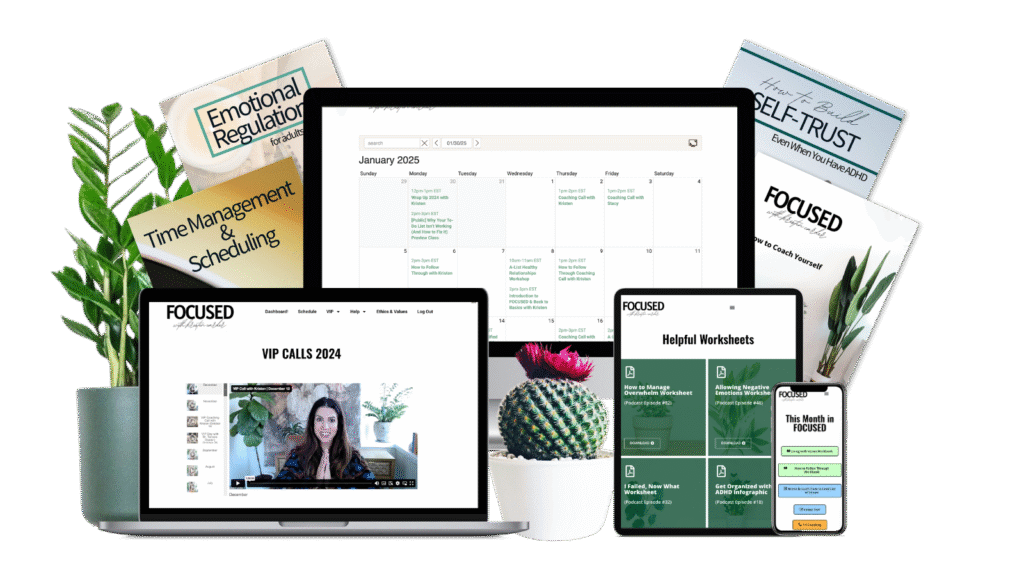
I couldn’t find anything, so I researched and I studied, and I hired coaches, and I figured it out. Then I created Focused for You. Focused is my monthly coaching membership, where I teach educated professional adults, how to accept their ADHD brain and hijack their ability to get stuff done. Hundreds of people from all over the world are already benefiting from this program, and I’m confident that you will too. Go to Ihaveadhd.com/focused for all details.