

Podcast Episode #60: Accepting Your Adult ADHD

Listen or Watch this episode on:

About This Episode

Self-acceptance is the FOUNDATION for behavior change. You will never produce consistent positive results in your life if you don’t first decide to accept your own humanity and your ADHD brain. This is probably the most important episode I’ve ever recorded.

[www.ihaveadhd.com](https://ihaveadhd.com) for more adult ADHD resources.

See Privacy Policy at [https://art19.com/privacy](https://art19.com/privacy) and California Privacy Notice at [https://art19.com/privacy#do-not-sell-my-info](https://art19.com/privacy#do-not-sell-my-info).

Episode Transcript

This episode is sponsored by Cure Hydration. You know that moment for me, it’s around like 2 or 3pm when my ADHD brain just decides we’re done for the day. We’re done here. The afternoon slump hits, the lights go off upstairs and suddenly answering an email or doing basically anything feels like climbing a mountain. That’s when I reach for Cure Energy. It’s a clean plant based energy drink mix made with 100 milligrams of natural caffeine and electrolytes so I get the focus and hydration boost I need without jitters, without a crash and without that like I drink battery acid vi that some of the energy drinks have. The peach tea and acai berry flavors are my current go tos. Crisp, refreshing and they don’t taste fake y’. All. They don’t taste fake. I’ll drink one before recording a session or when I need to get help through like that afternoon drag. And honestly I I drink it anytime. My brain just needs to cooperate. What’s wild is that Cure Energy is only 25 calories and has zero added sugar. It actually helps me stay hydrated while giving me energy. Okay, I love coffee, but coffee could never Staying hydrated isn’t just about water. You also need electrolytes. And that’s why I love CUR Cure. It’s clean, it tastes great and it actually works. And remember, Cure is FSA HSA approved which is amazing. You can use that money to pay for cure and for I have ADHD listeners, you can get 20% off your first order@curehydration.com I have ADHD with the code I have ADHD. And if you do get a post purchase survey, make sure to tell them that you heard about CURE right here on the podcast. It really helps to support the show. Don’t just drink more, upgrade it with Cure. With savings over $390 this shopping season, VRBO helps you swap gift wrap time for quality time with those you love most. From snow on the roof to sand between your toes, we have all the vacation rental options covered. Go to VRBO now and book a last minute week long stay. Save over $390 this holiday season and book your next vacation rental home on VRBO. Average savings $396. Select homes only. Welcome to the I have ADHD Podcast where it’s all about education, encouragement and coaching for adults with adhd. I’m your host Kristin Carter and I have adhd. Let’s chat about the frustrations, humor and challenges of adulting relationships with working and achieving with this neurodevelopmental disorder. I’ll help you understand your unique brain, unlock your potential, and move from point A to point B. Hey, what’s up? This is Kristen Carter and you are listening to The I have ADHD podcast. Episode number 60. You guys, episode 60. I’m so excited. I’m sorry, so proud. I got to 60 episodes. Every time I hit like a nice round number, I just get really excited. I’m already thinking about like having 100 episodes under my belt. That’s only 40 episodes away. I can’t even believe it. So exciting. How are you? I finally have childcare after three months of working at home with my kids and homeschooling them and having my husband also be at home working. And last week a babysitter started and we are so happy. We are so, so, so happy. We have gotten so much done in the last couple weeks. Just like all of the catch up things that we needed to do with our jobs and being able to like feel like you have a block of time in which you can accomplish the things that have been hanging over your head for months. It feels like such a luxury. Not take that for granted. It just feels so luxurious. So I’m currently in my home alone, which hasn’t happened in so long. So we have a babysitter that comes here. She’s so awesome and she took the kids to the park. I said I need about an hour and a half to record this podcast. And you know, as something new and different. I just didn’t really want children screaming in the background while I recorded this podcast. I wanted to do something different this time. So she was really cool about it, took the kids to the park. It’s like 90 degrees here in Pennsylvania. I’ve never been more happy in my life. So they’re probably just like totally sweating, but it’s fine because being hot is the very best. Wouldn’t you agree? Come on, let’s be real. All right, so today we’re going to be talking about self acceptance. And you guys, this is huge because so many of you are hating on yourselves constantly. Raise your hand if you’re in your car, driving, if you’re at home doing dishes while you’re listening, if you’re on a run. I just want you to raise your hand if your self talk is vicious, right? Like we have these thoughts about ourselves that just kind of pop into our heads. Like you’re doing it wrong. This is so bad. Why can’t you get it right? And we just think that that’s like the normal thing for our brains to be thinking. And that’s what we’re gonna be talking about today. Like, it’s a no. All right? And what’s so ironic is that we are so mean to ourselves, and then we wonder why we’re not able to accomplish our goals. Right? And so what I wanna communicate through this podcast, like, I wanna give you the end right now. Okay? So what I want you to take away is that self acceptance is literally the only way, way to get to a place where you can consistently produce good results in your life. Okay? So if you’re in a place where you can kind of beat yourself up enough to do the thing that you want to do, but then you find that you’re just not consistent, and so then you go back to your quote unquote old habits, and then you beat yourself up and you get yourself to do the thing, and then you go back to your old habits, it’s because you’re not accepting yourself. It’s because you’re not being kind to yourself. So there is a step by step process that I take my clients through, and I’m going to walk you through that process on today’s episode. Everyone do a happy dance. I cannot wait. Because this one topic is so pervasive and it causes so many problems for all adults with adhd, the work that we’re doing this month in Focus on Identity, self concept, confidence, self acceptance, it will be available for free as a bonus course to all members. Starting now, starting today. It’s already there for you. So starting now and moving forward. So this is foundational work. So if you join Focus, which I highly suggest you do, you can get started today on building your stuff. Self acceptance, your self confidence, your identity and your self concept. Okay? So this is like foundational work to getting the consistent results that you want in your life. And what I’ve learned after doing the Focus program for six months is that we really just need to start with identity, self confidence, self acceptance before we can layer on all of the other things that all of us want to see change in our lives, right? So, like, we all want to be better at organization, we all want to be better at time management, we all want to be better at our relationships. But what I’ve discovered in coaching through this program for the last six months is that the foundation of this is identity. The foundation of this is self acceptance. And so in order for all of my clients to get great results for themselves moving forward, I think this is where we need to start and So I want to offer this to you because whether you’re in Focused or not, I want you to have the tools for moving from self love loathing to self acceptance. You deserve these tools. Okay? So I don’t care if you’re my client or if you’re not my client. I want to walk you through this process so that you can get amazing results for yourself in your life. You deserve it. You are an amazing human being who deserves awesome results in your life. Okay? And so I’m going to use the bonus workbook, the free workbook that’s going to be available to all members, like, from today moving forward. I’m going to use that workbook, a portion of it, as my guide for today’s episode. And if you want to take the work deeper, join Focused. I would love to coach you. All right, so here we go. We’re going to start with this super basic concept that I don’t think that all of you believe, okay? It’s very basic and we need to start with this. Are you ready? Here we go. Your value is inherent. All humans are 100% valuable. All humans are 100% worthy of love. You’re not the exception to this rule. So I can feel your eye rolls. I can feel them. I know that when I said that, half of you were just like, yeah, whatever, Kristen, and you rolled your eyes. And if that’s you, honey, stop it. This applies to you, okay? No one has to do anything to be valuable and worthy of love. And this includes you. People are born worthy of love. People are born full of value. Now, if you don’t believe me, I want you to think about your kids. If you don’t have kids, do you have nieces or nephews? Do you have, like, friends with kids that are squishy and little and adorable and cute? Okay, what do those kids have to do in order to be lovable? What do those kids have to do in order to be valuable? Do they have to perform? Do they have to do it perfectly or serve you or love you? Right. What specifically do they have to do to prove their worth? The answer is nothing. Just the fact that they exist is enough to deem them worthy and valuable and lovable, right? And we even love them when they’re being jerks. Like, I love my kids. I loved them from the day that I found out that I was pregnant, right? But they’re also little jerks sometimes, and I love them anyway. It doesn’t take away from their value. It doesn’t take away from their inherent worthiness. They’re just, like, jerks once in a while. And guess what? I’m a jerk, too, once in a while. So, like, I can totally get it. So we have to start with this concept of your worth and your value being, like, the foundation of everything. Because a lot of you are trying to prove your worth. A lot of you are thinking, like, I’ll be worthy when I can do xyz, when I can graduate from high school, when I can graduate from college, when I can finish my master’s, when I can finish my dissertation, when I can get that job that I want, when I can, like, land the relationship that I want, then I will allow myself to feel worthy. Then I will allow myself to feel valuable. And that is approaching it all wrong. It’s just, like, 100% flawed. Because your value is just there. It just is. And what is so amazing about this is, like, whether you believe it or not, your value is there, but it’s a lot more fun to believe it. So I would just encourage you to start believing it. Like, it doesn’t matter how bad your ADHD symptoms are. It doesn’t matter what you’ve done as a result of your impulsivity or your poor planning or your inability to prioritize or your inability to think things through or your inability to manage your behavior across time. It doesn’t matter. You are still 100% valuable, 100% worthy of love. Your worthiness is not based on what you do. It’s based on who you are. You are a human. Humans are worthy. Humans are valuable. The end. Okay? No matter what anyone says or has said to you, no matter what anyone does or has done to you, nothing can add or take away from your value. Okay? Now, a lot of you are going to try to. Yeah, but your way out of this. Like, yeah, like, I kind of believe that, but. And then you want to list all of the things that you believe are wrong with you. Now here’s the deal. You’re just kind of wasting your time and you’re wasting your brain’s energy. It’s so much more productive to just grab onto that thought, that no matter what I do or have done, I am 100% worthy, 100% lovable, and 100% valuable. And then it’s like, okay, case closed. Let’s move on to the next thing. So many of us want to find evidence for our worth not being. No, I’m going to say that again. So many of us want to find evidence for our lack of worthiness or our lack of value. Or our lack of lovability. And that’s just so going to give you terrible results in your life. So if you have terrible results, if you don’t like what you’re creating for yourself, take a look at whether or not you believe you are inherently valuable and start there. It’s the foundation. I know you want to talk about, like, yeah, but like how do I manage my time? How do I organize my life? How do I blah, blah, blah. We have podcasts on that. But I’m telling you that this right here is the foundation for everything. So here are some questions that I would love for you to answer. Do you believe that you’re inherently valuable and worthy? Why or why not? Take some time to thought download on that. What do you think might add to your value as a human? What are you currently believing that you could do to make yourself more valuable? What do you think takes away from your value as a human? And are there any beliefs about yourself in this area that would be really good for you to change? Do you want to decide on purpose to change some of your beliefs? This is very good thought downloading questions. If you’re ever like, I’m not sure what to thought download on, press pause, write them down. Thought download on that stuff. Okay? So once you are able to acknowledge that you are inherently valuable, inherently worthy, inherently lovable, just for being a human, just for existing on this planet. Planet, the next step is self acceptance. And this is huge. This is the whole point of today’s podcast. Self acceptance is really the first step to changing how you think and how you feel about yourself. And it’s the start of a new identity. It’s the start of showing up differently. It’s the start to like showing up on time, to being kind, to holding back when you want to explode. It’s the start to creating amazing results for yourself. Now most of my clients, and I have a lot of clients, they struggle to accept themselves. They believe that there’s something wrong with them, that something they need to change in order for them to accept themselves. And I’m wondering, do you relate to that? See, my guess is that you have thoughts like, I’ll accept myself when I fill in the blank. So what is that thing for you? What are you kind of like waiting around to do before you will accept yourself? What do you currently believe that you need to change or accomplish so that you can accept yourself fully? So like fill in the blank here. In order to accept myself, I need to what? What is it? Very curious. See, here’s the thing we think we’re doing ourselves a favor, but by not accepting ourselves the way we are. We think that by not accepting ourselves the way we are, that’s going to lead us to change. We think it’s going to inspire us to change. This is completely false and we’re going to get there. Okay? So we’re going to tackle this in a couple minutes, but I just want you to, like, put a pin in this, because if you’re anything like me the way that I was, if you’re anything like the hundred plus clients that I have currently, you think that there are things that you need to change in order for you to fully accept yourself and that it’s actually a good thing that you’re not accepting yourself. You think you’re doing yourself a favor, but it’s actually completely backwards. It’s actually biting you in the tush. Okay? And so we’re gonna get there, but first I thought it would be really helpful to just talk about what it’s like to be a human. So I just want you to, like, bear with me for a second because in order to accept ourselves, we have to understand that we are human. Okay? And that sounds so basic, but it’s not. It’s not basic at all. Because so many of us, and we touched on this in the perfectionism podcast, so many of us are holding ourselves to standards that are not even realistic at all. And so understanding humanity, understanding what it’s like to be human, and then especially a human with adhd, can help us convince ourselves to accept who we really are. So what do we know about humans? Here’s what we know. All humans make mistakes. Every single human makes mistakes. Now, we often think that we’re the only ones. Yeah. But they don’t make the mistakes that I do. Or they figured this out by now, or they’re not anywhere near, you know, as quote, unquote behind as I am. But knowing that all humans make mistakes and is extremely important. And even when humans have good intentions, they often screw up, right? Like, even when people try to do it right, they often do it wrong. Sometimes humans are mean on purpose. Sometimes even kind, sweet, nice, gentle, whatever, good humans are mean on purpose just because they have a human brain and they just want to be mean, right? Humans are wired to protect themselves. The human brain is wired to look for the bad and to see danger in everything. This is a protective mechanism. I believe that God designed this on purpose so that we would stay alive. Right? But when we acknowledge, like, oh, I have a human brain and the human Brain always looks for the bad in a situation and that’s a protective mechanism. And so when I see the bad in something, it’s not necessarily, necessarily what I need to believe. It’s just my brain looking out for me. Right? It’s doing its job. All humans, and we’re talking about neurotypicals, all humans get tired, angry, sad, disappointed, frustrated, and all of those feelings lead to specific actions or inaction. Okay? So all humans have negative experiences in the world. And then those negative experiences usually lead to negative actions. Just the way it is. All right? And there’s never been a human who lived a pain free life. We will often look at the people on Instagram, on Facebook and say they have it so much easier than me, but they don’t. They do. Not everyone experiences pain, everyone experiences heartache, everyone struggles with self acceptance. It is a human condition. So what’s even more important than understanding humans in general is for you to know that the ADHD brain is wired a specific way. And there are certain things that we as adults with ADHD are going to struggle with, especially as adults with adhd. It’s very, very important for us to know and understand this. This is the kind of information that your doctor never gave you, right? Unless you, you had an amazing doctor, which, God bless that doctor. But for me, when I got diagnosed and they said, you have adhd, here’s some concerta. And I was like, okay, thanks, bye. And then that was it. And I had to learn all of this on my own. And I don’t want you to have to learn it on your own. That’s why I am here. This is what I believe my purpose is in the world, to help you to understand what it is truly means to be an adult with ADHD. So here we go. This is all adults with ADHD. And this is borrowed from the work of Dr. Barkley, especially from his book Taking Charge of Adult ADHD. He has done so much research and so much work on adhd, but Taking Charge of Adult ADHD is a very comprehensive manual on what it’s like to be an adult with adhd. And all of these, you know, ADHD characteristics have been taken from what I’ve learned through that book. Okay, so let’s go. Here are the things that we need to know about humans with ADHD. ADHDers are time blind. We have zero sense of time. We struggle to focus and we’re so easily distracted. We are impulsive and sometimes really, really, really impulsive. Right? There’s no stop and think. There’s no pause before we react. We’re extremely impulsive. ADHD brains forget things quickly, easily, often all the time. We have very poor working memories. We’re extremely forgetful. ADHD brains struggle to understand and control their emotional responses. This goes in the category of emotional dysregulation. Okay, we are super emotional, but we don’t understand how to process and to control our emotional responses. We struggle to accomplish long term goals. ADHD brains see everything as a priority and have trouble deciphering between what’s urgent and what can wait. ADHD brains are not good at learning from past mistakes. Your neurotypical friends will likely make a mistake, learn from it, do it differently next time. You as an adult with ADHD will likely make a mistake for. Forget. Make the mistake again. Forget. Make the mistake again. Okay. It’s very hard for us to learn from our past mistakes. ADHD brains have trouble starting and finishing tasks. Lucky us. All right. ADHD brains struggle to resist immediate pleasure in order to gain long term reward. So we want to feel good now. And we have trouble managing our behavior across time to reach a long term goal because we just want to feel good now. That goes with impulsivity. It goes with dopamine depletion. It’s like a whole combo. It’s a combo pack. We’re super lucky. And ADHD brains have trouble following directions and doing things in order. Now, why am I telling you all of this? Because we’re talking about self acceptance. And in order to accept your self, you have to understand yourself. You have to understand that many of the things that you hate about yourself are simply symptoms of adhd. They’re simply symptoms of the way that your brain was wired to work. So I wonder how much of your brain space is taken up by shaming yourself for your adhd. How much of your thought life is spent beating yourself up for the way that you show up in the world. But now knowing that a lot, a good portion of the way that you show up in the world is due to your adhd, is that something that you can accept? So based on what you know about all humans, and especially humans with adhd, do you think that maybe there are things that you could accept about yourself that you previously had not been willing to accept? So, like, if you could just press pause on this podcast right now and make a list of the things that maybe you’ve been shaming yourself for today or this week or this month that really after learning our ADHD symptoms, like, you could just let go and just be like, oh, like, of Course I’m always going to be late. I’m timelined. Of course I’m going to yell at my kids. I’m emotionally explosive. Of course I am going to forget things to like, you know, take the car in for an oil change. I have a poor working memory. Like, what are the things that you’ve been shaming yourself for this week that you could just accept and let go of? Do you shame yourself for your ADHD traits? Are your standards for yourself too high? Okay, take some time to think that through and we’re going to pivot here. Many of my clients fear that if they fully accept themselves, they’re going to stop working to improve their weaknesses. And I know that that is probably you too, where it’s like, I don’t really want to accept my ADHD traits because if I do, then I’m not going to continue to work to make progress in these areas. So my clients will tell me things like, I can’t accept that I’m always late, or I’ll never try to be on time, or I can’t accept that I’m emotionally explosive, or I won’t bother to work on self restraint, or I can’t accept that I’m disorganized, or I’ll never try to change it. I can’t accept this success that I achieved today or this week or this month because if I do, then I’ll never work toward my next goal. This is a common myth and you need to stop. I mean, seriously, think about it. How is self loathing working out for you? Are you improving your life by hating yourself? Do you enjoy the experience of being in your own body, your own brain, your own thoughts? Are you creating positive results? Here is the truth about the way the world works that nobody ever told me. When you feel badly, you will almost always take action that produces a negative result. Remember, your thoughts create your feelings. Your feelings drive your actions and your actions give you your results. So we’re always going to prove our thoughts true, right? So our thoughts are always, always, always going to end up in our results. So if we think we’re always late, we just like, can’t be late. Then we’re always going to show up late. If we think that we are like a terrible person, we’re going to show up as a terrible person. If we think we can’t get it right, we’re never going to get it right. It just is the way that the world works. Self acceptance, including acceptance of your flaws is actually the key to changing and improving your behavior. I’m going to repeat that for the people in the back. Okay? Self acceptance, including accepting your flaws, is actually one of the keys. I believe it is the key to changing and improving your behavior. You think currently, I know you think this. You think you need to do better in order to feel better, right? If I could just do this, this and this, then I would feel better. If I could just get out of debt, then I’ll feel better. If I could just find, like, the relationship that I want, then I’ll feel better. If I could just show up to work on time consistently, then I’ll feel better. But you’ve got it backwards, okay? That’s backwards. You need to feel better first, and then your behavior will change and you will do better. You’ve got to feel better and then you’ll do better. And in order to feel better, you’ve got to accept your ADHD and your own humanity. That’s like the first step to all of this, right? We’ve got to stop arguing with reality, which means we have to stop thinking we should be different than we are. This is the way that I am. I am time blind. I am forgetful. I do have trouble controlling my emotional regulation. I do struggle to learn from my past mistakes. I do make impulsive decisions. I don’t have a pause before I react. I have to accept that I have to stop fighting against reality and thinking, why can’t I just do this better? Why can’t I just be like everybody else? Why can’t I just do this right? Stop arguing against reality. So I wonder, like, how are you personally, my dear listener, whom I love, how are you currently arguing against reality? How are you currently thinking that you should be different than you are? It’s a very important question to answer. And kind of like tweaking that and fixing that is your pathway to self acceptance. So if I accept myself as I am, it means that I don’t care about other people or how my ADHD affects them. It means that I’m just kind of this, like, abrasive, indifferent person. That’s just like, I am the way I am and you just have to accept me and I don’t care about anybody else. And that is not true. That is not at all what I am proposing here. So I want to give you an example. Like, I accept that I AM TIME Blind 100%. And Greg and I joked about this on the podcast where he came on like, I am super time blind 100%. And here’s how it shows up for me. I am Often late to non essential appointments. So for work, I am so fixated on like showing up on time for, you know, my focused calls and my one on one clients. I am on time for all of that stuff because it’s like a very big deal in my mind. But when something is non essential, like for example, church or a family gathering or a friend’s birthday party, like, I’m rarely on time for that stuff and it drives Greg insane. But I’ve stopped beating myself up about it. I don’t feel badly about it. I’ve accepted, accepted that this is how my brain works. It’s just like this non essential thing and I’m just kind of like, yeah, I’m totally gonna go. And if I’m five or 10 or 15 minutes late, it’s totally not a big deal. No big deal. But at the same time, I’m not gonna dismiss it as something that doesn’t matter to other people. Okay? So like being on time matters. I do work on it every day. I, I ask for help, I apologize when my tardiness affects someone negatively. But it’s also not something that I beat myself up for anymore. Like if I’m late to a birthday party, I’m not going to shame myself the whole way there, right? I’m not going to like speed and drive like a crazy woman to get there on time and then arrive in this like total state of like, oh my gosh, I’m so good, I’m so sorry I’m late, blah, blah, blah, and like apologizing. I’m just like not going to, to do that. But I might like give the person a hug and be like, oh my gosh, I am so sorry that I’m late. I love you so much. Right? But it’s not going to affect the way that I show up in the world. I’m not going to let it drive me crazy. So here’s the important takeaway. I want you to write this down. I want you to tattoo it on your forehead. I want you to say it to all of the people that you love. Acceptance does not equal indifference. Just because you accept the way that your brain works and the quote unquote flaws that you may have and the things that cause other people some discomfort. It doesn’t mean that you’re indifferent. It doesn’t mean that you put up this like prickly wall and you’re just like, you just have to accept me the way I am, blah, blah, blah. No, no, no. You accept you and you understand that that does not mean that you’re indifferent to the way that other people feel or the way that it affects other people. It’s also not indifference to maybe working to change it, but in order to change it, you first have to accept it as like, yeah, this is totally the way I am. It’s the way that God designed my brain. It is what it is, and now we’re just going to move forward with making changes. All right, here is a part that I understand might be very difficult for some of you to hear. And I touched a little bit about this in the episode on talking to your friends and family about your adhd. But one of the things that I really want to help you and all of my clients understand is that acceptance is your job exclusively, is not anybody else’s job, but yours to accept your ADHD and just like yourself as a person. Lots of ADHDers wait around for other people to, like, validate them and accept them so that they can accept themselves. So my clients will tell me things like, well, I would be fine with my ADHD if my husband didn’t get so mad at me about it, or I could accept this about myself if my boss was more understanding about it. But no, no, no, no, no. This is such a common thought error. It is a 100% a thought error. Okay? And it’s one of the reasons why you’re in so much pain. You don’t need anyone else to accept you before you accept yourself. In fact, most people won’t accept you until you accept yourself. Self acceptance is, is your work and it’s not dependent on anyone else. It’s your job to accept you. It’s your job to understand you. It’s your job to validate you. It’s your job to like, get you and your ADHD and to make room for your own symptoms and impairments. Now I coach on this a ton on my one on ones and in focus because I. This is big for all of us. And I spent so much of my life waiting around and getting angry at other people because they were not validating me. And this went like far beyond ADHD for me. I wanted people to validate me as a leader. I wanted people to validate me as a musician. I wanted people to validate me as a company owner, all the things. And when I realized how pervasive this thought error was in all of my life and I started to like, take ownership and take responsibility for my own self acceptance, for my own validation, it changed absolutely everything for me. And I know it will change everything for you too. Acceptance is exclusively your job. Okay? So I want to leave you with like six steps, the pathway to acceptance. Six things that you can do to move from self loathing to self acceptance. So the first thing is recognize your weaknesses. See them, don’t dismiss them. I do not want to communicate to you that we’re just going to gloss over our weaknesses and pretend they don’t exist. That’s not true. That’s not at all what I’m trying to communicate. I definitely do want you to recognize your weak areas, Recognize the ADHD qualities that you exhibit in the world. Recognize your symptoms, recognize your humanity. Even doing a thought download on that. Like, pause this podcast right now and do a thought download on all of your weaknesses. What are the things that you feel like are weaknesses in your life? Recognizing them and really seeing them can be very helpful. Now, number two, intentionally decide what you’re going to make each weakness mean. Does being late mean that you’re careless or selfish? Does forgetting to pick up your kid from soccer make you a bad parent? Does impulsively looking at porn before you’ve even stopped to think mean that you don’t love your wife? You decide what you make things mean. So intentionally decide what you’re going to make each weakness mean. Number three, draw a line in the sand with yourself today. You’re going to accept your humanity, especially your ADHD flaws that you’ve been beating yourself up about. No more vicious self talk, all right? This is going to be a choice that you’ll have to make regularly. It’s not a once and done. It’s a daily practice. It might be a minute by minute practice. When your brain offers you thoughts like, why can’t you get it right? You’re doing it wrong. I can’t believe you did this again. It’s like, oh, sorry, brain, we’re not thinking those thoughts anymore. I see you, I hear you. We’re moving towards self acceptance. Like, talking about that even out loud can be very, very helpful. Number four, decide that you’re done beating yourself up for being human and for your ADHD brain. Done. I’m done with it. Done beating myself up. Number five, allow your friends and family. This is huge. So, like, lean in here. Allow your friends and family to have their own thoughts about you, to have their own thoughts about your humanity, your flaws, your adhd. Their thoughts are none of your business. Even if they say them to your face, there’s none of your business. They get to think what they want to think. They get to say what they want to say. They get to do what they want to do. But you are going to accept, accept yourself, your adhd, your flaws. You’re going to validate yourself. You’re going to find acceptance within yourself and not look outside of you for that. And number six, this is huge. Separate other people’s thoughts about you from your beliefs about yourself. Now, this goes back to last week’s episode where I shared a class that I taught in Focused. And a huge part of that class was identifying the thoughts that you’ve believed from other people, right? The thoughts that maybe people have said to you that you’ve just decided to believe. So what you’re going to do now is you’re going to separate other people’s thoughts about you from your own beliefs about yourself. Their thoughts do not have to be your thoughts just because someone tells you that you’re lazy. You don’t actually have to believe that about yourself. Right? No matter what anyone says, you get to believe whatever you want about yourself. And that’s where I want to leave you today. And actually, that’s where I think I left you last week as well. But it’s so huge. You get to decide what you’re going to believe. You get to decide what you’re going to accept. You get to decide what you’re going to validate. All right? This is the pathway to changing your behavior. All right? So don’t start like, if you’re brand new to this work, don’t start with trying to, like, keep a good calendar, showing up on time. You know, don’t start with those types of things. Start with, do I accept myself? Do I really understand my ADHD brain and who I am? That is what is going to open, ultimately allow you to change your behavior consistently across time. Because what’s going to happen is you’re going to inevitably mess up and do things wrong because you are human. But that self acceptance piece is going to allow you to restart and try again and then you’re going to mess up again and then you’re going to try again. And that is just the way that we get to success. We fail our way there, which is actually such an amazing segue because next month we’re going to be talking all about failure. So next month in Focused is all about failure. How to fail and not let it kill you. How to fail and be able to avoid the shame spiral. How to fail and just get back on the horse and try again so that you can fail your way towards success. And I’m telling you that self acceptance is the first step I got so fired up in this podcast. I hope that you enjoyed it. I found feel in my gut that this is maybe the most important podcast that I’ve ever recorded. I hope you loved it. I will talk to you next week. Hey ADHD er I see you. I know exactly what it’s like to feel lost, confused, frustrated and like. No one out there really understands the way that your brain works. That’s why I created Focus Focused is my monthly coaching program where I lead you through a step by step process of understanding yourself, feeling better, and creating the life that you know you’re meant for. You’ll study, be coached, grow, and make amazing changes alongside of other educated professional adults with ADHD from all over the world. Visit ihaveadhd.com focused to learn more.

Related Episodes

Kristen Carder

Episode 418: Tired of Feeling Tired? How to Rest When You Have ADHD

Kristen Carder

Episode #416: ADHD and Money: In This Economy?!

Lindsay Gibson

Episode #414 Good Enough Parenting: What NOT to Do (with Dr. Lindsay Gibson)

Stop Struggling Alone.
Start Thriving With FOCUSED.

A proven coaching program designed specifically for adults with ADHD who want to gain clarity, build confidence, and take control of their lives.

Join a community of hundreds of ADHDers

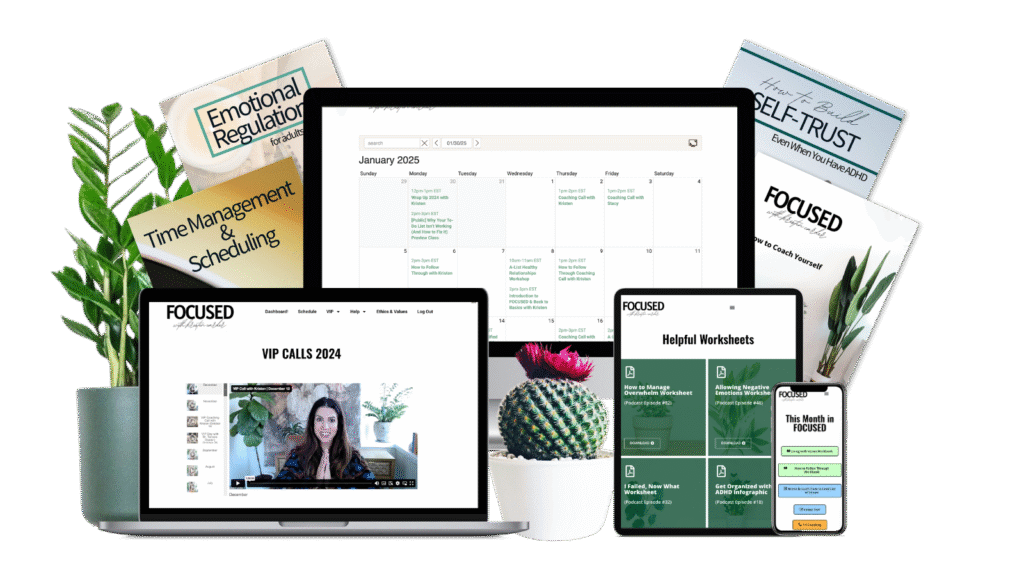
Learning About My Brain...

Changed Everything

Hi, I’m Kristen Carder—ADHD expert, podcast host, and certified coach who’s been exactly where you are. Diagnosed at 21, I spent years cycling through planners, courses, and systems that never quite worked. Everything changed when I discovered the power of understanding my ADHD brain and the transformative impact of community support.

Now, after 15+ years of research and experience, I’ve helped thousands of adults with ADHD thrive. I’m here to show you how understanding your brain can transform your life, just like it did for mine.

ADHD Tips That Actually Make Sense

Follow @i.have.adhd.podcast and join our Instagram community for daily strategies, relatable content, and real talk about ADHD