When I was diagnosed, my doc said, “Yep, you have ADHD. Here’s some meds!” Maybe your experience was similar to mine. This episode is a deep dive into all the things I wish I knew about ADHD 20 years ago.
Click here to hang out with me on Instagram.
When I was diagnosed, my doc said, “Yep, you have ADHD. Here’s some meds!” Maybe your experience was similar to mine. This episode is a deep dive into all the things I wish I knew about ADHD 20 years ago.
Click here to hang out with me on Instagram.
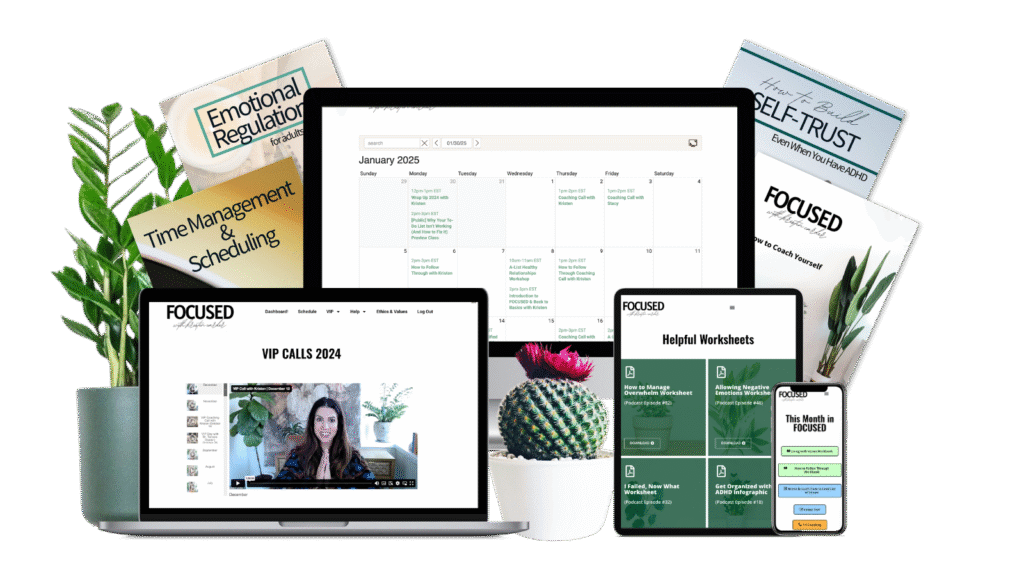
This episode is sponsored by Cure Hydration. All right, I’m going to be real with you. Drinking water is boring. My ADHD brain is like, wait, we have to do this again? Like every day, multiple times. What in the world? And because I’m running from meetings to coaching calls to kid chaos, staying hydrated is not something I’m naturally good at. It’s not something I naturally think about. That’s why I’ve been obsessed with Cure hydration packs lately. Cure is a plant based hydrating electrolyte mix with no added sugar, only 25 calories, and it actually tastes good. The watermelon and berry pomegranate have been on repeat for me. I’m actually like really running low on those flavors, which is so sad. They’re refreshing without being too sweet or artificial. It feels like my water finally has a little bit of personality, which I enjoy. I really do. What I love most is that CURE uses a science backed formula that hydrates as effectively as an IV drip. So when I’m scrambling through my day forgetting my water again, Cure helps me to catch up fast. I throw a few packs in my bag and it makes drinking enough water simple. Which for my ADHD brain is basically a miracle. So staying hydrated isn’t just about water. You also need electrolytes. And that’s why I love Cure. It’s clean, tastes great, and it actually works. And bonus, CURE is FSA HSA approved so you can use those funds to stay hydrated. The smart way for I have ADHD podcast listeners. You can get 20% off your first order@curehydration.com ihaveadhd with the code ihaveadhd and if you get a post purchase survey make sure to tell them that you heard about Cure right here on the podcast. It really does help to support the show. Don’t just drink more water, upgrade it with Cure. Vrbo Last minute deals make chasing fresh mountain powder incredibly easy. With thousands of homes close to the slopes, you can easily get epic Pow Freshies, first tracks and more. No need for months of planning. In fact, you can’t even plan Pow Pow is on its own schedule. Thankfully somewhere in the world it’s always snowing. All you have to do is use the last minute filter on the app to book a last minute deal on a sloped side private rental home. Book now@vervo.com. Welcome to the I have ADHD podcast where it’s all about education, encouragement and coaching for adults with adhd. I’m your host Kristen Carter and I have adhd. Let’s chat about the frustrations, humor and challenges of adulting relationships, working and achieving with this neurodevelopmental disorder. I’ll help you understand your unique brain, unlock your potential, and move from point A to point B. Hey, what’s up? This is Kristen Carter and you are listening to The I have ADHD podcast, episode number 102. I am medicated, I am caffeinated, and I am ready to roll. Now, I shared this before, but I’m gonna share it again and that is that these first couple episodes in the 100-hundreds, 100, 101, 102, you know, these first couple, I want to use them as a do over to kind of, you know, give myself another chance to cover the very basic fundamentals of adult adhd. The last time that I did these fundamental ep, I was a brand new podcaster having no idea how to do it. So this is episode 102, and we’re going to be talking about everything that your doctor never told you about adhd. But first, is it as beautiful today in your area of the world as it is here in Pennsylvania? Because I am telling you, it is gorgeous. My heart is, is bursting with happiness. My soul is full of sunshine. I am loving this spring weather. I was talking to a client yesterday and we were saying, like, it’s actually kind of obnoxious how much the weather affects us, right? It’s like, why does it have to affect us so much? Like, we’re coming out of winter and like, for the last couple months, I’ve just been blah, like, and I am a good time, guys. I am razzle dazzle, like a good time. But I’ve been so blah, so not fun in these last couple months. And I truly believe because like January, February, March in Pennsylvania, it’s not fun, it’s not pretty, it’s yucky. And now it’s like the sky is blue, the sun is warm, there are wildflowers in the grass that I’m looking at right now. Like the birds are chirping. Everything is right in the world. And so no matter where you are on the planet today, as you’re listening to this, I just hope that I can communicate to you just how full of happiness I am, how full of gratitude I am, first of all, that we get to experience things like sunshine and warm grass, but also that you press play on this podcast and that you are here with me today, even if you’re not listening in real time, even if it’s like 2024 and it’s years after I recorded this episode. I’m still glad that you pressed Play. And you still matter to me. I feel so much less alone because you are here. I feel so empowered to be myself because you are here. So thank you. Thank you for pressing play. Your attention means a lot to me because I don’t take that lightly. I know how hard it is to pay attention. I know how hard it is to, like, listen attentively. I get it. So I. I don’t take that for granted. I don’t take it lightly. I’m so glad and grateful to have your attention. And today I think that you’re gonna find this podcast to be very valuable because I’m going to make some assumptions about you and the assumption might be wrong, but I’m going to record this podcast with an assumption that your experience in your diagnosis was fairly similar to mine. I’m gonna make the assumption that you and I, you know, kind of had, like, similar experiences. So here’s what I mean by that. When I was diagnosed with ADHD, I was 21 years old. My doctor was actually a family doctor who diagnosed my dad. And then he, you know, took me through an evaluation process as well. When we were kind of done with that evaluation, he said, okay, it’s very clear that you have adhd. You are hyperactive type. Here’s some Concerta. So I didn’t leave that appointment with an understanding of ADHD at all. Like, I didn’t have a clear picture of really anything that was involved with ADHD other than I knew that I struggled to focus, and I knew that I was struggling in school. Okay. And 10 years later, when I was diagnosed again, this time by a psychiatrist, the format was very similar. Several questions that she took me through, she was like, yep, you’re hyperactive. She gave me medication, or at least a prescription for it, which I was grateful for. There’s no discussion on what ADHD is, what it entails, how it shows up in my life, what I can look out for, what systems I can put in place, what other help I could put get for it. So this is the most common experience that I hear from my clients as well. So you all know that I work with many, many, many clients in my focus program, and, you know, when I interact and when I read all of the introductions and everything on Slack, this is a very common experience that we go for a diagnosis. The clinician says, yep, you have adhd. Here’s some medication. And we leave not knowing everything that ADHD entails. So today that’s what this episode is all about. Let us just chat about all of the things that I wish that our doctors told us when we were diagnosed. Okay, First, ADHD is not really a deficit in attention. The name does not do it justice. Okay? We have plenty of attention. We have just as much attention as the next guy or gal or whatever. Okay? We have plenty of attention. It just goes to the wrong places. The struggle is not necessarily with our amount of attention. Our struggle is with our inability to constrain our attention to the thing that’s necessary at the time. Okay? ADHD is a deficit in our inhibition. And inhibition is the ability to pause and think. It’s your impulse control. So if you have adhd, you don’t have the innate ability to stop and think before you react. Now, neurotypicals do this naturally. We do not. Okay? So when something comes at you, whether it’s a sound or a thought or a text or an idea or a phone call, when anything like that comes at you, you react to it immediately. You have the attention. Your attention’s just misplaced. It’s just gu by the loudest thought or the loudest noise or the loudest whatever tap on your shoulder. I don’t know. That didn’t make sense. But you’re with me, right? So instead of stopping and thinking like a neurotypical, stop, think. Is this what I want to do? Is this the best thing for me to do? Will this help me get to my goal? I mean, they do it so innately. It’s kind of like putting one foot in front of the other. Like it’s not even something they think about. It’s like, not a big deal. Just stop and think, right? We do not have that innate ability. So we react immediately. A text comes in, Boom. We pick up our phone, someone calls, Boom. We’re like, I’m here for you. Someone walks over to our desk. Immediately we switch gears. Like, we just do not have the ability to stop and think before we react. Now, I will never stop telling you to get Dr. Barclay’s book taking charge of adult ADHD, because I really just believe with all of my heart that it is the easiest, most comprehensive guidebook for adult adhd. I’ve read a ton of ADHD books, I’ve read a ton of articles and research and blah, blah, blah, blah. His book is the most user friendly guide to adult with adhd. And one of the things that he says in that book is that we’re really robbed of our free will because we’re not actually making conscious Decisions, we’re not actually making choices from a place of clarity. Instead, we’re just reacting constantly, all day long to everything happening around us. And we’re doing that because of the deficit in our inhibition. We’re doing that because of our inability to stop and think before we react. Okay? Now poor inhibition, that leads to a lack of self control. So not only do we have like very low inhibition, but that low inhibition leads us to a lack of self control in every area of our lives. Lack of self control is just like a hallmark trait of adhd. So I want you to really think about that. You’re unable to stop and think and control your impulses. And additionally you have very little to no self control. Now think about that for a second. How might that affect every single aspect of your life? Don’t you think that might have been important for a doctor to tell us? Like, don’t you think that maybe that could have been useful information like 20 years ago? Okay. The next thing that I wish my doctor had told me when I was diagnosed is that all of my executive functions are impaired. So again, it’s not just a lack of focus, that it’s not a lack of focus, it’s a lack of inhibition, it’s a lack of self control and it is impaired executive functioning. Now, executive functions are the self directed actions that we use to control ourselves. So essentially, and hear me on this, it’s the ability to adult. Like your girl’s just gonna say it how it is. She’s always just gonna come out and say it. Our adulting ability, it’s not so good, it’s impaired. It’s neurodevelopmentally mother effing impaired. That’s just how it is. And here’s what I mean. Like your sense of time impaired. So you’re going to procrastinate. You’re going to put off doing things to the last minute. You are going to waste and mismanage your time. You’re not going to be prepared for what’s coming next. Okay? You’re going to fail to meet deadlines. You’re going to have trouble planning ahead and preparing for what’s coming up. It’s just a whole big thing, your memory. Yeah, that’s an executive function. So if you go around forgetting to do everything all the time, guess what? That’s a symptom of adhd. Right? So you forget to do the things that you’re supposed to do. You can’t accomplish what you set out to do. You are like late or you forget about appointments Appointments. What is that word? Kristin Carter? I don’t know. I like to make up words you forget about and pointments. Okay. You can’t seem to hold things in your mind long enough to do them, so you set out with really good intentions and you’re, like, sidetracked constantly. You have difficulty keeping track of several activities at once. Okay. And this is so big. Like, we really struggle to get things done unless there’s, like, a huge deadline or consequence or, like, a really big reward. And then even then, it’s like, do I have to? Ironically, And I’m just going to pause here. It has taken me four hours to record this podcast. It’s just really obnoxious that I have to. And by have to, I mean get to and want to study these symptoms and impairments of ADHD and see them playing out in my life. Then come on here and record this for you again, I say, do not ever put me on a pedestal. I do not consent. I do not deserve it. I am just as spacey, just as timeline, just as forgetful as you are. Oh, my word. So what is different about me, though, is that I have given myself all day to record two podcasts, and when, not if, but when I get them done, I am not going to say, I can’t believe that’s all I did today. I’m not going to say, oh, my gosh, I can’t believe I had to go for, like, 14 walks today because I just couldn’t get my thoughts together. I’m not going to tell myself, you should have done that faster. You should have done that better. Okay? That’s the difference. Because. Because I have such a deep understanding and acceptance of this disorder, I allow myself as much time and effort that it takes and space and energy to get the magic out. Because I’ve got magic in me. It just takes a while to get it out sometimes. And guess what? You got magic in you, too. Give yourself the space, the time, the grace, the acceptance, the love, whatever, to get it out of you. She preaching again. I didn’t mean to do it. Let’s continue. All right. We’re talking about the things that we wish our doctors told us when we were diagnosed with adhd. We’re now into the section on executive functions. I’m using, of course, as always, Dr. Barclay’s book, taking charge of adult ADHD as my guide. And I think you should use it as your guide as well. And we’ve talked about sense of time and our memory. Now let’s talk about getting frustrated or just Big explosive emotions that distract us and we don’t know what to do with executive functioning impairs our ability to feel, process, identify, understand our emotions. We struggle to self soothe. So, so that’s a big thing. Okay? We have trouble with self management when it comes to planning, executing goals. We have poor self organization and problem solving. We have trouble activating, getting started. We have trouble concentrating on the right things. Okay? So once again, things that could have been brought to my attention yesterday, to quote Adam Sandler in the Wedding Singer, best movie ever. Like this information would have been so helpful, right? Like why? Why didn’t anybody tell me? Why didn’t anybody tell me? Okay, here’s another thing that I wish my doctor had told me. You don’t have to be physically hyperactive to have adhd. So as we are, you know, moving into adulthood and especially women who are socialized to behave in a certain way. Hyperactivity. It might not look like physical hyperactivity. It might be restlessness, agitation, the spinning of your mind, ruminating and intrusive thoughts. Super common, right? So this can make working, sleeping, relaxing, settling down, all of that stuff really difficult. Here’s something really good about ADHD that I love, that I didn’t ever know before I started researching a ton is that we have this superpower where we are able to hyper focus on things that we find to be extremely fascinating and interesting. And that is so good. That is so good. We just kind of like go down the rabbit hole. We get totally lost and we hyper focus on things that we want to learn about or we want to fix or do. It’s awesome. Sometimes it bites us in the butt because we’re doing it like at the wrong time. But a lot of times it can be really, really, really good. I think if there was just one thing, if I had to just pick one thing that I wish my doctor had told me, I think it would be ADHD affects every single area of your life. There is no part of your life that ADHD does not touch. I think that that would probably have been the most useful information because I would have gotten curious about that. I would have been like, really? What do you mean? And I would have gone and done my own research. That would have sparked some real questions and curiosity for me. And I think that would have led me on my self acceptance and my self forgiveness journey much sooner because it is true. There is no area of our lives that ADHD doesn’t touch. Sleeping, eating, self care, our health, our parenting, our relationships, our sex lives, our work, like Mowing the yard, you know, like, all of the things, it affects every single aspect of your life. So for most of us, we think, oh, ADHD is an inability to focus, and it means that I have stress, like trouble in school. And then we become adults and we don’t transfer the information to the now. Like, how does this affect me at work? How does this affect me with my friends? How does this affect me in, like, renewing my license or paying my bills or saving my money or buying or remembering birthday presents? Buying birthday presents or remembering birthdays. Let me just say it that way, right? Like, it affects every area. And once we know that that’s very valuable information because then we can set ourselves up for success, then we can implement structure, system, accountability, help. But if we think, oh, it’s just, I just struggle to focus. And, yeah, I really struggled in school, but now I take Concerta, so I’m fine. Or now I take Adderall, so I’m fine. Now I take Strattera, so I’m fine. No, and that’s another thing. Like, when my doctor prescribed medication, I wish they had said, listen, first of all, this medication journey can take a while, so just be patient. Let’s work together to make it great for you. Secondly, the medication is going to help. That’s by design, right? And research does show that medication is by far the best treatment for adult adhd. Okay? That is the truth. But it’s not the only thing that you’re going to need in order to be successful. You’re going to need a combination. I like to call it a cocktail. You need a cocktail. You’re going to need a combination of systems and structures and support and help in order to really meet your potential, in order to really be the very best version of yourself. And that’s okay. Not only is it okay, but it’s like, expected. It’s like, duh, obviously, right? Medication is the most effective treatment, but it’s just not enough. It’s not going to solve all of your problems. You’re going to have to figure out additional layers of support and they’re going to look different in different seasons of your life. When you are single with no kids, support’s going to look one way. When you’re married with kids, if you choose to be, support’s gonna look another way. If you choose to go back to school for a master’s or a PhD, it’s gonna look a certain way. Then, like, don’t think that it’s just like cookie cutter, copy and paste type kind of support. It’s not okay. You’re scaffolding that support system. It’s important, it’s essential in order for you to live at your potential. I didn’t mean for that to rhyme, but it never hurts when it rhymes. That’s all I gotta say. One very important thing that I wish my doctors had told me is that ADHD is actually quite dangerous, especially if left untreated. And I was going to have that as a section of this podcast, but I’ve decided instead that that will actually be next week’s episode topic. We’re gonna dedicate an entire episode to the dangers of adhd. Sounds like fun, doesn’t it? I think that it’s important that we are all aware, cognizant of the risks, the dangers, and especially if we choose not to treat our adhd, what does the research show statistically what might happen? And I think that’s really important. So next week’s episode is all going to be about the dangers of adhd. In closing, the last thing that I really wish my doctor had told me about ADHD when I was diagnosed, I wish he had said, listen, most of what you’ve beaten yourself up for for the last 20 or 30 or 40 or however many years, they’re actually just symptoms of ADHD. So it’s time to practice some radical self understanding, self acceptance and self forgiveness. Now that you know better, do better. Now that you know you need help, get help. Now that you know that you need accountability, ask for it. Now that you know that you need structure, figure out how to put that in place. You are not a failure. You can be successful. With the right tools and support, you can do incredible things. You can live a very happy and successful life. So don’t be afraid to ask for help. Don’t be afraid to invest in support. It’s 100% worth it. And I think it would have been cool if he would like co sign that. Like I will co sign any investment that you need to make. I mean that would have been funny, right? Like sometimes you just need a cosign. Sometimes you just need someone to say like, hey, you do need support. Hey, you do need more than a neurotypical, hey, ADHD really is a thing that affects every aspect of your life. And if you want to be successful and do crazy amazing things, you’re probably going to have to invest in some sort of support. And so, hey, I’ll just co sign that for you and you can give that to your partner so that they can see that this is actually a thing that deserves investment. It’s a thing that deserves a time, energy, attention. So if you’re listening to this and you’re like, man, I wish my doctor had told me these things, like, I’m with you. Me too. But I feel so much less alone knowing that you and I had very similar experiences in many ways. I mean, we’re obviously different humans. We might be in different parts of the world and we might have nothing else in common, but we do have this in common that we thought ADHD was just an inability to focus. We thought ADHD was just like something that affected us when we were in school. But actually it’s a big freaking deal. And actually we’re going to work toward accepting it and supporting it and doing what we need to do in order to thrive. I am so glad that we are on this journey together. I will see you next time. If you’re being treated for your ADHD but you still don’t feel like you’re reaching your potential, you’ve got to join Focused. It’s my monthly coaching membership where I teach you how to tame your wild thoughts and create the life that you’ve always wanted. No matter what season of life you’re in or where you are in the world, Focused is for you. All materials and call recordings are stored in the site for you to access at your convenience. Go to ihaveadhd.com focused for all the info.
A proven coaching program designed specifically for adults with ADHD who want to gain clarity, build confidence, and take control of their lives.
Hi, I’m Kristen Carder—ADHD expert, podcast host, and certified coach who’s been exactly where you are. Diagnosed at 21, I spent years cycling through planners, courses, and systems that never quite worked. Everything changed when I discovered the power of understanding my ADHD brain and the transformative impact of community support.
Now, after 15+ years of research and experience, I’ve helped thousands of adults with ADHD thrive. I’m here to show you how understanding your brain can transform your life, just like it did for mine.

Follow @i.have.adhd.podcast and join our Instagram community for daily strategies, relatable content, and real talk about ADHD