


Kristen Carder 0:05
Welcome to the I have ADHD podcast, where it’s all about education, encouragement and coaching for adults. With ADHD, I’m your host, Kristen Carter and I have ADHD, let’s chat about the frustrations, humor and challenges of adulting, relationships, working and achieving with this neurodevelopmental disorder, I’ll help you understand your unique brain, unlock your potential and move from point A to point B. Hey, what’s up? This is Kristin Carter, and you’ve tuned into the I have ADHD podcast, I am medicated, caffeinated, regulated and ready to roll. Welcome on in. Welcome on in. Get cozy. Get cozy. We’re gonna have a roller coaster of a ride today. It’s just you and me. It is just you and me, and it hasn’t been just us. We haven’t had a solo show in quite some time. So I’ve got a lot of updates to give you. We’re going all over the place today, so you’re gonna have to buckle in. Buckle in. I’m so glad you’re here. Thanks for pressing play on this podcast. I know there’s millions of options for you as far as podcasters go, and the fact that you are here with me. I don’t take it for granted. I really, really don’t It is so good to be with you. I’ve got a lot of updates for you.
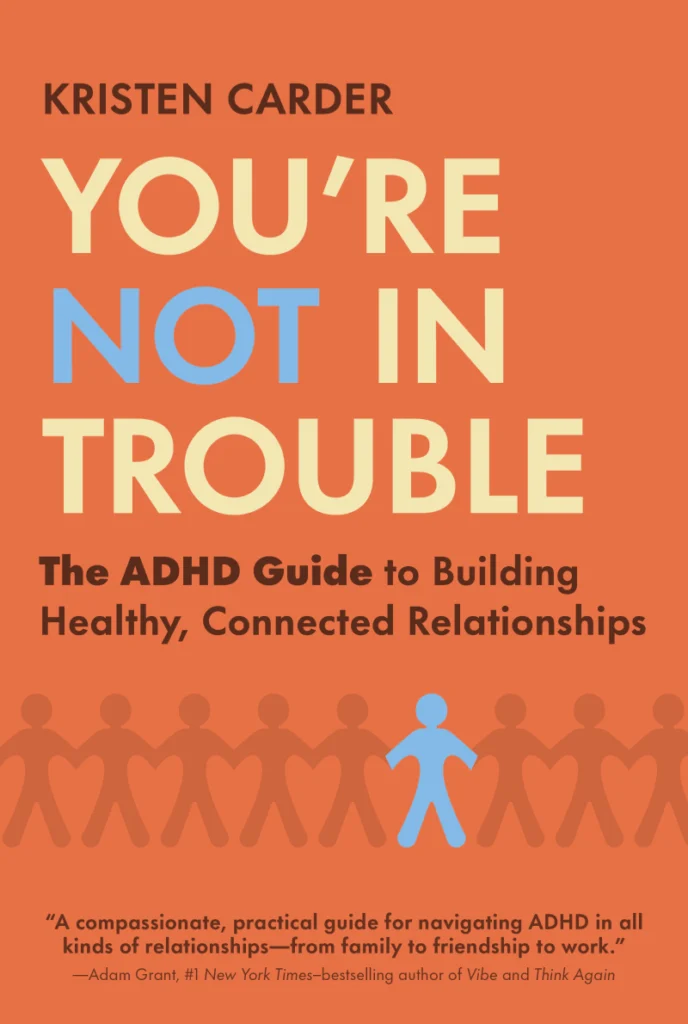
The first thing that I want to tell you is that I only have one chapter left in my book. Writing Process, it feels like it has been freaking forever. Actually, by the time you listen to this, it’s going to be the middle of December, and that last chapter will have been complete. Right now, I still have to write it. I still have to write it, but I can’t believe that we are almost done with this part of the book writing process. It’s not been easy. And of course, you hear that from everybody, like writing a book is not for the faint of heart, but truly it is not for the faint of heart, and I am shocked at how activating it has been. So, you know, the topic of the book is relationships, how people with ADHD can have healthy er, healthy enough, healthy ish relationships. It’s basically like the road map that we were never handed as to, like, here’s how relationships work, and here’s how, as someone with ADHD, you can improve the relationships with the people in your life that you really want to be most connected to. What’s been difficult for me is writing is a very vulnerable process, and my editors keep asking for more of me in the writing, more of my story, more vulnerability, more being exposed, and that is a little bit activating, because my goodness sharing, even just sitting and Thinking about my own experience in relationships with friends and immediate family and my partner and my kids and my parents and like all of those things, and then being able to put that onto paper and share it with the world, it feels So exposing. But after writing, it’s been 17 chapters, I am so convinced that this book is going to help so many people. So there’s this balance of like, giving of myself and being exposed, but then also knowing, like, this book needs to be read, and I think it’s going to help a lot of people. So I’m very excited and nervous at the same time, excited and nervous at the same time. This is a very much like two things can be true at once. What I’m realizing is that the writing process is not ADHD friendly at all. Is not ADHD friendly at all. I spend most of my writing time trying to convince myself to write very, very little. Like, a very small percentage of the time that I allot for writing is actually spent writing.
Most of it is me trying to support myself enough give myself enough encouragement, and, like, actually get myself to do the writing. And I don’t know if you feel like this in your job, where it’s like, Why does it take me so long to do the thing? I’ve been battling this for six months, since I started this writing process. Okay, if I could just solely sit down and focus and write, I would have cut my time. You know, less than half of my time would have to be spent, but because it takes me so long to convince my body to write, it is like, I don’t know. It’s just so much effort. And I wanted to let you know this, because. Yeah, I want to remind you that I do have ADHD. I want to remind you that it is not a simple process for me to sit down and just do the thing. So for me, a lot of times this looks like preparing my space, preparing my body, preparing my mind, having all of the snacks in place, the gum, the crunchy snacks, going for walks, having the headphones, finding the perfect music or or white noise, brown noise, sound, making sure that my environment feels safe enough to write and then, like, really encouraging myself. I used to be someone who would beat myself up. What is wrong with you? Why is this taking so long? Just write it. You know what you want to say. Just write it. Come on, Kristen, just do it. Why can’t you just do it? What I’ve realized in the last 20 years I’ve been on this path for over 20 years, what I’ve realized in the last 20 plus years of self development and and learning about ADHD is that that does not work. It does. It’s not sustainable to yell at yourself and berate yourself and just try to convince yourself to do the thing by shaming yourself. And so I have really learned a lot and been able to utilize these tools of like trying to offer enough support to myself to get myself to do the thing and listen all of the all of the content that I’m writing. I’ve already thought through, I’ve already worked out in therapy, I’ve already taught most of it in my focused ADHD coaching program. So it’s not like I’m having to come up with brand new content, necessarily. And so that’s another thing that is, like kind of sneaky that I’ve really had to not shame myself about because it it really makes me think, like, why is this so hard? You already know what you want to say. You’ve already done this work. You’ve already, like, curated this content. Just write it. And again, I have to remind myself, and I am telling you this to remind you that berating yourself in order to try to get yourself to do the thing is not super helpful. It’s not super effective. It’s not sustainable long term. It might help in the short term, but then I have to do it again the next day and then again the next week. So I’ve set aside every Friday and Saturday for the most part with about six hours, five to six hours of writing time.
And it’s not, it is not fun, it is not easy. And it’s, it’s the kind of thing where if I set up a situation that I absolutely hate, I know I’m going to resist it. You heard the episodes on pathological demand avoidance. And while I don’t know that I am like a proper PDA, er, I definitely have a lot of those tendencies. And so if I’m not supportive, if I’m not kind, if I don’t make it fun, and if I don’t give myself a lot of authority and autonomy in that situation, I’m just not going to do it right. I’m just not going to do it, but I have been able to get myself to write 17 chapters. I can’t believe it. I’m very, very happy. So after I write this final chapter, then we go into the editing phase, which I think is going to be a whole different kind of hard and and then it’s going to be published in October of 2026 so guys, get ready. I’m so happy to have you along for this journey, and I really hope that you will buy the book. And I’ve been thinking about this, like, what should I say about this? Because I want you to know that I’m not looking to make money off of this book, I’m really not. I was able to negotiate a very reasonable deal with a publisher where I here’s how publishing works. You negotiate a deal and you’re paid in advance, and I was able to negotiate what I consider like a respectable advance, so I’ve already been paid for it. Selling the book is not about making money. For me, it’s about making an impact. And I know that this book is going to help so many people in their relationships.
I really cannot wait to get it into your hands, and also, I’m also dreading it because my rejection sensitivity, which we’re going to be talking about today a little bit, is already on full blast, like it’s the kind of thing where I really hope no one reads it because I don’t want to be criticized and I don’t want to be exposed and I don’t want you to read my deepest, darkest, most personal relationship stories, but then at the same time, I know it’s going to make an impact, and so I hope everyone reads it, and I’ve got like, one foot in each situation of like, I really hope no one reads it, and then I really hope everyone reads it, because I also know it’s going to make such a huge impact. So I don’t know. I’m just letting you in on the dark and twisty process of writing a book. Book. It is not the easiest thing I’ve ever done. That is for sure. So I’m just, I’m letting you know what the process is like. In a couple months, you are going to have the opportunity to pre order this book, and I’m just really asking you to consider, now, will you consider pre ordering the book when it’s available. I want you to know again, it’s not about making money. It is 100% about making an impact. I’ve already been paid a reasonable fee to write the book. I’m really satisfied with that. I’m really happy with that. I don’t get another penny until all of that has been repaid to the publisher, and I don’t even care it’s whatever.
What I want is to make a huge impact and a huge ripple effect in the ADHD community where we’re able to improve our relationships, because this is one of the biggest pain points for us. My gosh, I hear daily about your relationship struggles. And it is so overwhelming to me to think about so many of us at each dears out there in the world, struggling to connect, struggling with rejection, sensitivity, struggling to have safe and healthy enough relationships. And that makes me like, feel like I’m on a mission. I am on a mission to help to make an improvement in this, for like, collectively, for our community. And also I hope no one buys the book because I’m scared. So there’s that too, right? Again, it’s, it’s a both and like, I really hope no one reads it, and also I really hope everyone reads it, because I really want to make an impact. So that’s the update on the book. One more chapter to go. Gosh, send me your thoughts and prayers because, Dang, this is not easy. I’m also curious to check in. It’s been a couple months since we started ads on the podcast, and I’m just wondering how you’re handling it. In no way am I here to, like, apologize for that, but at the same time, I do realize that it has an impact. That for almost seven years, we did the podcast one way, and now we’ve switched it, and things have changed, and especially for a neurodivergent community, I understand that it can be jarring and it can be hard. And I just wanted to, like, sit with you for a second and say, like, Dude, it’s kind of hard for me to I listen to my own podcast because I want to make sure it’s good. I want to find areas that I can improve and make it better. And and I am also, like, stunned by the ads when I hear them, and I just wanted to know how you’re handling it.
Are you good? Are you because, like, it was inevitable, it was something that needed to happen, but I also know it had an impact. And I really, really appreciate you hanging with me through them. I really, really appreciate you still being here. And if anything sounds interesting to you. Like, just supporting the show in that way that makes a big difference to me. So thank you. Thank you for just like, still being here with me and like, as the podcast evolves and changes, that you are, that you’re like, here for the ride. For those of you who are new on YouTube, welcome. YouTube is such a different animal. I’ve said it before. I’ll say it again, like this is a whole different space. It’s a whole different area. For me. It’s a whole different like ADHD rabbit hole, and it’s not it’s not simple. It’s not as cut and dry, in my opinion, as an audio podcast. The audio podcast grew really organically. It grew really fast. It’s been quote, unquote easy sort of in that regard. And then YouTube is like, Okay, this is different. This is new. So welcome. Welcome. If you are listening on YouTube, I appreciate you. I wanted to share an opportunity that I had last month, I went to the Chad conference. If you don’t know Chad stands for children and adult well, let’s just say it correctly. Okay, children and adults with ADHD, and pretty much everyone who’s anyone in the ADHD space attends the Chad conference, speaks at the Chad conference, and I will tell you that I have avoided it for six years. I’ve avoided it for six years. I knew it was a thing. It’s even been in Philadelphia, and I didn’t go the year that it was in Philadelphia. And a lot of that was imposter syndrome. A lot of that was like wanting to be on the fringes and not necessarily wanting to get involved with all of the like political ADHD stuff.
And I don’t mean like actual political I just mean like politics within the ADHD community. I just, I just was like, No, not for me. But finally, actually. Ari Tuchman twisted my arm. He peer pressured me in a very kind way, and was like, why aren’t you going? Why aren’t you speaking? And I was like, I don’t want to do it. And he was like, It’s time, and I appreciate that from a friend. Positive peer pressure is a good thing, right? Like, sometimes you just need a friend or a colleague to say, hey, you should do this. I believe in you. You need to do like it’s time for you to take this step. And so he peer pressured me in a very good way, and I actually applied to speak. So in May, I think, I filled out the application to speak, which was not easy. It was so hard, I actually took a chapter of my book and was like, I’ll create a talk around a chapter of my book. So my talk was on how to prioritize people, which you’ve actually heard me talk about here on the podcast. So it was like nothing new for you, but I will tell you something. I’ll tell you something. I experienced so much rejection sensitivity around this conference. I had so much drama in my mind about this conference. I had created so many rejection scenarios. I had not been rejected, but I was bracing myself for rejection when it comes to this conference. So it was in Kansas City, Missouri. Never been to Kansas City before, great little spot. And I was so scared. I was having tons of headaches, tons of like jaw pain. I was struggling to sleep, and I was like, bracing for impact. I truly was. I was bracing for impact. I didn’t realize it. It was actually my therapist that helped me kind of work out what was happening. Because I was like, What is going on? Why Why am I so tense? Why do I have all these headaches? Why am I getting jaw pain?
Why can’t I function in terms of, like, thinking through my talk, planning, you know, meeting up with people I was just, like, resisting all of it. I wonder if you relate to this ADHD or, like, rejection, sensitivity is such a thing. I actually recorded an Instagram video on this I’m going to play it for you in just a second. If you’re not hanging out with me on Instagram, what are you doing? Come be my friend. You can follow me at I have ADHD podcast. It’s the one social media platform that I enjoy hanging out on. I’m on the other platforms too, but I enjoy hanging out on Instagram, and I recorded a pretty vulnerable reel about like working through my rejection sensitivity with the Chad conference. I’m going to play it for you here. What does rejection sensitivity look like, practically, for someone with ADHD, I’ll go first. Last night, I was awake from 1am to 4am panicking, panicking, truckloads of cortisol flowing through my body, because in three weeks, I’m going to an ADHD conference, and I don’t know if people are going to like me. I’ve never been before. It’s full of academics. I can hang with academics, but I’m not, personally an academic. I don’t identify as one, and like, I I’m panicking.
Why? Why can’t I just be why can’t I just be like, Yeah, I deserve to be there. It’s gonna be great. No, no sweating, laying in my bed, just like waves of cortisol washing over me. It’s gonna be terrible. They’re gonna hate you. It. Everyone’s gonna be mad at you. Like, literally, this is what rejection sensitivity looks like in an ADHD or at 44 years old. It feels like high school. It feels like I’m right back to the lunch table, like getting kicked out of the lunch table. Like, right back there. So that’s how it shows up for me. How does it show up for you? Let me know in the comments. I had so many people comment on that video just saying that they related to it, and so I wanted to play it for you, because I feel like it’s probably relatable to you too. Thinking that everyone was going to be mad at me, why would anyone be mad at me like that? It doesn’t make logical sense, but I pictured myself walking into the room and having people scowl at me. It’s so fascinating. I created so many rejection scenarios, rejection stories around this conference. And here’s the thing about rejection stories, they hurt just as much as actual rejection. They feel the same as actual rejection. So even though I had not been rejected, I was still feeling my body was still reacting as if I was being rejected. It’s so fast. Fascinating what the brain does, especially an ADHD brain that has lots of history of rejection. I have lots of history of actual rejection, and my brain and body were convinced that this was going to be yet another example of me being what’s the word I mean, maybe ostracized or thrown out or unwelcome or misunderstood or laughed at or scoffed at, or fill in the blank, whatever, judged judged. I was so scared that I would go and everyone would be so judgmental.
Why? Why? Kristin, I have so much compassion for myself, but I’m telling you all of this because I have compassion for you. I think that this is likely extremely relatable to you, and that even me, as a professional who’s been in this industry since 2019 who has coached 1000s of adults with ADHD, who’s put out hundreds of hours of content, who’s been able to interview all of the experts, like so many amazing people, and I’ve been able to help people. I’ve been able to interview people, blah, blah, blah, blah, blah, like the resume doesn’t lie, and yet my brain was like, they’re going to hate you, they’re not going to welcome you, they’re going to think you’re stupid. They’re going to wonder why you’re even there. So when I realized what was happening right around this time that I created the real I decided to get pretty serious about taking care of myself. I really had to get serious about supporting myself because I was not able to function at that time. And not functioning is not an option when you are a company owner, when people are relying on you, when you have a family, when you even just want to, like, show up for your own life, like not functioning, just feels like it’s not an option. And so here’s how I supported myself. I scheduled a couple massages, and I cannot recommend enough the power of therapeutic massage. I was so tense, my body, literally, like I said, was bracing for impact.
My jaw was so tight. I was laying every night with a heating pad. I was having to take Tylenol or ibuprofen, which I don’t love doing, but I was like suffering, and I scheduled a couple massages that relieved the tension like you wouldn’t believe. A lot of times we don’t allow ourselves these luxuries because they’re expensive, because we don’t think we need them, or we shouldn’t have to need them because they’re time consuming, because our partner might look at it as like a frivolous expense, like, what are you doing? You getting a massage? Like, what are you special? But I have to tell you that this was actually a way that was extremely important to me to calm my nervous system and calm my body down. It helped so much. One massage didn’t take care of it. I had to go back a couple times in a row, like weekly, but it was extremely supportive, very, very helpful. Another thing i did was i i have restarted therapy, and that’s been an interesting experience. I’m actually working with a therapist who’s also a somatic experiencing coach, which is someone who is helping you with your nervous system regulation, which your girl needs, your girl needs it okay? And so I’ve been working with her, and I focused a couple therapy sessions on this specific conference, on this specific experience, because I was like, I’m not okay. I’m being a total weirdo. I need help just functioning, and like going to this conference, and so that was really helpful, and she really did help me to unpack the expectations I had, how my body was responding to it, and how I was really bracing for impact.
I know I’ve said that phrase so many times, bracing for impact, but it’s really important to me. That’s something that we uncovered in therapy, and I wanted to name that because I think maybe it will be important to you. I wonder if you notice when you’re going into social settings, when you’re when you’re meeting new people, when you’re going to whatever your equivalent of the Chad conference might be, if you notice that you’re tensing up and that you are preparing all of these scenarios in your mind and bracing for impact, another thing that I did that was really important was I invited my coach to come with me. I am always. Is better when I have someone that knows me, that I trust and that I can co regulate with. And if you heard on the podcast with Casey Ehrlich and Kendall damashek, we talked about pathological demand avoidance, but we also talked about having a safe nervous system with you to co regulate, and I they named that. They put language to it. I didn’t realize that that was what I was doing. I at the time of that recording, I had already planned to have my coach come with me, but I didn’t realize that that’s what I was doing. I was inviting safety to come with me into what felt like a dangerous situation, and it was amazing. I wonder if you have people in your life that would be more than happy to support you in situations like this. I didn’t realize that I actually do. My coach did it. One of my team member, team members would have come to be that person for me. I know my best friend would have come to be that person for me. I also know that my sister would have come to be that person for me or my husband. So I wonder if you can think through like, do you have safe people in your life that you can invite into these like, scary, quote, unquote dangerous, although not physically dangerous, but they just feel so dangerous. Into those situations with you to be a co regulator so that you can show up and be you. That’s the thing, like with my coach there, I was able to show up as myself. I had more of myself available to me because I had a safe nervous system there to help me co regulate. It was beyond helpful. And I am so happy to report that I had the most amazing time. I had the most amazing time. Nothing that I worried about actually happened, and I don’t say that from a place of judgment or shame or diminishing anything that I was feeling prior to going, because everything that I was feeling prior to going was real. It it was painful, it was scary. I was bracing for impact. And those scenarios could have played out in that way, but they didn’t at all being there felt so purposeful. It felt like, really like a warm environment. Shout out to like the Chad conference organizers and the Chad organization in general. It was a wonderful conference, and I absolutely loved being there. I met and hung out with people that I love. I was able to see Ari there. He’s like, in charge of the whole thing. I didn’t really realize that was, like, my bad. He was on stage at every general session. He’s like, the main guy. I didn’t realize I was just like, he’s just my bud. Nope. He’s like, he’s he is the guy anyway, so I got to hang with him. I saw Marcy Caldwell, who’s a two time guest on this podcast. We had dinner. That was wonderful. I saw Brooke schnittman from coaching with Brooke, who I often recommend to teens and children who are looking for coaches her organization.
Coaching with Brooke is wonderful. We hung out a ton. And I also got to hang out with focus members who were there, and that was the best we had such a good time. I spoke, and I enjoyed speaking. What what? I know it was crazy. I I spoke in front of, I don’t know how many, probably 50 people, maybe 35 to 50 people. I had fun. I did a good job. I didn’t have a vulnerability hangover afterwards, which is shocking, like it was just overall, a wonderful experience. I’m glad I went. I will do it again, and I’m glad that I gave my brain a map for it. Here’s the thing, when we have not done something before, when we’ve not been in a scenario, when we’ve not been in this social environment before, our brain does create a map of like. Here’s what I think it’s going to be like. And if you have ADHD and a lot of history with rejection, your brain will likely create a map that looks like rejection, judgment, people, hating you, scorn, all of that, right? And that’s what my my map looked like. And then I went and I was able to be in the reality of the situation.
And now I actually do have a map for what it’s like, right? I know what it looks like now I’m not afraid to go again. So this is just like a shout out to you and a reminder of sometimes the rejection stories that we create in our heads while they are painful or. While they are understandable that we’re doing, that they don’t actually work out the way that we think they’re going to work out. And if we are able to support ourselves well enough to go into that situation and to do the thing, if we can find a safe nervous system to co regulate with, if we can have the support of a therapist or a coach. If we can do things like get a massage or ask a partner or a best friend for a massage, like those kinds of like very grounding and regulating things, if we can give ourselves enough support to actually do the thing, our brains can create a realistic a better map. And so now, when I think about next year in I believe it’s in Baltimore, which is awesome. No time zone change, no flight. It’s in Baltimore. I’m gonna go. Maybe you should plan to go too. Maybe we can meet up. It would be so much fun. But in summary, so glad I did. It would definitely go again. And while the rejection stories that I created were understandable and they felt very real, it’s not how it actually went, and I’m so so glad about that. All right, my friends, let’s transition here and listen to a voicemail. I absolutely love it when you send in voicemails. I love when you ask questions. I love when you leave me love notes. It’s the best if you want your question answered on the podcast, you can call 833-281-2343, of course, the number is in the show notes we’re going to hear now from Deborah.
Caller 33:19
Hi Kristen. My name is Debra. I am 58 years old. I live in Highland Park, New Jersey. I was diagnosed with ADHD at 54 on medicated and on therapy, but I’m still struggling a lot with many things, so many that I had trouble choosing one thing to make a question about. But I want to ask you what you think and what you recommend, because I have incredible talent for disappearing things in a second. I just cannot remember where I put things. And this is happening too often, and I’m getting really worried. It’s a very serious issue. And the thing is that many times I’m in a hurry and I’m looking for something and I can’t find it, so I have to rummage through the mess that I have everywhere to find that thing. And if I’m lucky enough to find it, I of course, I have to sprint out to wherever I have to be, and then when I come home, I just cannot deal with that holy mess of messes. It happens with physical things, documents, computer files, emails, whatever, and the feeling is like my brain stops functioning. It’s like I have a blackout and I can retrieve the memory of it, and it really scares me. I’m sure this is not the first time you hear something like this, but again, I just wanted to know if you have any comment or recommendation for now, I reached out to a professional organizer, and we’re going to talk tomorrow and make a plan, and I hope I’ll be able to keep things right. Nice, I’m not sure.
Kristen Carder 35:02
I hope. Deborah, oh my gosh. That sounds so freaking frustrating. That sounds so frustrating and anxiety inducing. She said, I have an incredible talent for disappearing things in a second. Did you catch that? And do you relate to it? Listener, like, it’s so frustrating. I have an incredible talent for disappearing things in a second. Yeah. I mean, this is really, really, really frustrating. The first thing I want to say, though, is that you’re you. You said that you’re worried, and you said that you’re scared. And I’m just curious, like, what is, what is scary about it, and what are you worried about? And if you feel like this is maybe more than ADHD, I would suggest that you talk to your doctor about it, just to make sure that it it is falling within the lines of ADHD, and maybe not something else. So that is the first thing that I want to say, the worried part, the scared part. I wanted to speak to that first, because if this is something beyond the scope of ADHD, I would hate to just give you, like ADHD, appropriate advice that maybe will not be helpful to you. So I just want to say, hey, the next time you talk to your doctor, your psychologist, your psychiatrist, any of those people the next at the next appointment, please bring this up so that you can discuss with them whether or not this is really falling within the scope of ADHD, or maybe it’s something beyond that. So that’s what I wanted to say first.
But I want to commend you, because reaching out to an organizer is an awesome idea. It’s an awesome idea. I’m so glad you did that. I hope the conversation went well. I hope that you loved this person and that you hired them, and that maybe by the time that you’re hearing this podcast, it’s already taken care of. Your house is organized. Everything’s good, okay? If not, if you didn’t like how the conversation went, if, if they weren’t a good fit for you, keep working on having someone come in and help you. There are many, many organizers out there. There are people that work with ADHD, or specifically, there are people that work with trauma survivors. There are a lot of different, like flavors of organizers. So I do want to encourage you, that’s a great first step, and it doesn’t have to be a one time thing. This could be they could come in monthly. They could come in weekly, if that would be helpful to you, and if you have the means to pay them to do so. Okay, it sounds like this is a support that you need. This is not a want. It is a need. Hear me, this is not a want. This is not frivolous. This is not like above and beyond. This is something that you actually need. So I’m just gonna, like, write a permission slip for you. This is my left hand, but I’m still gonna do it with my left hand. I’m just writing a permission slip for you to, like, really lean on an organizer to come in and help you with the executive function pieces that you are lacking. Okay, huge. I’m so proud of you. I want every listener to hear me say, this is an amazing, supportive thing that you can do for yourself. Absolutely wonderful.
The other thing that I want you to think through is, what are the things that you’re losing all the time? Because there are things that you’re going to have to dig up that’s just like that one time thing, like the tax document or that one letter from whoever, right? But I want you to think through on a daily basis. What are the things that you’re just consistently, always freaking losing? Is it your purse? Is it your keys? Is it your phone? Okay, so like, take a moment and listener, if you are resonating with Deborah’s story, I want you to do the same. Take a moment and really be reflective. What are the five things that I’m losing all day, every day, and can I assign a home for them and force myself to use it right? So when I first married Greg, I came from a very dysfunctional, chaotic home, and I didn’t know that putting your keys in the same place every time was a thing. I didn’t know that. I didn’t know that Greg had to, like, hold me on my shoulders and like, look me deep in my eyes and say what you’re doing isn’t working. You need to put your keys in the same place every time. And let me tell you, I resisted that for like, two years. I was like, whatever, you don’t know me. You don’t know me. You can’t tell me what to do. Leave me alone. Okay? But he was right. He was right, all right. So now I never put my keys. Stay in my purse. My purse goes on the hook, and it doesn’t go anywhere else. So if I accidentally walk up to my bedroom with my purse on, I will walk right back down. I will take the time to walk right back down and put it on the hook, because it has to live there. Okay, my phone. Most of us are, like, pretty much attached to our phones at all time, but the Find My Am I right? Am I right? That little ability to like, click a button and have your phone play a sound, life saving. There’s also air tags that you can get for your items that you use regularly, and I highly suggest that you use something. I’m sure there are many iterations of an air tag, but use that for your phone, your wallet, your keys, your purse, whatever things that you’re constantly losing. I want sweetheart to solve the problem like triage here, the things that you’re just always losing. Yes, there’s going to be the documents that you need to find. Yes, there’s going to be that random email that you need to find, but that’s not on a daily basis. Let’s solve the problem and ease the frustration of the day to day, hour by hour, things that you’re losing. Okay? Whew. I’m getting hot talking about this because it’s so relatable.
The next thing that I want you to do is set aside time. And every ADHD or hates to hear this, so I’m so sorry. I’m so sorry to say this, but set aside time every morning to just think through your day, where am I going? What am I doing? What am I going to need? Because a big part of your issue, Deborah, and this was the issue for me as well. And listener, I bet you’re relating to this, a big part of the issue is the time urgency. By the time you realize you need it, you’re already late. You should have already left five minutes ago, and now you’re scrambling. And so it’s not only frustrating that you can’t find the thing that you need, but it’s also panic inducing because you’re late, you’ve got to be somewhere. You’re you’re you’re running around. Oh, I remember one time, gosh, this is not fun to remember. I hate these memories. I remember one time my husband was a youth pastor and we were going on a youth retreat. Does anyone know what that is. We were going to like camp at the beach with the youth group, and I had to be at the church at 8am so that the bus with 50 youth group kids could leave on time to go to Harvey cedars, New Jersey, Long Beach Island. Shout out to LBI, love you.
Okay, so I remember specifically one morning I could not find my keys, and I was literally running around my house panicking, could not find my keys. This was probably the catalyst of me keeping my keys in one spot, because I was finally like, fine. I consent. I will do it, because this one memory, I mean, this is, like, 20 years ago, probably is so impactful to me, I can feel the panic rising in my body right now, the thought of 50 teenagers sitting on the bus waiting for Kristen Carter, who’s going to pull into the parking lot like a crazy person and run onto the bus late when all the kids are there before her and all of the youth leaders and my husband, who’s like the most neurotypical person in the whole world, it’s so embarrassing. It’s so embarrassing. So I feel for you. What I want you to do is prepare for these moments in advance every day, set aside time. Where are you going? What are you doing? And what do you need to be prepared for that this way you’re going to be looking for the items. It doesn’t solve the problem of the missing items. What it solves the problem is, of is the urgency and the time panic and the rush and the leaving the mess behind that you then have to come back to and feel the wave of shame about. Okay, so you’re going to set aside time every morning, you’re going to check your plan for the day. Where are you going? What are you doing, and what do you need in order to make that happen, you’re going to look at your appointments. You’re going to just kind of look at your plan, you’re going to look at your email inbox, and you’re going to figure out, okay, what do I need to be successful today? And you’re going to set aside time to find it in advance, because the problem is twofold. Yes, losing things. Sucks. Not being able to find things sucks. It’s frustrating. It’s annoying, it it’s a time waster. I understand that’s a problem.
But also there’s a huge problem with the time urgency, with the panic, with being in a rush, being in a hurry, leaving a huge mess behind, because you’re just kind of rummaging through everything, trying to find the thing. Okay. Oh, I feel for you. I really do. I have been there. It is not fun. It is not fun. So what you’re going to do, I’m just in summary, you’re going to make sure that at your next doctor’s appointment you talk about this, and you make sure that it is still falling within the scope of ADHD, you’re going to continue with the organizer and maybe lean on them regularly, not just a one time thing. This is maybe a once a month, once a week situation. You’re going to create a home for the items that you always, always, always lose, and you’re going to force yourself to take the time to put them where they belong, because you know how terrible it feels to lose them. Okay? And then you’re gonna set aside time every day. It could be five minutes, it could be 10 minutes, it could be whatever. And you’re just gonna think through the day. You’re just gonna say, What am I doing today? Where am I going? What do I need to be successful? And you’re going to find the things in advance so that you don’t have the pressure and the panic of the time urgency. Whew. All right. I hope that was really helpful. I really do feel for you, Debra, and anyone who relates to this, I feel for you. I have been there. It is so so not fun. Don’t forget, if you want your question answered on the podcast, you can call 833-281-2343, leave me a message. Leave me a love note. I will answer you. I will listen to it. I absolutely love hearing from you. The last thing that we’re going to talk about today is a resource that I have for you that I have been using. I believe I mentioned it on the podcast before, but I’ve been using it so often recently that it bears repeating. I want you to know about it. It’s called brick. And listen, brick is not a sponsor of this podcast, although I think it should be shout out to brick. I would love to read ads for you, because our people need your product. Brick is a physical device that temporarily removes distracting apps and their notifications from your phone. It’s designed for simplicity, no subscriptions, no complex setups, just more time for what matters.
Okay, so that’s directly from their website. Let me tell you about it. It is a physical device. What that means is, I take my phone, here, I go into my brick app. I click brick phone, I tap it there, and immediately it goes Bing, and it bricks my phone. What that means is it shuts down all of the apps that I’ve asked it to shut down for me, that is all my social media, all social media shut down. Then I go to work and I leave the brick at home. It’s magnetic. It’s on my fridge. It just stays on my fridge. I go to work and I literally cannot get into my social media or my games like block blast, which my high score on block blast is 194,000 which I don’t know if I should be proud of or embarrassed about, because that shows you how much time I spend on that freaking game. Okay, so I block my games. I block my social media. I go to work, I go to work. I literally cannot get into it from work, because I have to have the physical brick in order to unbrick my phone. Let me tell you about how I’ve been experiencing the world recently. The political environment right now is a lot to handle. It’s a lot and as someone who’s highly sensitive with ADHD, who has a heart for justice and the truth and wants people to be safe and happy, and also, I, even though I’m an Enneagram eight I absolutely hate conflict, and I hate feeling conflicted. I feel like all I am served up on social media right now is all of that crap. It’s just fighting. It is just politics. It’s just reminders of how difficult it is economically right now. And while I want to stay informed, I cannot be informed to the extent that it debilitates me. I still have to show up to work. I still have to show up for this podcast. I still have to show up for my clients. I still have to Mother My children and sometimes interacting with. World debilitates me to the point where I’m not able to show up for myself or for the people that I love, for myself, or for my responsibilities, and this little device I am telling you, is helping me so much.
When I notice that I’ve just had too much social media, I will brick my phone, and I will just walk away, and I will, if I need, like, the stimulation, I’ll put on a podcast. But I like to listen to gossip podcasts that are about literally nothing, okay, nothing political, nothing like whatever. Just gossip, fun podcasts that are just like easy, okay, and so I don’t allow brick to block my podcasts, but I do allow them to I do allow it to block social media and games, and it has changed my life. It has helped me to stay present. It has helped me to stay working. It has also helped me to find ways to regulate myself that are not on social media because my phone is very regulating, and we use it as a regulator, and there’s nothing wrong with that. But when it goes awry is when I go into social media to find regulation. And instead of finding regulation, I’m finding a lot of dysregulation. I’m finding a roller coaster of emotions. I’m finding things that are actually getting me more dysregulated than regulated.
Okay, so now that it’s not working, now I need to find something else. Now I need to go for a walk. Now I need to call a friend. Now I need to text someone. Now I need to reach out for connection in ways that are regulating that don’t involve social media. So we’re gonna put a link in the show notes to the brick, if you want it again, brick, call me. Would love to read ads for you, because this shit works. I absolutely love it. And one of my goals is that the next time I go on vacation, I brick my phone and I and I go, I leave the brick at home and I have no access to the to the socials while I’m on vacation. That’s next level. The longest that I’ve had my phone bricked for has been like, 23 hours, which is still pretty impressive, very, very impressive. But I do have a goal of bricking my phone and like leaving the brick at home and going on vacation and just not having the access to the outside world in that way. I think that would be really supportive for me. I wonder what you think about that anyway. Link in the show notes. Check it out if you want it. I hope you enjoyed this roller coaster of an episode. Thanks for being here with me for this solo show. I will see you next week. Bye.