Kristen Carder 0:05
Welcome to the I have ADHD podcast where it’s all about education, encouragement and coaching for adults. With ADHD, I’m your host, Kristen Carter and I have ADHD, let’s chat about the frustrations, humor and challenges of adulting, relationships, working and achieving with this neurodevelopmental disorder, I’ll help you understand your unique brain, unlock your potential and move from point A to point B.
Hey, what’s up? This is Kristen Carder, and you’ve tuned into the I have ADHD podcast. I am medicated, caffeinated, regulated and ready to roll. Hello. Hello. How are you get in here? It is a beautiful, freezing, cold, snowy winter day here in Manayunk, Pennsylvania. So glad to be in studio, so glad to be with you today. It is just the most gorgeous, like if winter in Pennsylvania was like this constantly from December to March, I would be so pleased. It is absolutely beautiful. We got about nine inches of snow recently, and everything is so white and clean and crisp and beautiful. I am loving it. My kids were out shoveling and snow blowing and sledding, and it just feels so magical when winter is like this. It’s very rare, usually in Pennsylvania. I mean, we do get snow from time to time, but this winter has been unseasonably beautiful and snowy. Usually, it’s just like cold and wet and rainy and not that fun, but it is just gorgeous right now, my ADHD soul is loving it. The sun is shining, the birds are chirping, and my heart is feeling good. I am here with you today to talk about different versions of ADHD that show up for us, and today we’re talking specifically about when we’re overwhelmed and under functioning, overwhelmed and under functioning. But before we get there, we’re going to take some voicemails, and I’m going to tell you about a resource that I have. I don’t know if I’ve mentioned it recently, but I have a free download if you are just like exploring ADHD, wondering about the symptoms, wondering whether or not you have ADHD.
I have a list of symptoms that I’ve compiled from the work of Dr Barkley, Dr Ari Tuckman, Dr Ned Halliwell, et cetera, et cetera, just like all of the psychologists that I follow that I absolutely love and adore all of those ADHD experts that have written all of the amazing books, I compiled a list of symptoms that I’ve had on my website forever and ever, but I just wanted to point you to it if you didn’t know that it existed. So it’s a very long, comprehensive look, look at the symptoms of ADHD, and it kind of like displays the symptoms as like this is what it looks like in real life. I always recommend that whether you use my resource or another resource, that when you’re going to an appointment to talk about ADHD, to discuss whether or not you might have ADHD that you go with a resource in hand, you go kind of equipped with, Hey, here’s what I see in my own life. Do you think that this might be ADHD? So what I always recommend, and I highly recommend to you, if this is something that you feel like would be useful to you, is that you print out the symptoms and then circle the ones that you feel like are relatable to you, and then make actual notes. Because here’s the thing, if you do have ADHD, you will likely kind of freeze in the appointment and not have a clear memory. You know, if a doctor asks you, like, when have you seen this in your life? It’s very hard to recall those memories on the spot, but if you take some time in advance to think through it, like, what, how has working memory impacted my life? How do I remember seeing this in my life as a kid? Maybe even go, if you, if you’re close with your family, go to your family and say, Hey, do you remember me having these symptoms as a child? Because that is one of the diagnostic criteria for diagnosing ADHD, is that these symptoms were present in your childhood and adolescence, and that can be very, very difficult to recall when you’re on the spot, sitting face to face with a clinician.
It’s just like our memories fail us in those key moments. And so I just really encourage you, if you think maybe I have ADHD, I’m wondering if I have ADHD, it might be worth getting a an evaluation for ADHD if, if that is the case, for you, go to my website. I have adhd.com you can print out the symptoms. You can circle the ones that you feel like applied you. You can make notes of like, here’s where I remember this happening for me in my childhood or in my adolescence. You can talk to family. Members, you kind of like, talk to your partner, your kids, like, Hey, do you see this in me? Obviously, we need clinicians to diagnose and do the process of, like, making sure that there are not not that something else is not present, that would kind of like, explain away those symptoms. But it is a really useful thing to have something in your hands that you can then, like, kind of base off of your memories and input from family members, like, hey, does this? Is this me? Is this something that is affecting me? So I just wanted to put that out there for those of you who are maybe new to the podcast, new to ADHD stuff. If you go to I have adhd.com that’s my website. You can find a bunch of resources there, including, like, all the podcast episodes and things like that. But the symptoms resource is there for you. If you want it, okay, we’re gonna start with a couple voicemails today. I absolutely love when you guys give me a call. I love hearing from you. It’s the best. And over like Christmas and New Year’s, we got a bunch of voicemails, so we’re going to tackle some of those in the next couple episodes. The first one we’re going to hear from is Ashley. Let’s go ahead and hear from her.
Caller 6:15
Hi, my name is Ashley, and I’m from Iowa. I was diagnosed with ADHD as an adult about a year and a half ago, and one of the things that I really struggle with is, and it’s embarrassing, but like basic systems and functions that I have to do for my work, like requesting a day off the right way and not making it harder for somebody else, because it doesn’t happen all the time. I forget how to do it, and then I make these mistakes, and it’s just so frustrating, and it makes me feel incompetent, even though I’m an excellent employee. For example, the other day, I literally I had to do these like certification trainings, and I didn’t ask anybody for four months where to find the like links to be able to redo the certifications, because I couldn’t find them on my own and I couldn’t figure it out, and I just found them and completed them, and they had already been expired for like, four months. So just another example of those types of things, and it just is there a way of like, making that easier, putting a system in place so that you don’t forget, you know, when things get foggy anyway. Love your podcast. Thank you so much. And my cat says hello to have a great day.
Kristen Carder 7:37
Bye. Hi Ashley, and Ashley’s cat, I’m so glad you called in, and I really feel for you. I When you said it makes me feel incompetent, that like that did something to my soul. Because I think that all of us can relate to that so acutely, where we know that we’re smart, we know how to do our job. We’re generally really good at the daily tasks. And then every once in a while, these things come up that we just are not practiced at, and we can really spiral, if we let ourselves, we can really spiral, because we can use that as evidence of incompetence. And the first thing that I want to say to you, Ashley and everyone listening, is, hey, let’s not use those types of things as evidence against ourselves, as evidence that we’re incompetent. Why don’t we instead use them as evidence of our ADHD, hey, it’s clear that I have ADHD. It’s clear that this is an issue for me. It’s clear that, like, even though I have managed to do my job, like the day to day tasks, when something new and different and occasional comes up, and that’s the key thing here, right? It’s it’s just like something that happens once in a while. I don’t have a well practiced system for it. It’s like when I go to a new appointment at a at a doctor’s office, or like my kids are going to the dentist today, I’m so excited. We found a new dentist, and I am so excited. And I know it is kind of embarrassing, but dental care is one of the things that I’ve sort of neglected in the last like couple years. Like they go once in a while, but we just have not been consistently going to the dentist.
Why am I telling you all of this? I guess what I’m saying is I like, this is the once in a while thing for me, the like, Hey, your your kids need dentist appointments every six months. Every six months, and you don’t have an office, like, a dental practice that you really like, so now you have to go find a new one, and you’re really bad at doing that. And now you have to, like, make phone calls, and you’re they’re scheduling out six months. Blah, blah, blah. I relate to you so much, Ashley, because it’s like the occasional things in my life that that show up. Yeah, that I can really use as evidence against myself. You’re incompetent, you’re a bad mom, you’re not doing it right. You must not be that smart. And I really want to encourage you. Let’s not do that to ourselves. Let’s instead use it as evidence of hey, this is something that I’m not practiced at. This is something that I need to get better at, and I’m allowed to ask for help. Asking for Help does not mean I’m incompetent. Okay, so let’s just do two things here. The first thing, Ashley, I want you to do is, I do want you to start a Google Doc, or whatever you use, like I would use a Google Doc, you use whatever it is that you would go to and start to think through, okay, what are like the the two or three things that I have to do once or twice a year that I that I’m continually screwing up, and write out the actual step by step process for it. So it sounds like you said requesting time off in the right way so that I’m not creating more work for someone else. Okay, that’s your first step. Ashley is like, go figure out the practice, like the actual step by step process. I meant to say, not practice the actual step by step process. Write it down. Like, wherever it is in the manual or the handbook or the web, like, go find it and put it in a place that makes sense to you, and write it out in a way that makes sense to you, and then reference that little spot for yourself when you have to do that a couple times a year.
So there’s that you can absolutely create a system for that. Now you have to remember to access the system, and you have to take the time to create the system. So those two things are really hard for us with ADHD, but it is possible. But the thing that I also want to say here is you’re allowed to ask for help, and if you don’t view yourself or view this like, Oh, I’m not sure where those training videos are. That must mean I’m incompetent if you don’t view it that way, if instead, you view it as I’m a really good employee, as you already said, I know what I’m doing. I contribute to this business and this company. However, the training video things I’m not going to be great at. So I do need someone that I can go to and say, Hey, I’m really sorry to bug you. Where are those training videos at? I’m really good at my job. I’m really bad at finding training videos. Can you point them to me if you weren’t embarrassed, and that’s the that’s something else you shared. It’s embarrassing. I’m embarrassed about it. What if we worked on not being embarrassed. What if we worked on building up our evidence that we are a good employee and continuing to be a good employee, and then just allowing ourselves to be vulnerable and ask for help? I’m allowed to say, You know what, I kind of suck it at, at these training video things, but I do want to do it because I love this company. So where do I find them that will allow you to not kick the can down the road four months after they’re expired, right? If you weren’t embarrassed, who would you have asked, if you didn’t use it as a sign of incompetence, who would you have reached out to and just said, like, Hey, can you point me in the direction of those training videos I totally missed, where they were easy peasy, right?
But not easy if we’re using that as evidence of embarrassment and competence and our own like not being a good employee. So I really want to encourage you, yes, create a system if you can think through like, two or three things that you know you’re gonna have to do in the coming year, in 2026 okay, I know I’m gonna need to request time off. What else is it that you feel like, oh, sometimes I’m making this harder for other people. Write out those that process for yourself, and you might need to ask for help for that. Okay, all right, but we’re asking for help one time for these systems, right? And you’re going to write it down, and you’re going to make it make sense for you, and then with the random things that come up once in a while, like the training videos, you’re going to really sit with, do I have to feel embarrassed about this? Do I have to use this as evidence of incompetence? Or can I just simply ask for help and move on and get it done? Make it easy. All right, Ashley, I just, I want to encourage you with that, that if we don’t view it as evidence of our incompetence, but instead, we view it as evidence of our ADHD. And what do we know about ADHD? It needs support. It needs help. In order for someone with ADHD to thrive in the workplace, they’re going to need some support, and this is you providing yourself with the support that you need and deserve because you have ADHD. I’m. Right, my friend. All right, tell your cat. I said, hi. Next we’re going to hear from Maddie. But first I want to give you the number to call in if you want me to answer your question on this podcast. The number is 833-281-2343, it’s always in our show notes, so you can always go and grab it there. But again, I’ll say it. It’s 833-281-2343, okay, let’s hear from Maddie.
Caller 15:25
Hi, I’m Maddie. I’m 14 years old, and I have ADHD, and I also I’m from Fairfax, Virginia. I have dealt with ADHD since I was 11 years old. I think I was 11 or 12 when I got diagnosed. Do you ever just have one of those days where you’re just like, don’t know what to do with yourself, and it’s just like a bad day in general for me, that was today. Today was just a bad day. I started biting myself and scratching my hands and on purpose, but my brain doesn’t know any better, like, I just didn’t know what to do with myself. I was over stimulated and frustrated with myself. So that’s how I regulate my body, and I didn’t know how to cope. So I started biting myself. And I just want to know, how do you cope with like, when you’re like, overstimulated and frustrated?
Kristen Carder 16:24
Can we pause there? Okay, Maddie, honey, I just, I’m so glad you called in, Maddie, I just want to give you the biggest hug. First of all, 14 years old and listening to this podcast, my heart is so full. My heart is so full, Maddie, I’m so glad you’re here. Okay, so do I ever just have a bad day? Yeah, yes, yes. And sometimes that bad day is because something happened, right? Because, like, my life is really hard, sometimes, just like everybody else’s is, or because something weird happened with my kid or my husband or my job, but sometimes I have a bad day just because I’m in a funk, because I struggle with depression, sometimes because I have really high anxiety, sometimes because I get really overwhelmed and overstimulated, just like you’re describing Maddie. And I just want to share something with you that I’ve never shared on this podcast before. I have memories of myself doing the same thing that you described, biting myself. I would actually pull my own hair. And so I just want you to know that you’re not alone and that this is something that I’ve struggled with as well, and I don’t know anything about you, Maddie, so I’m going to talk about me, and maybe you’ll relate to it. But I didn’t have anyone that I felt I could talk to, and when I was really overwhelmed and when I was really frustrated, I would take it out on myself, even though I didn’t deserve it. And I wonder if that’s what’s happening with you, honey. I just have so much compassion. And I, like I said, I just I would love to give you a hug. I would love to look you in your eyes and say, You’re there’s nothing wrong with you, Maddie, you’re not broken. You’re not a bad person, but you do need some support here. And I wonder if you have support at home. I wonder if this is something that you can take to your mom or to your dad and say, Hey, I’m I’m really struggling like when I get overstimulated and overwhelmed, when I’m having one of those really bad days, I’m actually taking it out on myself. I really hope and pray Maddie that you have someone that you can talk to about that, if it’s not one of your parents. I wonder if it’s something that you could tell a school counselor, and maybe, maybe you don’t tell them about the biting, but me or the scratching, I think you said, and I’m guessing that you’re doing it like this. And listen, that feels really good, sometimes really regulating.
And I don’t blame you for doing that. I maybe wouldn’t. I don’t know you can decide if you want to tell the counselor at school, but I think it is worth going to if you can’t talk to your parents, to a school counselor, and saying, like, I’ve been having really bad days, and I’m really struggling. I’m really over stimulated, and I don’t know what to do with myself, and I need a little bit of help, because, sweetheart, this is no way to live. And I’m sorry that you’re struggling, and what I want to tell you is. Is the struggle is not evidence that you are a bad person. The struggle is evidence that you need some support. That’s what it’s evidence of. And I just wanted to encourage you with that, okay, but yes, I have bad days. Yes, and sometimes there’s a reason that I can point to, and I can say that’s the reason I’m having a bad day, but other times I just feel terrible inside of my body and and so that’s not fun. Now, I’ve lived a lot longer than you have, and I’ve had the privilege of being able to do some self development work, and so I’m able to access some other tools in my toolkit, right? It sounds like right now, the tools that you’re accessing are ways of coping, like biting and scratching, and for me, it was like biting and hair pulling when I was little, so I relate to that. But I wonder if you could listen to some of my podcast episodes on emotional regulation, and I wonder if you could talk to someone that you trust, that you feel like is a safe person, and tell them that you’re struggling. Okay, those are the two things that I really suggest for this. Now I want to hear the rest of your message, because I know you have more questions, so let’s go ahead and hear the rest of her message.
Caller 21:17
And another question I have is, how old were you when you got diagnosed with ADHD? And then one last question, as someone with ADHD, what advice would you give me as someone who’s older, like I’m 14, and I don’t know how old you are, but like that, yeah, thanks for letting me call.
Kristen Carder 21:40
I’m so glad you called Honey. Okay, so your first question, When was I diagnosed? So I was diagnosed when I was 2120 or 21 and I was in college at the time, and I was really, really struggling. At the time of my diagnosis, I was struggling with, yes, I had ADHD, but I was really struggling also with depression and anxiety and disordered eating. So there were a lot of things happening in my life because of a bunch of factors, and one of those factors was untreated ADHD. And so I was really lucky to be diagnosed at 21 I did go on medication that helped a lot, and what helped even more was the combination of medication and then getting therapy and coaching, creating safe relationships in my life. And this leads me to answer your next question, which is, what would I recommend to you, like, what advice do I have for you as someone who’s 14, so I’m 44 so I’m 30 years older than you, and what I want to say to you is that it’s not always going to be this hard. It’s not always going to be this hard you. You will not always struggle this much, and here’s how I know, because you already have a diagnosis and you are reaching out for support, you are someone who knows how to ask for help. And with that being the case, Maddie, I know that it’s not always going to be this hard for you, and so what I want you to know is continue down this path of asking for help, continue down this path of listening to this podcast and going to find other resources that are going to be helpful for you.
Okay, honey, it’s not always going to be this hard being 14 with ADHD, with a brain that is, you know, just trying to figure it out like it’s it’s not fully developed yet. You are struggling with a lot of different things. It’s not always going to be this hard. There is hope it will get better. Keep doing what you’re doing, keep listening to this podcast, keep reaching out for help and and like I said earlier, I encourage you to talk to someone that you trust, to an adult that you trust, and maybe ask your parents like, Hey, I’d like to go to therapy. I’d like to talk to a therapist about how I can have more tools in my toolkit so that I’m not just struggling so much and and kind of putting that on myself, because that’s what’s happening. You’re struggling, and then you’re internalizing that, and you’re directing it at you. And I don’t want that to happen anymore, honey. I want you to have the ability to be able to talk to someone who can give you more and more and more help. Okay, I’m so so so glad that you called in and again, if you want your question answered on this podcast, the number is 833-281-2343, all right, we’re going to talk about the type of ADHD that looks like overwhelmed and under functioning. And this doesn’t really get talked about. Whole lot, because a lot of times we’re talking about the version of ADHD that is loud and hyperactive and chaotic and like, I have so much energy I can’t sit still. I’m just like, I’m going, going, going, like, hyperactive. And not all ADHD looks the same. This type of ADHD is more quiet, it’s it’s more heavy, it’s paralyzing.
We’re, we’re talking about the version of ADHD that looks like overwhelm. And it’s interesting, because I think it’s really important for all of us to know that ADHD doesn’t show up the same way for everyone, it’s going to show up differently depending on your personality, your nervous system, the severity of ADHD, the type of ADHD that you have, whether it’s hyperactive, inattentive or combined presentation, it’s going to depend on your childhood, your trauma history, your environment, the stage of life that you’re in, all of that. Okay, so all of those factors kind of go into how ADHD is going to show up for you. Sometimes it shows up as, like, the over functioning, high output, high energy, hyper verbal, over committing, like, go, go, go. But sometimes it shows up as shut down, right? And if you’re listening, you’re like, oh, okay, yes, that’s me. I don’t feel hyper. I feel stuck. This episode is for you, or maybe, maybe you love someone, you’re married to someone that you’re just like, why can’t you get moving? Why are you just stuck? It’s like you’re in concrete. Like, what’s going on? So we’re going to slow this down. We’re going to name it in the context of ADHD. Overwhelm is not just having a lot to do, like, Oh, I’ve just got so much to do. I’m so overwhelmed. Overwhelm, when we’re talking about ADHD, is a state of total cognitive, emotional and sensory flooding. It’s just like you’re totally flooded. Your brain gets so full that it can’t prioritize anything. It’s like all the browser tabs are open at one time. Every notification is firing. Someone just hit play on five podcasts at one time. You’re just like, totally flooded. And instead of your brain being able to just sort through all of that, like that would be just a dream, wouldn’t it? Like, oh, I’ll just sort through all of that. I’ll make sense of it. I’ll prioritize instead of that, your brain shuts down. Okay? So you might notice, like your thoughts stop making sense. You can’t find clarity. Even the easy tasks feel impossible. Your your body gets heavy or slow or frozen. This, this can often look like I need a nap. I need a nap, right? Like I can’t even function. I don’t even know what to do. I can barely move. I’m gonna go take a nap. Okay, your system is flooded, and that when that happens, ADHD brains go into what we would call freeze. Now, freeze is a trauma response, and maybe it’s a trauma response for you, or maybe it’s just kind of how your ADHD is showing up, but freeze is one of the nervous systems, if we’re talking in terms of a trauma response, is one of the nervous system’s survival responses, alongside of fight and flight and fawn right? Fight says I can overpower this. I’m gonna fight against it. Flight says I can escape this. I’m just I’m gonna get out of here and freeze. Says neither flight nor fight are possible, so I’m just gonna shut down. I’m like a deer in headlights, right? Freeze looks like numbness, inaction, dissociation, avoidance, feeling stuck, even though you want to move forward.
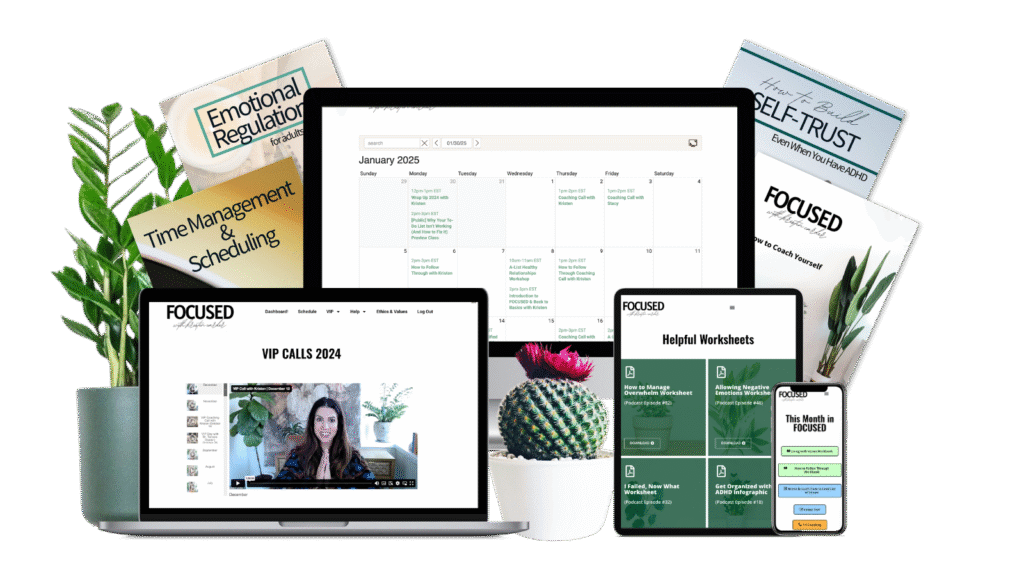
Everyone with ADHD knows what to do to improve their lives. You go to bed at a reasonable time. You wake up early, you make a list, you cross things off the list in order, blah, blah, blah. Like, yeah, we know what to do, but ADHD is not a disorder of not knowing what to do. It’s a disorder of knowing exactly what to do but not being able to get yourself to do it. That’s why I created focused. It’s an ADHD coaching membership for adults with ADHD. I’m a life coach with multiple certifications, and since 2019 I’ve coached over 4000 adults with ADHD from all over the world. I know what it takes to help an adult with ADHD go from Hot Mess express to grounded and thriving. I’ll teach you how to understand your ADHD brain, regulate your emotions and your behavior and accept yourself, flaws and all. And with this foundation, we’ll build the skills to improve your life with ADHD. And not only do you get skills and tools and focus, but you’re surrounded by a huge community of adults with ADHD who. Are also doing the work of self development right alongside of you. Dr Ned Hallowell says healing happens in community, and I have absolutely found this to be true. So if you’re an adult with ADHD who wants to figure out how to be motivated from the inside out and make real lasting changes in your life, join hundreds of others from around the world in focused go to I have adhd.com/focused to learn more. That’s Ihaveadhd.com/focuseded to check it out. For many of us, you know, I can’t stop talking about it. For many of us who grew up overwhelmed, criticized, emotionally unsafe, unsupported, just in really difficult family situations. Freeze can be adaptive in those times, right? It could keep you safe. It can help you survive. It can reduce conflict, it can minimize exposure. Can make it so that you don’t stick out to anybody, and so maybe your body learned, if I stop moving, if I stop needing, if I stop reacting, if I stop messing up, I’m gonna be okay, all right.
And if that is the case for you at the at the time, like childhood and adolescence, that was smart, that was protective, your body was doing what it needed to do. But the problem is with so many of our coping skills, what worked for us in our childhood and adolescence now is preventing us from thriving in our adulthood. Let me repeat it. What worked for us in our childhood and adolescence, the so in this case, like the becoming small, the becoming quiet and silent and frozen and and inactive. What worked for us then is stopping us from thriving now, okay, and as an ADHD er, our brains are extremely vulnerable to becoming overloaded because we are so aware of everything that we are inputting. So we’re hyper aware of all of the input of visual input, audio, like what we’re hearing, what we’re seeing, everything what we’re feeling. We can become overloaded and over simulated. So so quickly. Now I grew up in a family where overwhelm was 100% tolerated. It was part of my family culture that we would get overwhelmed, and it was actually validated in my family, which I do appreciate to a certain extent. We talked about it, we named it, but the thing is, we didn’t have a pathway out of it. So I could say to a parent, I can’t do it. I’m too overwhelmed. And it was met with kindness and compassion, and I appreciate that. It was kind of used as a Get Out of Jail Free card in my family, like we’re just overwhelmed. And, you know, I come from a family. I mean, you you’ve already heard me talk about it. I’m trying to think of really nice ways to put it. I come from a family of ADHD ers who are also highly traumatized and very dysregulated, and so overwhelm was absolutely a part of our family culture, and we used it to kind of explain why we couldn’t engage, why things stayed unfinished, why we avoided real life demands. And I do appreciate that it was validated. I do. I’m genuinely grateful for that.
But the thing is, like validation without tools can quietly turn into becoming paralyzed and stuck. And that’s exactly what happened for me, right? Because I never learned how to move through overwhelm. I just lived inside of it. And so there were times when I was really, really inactive, really, really stuck. And I do kind of tend to go there once in a while, like this last month has been really busy coming out of the holidays. The holidays were amazing, and then I moved right into a launch book editing and several solo podcast recordings, and it was just like, Oh my gosh. My brain was so flooded, and I really struggled with kind of walking through that muck, what I wanted to do was shut down. I really, really did. And so let’s talk about how overwhelm can turn into under functioning. It’s such a classic ADHD pattern because, like, let me illustrate it for you. You start a project, right? And it’s like something you care about it. Maybe it’s at home, or maybe it’s at work, or maybe it’s like something you’re volunteering for. You start a project, you care about the project, you want it to go well, and then it just gets complicated, and you become flooded, and all of the sudden there’s all of these moving parts. There’s so much that you need to do, and your brand. Just kind of fills up and gets really, really noisy, and your nervous system kind of taps out. It was like, Okay, we’re done here, and now it’s really hard to proceed, right? We just are like, I don’t really know how to move forward, so I’m just going to stop. And then the project gets abandoned again, right?
There’s just, like, another unfinished thing, another project that you’ve left undone, and then you’re just like, Oh my gosh. Like, I keep doing this. I’m so unreliable. It’s like another hit to your self trust. It’s so it’s just so difficult. And this, this can be something simple, like cleaning out the garage, not, not that the garage is simple, but like, you know, it’s not a life or death task, but it can also be a project that, like, really matters at work. And you’re like, my job kind of depends on me moving forward with this. I kind of felt that way in January with, like, all of the things that I was doing, where it was just like, my job depends on my ability to move forward with this. Like I’m trying to edit a book like my my job depends on whether or not I can move forward with this. I’m trying to record podcasts. My job depends on whether or not I can proceed like where we were doing a big launch for the rejection sensitivity course, like, my job depends on whether or not I can complete tasks to get this done, and what my body was craving, and what I was like being pulled to was this, like, shut down, this avoidance, this like, let’s just cancel everything and go hide in a cave.
So it can absolutely apply to your work. It can also just applied to, like, everyday life, the dishes pile up, the clutter gets really crazy and loud, the visual noise at home becomes so unbearable. And instead of just like, you know, little by little, tackling the projects, that would be the ideal, right? Like, Oh, I’m just gonna like, I’m just gonna do, I’m just gonna tackle this a little bit at a time, and I’m not going to let it paralyze me. I’m not going to let it shut me down. But instead of that so often, all of that clutter and visual noise and all of the like demands around the house, it does lead to us becoming totally flooded, totally overwhelmed, totally paralyzed. It can also apply to situations like parenting. I remember having three little boys. I like if you don’t have boys, if you never raised boys, I want to let you know that it’s kind of like trying to domesticate baby goats, like it’s just like it’s, they’re wild little animals, and you’re having to keep them in your house, and you’re trying to get them to be like, human, but it is really like trying to domesticate a baby goat, and if you’re a boy, mom or dad, you know? And if you’re not, that’s fine, too. Or maybe you had like, a, like, a sweet little feral baby girl. And you can be like, Yeah, I relate to that. But like, the requests and the questions and the noise and the trying to keep people alive who seem very intent on self destructing, like my two year old is standing on the table and like, jumping off the dining room table. Like, why? Why do I have to work so hard to just keep you from self destructing? It can be so overloading to our system, right?
And so when we don’t have a pathway of, like, regulating that and dealing with that, are, we can really shut down, like, we just begin to melt down or hide in the bathroom, which is what I used to do, like I I would just like, hide in the bathroom, and then they would, like, knock on the door and they would stick their little fingers under the bathroom, Mom, what are you doing? It’s like, I just need a minute of peace, right? Yes, I’ve done that. I have done that. And listen, don’t judge me. Don’t judge me. So the overwhelm of our lives, and especially if this is something that you struggle with, like with your ADHD, it can really lead us to under functioning. And it’s not because you don’t care, it’s because your nervous system can’t handle the load of all that is coming in all of the input.
It’s just so much okay. I’ve heard this called, when we do go into that shutdown, experts refer to it as functional freeze. I love that term because we’re functioning on like a basic, basic, basic level. But we’re really not able to move forward. And any moment that we get we are scroll like Doom, scrolling, napping like checking out of real life. I just want you to know that, like this is. Stress response. It’s a nervous system response. It is your body trying to deal with all of that overwhelm, all of that input, okay? And like, the problem isn’t that that tendency is there. The problem is that we don’t have a pathway out of it, right? The problem isn’t that you are in freeze. The problem is that no one taught you how to thaw out of that freeze. Like, okay, I can feel my body freezing. How do I get myself to thaw so that I can actually make some progress, so that I can actually take some step forward, so that I can actually kind of claw my way out of this overwhelm. Okay, so we’re gonna talk about just a couple gentle solutions. And when I say gentle, I really do mean that, because you can’t bully yourself out of freeze like, being mean to yourself, being like, What is wrong with you? Just get moving like, I know you know that that doesn’t work, but that does not work, and I know you’ve tried it, because I think all of us have right what’s going on with you? You’re just fro like we have so much to do. Why are you just sitting here? Let’s go. Let’s go. Let’s go. If that is what your brain is saying to you, we’re going to need to work on the self talk a little bit.
Okay, the first thing we’re gonna do in order to like, move through freeze is we just need to identify it and accept it for what it is. And I don’t mean accept it like this is the best I love it so much. Like I totally accept this and I love it and this is where I want to stay forever. That’s not what I mean at all, okay. What I mean is, identify it, recognize it, and accept, like, Okay, this is where I’m at right now. This is where I’m at, okay, so when we’re doing any kind of emotional regulation, the first step is always just recognizing and like, identifying and accepting this is where I’m at. Like, I just wonder, if you take a second with me here, no matter what state you’re in, it might be freeze. You might be on the go, go, go, go, go. But just like, tune into you. Where are you at? This is where you’re at right now, I wonder how it feels to say to yourself, This is where I’m at. And for those of you who are identifying with being overwhelmed or in freeze, like can you say I’m overwhelmed, my system is flooded. I think I’m in freeze right now. I see it. I see what’s happening for me. Do you feel how validating that is? It’s just very simple. But instead of saying like, what’s wrong with you, get moving, you’re being so dramatic, whatever your brain tells you, just identifying and validating. Like, okay, this is where I am. I’m in freeze or I’m overwhelmed. My system is flooded. All right. There doesn’t have to be shame or panic or self attack. You can just take a second and tell yourself the truth. I do want to reiterate, like accepting it as the current truth. Doesn’t mean you’re going to stay there forever. It’s not like, and I’m so glad that I’m here and I’m going to stay stuck and paralyzed for the rest of my life. No, it’s just saying, like, right now, this is where I’m at. Okay? It’s like, it’s an interruption and a validation of what’s happening. Usually, what I would recommend is like, Okay, now we’re going to, like, allow the emotions, and maybe you do recognize that there is some emotion here. Maybe there is some fear that’s like, you didn’t recognize it, but now that you’re kind of tuning into your body, you’re like, Okay, I see what’s happening. I’m scared. Or maybe it’s dread, like, I really don’t want to do this.
I know how hard it’s going to be, and I’m just over overcome with dread. Or maybe it’s something else. Maybe you’re bored, maybe you’re just so under stimulated, and your brain is just like, I’m checking out, because this is so gosh darn boring. Okay, so recognizing maybe there’s something underneath could be really, really useful, but because we’re already overwhelmed, that might not feel accessible because you’re already overwhelmed, like, obviously, right? So it might not feel accessible to kind of like, touch, those really not so fun feelings. It might be more accessible to choose. Try to gently get yourself moving, because when you’re frozen, your instinct is to just slow down, retreat, hide in the cave, go take a nap, scroll on your phone, avoid, avoid, right?
But you’re already under aroused when you’re in this overwhelm free state, okay, this is called hypo arousal. So you’re kind of already stuck in the muck. You’re kind of like frozen in that concrete state. And so you might need some gentle self activation. You might need to just kind of get yourself moving a little bit. And I don’t mean go do the dishes right now. That’s not what I’m talking about. I’m not talking about pressure or hustling or like, intensity, but just a little bit of movement that’s gonna feel doable. So some examples might be going for a walk outside. Like, if you can get yourself in nature, if you listen to me, like, turn up the volume, lean and close. If you are in overwhelm or in like a freeze mode, nature can soothe that for you. Okay, so getting out into nature, even if you’re you’re walking so slowly, or maybe you can’t even walk. Maybe we’re just sitting in the grass, or we are putting on a snow suit, and we’re literally sitting in the snow, like I’m not moving, but I am outside, and I am feeling the wind on my face, and I’m feeling like what little sun February has to offer me. I’m feeling it on my cheeks, and I’m just allowing myself to be in nature. Maybe we can’t even move, but can you allow yourself to be in nature. If you can’t get yourself outside, you can just sit on the couch and do some light stretching, or some like rocking, some like repetitive movements. Maybe we’re going to do some tapping back and forth. For those in the listening audience who are not watching on YouTube, I have my arms crossed against my chest, and I’m alternating hands padding on my chest and shoulder here, back and forth. That can be very regulating. Okay, tap, tap, tap, tap, tap, okay. That can feel very it’s just a tiny bit of arousal. It’s a tiny bit of movement.
It’s a tiny bit of regulation that’s not forcing you to tap into any deep emotions, but kind of getting you moving a little bit. You can shake out your your hands, or stand up and shake out your arms, or do a jumping jack, or two or five or 10, all right, even just moving and like changing rooms, maybe if your house is overwhelming, like, go work at Starbucks, if you if you’re like a work from home kind of a person, go work somewhere else where you’re not being yelled at by all of the clutter in your home. Okay? The goal here is to get yourself just moving in a very gentle and safe way, just a tiny, tiny bit. It’s telling your nervous system. Hey, we’re safe, we’re moving, we’re okay. It’s not kind of, and I don’t mean to sound dismissive here, but it’s not kind of like giving in to the overwhelm. Like, okay, fine. I’m just going to go scroll. I’m going to avoid even more. I’m going to go take a nap. That’s probably not even going to be supportive, because I’m going to be even more overwhelmed when I wake up, because now it’s two hours later and I’ve got the same shit to do, but it’s just getting moving just a tiny bit. It’s telling yourself like, Hey, I’m going to take care of you, but I’m not going to be mean to you. Hey, we’re going to get moving a little bit, but in a way that feels supportive, all right. The next thing that you can do is really try to shrink the cognitive load when you’re overwhelmed.
Oh my goodness, it just compounds when you’ve got a lot of demands, right? And so my my plea is, can you reduce demands? Can you instead of trying to get 10 Things Done, can you just try to get one or two things done. Can you set just a very short timer? Instead of saying, I have to work on this for two hours, can you shut it? Set a timer for 20 minutes. I’m just gonna get started. I’m only gonna do 15 minutes. Okay, even to start with one minute. Put on a show for CO regulation. Do some body doubling, call a friend. This is the next thing first before I move on, progress is going to count, even if it’s microscopic. So a lot of times, when I was overwhelmed, I would not even try to move forward on a project, because I was like, I need to dedicate 10 hours to this. And if I don’t go balls to the wall for 10 hours. It’s not even going to be worth it, so I’m not even going to do anything on it, because what I need is 10 hours of intense work. Well, listen, that’s not accessible to me. When I’m overwhelmed, that’s not accessible, all right, what’s accessible is okay, I can get myself moving a little bit gently, and I can give 10 minutes to. This and see how I do. And then I’m going to reassess after 10 minutes. Can I give it another 10 minutes? If not, that’s fine. I’ll do a little gentle movement. I’ll see if I’m willing to circle back afterwards. All right, next, we got to ask for help. We have got to reach out to our trusted allies and ask for help. And then when they give the help, we need to receive it, and we need to do what they tell us in these moments of overwhelm. And I am not saying let people boss you around, but when you are overwhelmed and flooded, and your brain is like stuck and I can’t think and I can’t even see my way out of this, ask for a trusted friend to help.
You got to borrow someone else’s brain in these moments, what do I need to do? What’s the priority here? Last month, when I was so just freaking overwhelmed with all of the demands and all of the things that I quote, unquote, had to do, I relied on my team. I’m very lucky to have. I know that, and I’m just like, tell me what to do, like, what’s the most important thing here? What? What is essential here? Just tell me what to do, and I just listen to them like they’re not the boss of me, but I let them boss me around in these moments, tell me what to do. I also rely on my husband. What? What should I do next? What matters right now? Because to me, it feels like everything is heavy, everything matters. Everything is life or death, and if I don’t, if I don’t do it, then I’m screwed. So just tell me. Tell me what matters. And when they told me, this is gonna sound so like childlike, but like, listen and obey. I trust you. Tell me what matters, okay, I’m gonna do it. Okay? I didn’t negotiate. I didn’t overthink it. I just trusted them. I just did it. I borrowed their nervous system. I borrowed their brain. I borrowed their ability to prioritize. Tell me what to do. It works. It really, really does next. And this is more like when you’re in a place where you have access to your brain and to your nervous system. Try to reduce decisions for yourself moving forward. Simplify your life. Man, if you are prone to overwhelm you have got to simplify your life. You’ve got to be willing to like, eat the same foods every day, create a clothing uniform so that you don’t even have to, like use the mental capacity to decide what to wear. Try to automate as many routines for yourself as possible, outsource your as many decisions as possible, and pre decide as much as you can, because every decision that you remove is some capacity that you’re able to reclaim to use on what matters most. So, like, if I’m not using my brain to decide what to wear in the morning, I can use that for a different decision that actually matters in my job, right? Like, if I don’t care about if I don’t care about what I wear, then I can use that capacity for something that matters more. You notice today, if you’re watching on YouTube, that my hair is wild, and I did that on purpose today, because I didn’t have the capacity to do the whole roll brush, blow dry, and the the, you know, the curling iron, or the little I just I was like, I don’t care. I cannot care about this. If I’m going to drive to mana, yank, if I’m going to record these podcasts, which is already very, very hard for me, I have to remove something from my life that feels hard. And so I removed my hair. Okay? I mean, I still have hair, but you know what I’m talking about. As much as you can remove those little things that don’t matter. And last we’re gonna we’re gonna end with like, something we talk about all the time. You gotta be nice to you. You gotta be nice. You gotta speak sweetly to yourself. If you are overwhelmed, yelling and bullying and berating and judging is going to make it a million times worse. You’re not a bad person because you’re overwhelmed. You’re not a bad person because you’re stuck or frozen, and the more you shame yourself, the longer you’re going to stay stuck. Okay, so you’ve got to figure out a way to talk to yourself nicer. You can borrow some of the statements that I use. First of all, just kind of recognizing like, this is where I’m at, this is where I’m at.
And this makes sense. This overwhelm makes a lot of sense, and I’m going to figure out how to get through it, and I’m going to lean on people that I trust to help me. And I’m like, that doesn’t make me weak or a bad person. It makes me smart. I’m going to lean on the resources that I have. Compassion is not passive. Compassion is really hard. Do you know what’s easy being a jerk to yourself? That’s what’s easy. That’s what is very, very easy. Compassion is actually. Actually more difficult, but it’s what allows us to change. And if you feel like this is kind of like the overarching theme of your life, you might want to get some additional support. You might want to reach out to a therapist. If you feel numb, disconnected, trapped, or like daily life is just unmanageable, trauma informed therapy will help you, especially if it’s in conjunction with treatment for ADHD or whatever other mental health conditions are coming up for you. Okay, because if you’re especially if you’re working with someone who knows the body, the nervous system, how to help you process what’s going on when you’re flooded, when you’re overwhelmed, when you get stuck in that frozen state.
So a lot of somatic work, EMDR, internal family systems, emotional focus therapy, like those kind of modalities will be really useful to you. I just want to end here, because part of how we help ourselves is we surround ourselves with nice people. And I came across this reel last night, and I was like, This person is the exact example of what we don’t need in our lives. I’m gonna play it for you. Trigger warning. It’s annoying, but I want to just give you example of the types of people we don’t need in our lives when we’re struggling with overwhelmed, being overwhelmed and being frozen. So let’s go ahead and hear from this annoying creator. I hate it when people say, Sorry, I’ve just been really busy. No, you haven’t. No one magically has more time than anyone else. We all get the same 24 hours. The difference between you and me isn’t time, it’s priority. I prioritized you. You didn’t prioritize me. If something matters, it gets time. If it doesn’t, it gets an excuse. So when someone tells me they’re too busy, I don’t get offended. I just take that as information and I start prioritizing them less. I mean, wow, wow, wow. There’s a lot I could say, but the main thing that I want to say is, if you are someone who is really struggling, if you are someone who is struggling with your ADHD, who’s struggling with overwhelm, who’s struggling with functional freeze, who is just trying to work through this muck, you’re not going to have the capacity to be there for your friends in a way that they might want you to, and this is the type of friend that you do not need at all. Okay, we don’t all get the same 24 hours in a day. We don’t. We don’t. Okay, my 24 hours as someone with ADHD who has evolved quite a bit, looks very different than someone with ADHD who’s at the beginning of their journey and really, really struggling. Our 24 hours are not the same. Okay, if you’re at the beginning of your journey, or if you are in this overwhelmed, functional freeze, like really difficult state, I know that my 24 hours and your 24 hours are not the same. They’re not you do not have access to the full capacity of yourself and your brain and your nervous system and your ability to make decisions and make choices and be there for friends and so I just want you, if you’re getting this vibe from people in your life, it is their right to feel this way. It is their right to feel this way. But this is not the type of friend that you need in your life. What you need is someone who’s compassionate, who’s kind, who’s understanding, and who’s like, Girl, I got you, listen, I don’t need anything from you right now. You circle back when you’re feeling better. I mean, that is like baseline. That’s not even Can I help you? Is there anything I can do to support you? But it is. Listen, I got you. We are good. I don’t need anything from you. Circle back, when you have the capacity, at the very least, that’s the type of friend we need, not someone who’s like, well, if you’re not going to prioritize me, I’m not going to prioritize you.
Okay, I guess we can’t be friends. Then, I guess we can’t be friends, because what am I supposed to do with this brain and this body that won’t let me prioritize, that won’t let me make decisions that won’t let me move? What am I supposed to do with that? Okay? So I, like mama bear is coming out right now, like, I just want to protect you. From those types of people who offer zero compassion to you when you are struggling. And I you know how I talked to Maddie at the beginning, and I said, you’re struggling and you’re turning it on yourself, and that’s what I worry that will happen if we’re surrounded by people who treat us like this, that we’re going to struggle and we’re going to turn it on ourselves, and we’re going to say, I guess I’m a bad friend. I guess I’m not prioritizing people. I guess I don’t deserve to have people in my life. No, that’s wrong. That’s not true. You do deserve compassion. You do deserve to have friends. You do deserve to have supportive people in your life, and you also deserve to reach out for help when you need it. Okay, so surround yourself with nice people. I think is the moral of the story, as we close this out, that can be a very, very effective way to move through what you’re struggling with is to surround yourself with nice people. All right, y’all, I mean, I’m nice, you’re nice. So let’s meet here next week, same time, same place. I can’t wait, I can’t wait to talk to you. Then bye. Bye. A few years ago, I went looking for help. I wanted to find someone to teach me how to feel better about myself and to help me improve my organization, productivity, time management, emotional regulation, you know, all the things that we adults with ADHD struggle with, I couldn’t find anything. So I researched and I studied and I hired coaches and I figured it out, and then I created focused for you. Focused is my monthly coaching membership where I teach educated professional adults how to accept their ADHD brain and hijack their ability to get stuff done. Hundreds of people from all over the world are already benefiting from this program, and I’m confident that you will too go to Ihaveadhd.com/focused for all details.