Kristen Carder 0:05
Welcome to the I have ADHD podcast where it’s all about education, encouragement and coaching for adults. With ADHD, I’m your host, Kristen Carter and I have ADHD, let’s chat about the frustrations, humor and challenges of adulting, relationships, working and achieving with this neurodevelopmental disorder, I’ll help you understand your unique brain, unlock your potential and move from point A to point B. Hey, what’s up? This is Kristin Carter, and you’ve tuned into the I have ADHD podcast. I am medicated, caffeinated, regulated, exhausted, but ready to roll.
How are you get in here? We are going to have a chat today that I really hope will change your life. We are talking about taking the path of least resistance, and this is a conversation that I need for me, so I’m sharing it here, and that is so much of what this podcast has always been for the last six, seven years, seven years is me chatting on here about the things that I’m working on, and like sharing them with you in real time. And right now, I’m working on taking the path of least resistance. So we gonna talk about it. We are gonna talk about it. If you are watching on YouTube, I literally am struggling to even open my eyes. When I get tired, my eyes just get really small and they do not want to open. So that’s where we’re at right now. You know, give me a little grace, because your girl is tired. She is so tired. Last week, I sent in the full manuscript of my book. And while that is something to celebrate and be so proud of, and I’m trying to do that, I’m trying to be very, very proud. I am so hung over. I’m so so hung over mentally, emotionally and even physically. The work, the Herculean effort that it took to make all of those edits, I had to rewrite a couple chapters, I had to look at the book as a whole. I turned in 86,000 words. It’s like a lot of words, but it’s out of my hands now, and I’m so happy to report that I submitted the entire manuscript. This is a big step on for me. Is a big step for me. I hope that it’s helpful to you as I kind of take you along this journey with me. Because, you know, when we set these big goals, it’s hard to keep in mind the difficulty of the goals, and when we set the goals, we often set goals from a place of dopamine, like, I’m going to write a book, it’s going to be amazing, and and that, like, brings up some dopamine, and we get kind of, like, a hit of it. But then the actual doing of the thing, there’s pretty much zero dopamine involved. The process itself is so dopamine depleting. There’s, like, none. But it doesn’t mean that it’s not the right thing. It just because it’s hard doesn’t mean it’s not the right thing to do. And so I’ve just had to continually, continually remind myself that, like, um, everything worth doing is going to be really difficult, and it’s going to lack dopamine. And the things that change my life are the things that are the most work that is so annoying. I think that’s probably like a very human thing. It’s a very common experience.
But I am happy to report that I was able to turn in the full manuscript. There’s still going to be back and forth. My editors will take a look. They’ll probably want to shift some things around and cut some things, etc, which is totally fine, but for the most part, the bulk of my sitting down and working every Friday and every Saturday on this on this book is done. So I get to go into this weekend not having to work. And I’ve been working six days a week for six months. I’m tired your girl, your girl is tired to the point where I’m like, am I? Am I close to burnout? Question mark? I think yes, and it’s part of what we’re going to be talking about today, but we will definitely get there. But anyway, I really do hope that this episode for you is very humanizing, that you that you really connect with just like the human experience of how hard it is to accomplish anything meaningful, and how we can set ourselves up for as much success as possible with as much support and as much compassion. Passion as possible, so that we can get the things done that matter to us the most, which I know is that’s our goal. That’s why you’re listening to this podcast. I know that it is.
I do want to remind you that if you are kind of new to the ADHD space, maybe you’re recently diagnosed, you’re or you’re going for an evaluation, you’re learning about ADHD. I have a freebie on my website called the 10 Things I wish my doctor had told me when I was diagnosed with ADHD. And the reason why I keep shouting out this freebie is because, number one, it’s a really, really helpful resource. And number two, I know that people kind of come in and out of the podcast. Some of you have been listening since day one. But so many of you just kind of, you know you’re in the process of getting diagnosed, and you Google ADHD podcasts and mind kind of like you’re just you’re new. And so I want to let you know that if you either have been recently diagnosed and your doctor told you absolutely nothing about what it means to have ADHD, which was my experience, and so many people’s experience, or if you are like just researching it and trying to figure out, what does it mean to have ADHD go to my website. Ihaveadhd.com/tenthings to grab this very comprehensive, long, detailed, very important freebie. It’s a resource that I think will be really, really helpful to you. It’s the 10 Things I wish my doctor had told me when I was diagnosed with ADHD. I truly wish that every doctor could, just like, hand it to their patients as they receive a diagnosis. Because I do think it’s 10 things that are eye opening, that are validating and that are very little known facts about ADHD when you’re just kind of entering this world. So that’s I have adhd.com/ten things. So we’re talking about the path of least resistance today.
And one thing that I’ve noticed in our community, and I get to talk to people with ADHD every day. So whether that’s in focused, which is my coaching membership, or on Instagram or just like back and forth emails or the podcast, I get to talk to ADHD ers every day. And the thing that I notice is that we often prevent ourselves from accomplishing a task because we’re convinced there’s a right way to do the task. We think there’s a right way to do it, and that right way, quote, unquote, feels enormous. It feels difficult. It feels overwhelming. It’s like an Everest that we have to Summit, and we don’t have the time, the energy, the executive function, or the dopamine for that, right? So instead of doing a little bit, instead of doing it badly, instead of doing it in a scrappy way, instead of instead of just kind of like doing 10% we don’t do it at all. We don’t do it at all. So many of us were conditioned, whether by family or school or society to believe, listen, there’s a right way and there’s a wrong way to do things right. So like the messages of anything worth doing is worth doing right, which I don’t agree with, I don’t agree with it all, but those are the types of messages that we often receive. And what’s what? Happens is that sets us up to be deeply perfectionistic, black and white thinking, an all or nothing mindset that really does not serve us.
Because, you know, who has two uninterrupted hours to finish the project I don’t like you probably don’t either, right? And when the only acceptable version of the task is the two hour fully optimized, perfectly executed version, then the task just never gets done. One example that I can think of that’s happened to me a bajillion times and that I hear from focus members constantly is like with email. Have you ever had to, like, respond to an email or send an email? It’s just one email. It’s not that hard. It’s not even that emotionally, emotionally loaded. It’s just a normal email. But it takes you, like, days to send not because you don’t have time, not because you don’t know what to say, but because your brain tells you, okay, there’s a right way to do this. You need to sit down at your computer. You need to be really focused. You need to craft a thoughtful response. Need to check your calendar. You need to sound professional, but also warm. You need to make sure that like you have the right number of exclamation points. Have you ever like gone through an email and been like too many exclamation points? I need to like not sound too happy, but also not sound too mean. So where do I strategically place my exclamation points to make sure I’m coming off with like the perfect vibe? Oh my gosh. So it we make it like this, there’s a right way to do it, and then we don’t do it for days, or maybe even wink weeks. And then do. Magically, in like 45 seconds, you voice to text a two sentence reply on your phone in the school pickup line, and done. It’s just completely done. And you say to yourself, Okay, why did that take me so long? Why do I have to make everything so hard? Why? Why is everything I do turned into like the hardest possible version of itself, okay? And that, if you are resonating with this, that’s what we’re talking about today, the tendency of our brains to think in this black or white, all or nothing, right or wrong way, and then to make everything more difficult than it actually needs to be. Okay? So what I want to introduce to you is obviously not a new concept, and you’ve heard of it, I’m sure, many, many times, but it’s the path of least resistance, and why for ADHD brains, it’s not the lazy path. It’s actually the only path that gets us moving. The phrase path of least resistance comes from physics. And, you know, I am not a science girly, but energy flows in the direction where there is the least resistance. We all know that that’s pretty obvious, and in ADHD language, that simply means that the version of the task that requires the least activation, the least energy it uses, the least executive function. It hurts the least and it gets you into motion the fastest. That’s what the path of least resistance for us, ADHD ers is not the fantasy version, not the neurotypical version, not the a plus version, not the perfectionism version, but the version that you can actually do even just a half assed version of it, okay?
And this is where we can get into some of the like conditioning that we’ve brought been brought up with, because so many of the so many of us label this as laziness, as not enough, as like doing it wrong. But I want to offer to you, can we throw all of that in the trash can and flush it down the toilet and understand that actually, this is intelligent and compassionate self accommodation. This is working with your brain, instead of constantly trying to force your brain to perform in ways that it really just does not want to perform. Well, can I do it perfectly? Sometimes, yes. Can I do it perfectly all the time? No, and that’s the problem. Is that sometimes we can show up with energy, with motivation, with purpose, and just get the job done really quickly. And then what happens is we hold ourselves to that standard every single day, and that’s an issue because we are not the same every single day. Your girl is tired today. She’s hung over. I’m actually like, getting close to burnout. So, so what are we doing today? We we’ve got day two hair, we’ve got a big, baggy t shirt. We’ve got the path of least resistance in the form of sweat pants underneath this table, right? It’s not perfectionistic, and we’re not, I’m not like, glammed up in the way that I would normally want to be, but I still showed up right? Like I’m still here. I’m here in sweatpants, but I am still here. It is so helpful to identify for yourself in a compassionate way. What is the path of least resistance for me, here today, for me, it was sweatpants and a baggy t shirt, right with the eagle on it, because obviously that, for me, was like, okay, what can I do for you to get you out the door? What do you need? And I was like, I don’t want to put on hard pants. Please don’t make me put on hard pants. I’m like, Okay, we’re gonna wear soft we’re gonna wear our fury wide leg, softest pants that we own. You can do your job in sweat pants. It’s totally fine. But when we make it too hard for ourselves, when we say no, there’s only one right way. When we say, I have to look business casual every so or whatever the case may be, then that sets us up to just stop and not do the thing. So instead of doing it partially, instead of giving ourselves partial credit, we don’t do it at all. So if the path of least resistance is helpful, why don’t we do it? Why do we sit for three days and not send the email when there is a 45 second voice note version available to us, and the answer, I promise you, I truly believe the answer, is perfectionism. You’ve heard me say this before, but Russell Ramsey wrote a book called rethinking adult ADHD and.
And it is just so gosh darn good. It’s a book for clinicians. So it’s very academic. It’s not really accessible, I would say, to like the typical ADHD or because it’s actually written for, like, neurotypical professionals. But in that book, which I love, Russ Ramsey says that perfectionism is the number one cognitive distortion in adults with ADHD. So he did a bunch of research out of the University of Pennsylvania with his colleague. And I forget the colleague’s name, please forgive me. And they did all this research on adults with ADHD, and they found that perfectionism is the number one cognitive distortion, and that’s what like resisting the path of least resistance looks like it looks like perfectionism. We tell ourselves, if I’m going to do it, I have to do it right. Hello. If I’m going to do it, I have to do it the right way. And the right way usually means the neurotypical way, the perfectionistic way, the most thorough way, the most optimized way, the most complete way, the most beautiful or like put together way, which is also almost always the hardest way. It’s the most overwhelming way, and it’s the way that makes us feel like I just I can’t do it. I don’t have it in me. It’s too much of an effort. I want you to think of like a steam train. I think about this a lot, like our momentum. It takes so long to get going right. It’s like this the steam train, like warming up its engine. And you can, I’m doing the motions here, if you’re watching, and it’s kind of embarrassing. So forgive me, but it’s like the start of the steam train down the track. And we know because we’ve seen movies, right? We know, like, I’ve never ridden a steam train, but I have seen movies and I read the book The Little Engine That Could so I know, I know that it takes a little while for that steam train to get going right, and then once we have some momentum, it’s really not as hard, but what often blocks us is making it so difficult to get started in trying to do it right, we just don’t do it at all because we’re like, I don’t have The energy, I don’t have the time. I’m not able to accomplish it the way it, quote, unquote, should be accomplished. So I’m just not going to do it. And that is a real tragedy, because if you can get 70% of it done, it could change your whole life. I mean, even, even if you can get 50% of whatever it is that you’re looking at. If you could just say, what does it look like to get 50% done that can change your life, that little bit of progress, but 0% done keeps you stuck in shame. It keeps you stuck on the couch. It keeps you stuck, Doom scrolling. It keeps you stuck feeling like I knew I’d never do this.
I knew I was someone that couldn’t get it done, or I knew I was a failure. It’s just like proving all of the things that you all of the things that you like, wish you didn’t believe about yourself, but you do like proving all of those true, because we we tell ourselves, if I’m going to do it, I have to do it right. Okay, so perfectionism is huge, and black and white thinking also plays into that. And so many of us, ADHD ers or neuro divergent people really struggle with black and white thinking. There’s a right way to do it and there’s a wrong way to do it. So if I only do it 50% that’s not right, right? And that that shows up all over the place for us, this all or nothing, thinking, if I can’t cook a full meal, I just won’t eat. If I can’t do a full workout, if I can’t give it a whole hour, I’ll just skip it. If I can’t clean the whole house or the whole kitchen or whatever. I’ll just leave it. I won’t even start. I’m not even going to give it any time at all. If I can’t answer every email, then I’ll just avoid my inbox altogether, like, I don’t have time to do all of it, so I’m just not going to do it at all. We need to start seeing this for what it is. This is not like, like, morally superior or high standards. This is actually a cognitive distortion, in my opinion, that’s keeping us immobilized, right? And I didn’t mention, like, morally superior, I do think that there’s a moral layer to this that we carry, like the easy way is cheating, right? Taking the easy path is cheating that somehow it’s just like, not good enough, it doesn’t count. We should be able to do it the quote, unquote, normal way. And I want to say normal for who, like, what? What do you mean by normal? And I know that, like, we’re not actually thinking through it, but when our brain serves. Up that thought, we need to really question it normal for who normal for a brain that has a completely different relationship to dopamine, to activation, to working memory, to overwhelm right? You’re not failing at the normal way. The normal way is failing you. It is, and there’s a cost to refusing the path of least resistance, to saying, No, I can’t, I can’t half ass it. I have to do all of it. I have to give it my all. I have to do it perfectly. Because we don’t get to build that little bit of momentum that then helps that steam engine just keep going a little bit faster and a little bit faster and get a little bit of progress, just a tiny bit of progress. Tiny bit of progress. I remember, I really, really, really struggled with this.
I remember, like in my teens and early 20s especially, was this very black and white, all or nothing. If I can’t do it full on, then I’m not even going to bother to do it at all. And it prevented me from from making a lot of progress in my life. It truly did, but in one of like the small ways, was just with my health and with being able to move my body. So I had a very high standard for what it meant to move my body, to be healthy, to work out. And it would be like, I need to give it a full hour. I need to have the right outfit. The weather needs to be perfect. I need to be able to do all of this in order to to even have it count. And now I’m able to say, let’s just go for a walk around the block, like, let, let’s just start there. If that’s all we do, at least we’re moving our body a teeny tiny bit. That’s better than doing nothing at all. Right? But I didn’t allow myself to get even a tiny bit of momentum, even a tiny bit of dopamine from the completion, even a tiny bit of like feeling of accomplishment. And instead, I lived in chronic procrastination because the goal was perfection, and I really didn’t have the capacity to achieve perfection, and so I procrastinated even doing it at all, because I knew that I wasn’t able to do this Herculean effort of the perfect workout. And so I told myself, I don’t follow I don’t take action on my own goals. I don’t do what I say I’m going to do. I just I had all of this negative self talk, but it was really wrapped up in me just not being willing to do a little bit. I eroded my own self trust. And I wonder if that is the case for you, too. I wonder if you’re just kind of stuck in a shame cycle. If you’re just kind of stuck in this shame spiral because you’re just not willing to do a little bit right, to set the timer for five minutes. I’m going to move my body for five minutes if I want to keep going after that, once the steam train that engine has gotten, you know, first of all, like out the door maybe, or like down to the basement, or just like moving a little bit. Is it possible for me to keep going and in those moments, that is a beautiful thing to say, Okay, I’ve already gotten started. Do I want to continue? Do I want to continue? Do I want to keep going once you allow yourself kind of to take that path of least resistance, of like, okay, I’m just going to do five minutes and you get yourself moving, then you can check in and say, do we want to keep going here? And I just, I love that. I just, I really want us to understand that we don’t have to always make it so hard. Life is so hard, and it ebbs and flows. So sometimes there are easy seasons, and sometimes things just come pretty naturally to us, and then we think on our hard days, why is this so hard? What is wrong with me? What am I doing wrong? You’re not doing anything wrong. You’re just ebbing and flowing like every other ADHD or on the planet. So what do we do when we’re in that ebb, like I am now, I’m tired. I’m in an ebb, y’all. I’m just like, Oh my gosh. I can’t even keep my eyes open, I’m really struggling to think and perform and do my job. I am in an ebb What am I gonna do? Okay? Because the hard way, the hard way, doesn’t always work. The hard way
Kristen Carder 24:36
actually becomes the never finished way. And if I’m telling myself that the hard way is the only way, well maybe that’s why I’m struggling to finish. Maybe that’s why I’m struggling to finish. Because I’m saying there’s only one way to do it. You have to do it this way, and if you’re not willing to do it this way, then don’t even buy. Bother. Don’t even bother. So how do we shift this? How do we how do we, like evolve into people who are willing to just take the path of least resistance? The first thing we need to understand is that this is not a cop out. I can already hear you screaming at me, Kristen, I don’t want to lower my standards. I don’t want to become someone who’s just like, half assing life, right? I don’t want to become someone who’s just like, only doing the easy stuff. And what I want to send back to you is like, I understand that’s definitely not where we would want to stay, but if you’re not able to start at all, what if we lower the bar just so that you can get some momentum? What if we say, instead of giving 100% to this task, give 50% right, because 50% is way better than 0% one of my kiddos, my actually, my youngest little guy, had a math test this week, and he’s in Advanced Math. Okay, I don’t know how one of my children is in advanced math, but he is and like, bless his little math brain, it’s so amazing, but he’s really struggling with the material, and his mother cannot help him, and his father could help him. If we had some resources, we couldn’t figure out how to how to help him. And one of the things he said was, like, we were doing the review with him. You know, they give him the review before the test. And he was like, I have to do it her way, or I’m not going to get full credit, and I don’t remember how to do it her way, so I’m just not going to do it. And I was already thinking through, like, preparing for this podcast, this idea of path of least resistance was already on my brain. And so we had a conversation about, like, What grade do you think you will get if you get the right answers but you don’t show your work her, you know, in her way. And he was like, I’ll probably get a 60% I was like, Okay, what grade do you think you will get if you don’t do it at all, like, if you just leave them blank? He was like, I’m gonna get a zero. And I was like, which one do you prefer the 60 or the zero? And he was like, you know, he’s little.
He’s actually not that little, but I treat him like he’s a baby, because he’s my baby. He literally just turned 12, and I’m like, he is still shorter than me. He’s the only one in the home that is, like, smaller than me for a very short period of time, I know. So we had this conversation. He was like, okay, I’d rather get a 60% and it was just a really beautiful example of, okay, you can’t do it perfectly. You’re not gonna do it perfectly. He did go in for tutoring, but he didn’t get a good grade on the test, and I don’t really care. I do not care. He got a 67 okay, but he got a 67 he did not get a zero on the test. And that is my point. A 67% is better than a zero. He was willing to do it wrong. He was willing to do it wrong. I want you to take that and like, think through. How can you weave that into your own life? What are you looking at right now? It might be a project at work. It might be your email inbox. It might just be like your kitchen counter, okay? Like it might be something that seems inconsequential, but you’re actually shame spiraling about what does getting a 67% look like for you in this area? Are you willing to do it, quote, unquote wrong and get a quote unquote bad grade instead of or in replacement of getting a zero and failing altogether? What does it look like for you to say Done is better than perfect. If I can get a D that’s better than a failing grade, right? Like, what? What does that look like for you? This podcast is certainly not built on a plus work, and your relationships will not be built on a plus work, and your parenting will not be built on a plus work, and your home life and your own career, there is no way that you can hold yourself to an A plus Standard and meet that bar every single day. There’s just no way to do that, especially not with a neurodivergent brain, especially not with energy and capacity that ebbs and flows.
Okay, your consistency is highly attached to your willingness. Us to do it badly, your consistency, your ability to be persistent and show up over and over and over is it is so connected to your willingness to allow yourself to do a bad job at something, to just say, Okay, I know I can’t do it perfectly, but what would it look like to do a bad job? Can I just, can I give it a little bit of time? What does it look like to actually do a bad job at working out? What does it look like to do a bad job at eating healthy? Like, if I’m gonna try. Can I do like, could I have one meal a day that’s decently healthy? Can I have 10 minutes of moving my body? That’s a quote, unquote bad job, right? But it’s at least something. Looking around your house, what it does? What does it look like to do like a like my son, a 67% if I could get a 67% on this, isn’t that better than a 0% right? Your your persistence is built on doing things in a way that you can actually repeat, and we cannot listen to me. Get in here. Let me hold your hand while I say this. We cannot repeat a plus work every single day we can’t do it. You may have to take a moment and, like, grieve the fact that you can’t do it perfectly every day. You might actually have to, like, come to terms with that the reality of that, and as I say very often, Reality Bites it does like I would love to be able to do it perfectly every day. I can’t. I’m not going to be able to, but I will be persistent, AF you better believe it, I’m going to be so persistent, and I’m going to do whatever it, it takes, even if I’m doing it badly, right? So I’m going to show up, I’m going to submit a manuscript for my book, even if it’s not a perfect manuscript. And let me tell you, it’s not a perfect manuscript. It is not I could have spent a whole additional year perfecting that manuscript, but I wanted to get that thing done, and so I got it done, and it’s probably like, you know, B, B work. I’m okay with that. I’m okay with that. Let’s submit B work, or even lower when, when, when you can. Even lower when you can. Okay, so when you’re feeling stuck, when you’re feeling the wall of resistance, when you’re just like, ah, when you’re noticing the thoughts of like, I don’t have time to get it done that, that thought is actually an extremely derailing thought, because we’re never gonna have time to get it done. But do I have time to give it a tiny bit? Do I have time to give it 10% do I have time to get a 67% on this task right? Because I’m never gonna have time to get it done. But can I give it just a tiny bit? I want you to ask yourself, What’s the easiest possible version of this? What do I need right now to just take one step forward. What would this look like at a 67% what requires the least amount of energy from me? What can I give to this that that actually requires the least of out, the least amount of energy out of me? All right? Like, how can I be nice enough to myself to let myself do a meh version?
Because so much of this is us holding us back. No, you don’t get to do a bad version. You have to do it perfectly. No, you don’t get to half ass this. You have to give it 100% No, you don’t get to send a quick Voice Note email. You have to sit down at your computer, and you have to put it through chat GBT, and you have to strategically place all of your exclamation but no, what if we talk back to that voice in our head? What if we say stop? Thank you for your input. I appreciate what you’re saying. I don’t agree with you anymore. I don’t. I don’t actually consent to what you’re telling me. Just because our brain offers up a thought doesn’t mean that we have to grab on to it and think that it’s true. So when your brain says, No, that’s not good enough. No, you don’t even have time to start. No, don’t even bother, because you’re not going to be doing it right? I want you to notice those thoughts that come in. I want you to capture them and say, whoa. Thank you for your input. I hear what you’re saying. Actually don’t agree with you anymore. I don’t consent to this way of thinking anymore. I’m just gonna give it a little bit of effort. I’m just gonna give it 10% and see where it takes me. 10% is better than 0% Percent repeat after me. 10% is better than 0% it is every single time. So what’s the 10% version? And your brain is going to fight against this. You’re going to be full of shame. You’re going to be full of self judgment. I promise you you will. I know you will, because I live it and I coach people every day. I just, I know it, you’re going to be like, No, that’s not enough. No, that’s not good enough. You’re doing it wrong. You’re doing it wrong. And I just want you to be like, I hear you.
Thank you for your input. Appreciate what you’re saying. Actually don’t agree with you anymore. I think that 10% is better than 0% I think giving it a tiny bit of effort is better than no effort at all. I think my persistence is actually something to celebrate, and I’m going to make just a tiny bit of forward motion here, even if it doesn’t get me all the way to the goal, because a little bit of forward motion is better than zero forward motion. Okay, I’m telling you, I really do think that this is one of the main things that holds us back from being able to be consistent. Because if consistent, and I’m using air quotes for the listening audience, if consistent looks like perfection and perfection is difficult and overwhelming, then we’re always going to be in this start, stop cycle, right when I feel good, when I’m able to do it perfect, I will do it perfectly. But then life happens. Kids get sick. I get sick. I’m tired. My energy and capacity ebb and flow. And then now I know I can’t do it perfectly anymore, so I’m just not going to do it. So I stop all together. Instead of, you know, going from those great days where I’m able to give it 100% and then allowing myself to have 10% days, 15% days, 67% days, right? When we don’t allow ourselves to do it badly, then we prevent ourselves from doing it at all right, because we want to do it perfectly, and we can for a little bit, until life gets hard, and then when life gets hard, I don’t allow myself to adjust and do the bare minimum. Like, what if you were allowed? What if you allowed you to do the bare minimum?
My sweet ADHD, neurodivergent person, what if you were allowed to just do the bare minimum, right? So if I don’t allow myself to adjust and to do the bare minimum, then I just stop and kind of give up until I know I can do it perfectly again. And so it’s start, stop, start, stop, start, stop, right, right. Okay, I’m going to use myself in this as an example here. And I was thinking of this as I was driving in today, and I was like, should I use should I say it? Should I not? I’m just going to say it. You know, I’m just always going to say it. So this podcast, I love this podcast. It is a gift to me. It is I hope you love it. I hope you enjoy listening to it. I hope it’s meaningful and it’s life changing for you, but honestly, it’s been a gift to me for seven years. It’s allowed me to do a bunch of research and learn so much and interview amazing professionals and just grow in my own understanding and knowledge. It’s pointed me to coaching. Truly, it has pointed me to coaching. It’s changed my whole life. But as someone with ADHD, whose capacity ebbs and flows, obviously, podcasting weekly, like putting something out for you every week is a huge task. I’m not different from you. I’m not I get tired. I get overwhelmed. My personal life right now is hard in the background of my life, parenting my kids, it’s we’re in a particularly difficult season right now, and I have been wrestling with just like I can’t. I don’t want to do it anymore. Just can’t right now. I promise you, I’m not going to quit, but that’s where I am, where it’s just like I just don’t want to. And I’m realizing that why, the reason why I don’t want to is because I’m not allowing myself to take the path of least resistance. I’m wanting to do it perfectly, of course, of course, I am. I have a right version and a wrong version in my head. If I’m gonna have a podcast, I have to record new episodes every single week. I have to get fancy and dress up, I have to drive an hour into Philadelphia and record at a professional studio to make it happen like there’s a lot of perfectionism that I am realizing that is happening for me, right?
And so my brain is going we either do it perfectly or we take a two month break altogether, and. Like, I don’t want to do either of those things. I don’t have the capacity to do it perfectly, and I don’t want to take a break, right? So in my adorable black and white brain, I am giving myself those two options, do it perfectly, like, create new content, get super fancy, wear hard pants, like all of the things, right? Come into Philly, make it a big thing, or just quit and like, neither of those options are good. They’re not good for me. They’re not good for me, for you. So I’m gonna lead the way here, and I’m gonna tell you how I’m actually, like, incorporating this idea of path of least resistance for me, while I’m in an ebb of my life. Okay, so for today, it looked like really just showing up as basic as I could, and I already said this, I’m in sweatpants. I’m wearing the baggy t shirt I didn’t have the capacity to even think about what I was wearing is, like, whatever it was, whatever I’m comfy, all right? And I don’t usually allow myself to be comfy. I usually am just like, let’s get fancy. Let’s look cute. Let’s wear the hard pants. It’s look wear the best jeans, everything. It’s just that, for me, was like, Okay, we’re gonna do that today. But what I’m gonna do over the next couple weeks, not next week, but for the next couple weeks, I’m going to take a break from recording brand new content.
I’m going to give myself two whole weeks of just, not just but of using focused classes, content that is my own, that I have recorded, that has been useful and that people have been like, oh my gosh, this is life changing. I already have a class in mind that I’m going to use on self sabotage. So we’ll be having an episode come out in the near future on self sabotage, and I’m going to reuse some of my material. Do you know what that does for me? I will record a new intro. That’s great. It allows me to work at about 25% that’s what that is for me. So I have to go find a couple really meaningful, useful classes. That’s great. I have to make sure that it’s content that I think you are going to love, and you will, I promise. I’m like, pointing to the camera right now. If you’re listening, I’m like, You’re gonna love it. I’m gonna record a couple intros. Still great, no problem. That’ll be like, up to date. But I’m not gonna drive into Philly. I’m not gonna have to write, you know, out notes in a script for a podcast. And I’m not. I’m gonna give myself that 75% I’m going to take that for me so that I can recover, right? So I just, I want to show you that doing 25% of the work and still allowing yourself to do something is what allows you to be persistent. I hesitate to use the word consistent, but maybe I will use the word consistent, because you’re still going to get a podcast coming out every Tuesday, that the podcast will still drop consistently, but I will be taking the path of least resistance. That is a 25% effort for me, okay, still going to be a great podcast. You’re still going to get what you need. But for me, my effort will be able to be reduced. And I want to lead the way. I don’t want just to, like, tell you to do it. I want to do it. This is me in real time, leading by example, saying there’s a better way. We don’t always have to show up with perfectionism. We don’t always have to make ourselves do the hard thing. We can get creative, and that requires us to step outside of our black and white thinking. That requires us to get a little bit compassionate.
Okay, actually a lot that requires us to get really compassionate with ourselves and say, Okay, this is getting hard for you. I can tell what do you need in order to just do a little bit how can I help you? This? Is you talking to you? How can I help you? Just move forward a little bit. Just give it some effort. Just be able to to get something done. Because 25% is better than 0% 67% is better than 0% I just love using my little kiddo as an example. 67% that’s what he got in his grade. He didn’t get a zero. He didn’t get a zero on his math test because he was willing to go in there and give it his best effort that he knew would not be perfect. That’s also something that I want to say here is that. When you’re depleted, when you’re overwhelmed, when you’re at low capacity. If 25% is all you can give and you give it, then you’ve given it your all. I really hope that’s like translating and making sense. If you understand, I can only give 10% I can’t do the whole thing. I can only give 10% and you give it, then you’ve given it all. You can give like that is a win to be celebrated so often. We’re just in this place of self judgment and shame where we say you only didn’t mean maybe I can’t believe you didn’t know you’re not doing it. You’re not doing it good enough. All of that mean self talk that we allow in our brain.
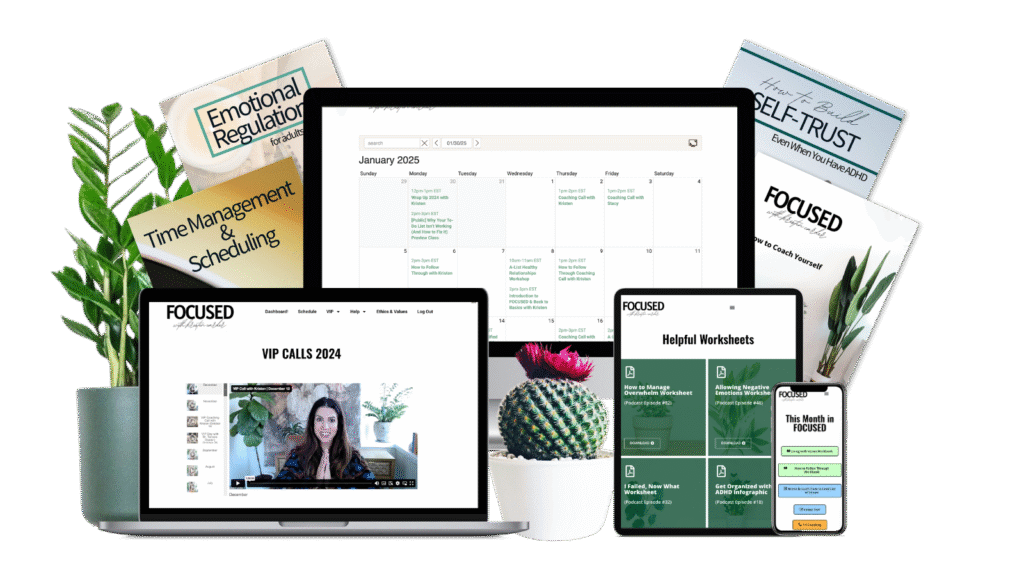
That has got to stop. If all you can give is 25% and you give it, that is a huge win. You’ve given it all you can. It’s not a standard of 100% all the time, because sometimes you do have 100% to give great but then other days you don’t. And so are you willing to give it 67% or are you going to fail the whole thing? All right, take the path of least resistance. Allow that steam train to just get a little bit of momentum, celebrate the small wins and and remember, remember that when you are struggling, when your capacity is in ebb, when you are overwhelmed, and all you can give is 10% and you give it, that’s a huge win. That is a huge win. Thank you for being here. I have loved every second of this. I’m going to see you next week. A few years ago, I went looking for help. I wanted to find someone to teach me how to feel better about myself and to help me improve my organization, productivity, time management, emotional regulation, you know, all the things that we adults with ADHD struggle with, I couldn’t find anything. So I researched and I studied and I hired coaches and I figured it out, and then I created focused for you. Focused is my monthly coaching membership where I teach educated professional adults how to accept their ADHD brain and hijack their ability to get stuff done. Hundreds of people from all over the world are already benefiting from this program, and I’m confident that you will too go to Ihaveadhd.com/focused for all details.