Kristen Carder 0:05
Welcome to the I Have ADHD podcast, where it’s all about education, encouragement, and coaching for adults with ADHD. I’m your host, Kristen Carter, and I Have ADHD. Let’s chat about the frustrations, humor, and challenges of adulting relationships, working, and achieving with this neurodevelopmental disorder. I’ll help you understand your unique brain, unlock your potential, and move from point A to point B. Hey, what’s up? This is Kristen Carter, and you’ve tuned into the I Have ADHD podcast. I am medicated, caffeinated, regulated, and ready to roll. What is up? Get in here! I am so glad that you press play on this podcast today. I’ve got a fun one for you. We’re going to shoot the shit today. Hope you don’t mind that term. I hope you don’t mind my client, friend, and community manager in focus, Matt Cicerelli is here with me today, and we are just literally going to shoot the breeze, have lots of conversations about lots of different topics. We are going to entertain you. We are going to make you laugh. Hopefully, we will not make you cry. How this came about is that I have had so much time to prep for today’s podcast, and I failed.
Matt Ciciarelli 1:23
You admit it, though.
Kristen Carder 1:25
I admit it.
Matt Ciciarelli 1:25
That’s good.
Kristen Carder 1:25
I failed. I I had a very like ADHD week, and by that I mean I was extremely distracted. I was hyper focused on things that I wanted and needed to get done, and then the like podcast recording was kind of like just out there in the ethers, and I never really, when it was time to think about it, I was like, I have no idea. So one
Matt Ciciarelli 1:49
of those things where you know, all right, I’ll get to it. I’ll get to it. I’ll get to it. I’ll get to it. 100%
Kristen Carder 1:52
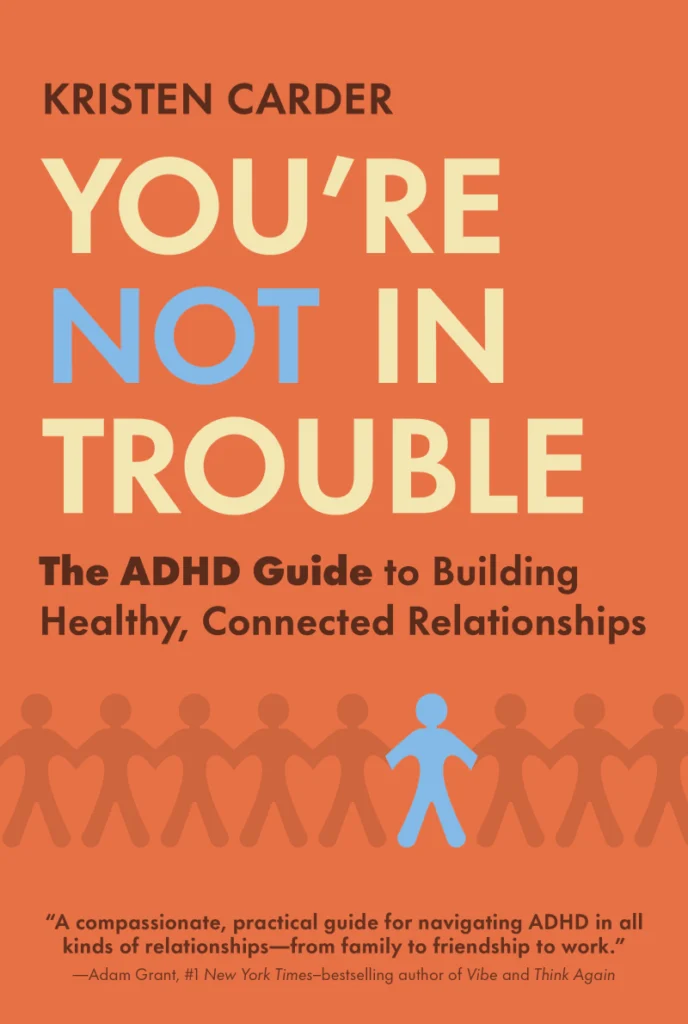
Yeah. I was so, so procrastinating and distracted, and so yesterday I met with my team, and I was like, you have got to help me figure out what to do. And in that discussion, they were like, the episodes with Matt always do well. And I was like, I will see if he wants to go on. And literally, Slack, like, any any chance you’re free tomorrow? So Matt is here with me today. We are going. We have. I have a list of topics. We’re just going to chit chat. This will be an ADHD ride. Buckle up, my friends. But before we get started, I want to let you know that my book, You’re Not in Trouble, is available for pre-order. It is so good. I’ve been doing the audio book, and I’ve been worried as someone who just like has rejection sensitivity and obviously a flavor of perfectionism and obviously just wants to do everything perfectly, wants everybody to like me, and with putting something so massive out in the world, like what if I actually don’t like it? What if I hate it? What if I get to the end of this and I’m like, oh my gosh, it’s not that good. I’m so, but I’ve been reading the audio book here in studio, which has been really fun to be able to do it with Dan, my producer, and just like be in a place that feels like home. And every day that I like finish up, I’m like, that’s a really good. This is going to help a lot of people. I’m really really excited. So it’s available now. Go grab it. You’re not in trouble. If you do a search for it, don’t forget to use the correct form of the word your y o u apostrophe r e. We’ve gotten a couple emails of people being like, I’ve searched for your book and I can’t find it, and it turns out they’re using the wrong your. I mean, listen, listen, I get it. So just it’s you’re not in trouble, and I hope yes, don’t forget that apostrophe. But we’re here today just chit chat to entertain you, to give you an insight into our own lives with ADHD, our own experiences with ADHD. I didn’t say this in advance because I wanted to say it in real time and get your reaction. One of the reasons why I thought of you for this podcast is because I actually, not to be weird,
Matt Ciciarelli 4:06
okay,
Kristen Carder 4:07
had a dream about you the night before. Whoa! I know it’s so so so weird. Here’s the dream. I was sitting in like a really old Buick.
Matt Ciciarelli 4:16
Okay.
Kristen Carder 4:18
Why do I know it’s a Buick? I have no idea. Okay. In Philly,
Matt Ciciarelli 4:21
okay, just sedan, station wagon, vertical, like
Kristen Carder 4:23
sedan.
Matt Ciciarelli 4:24
Talk to me here.
Kristen Carder 4:24
Sedan, sedan, like an old, like one of the the ones that were really long, though. Do you know what I mean? And I’m sitting in the driver’s seat, and you come in my dream up to the passenger side window, and you’re like, “Hey! And I was like, “What’s up? Get in here! You climb into the passenger seat. I’m in the driver’s seat, and we just chit chat. We’re just like chit chatting. So when my team was like, “Oh, maybe Matt Cicerelli, that’s when I remembered my dream. I was like, “Oh my gosh, I had a dream about him last night. I think it is meant to be. It was a dream about us chit chatting.
Matt Ciciarelli 4:56
Okay,
Kristen Carder 4:56
here, here we are. Are isn’t that weird?
Matt Ciciarelli 4:59
That is. Weird. I mean, the fact that good thing I know you because in my dream get into a stranger’s car or something they told me. Mom and dad told me not to.
Kristen Carder 5:07
We were in Philly.
Matt Ciciarelli 5:08
Okay,
Kristen Carder 5:09
so that makes sense.
Matt Ciciarelli 5:09
So it was an old car. Was it? Was it? Was it like current times with an old car? Was it a time current? No, it was
Kristen Carder 5:15
current times with an old car.
Matt Ciciarelli 5:16
Okay,
Kristen Carder 5:17
it’s so strange.
Matt Ciciarelli 5:18
Weird.
Kristen Carder 5:18
I know.
Matt Ciciarelli 5:19
Anyway, back to the book real quick.
Kristen Carder 5:21
Yeah,
Matt Ciciarelli 5:21
my mom ordered
Kristen Carder 5:22
it. Do you know that I know your mom ordered it because we’ve been running this promo where people can fill out a form and get a signed copy, and she literally labeled herself as Mama Cicerelli. I was like, I thought that you would fill it out on her behalf because who calls themselves Mama Cicero. Kathy would, yes. Shout out to Kathy.
Matt Ciciarelli 5:44
Kathy with a K.
Kristen Carder 5:45
She’s so sweet.
Matt Ciciarelli 5:47
I love her. She’s my mom. That is so sweet, Mama
Kristen Carder 5:50
Cicero. So I wrote her a personalized note.
Matt Ciciarelli 5:52
Oh God,
Kristen Carder 5:53
Mama Cicerelli.
Matt Ciciarelli 5:54
She’s gonna have that on the shelf next to my dad. Send her
Kristen Carder 5:57
some stickers.
Matt Ciciarelli 5:58
Oh God.
Kristen Carder 5:58
I know. Thank you, Kathy, and everyone else who has ordered the book. I really, really appreciate it. You won’t be disappointed.
Matt Ciciarelli 6:06
No, I’m. I’m excited. You
Kristen Carder 6:07
won’t. I think it’s going to be excited for it. I think it’s going to be good. I am excited. I’m no longer nervous.
Matt Ciciarelli 6:13
Good. Well, that’s good.
Kristen Carder 6:14
Can you believe it? Look
Matt Ciciarelli 6:14
at you. I know.
Kristen Carder 6:16
I wanted to puke for about probably two weeks, like a week prior to announcing it, and a week after announcing it. I was just like, “Oh my gosh, this is so. It just feels big, you know. And there’s a lot of personal stories in there. There’s a lot of vulnerability that I have never shared writing the book. I
Matt Ciciarelli 6:39
mean, you knew that going in, right?
Kristen Carder 6:41
You know, I was hoping to write it from a position of not necessarily expertise, but more distant.
Matt Ciciarelli 6:49
Okay,
Kristen Carder 6:49
but my editors kept saying we want more of Christmas. Right. I
Matt Ciciarelli 6:52
think part of that is showing how you can is being relatable.
Kristen Carder 6:55
Yeah, and and that’s part of the reason
Matt Ciciarelli 6:57
that you’re so good with what you do with us and focused is that you relate to us.
Kristen Carder 7:02
I do, and it feels easier in the context of a place like Focus to be vulnerable because it’s a contained right,
Matt Ciciarelli 7:09
right.
Kristen Carder 7:10
It’s a contained environment. Even though there’s hundreds of people there, it’s still like I know they’re my people. Right, they chose to be there. They chose to be there. There, there’s a there’s a level of trust already built, whereas I mean, this is just gonna like it will outlive me, and it’s just gonna be in anyone’s hands. And so, hopefully, oh gosh, it’s gonna be
Matt Ciciarelli 7:32
great.
Kristen Carder 7:32
It’s gonna be great. It’s gonna be awesome. I can’t wait
Matt Ciciarelli 7:34
to get that little surprise in the beginning of October when it shows up on my in my mailbox.
Kristen Carder 7:38
I picture all of these ADHDers getting packages on october 6, or if you’re in the UK, october 8, and just being like, “What did I order? What the hell is this? What? It’s always like the Amazon surprise, or you know, wherever you order it from. You’re just like, “Wait, what is this? My husband always laughs at me because he’s like, “How do you not know what you order? Our neighbors
Matt Ciciarelli 8:00
across the street every day have. He’s I work at home, so I work in our bedroom, and I’m looking right out across. And every day, this Amazon guy shows up, and
Kristen Carder 8:10
what do you think they’re getting?
Matt Ciciarelli 8:10
I have no idea, but it’s big boxes, at least four or five every day, and I’m like, man, what are you guys doing? So, oh
Kristen Carder 8:18
my gosh, I’m so curious.
Matt Ciciarelli 8:21
I don’t want to be that nosy, but
Kristen Carder 8:23
I’m very really cool
Matt Ciciarelli 8:25
people. I mean, it’s just like
Kristen Carder 8:27
what are they getting? And do they even know? Do they even remember when the boxes show up? Because I would be like, “What is what is this? And then like I open it up, I’m like, “Oh yeah, I ordered socks. Oh yeah, I ordered her bug. That’s right. That’s so
Matt Ciciarelli 8:43
funny. Yeah, yeah. That’s an Amazon thing. I mean, we for a while there we kept Amazon in business. It seems like. I mean, we didn’t.
Kristen Carder 8:49
I mean, with three kids.
Matt Ciciarelli 8:51
Yeah, but
Kristen Carder 8:52
it is okay. So the ethics of Amazon are just like oh, and I had a neighbor in our old house who was just like I’m not ordering from Amazon. Like she’s like I refuse, and I was like I respect it. And how are you surviving? I totally respect that decision, and I’m like fair, totally fair. And how? Because she has three kids. How are you living your life? Yeah, like what?
Matt Ciciarelli 9:21
Yeah, you respect it, but yeah, you you wonder.
Kristen Carder 9:23
I do.
Matt Ciciarelli 9:24
Julie, my wife’s aunt, still has a flip phone.
Kristen Carder 9:27
She’s a flip phone. She
Matt Ciciarelli 9:28
does. I’m like, I respect it,
Kristen Carder 9:31
and also
Matt Ciciarelli 9:32
I just don’t know how you do it.
Kristen Carder 9:34
Sometimes I do wish that I could have a flip phone. Oh, we wish we could give. We
Matt Ciciarelli 9:40
wish we could give our kids photos. Believe me,
Kristen Carder 9:41
100%
Matt Ciciarelli 9:43
Bang, talk, talk. You have to wait for the space to come. And do
Kristen Carder 9:48
you know? I’m going to say his name incorrectly. Hold on, let me think about it. Anzi’s Anzari. Do you know him? I
Matt Ciciarelli 9:56
know of him. Yeah. Okay, so
Kristen Carder 9:57
I I think I listened to him on Theo. Vaughn or something like that, and he has a flip phone.
Matt Ciciarelli 10:03
Okay,
Kristen Carder 10:04
and he talks about how like like the inner. I think it was Theo Van. I can’t remember. I was like, “How do you survive in life with a flip phone? And he was just like, “I yeah, like I have to use my wife’s phone for like Google Maps and that kind of thing. But imagine the peace of like for me, no social media. Sometimes I think for me, social media is like a self harm tool. Like I just go there and I don’t feel good. That
Matt Ciciarelli 10:32
language, yes, yeah, she’s she hates it.
Kristen Carder 10:35
But then also I I’m on
Matt Ciciarelli 10:37
it. Oh, I’m on it all the time, and
Kristen Carder 10:38
I’m addicted to it. Yep, and yet it doesn’t make me feel good. So the thought of like, oh, if we could go back to like the ’90s era of like a little bit of communication,
Matt Ciciarelli 10:48
just enough,
Kristen Carder 10:49
yeah, just enough,
Matt Ciciarelli 10:50
yeah. The social media thing is, I’ve a long way to go, but I’ve gotten better at cutting it off at night.
Kristen Carder 10:59
Oh, that’s good.
Matt Ciciarelli 11:00
I’ve, I mean, there are times when I’m, the lights go out, you know, Julie’s rolled over,
Kristen Carder 11:06
yep,
Matt Ciciarelli 11:06
and I’m like, all right, I’ll put my white noise on and set my alarm, and then oh look at this alert that came in, and I’ll just and then 10 minutes later I’m still scrolling and she’s hitting me,
Kristen Carder 11:15
yeah, like turn it off.
Matt Ciciarelli 11:17
What are you doing? What are you doing? I’m like, all right,
Kristen Carder 11:19
that’s true love, by the way.
Matt Ciciarelli 11:21
Yeah. Now what I’ve done is I used to say, “Well, I’m just relaxing. I’m getting.
Kristen Carder 11:26
No, that’s not. That was my
Matt Ciciarelli 11:27
way of trying to convince myself. But now I’m like, I have a solitary game on my phone, and I was like a three daily challenge where you got to win like three games or something like that. So I try to do that every night before I go to bed.
Kristen Carder 11:39
I like things like that too. I play Block Blast.
Matt Ciciarelli 11:41
Okay,
Kristen Carder 11:42
and I listen to a podcast, and I play Block Blast, and then I turn the or an audio book, and then I turn the Block Blast. So it’s like a gradual process, right? Like it’s like social media. Then I switch to like Block Blast in the podcast. Then I’m like, okay, turn the Block Blast off. Do you play Block Blast?
Matt Ciciarelli 11:59
I do not.
Kristen Carder 12:00
Does everyone listening play? Like who? Raise your hand if you play Block Blast? I love
Matt Ciciarelli 12:03
it. Yeah, I’m a solitaire guy.
Kristen Carder 12:06
That’s so a minute 10
Matt Ciciarelli 12:07
seconds the fast I’ve ever done it.
Kristen Carder 12:09
Wow,
Matt Ciciarelli 12:09
I know.
Kristen Carder 12:10
Okay,
Matt Ciciarelli 12:13
that’s a claim to say. Okay, so that’s a fun fact.
Kristen Carder 12:14
Speaking of ethics, I wanted to have a chat about AI and how those of us with ADHD can use AI as a tool while still being conscious of the ethics behind it, and I just think that’s such a broad conversation. I don’t have any answers.
Matt Ciciarelli 12:34
I don’t either. I do not think that AI is coming to take over the world where they’re going to be. It’s going to be so much that we just need to. We don’t need to exist anymore. I mean, there are things. That’s a
Kristen Carder 12:50
scary thought. And some people do believe. I know, and I don’t know how you get to that point. I mean, I
Matt Ciciarelli 12:55
get where it’s like, okay, all right, they’re driving cars now, and it’s you know they’re turning the lights on from you know, 100 miles away, or whatever the case may be, I I use it or I think of it from a from a from an ADHD perspective. What’s our biggest problem getting started?
Kristen Carder 13:15
Yeah.
Matt Ciciarelli 13:15
So if there’s like if I need to write a letter, write an email or something like that, I would say here’s type in here’s what I’m thinking here’s the email I need to write to help me get started
Kristen Carder 13:26
yes
Matt Ciciarelli 13:26
and if it gives me the first paragraph I’ll be able to take it from there
Kristen Carder 13:30
100%
Matt Ciciarelli 13:30
so that’s what I use it for
Kristen Carder 13:32
a tool
Matt Ciciarelli 13:33
a tool yes and I you know my son’s going to college freshman in college this this fall I was telling him about. He was asking about it, and and we were while we were at orientation, and people were asking about it, and and someone there said, think of it as if you have a pencil, old school pencil, all right. Think of AI as the sharpener. It sharpens it. It doesn’t replace the pencil. See, I still have. You still have to use it.
Kristen Carder 14:02
Yes.
Matt Ciciarelli 14:02
So I use it in that it sharpens a perspective.
Kristen Carder 14:06
Yeah. It
Matt Ciciarelli 14:07
sharpens my writing a little bit. I write it nine times out of 10. I’ll write something first, and then yes,
Kristen Carder 14:14
yes,
Matt Ciciarelli 14:14
fix it.
Kristen Carder 14:15
Pop it in. Pop it in. Say, hey,
Matt Ciciarelli 14:16
make make this more concise. Make me sound like less of an asshole.
Kristen Carder 14:20
Yes, I’ve done that.
Matt Ciciarelli 14:22
Yes, I’ve done that. But make me, you know. Here, here’s a letter. Here’s an email I wrote. Here’s the here’s the email I’m responding to. Here’s the email I wrote to responded to it. Is this too harsh?
Kristen Carder 14:31
Yeah.
Matt Ciciarelli 14:32
You know, can I soften it up or something? Yes. And that’s what I use it for. Yeah. I’m not using it to, you know,
Kristen Carder 14:41
create ideas.
Matt Ciciarelli 14:42
No, it’s it’s. I mean, there’s there’s ways you can, and and and in the name of efficiency, that’s great.
Kristen Carder 14:51
Yeah,
Matt Ciciarelli 14:52
but in the name of replacing,
Speaker 1 14:55
no, thank you. I would never
Matt Ciciarelli 14:56
do that.
Kristen Carder 14:57
It’s interesting having just written a book. To think about like how AI might impact the publishing industry and how many books, particularly on Amazon, are written by AI-that is
Kristen Carder 15:11
a scary thought. That’s a really scary thought because, I mean, presumably you could put a topic into AI and say write 150 page book on this topic, and it would, and that is really scary. I think from a publishing industry standpoint, as someone who due diligence level, careful not to you know with my own writing. Every once in a while, I’d throw a paragraph in, like after having written the paragraph, just like you said, and just like I’m not getting the point across with this paragraph. Like, help me to get the point across. But now that I’ve written the book, what’s so great is I can put the entire book into my AI. And now when I’m like, you know, maybe pulling a podcast episode, and I can say like, “Help me pull
Matt Ciciarelli 16:04
out of topic. Give me, give me some anecdotes. Give me some passage again from my
Kristen Carder 16:08
own work. Perfect. Yes. And I think when we’re using it in that way with our own brains first, and then using it as a tool,
Matt Ciciarelli 16:14
right?
Kristen Carder 16:15
It’s great. But the idea of like it doing the thinking for us-that’s where I’m like, oh, are we just gonna get dumber?
Matt Ciciarelli 16:23
I saw a. This is back when in the spring when school was ending, and I saw a thing on Instagram. Of course, probably while I was scrolling at night, a professor. I forget where he was, but he his final exam. He had the question on on screen, and then he put in white text.
Kristen Carder 16:45
Yes, I’ve seen this. So
Matt Ciciarelli 16:46
you know, put the word fit the word hippopotamus hippopotamus hugging an elephant or something like that. Whatever it was, in in your thing, in in your in your answer.
Kristen Carder 16:56
So smart. So
Matt Ciciarelli 16:56
people who copy and pasted it,
Kristen Carder 16:58
yeah,
Matt Ciciarelli 16:59
wouldn’t see it, and if and if they just copy and pasted out of AI and gave it to him, he failed him.
Kristen Carder 17:03
So smart. He
Matt Ciciarelli 17:04
said like 32 out of 35 or something like that.
Kristen Carder 17:07
You’re kidding? Failed.
Matt Ciciarelli 17:08
Yes, it was. It was. I don’t remember the exact number, so don’t. I mean, imagine
Kristen Carder 17:12
you with ADHD at 16 years old, knowing that AI could do it for you. I would absolutely have done that,
Matt Ciciarelli 17:21
yeah. Probably would have too.
Kristen Carder 17:22
Absolutely. Even as like a a good person back then, like I think I was a good person, but still, I would have been like,
Matt Ciciarelli 17:29
I I don’t know how we survived with the Dewey Decimal System and the card catalogs and everything. I don’t. I do
Kristen Carder 17:35
think though that we may be going back to that place where like college students may be writing essays in blue books now.
Speaker 1 17:44
Do you know what I’m saying? Like we may get like actually
Matt Ciciarelli 17:47
writing exactly.
Kristen Carder 17:48
Do you remember? Oh, God bless
Matt Ciciarelli 17:49
my my son’s professors because his handwriting is awful.
Kristen Carder 17:53
I know. I do have a son who has an IEP that makes it so that he can he doesn’t have to handwrite because he has a version of dyslexia that impacts his writing and a literally like a handwriting disability. Really, so he I know this is my middle guy. He did occupational therapy for years and it really didn’t change his handwriting at all. So for him, his IEP. There’s really nothing else to it other than he doesn’t have to handwrite anything. So anything that a teacher asks him to handwrite, he’s allowed to type out. And I’m so pleased that we live in 2026 and that any work that he does as a man moving into like he’s extremely bright, and he’s got the emotional intelligence of a therapist. I am telling you, this child, yes. And right now he’s thinking that he wants to be like maybe some sort of like airline mechanic or like something like that. And I’m like, you’re gonna waste your emotional intelligence on mechanics. And he’s like,
Speaker 2 19:01
Mama, what do you think I
Kristen Carder 19:03
should be? I’m like,
Matt Ciciarelli 19:03
it makes him happy. You
Kristen Carder 19:04
can be whatever you want, but anyway, he does not have to handwrite. But for the majority of people, I think that I wonder if we will get back to that place where we’re not really, you know, in in a way to mitigate the AI like taking over and like eliminating thinking and college students not being able to really like prove that they’ve learned something is a really interesting thought. Just
Matt Ciciarelli 19:31
have everybody give speeches for their final.
Kristen Carder 19:34
Yeah, I think that’s amazing, right? Because if you can teach it, then you really do know
Matt Ciciarelli 19:38
it. Right. As a speech major in college, I would I would love that. Yes.
Kristen Carder 19:42
So other than using AI for like maybe writing an email or like helping clarify your thoughts, do you use it in any any other way?
Matt Ciciarelli 19:55
Um. Yeah. Yeah. Yeah. I mean, we use it at home for like. In fact. Did this to our kitchen pantry. We it was a mess. If if you would have seen it before, it was just stuff coming out of bags everywhere.
Kristen Carder 20:10
Yeah,
Matt Ciciarelli 20:11
my wife said, just put it in put it in chat and see what it says. So I took a picture of it and I said, we live in a house with four ADHDs.
Kristen Carder 20:18
Help me,
Matt Ciciarelli 20:20
Help me, help me organize this the right way. Two minutes later, it said, “Bring out bins. These, this is the space you have. Bring out bins. Label the bins. Do this. Do that. This is where this should be up on the top. Put the put the put the cookie sheets on the bottom and everything. It was awesome.
Kristen Carder 20:37
And did you follow the plan?
Matt Ciciarelli 20:38
We did.
Speaker 3 20:39
You’re
Matt Ciciarelli 20:39
and it’s awesome. And it you know, knock on wood. Three months later, here we are. It’s still looks pretty good.
Kristen Carder 20:46
Is it again? You still had to do the work.
Matt Ciciarelli 20:49
Yeah, yeah, but it just beat up again. Gave us because we’ve been looking at that pantry for months. Yeah, saying God, we just throw it all out and start from scratch. Yeah,
Kristen Carder 21:00
yeah,
Matt Ciciarelli 21:01
and but so again, starting the process was the hardest thing. This was our way of starting the process: is using so
Kristen Carder 21:09
smart
Matt Ciciarelli 21:09
using the using the chat and said, “All right, help us out.
Kristen Carder 21:12
Yeah, that is so smart. There’s no
Matt Ciciarelli 21:13
problem with asking for help.
Kristen Carder 21:14
I that’s the thing is like, there’s two sides, right? There’s the side that’s like I have to do it all myself. If I don’t do it all myself, then it’s not legitimate.
Matt Ciciarelli 21:25
Right.
Kristen Carder 21:25
And then there’s the other side that says, “No, I’m allowed to ask for help, or, or actually, the the pendulum on the other side is probably more like, “I want AI to do everything for me. Yes, that’s the far. Right. Yes. And somewhere in the middle is like, I could probably use it as a tool, and I do deserve some help,
Matt Ciciarelli 21:44
right? And I think for us as ADHDers, at least for me, is I need to do this all myself. Need to do this. I’m the. You asked me to do this for a reason, so I’m going to do it. And I think I’ve told you before is that at work, I would be like that. They, if I was the marketing guy. They would come to me and ask me a question, and if I didn’t know it, I’m like, “Oh shoot, I’m a failure. This is, you know, they’re you know yada yada yada. So they’re gonna
Kristen Carder 22:13
fire me. I don’t deserve to work here, and because fraud,
Matt Ciciarelli 22:17
right? Because if you ask the the chief investment officer, what something they can rattle off off the top of their head because they’re brilliant people, and if I had to like keeping up with the Joneses in there, like okay, I have to, and
Speaker 1 22:32
yeah,
Matt Ciciarelli 22:33
and so asking for help is always a sign of weakness for me. So now I feel like I have to do everything, and even at home, it’s like if I’m doing the laundry, I have to, I have to start to finish, start finish, fold it, and if I don’t, it’s just gonna sit there forever because it’s just, it’s just the way it happens. Yeah, yeah.
Kristen Carder 22:53
Remind me of that story you told it on here. I think maybe the first time you were on the podcast about when you worked at a job that you actually didn’t know what you were doing, like literally, you didn’t know what the company did. Right.
Matt Ciciarelli 23:07
So we, I, the way I came to the job, I started as a temp,
Kristen Carder 23:12
yeah,
Matt Ciciarelli 23:12
temp employee in the marketing department, and I was supporting a certain one business line. And as a temp, I was. They just gave me the. We gave me the work, and I did it. And and my temp job was a nine month position. Yeah. And at the end of my nine months, the person that I was helping was leaving. So the timing really worked out. In that they’re like, “Hey, you want? You need your temp jobs over. You need a job. Just take over. Like perfect, great. I thought it was going to be a temp job the entire time. I never thought it was just there for never bothered. Never bothered to learn the mission, the vision, the who we are, what we’re all about, and how everything works. Suddenly, here I am, and I’m like, I can’t ask these people what I’m what we’re supposed to do. So I faked it till I made. I just, I just, I BS my without AI because this is
Kristen Carder 24:04
yeah
Matt Ciciarelli 24:05
15 years, 16 years ago at this point. So this is before all that came to pass, and I’m like, I would, I would walk on eggshells every day and like, oh god, oh god, how am I going to get through this day? And and that job, thankfully, was a lot of reporting. It was a lot of just very cyclical. But when it came to actually promoting what we do, now I was like, “This is going to be a struggle.
Kristen Carder 24:31
And you were in marketing.
Matt Ciciarelli 24:33
Yes, was talking about trying to promote what we do for a living, what we do as a company, and everything. And I don’t ask me how I did it because I can’t explain. What was
Kristen Carder 24:43
the emotional toll?
Matt Ciciarelli 24:45
I would come home every day, and I would just be completely drained every day. There are some days I would come home, I’d just sit in the driveway, turn the car off, and just like, oh god, I fooled him again.
Kristen Carder 24:57
My God, and
Matt Ciciarelli 24:58
I just sit there.
Kristen Carder 24:59
Like that is such a common ADHD feeling of like I fool like I did it
Matt Ciciarelli 25:05
yeah
Kristen Carder 25:05
I fooled them
Matt Ciciarelli 25:06
right yeah and I know you’re supposed to ask for help I think at that point it would have been bad after being there years or whatever I was like hey what do we do here and they’re like they would be like huh so and I think all the workarounds I had were working for a while, and I think they just eventually started to break down.
Kristen Carder 25:30
Yep, yeah,
Speaker 1 25:31
and you know,
Kristen Carder 25:34
how does that differ now? You love your job.
Matt Ciciarelli 25:38
Love my job.
Kristen Carder 25:39
You love your job. My
Matt Ciciarelli 25:41
job.
Kristen Carder 25:41
And you have this. You’ve been. You said you’ve been thinking about like hyper focus and how that has really been helping you at your job. Can you tell me about that?
Matt Ciciarelli 25:49
Yeah. So our job, our our company is a it’s a revenue growth leadership firm. So we’re basically consultants, but we don’t like to use that word.
Kristen Carder 25:58
Okay.
Matt Ciciarelli 25:58
Okay. But um. But yeah, so we have clients. We we they they. Our main clients are clients that have kind of hit a revenue plateau.
Kristen Carder 26:08
Sure,
Matt Ciciarelli 26:08
and they’ve been around a while. They’re established companies, but they don’t. They’re just not growing anymore. And so we go in and we see we kind of do like an audit of everything of what your marketing, what your sales pitch, what you how are they connected, how
Kristen Carder 26:24
is
Matt Ciciarelli 26:24
communication in between, what are the points of friction inside, and all that kind of stuff, all these buzzwords. And what we do is we kind of help. We what we say is we help stuck companies get unstuck.
Kristen Carder 26:38
Love,
Matt Ciciarelli 26:38
and so that kind of registers with me because my brain gets stuck all the time versus exactly like so what we do is like like we’re working with one client now where I went in back in April I interviewed maybe 10 people in their company and just said tell me what you do give me and I had a list of questions and you kind of to get a get a picture of what daily life is like and what they’re where they’re where they’re struggling with delivering to the customer, where they’re struggling with communicating internally and that kind of stuff. And so we take all that back and we analyze it and we use AI a little bit to help us out and and put us in, you know, you know, kind of strategize and everything. And then we deliver a couple different things over the next couple months, and we have like there’s little sprints, like the the engagement
Kristen Carder 27:30
part,
Matt Ciciarelli 27:31
right? The engagement is like let’s say it’s six or nine months, but throughout that we’ll have we have what we call micro deliverables, where each of those we’re gonna deliver something to you that is all right. This is what we found here. This is what we found here. This is what we found here. And at the end, here’s the here’s the summary, and here’s what we’re going to do next.
Kristen Carder 27:49
Yeah.
Matt Ciciarelli 27:49
As opposed to, hey, I interviewed everybody back in the spring, talked to you in December,
Kristen Carder 27:53
right?
Matt Ciciarelli 27:54
And you don’t hear from us, right? This is a way of really keeping in touch,
Kristen Carder 27:58
yeah.
Matt Ciciarelli 27:58
Keeping engaged, and to me, my brain is all right. Three months or or six weeks. It’s this project. Six weeks. This project. Six weeks. And I am laser focused on that. And yes, we have multiple clients, which is great. But my role as like the strategy guy and you know analyzing all that stuff and gathering all that stuff that is like right in my wheelhouse, and I love
Kristen Carder 28:23
it. I feel like you know there’s so many career options for someone with ADHD, but if we can find something like that, where I love the word that you used, sprints, where there’s just like moments of intensity that are built into the process, where you can just like really deliver the product.
Matt Ciciarelli 28:44
Like I’m hunkering down. I am tunnel visioned right here and blocking everything else out. And I and it’s it’s it works really really well for me. I think as we grow as a company, we’re going to be able to operationalize everything and kind of put get it to be where it’s like turnkey.
Kristen Carder 29:05
Yeah,
Matt Ciciarelli 29:06
obviously every client’s different. Every their needs are all different, but they’re the the same template is going to be this. The template is going to be the same that we can just pull off the shelf. All right, let’s do this customer analysis. Let’s do this social media analysis. Let’s do this social media strategy. Let’s do this, you know, growth architecture, whatever the case may be, and we can tailor it, tailor that template to whatever client we’re talking to. And
Kristen Carder 29:32
it’s great. So
Matt Ciciarelli 29:32
far, so good. I love it. I love it. What again?
Kristen Carder 29:34
You, you. When we were just chatting before hitting record, you said it was similar to like how I had said my son is working to be an EMT, and it’s the same thing with him. Sprints, yep. Like moments of hyper focus followed by downtime followed by moments of hyper focus and down, and it’s just like so interesting how our brains. I feel like that with podcast. Test recording where it’s like hyper focus on the hyper focus on the episode, lots of adrenaline while recording, and then like okay we’re done you know and coaching is the same
Matt Ciciarelli 30:11
and even the sports because and I you know me I love sports I’ll talk about sports all day long but the NFL you have a game on Sunday you spend all week preparing for it there’s your sprint. You have the game. You take Monday the following Monday off. You spend Tuesday to Saturday getting ready for it. Boom, Sunday game, and it’s just repeat, repeat. And that, to me, that’s part of the reason I just love sports as much as I do.
Kristen Carder 30:33
I just really feel for people who are in jobs where there is not that sprint mentality, like ADHD people who are just feeling like ah, like everything is the same every day, or like this is just it’s the same every year. Like it, it’s sick. It
Matt Ciciarelli 30:54
can be cyclical. The cyclical jobs are the
Kristen Carder 30:57
yes, are
Matt Ciciarelli 30:57
the you know I want to gouge my eyes out with spoons jobs,
Kristen Carder 31:01
100% Yeah,
Kristen Carder 31:02
yeah. If we can find things that include those micro sprints, I think
Matt Ciciarelli 31:07
in any industry. Yeah, and and and the way we we we do this at my work is just it’s very collaborative. Yes, I’m on an island where I’m like fun. Yeah, I’m focused. Like Tuesdays are are are in office days.
Kristen Carder 31:23
Yeah,
Matt Ciciarelli 31:23
we go and there’s there was there’s four of us, so it’s just one of them is she’s she’s remote, so she’s on screen, but the other three of us are there, and we just
Kristen Carder 31:34
that’s awesome. We’re just riffing. I mean,
Matt Ciciarelli 31:35
that’s our collaboration day is where we have our meetings and we have our you know we don’t get a lot of work done on Tuesdays, like actual work. It’s more thinking. It’s long term. It’s bigger picture stuff, and it’s that’s. I really, really, really, and I never thought I would enjoy going into an office, but when it’s like that, it’s it’s it’s pretty cool.
Kristen Carder 31:56
I just want to take a moment to honor the fact that a year, two years, however long ago, you were sitting here saying, “I don’t have a job. I haven’t had a job for a year. I feel so horrible about the fact that I don’t have a job. I’m looking for a job. I can’t find a job. And like, look at what you’ve done.
Matt Ciciarelli 32:19
I mean, happiness in the job is it’s I am at least I think
Speaker 1 32:27
yeah
Matt Ciciarelli 32:28
you would ask my wife she might say differently but I think I’m easier to live with
Kristen Carder 32:32
yes
Matt Ciciarelli 32:32
I am because more
Kristen Carder 32:34
satisfaction right
Matt Ciciarelli 32:35
those jobs I had before were corporate jobs they were be at your desk or be online. Oh, your mouse hasn’t moved, and if you’re working remote, your mouse hasn’t moved in two minutes. We’re gonna we’re gonna be able to tell. I mean, is it sad? It’s but it’s true.
Kristen Carder 32:50
Yeah.
Matt Ciciarelli 32:50
Um. But and so I was always struggling. Like, oh my god, I have to be there. I have to do this. I have to do that. Now it’s just so much more. It’s at our pace. We can. We’re the one. It’s not at somebody else’s pace. It’s not at an executive who is in New York, who is on the 52nd floor of a building, who has no idea who I am, but he. I’m having to go at his pace. Oh
Kristen Carder 33:14
God, I’m just so happy for you.
Matt Ciciarelli 33:16
Thank you. Yeah, there’s still work to be done.
Kristen Carder 33:18
There’s still work to be done. But to those listening, and like go back and find the other episodes with Matt because he he struggled, and you worked at a grocery store, you worked as a grave digger, you worked like you were just like finding jobs to support your family, which is admirable. But feeling like, will I ever be able to get the job that I want? And you did. I did, and I and
Matt Ciciarelli 33:42
I learned a lot along the way. And I learned that I because what happened was is I got hung up on being, I got hung up on titles. I got hung up on being. This is what I need to be doing. This is what I was born to do. This is what this is where I was. I can’t go backwards.
Speaker 1 33:59
Yeah,
Matt Ciciarelli 34:00
and
Kristen Carder 34:01
a little bit of pride,
Matt Ciciarelli 34:02
a lot of pride. It took me forever to admit that, but but even now, you know the holes that that were dug because of not no no pun intended having been a grave digger having been to the cemetery yes, but the financial holes that were dug,
Kristen Carder 34:19
yeah, it’s a bummer are
Matt Ciciarelli 34:20
are still very very deep, and we are still and and even now the the the job I have I love it
Kristen Carder 34:27
yeah
Matt Ciciarelli 34:28
but it’s admitted it’s not the salary I was making before it’s it’s significantly less and I’m I I know trying to find ways to make up for that gap and yeah I don’t know what it’s going to be, but I, I, you know, it’s there’s still. I mean, I I think maybe the first time you and I talked, we were we were talking about paying bills and how I don’t want to pay bills and that kind of stuff. And you, I remember you saying that when you and your husband were first married or whatever, you guys were struggling for. Financially, you couldn’t do the bills because you felt responsible.
Kristen Carder 35:03
Yes,
Matt Ciciarelli 35:04
like you, you. That’s and I’d never thought about it that way. And it took me hearing you say that like three or four times before I realized that’s what my problem
Speaker 1 35:15
is.
Matt Ciciarelli 35:15
And I always thought it was. Now I just don’t know how to do it. I don’t know. I don’t you know, but now I’m like every time we talk about finances, my shoulders go this. My I’m like God, here we go again.
Kristen Carder 35:29
Yeah,
Matt Ciciarelli 35:30
and they’re very very important conversations, and I just check out, and that’s not fair. Yeah, I
Kristen Carder 35:35
it’s a work in progress.
Matt Ciciarelli 35:37
It is a work in progress, and I’m like I don’t know how to do it. I don’t know how to do it, and then my wife said something. This is actually just yesterday. My roommate from college, my very very best friend in this whole world, is turning 50 in a couple weeks. Lives in Minneapolis. Shout out! Shout out to Jeffrey W. Kaiser.
Kristen Carder 35:51
Love it. I love that man.
Matt Ciciarelli 35:53
He he lives in Minneapolis.
Kristen Carder 35:56
Cool.
Matt Ciciarelli 35:56
Okay. He’s he’s a big golfer. I’m a big golfer. He’s he and all his friends are having a big golf tournament on his birthday. Oh, so funny! He sent it to me. He’s like, “Dude, you got to come. I’m like, “Oh, I love it. I would love to be there.
Kristen Carder 36:09
Yeah.
Matt Ciciarelli 36:09
I spent the next three days dissecting every way I could get to from Philadelphia to Minneapolis
Kristen Carder 36:16
on $14. Right. So I looked. I looked at flying out of
Matt Ciciarelli 36:20
Philadelphia, Newark, Baltimore, Allentown, Harrisburg-all these different places-and I’m like, I literally on leaving on Tuesday, coming back Friday, leaving on Wednesday, coming back Saturday-all these different things. I, I six ways to Sunday. I was doing it, and it’s not going to work out. I just-it’s like $500. The math, the math did not math. Yes, and so
Kristen Carder 36:47
disappointing. It
Matt Ciciarelli 36:48
is, and I’m really bummed out. I can’t do it. And I told, and Julie was like, “If you want to go, we’ll make it work.
Speaker 1 36:53
Yeah.
Matt Ciciarelli 36:54
And I, deep down, I’m like, “All right, we can make this work. We can find a way. But after three days, I’m like, “You know what? We’re trying to fit a square peg into a round hole. I just can’t do it. It’s something the universe is telling me I can’t do it. And and Julie said she said if you would put as much energy into our finances and working out figuring out how to do the bills as you did to trying to find a way to get to Minnesota for three days, she said our problems would be much different if we had it. I say, oh my god! And that you could the light bulb that went above my head was probably as like the size of a globe. It was like
Kristen Carder 37:38
it was like a dagger right to
Matt Ciciarelli 37:40
the heart, and I’m like, she’s not wrong. She’s not wrong at
Kristen Carder 37:44
all.
Matt Ciciarelli 37:45
And sometimes it takes a statement like that to make me realize and think about the emotions. But it took three years for for that statement to come to
Kristen Carder 37:55
land
Matt Ciciarelli 37:56
to land. Yes, and she had been saying it 1000 ways,
Kristen Carder 37:59
yeah,
Matt Ciciarelli 38:00
for three years, and I don’t ask me why it just doesn’t. I think
Kristen Carder 38:05
it makes sense though because when someone says that, first of all, when we’re struggling so much, emotionally depleted, looking for a job, working a job that you hate, it’s just a nut. It feels like piling on.
Matt Ciciarelli 38:19
Yes, but you were actually
Kristen Carder 38:20
in like a much better place now.
Matt Ciciarelli 38:22
Yes, where that
Kristen Carder 38:23
probably didn’t land in the same way,
Matt Ciciarelli 38:25
right? And I thought once I got a job, a job went to college for everything would be all right. Yeah, and in some ways it did because I’m much happier at home and everything. But the financial struggles are still there. Sure,
Kristen Carder 38:36
sure.
Matt Ciciarelli 38:37
Especially with the one going to college.
Kristen Carder 38:40
Yikes!
Matt Ciciarelli 38:41
Yeah, I thought, okay, all good.
Kristen Carder 38:45
Yeah,
Matt Ciciarelli 38:46
it didn’t go away.
Kristen Carder 38:47
That ADHD optimism that sometimes bites us in the ass.
Matt Ciciarelli 38:50
Yep, yep, and I’ll be
Kristen Carder 38:52
fine. It all works out exactly right. And
Matt Ciciarelli 38:54
I don’t think that I don’t think I realized that that was going to happen.
Kristen Carder 38:59
Yeah,
Matt Ciciarelli 38:59
I was like reality bites that, and and thank God for her because we we wouldn’t have a house. We wouldn’t the the the the the electric would have been turned off, the water would have been turned off, and
Kristen Carder 39:10
yeah. So what do you think? I’m really interested in this because I think all of us ADHDers can really relate to. Yeah, I can put my capacity and time and effort and energy into figuring out things that are fun.
Matt Ciciarelli 39:26
Yeah,
Kristen Carder 39:27
but when it comes to things that are emotionally heavy, where I feel shame, I can’t put any effort into that. It’s
Matt Ciciarelli 39:34
that interest based versus importance based thinking that mentality. And yeah, I yeah yeah yeah. If I had, you’re learning in real time. I am. I’m like answering. I know, but it’s it’s and God. I mean, here I am, 50 years old, and I still can’t figure this stuff out. Like I can’t. It’s it’s in a way shameful, but it’s also relatable. Yeah. Yeah.
Kristen Carder 39:59
So relatable because I think we all have those things where we’re just like, I like I’m a grown up now, and I thought that by this time I’d just be able like grownups maybe I’ll just figure out what I did right or grownups figure this like
Matt Ciciarelli 40:13
I mentioned to you before it’s like my son is 18, he’s doing a very grown up thing today. His he’s taking his girlfriend to helping her move into college,
Kristen Carder 40:22
yeah,
Matt Ciciarelli 40:22
and and I he when I dropped him off last night to at her grandparents’ house to help the you know get her because they’re leaving early that they left early this morning and I’m like, hey dude have a good time I’m glad you’re doing this
Kristen Carder 40:35
yeah
Matt Ciciarelli 40:35
and my wife even said it too she goes she goes you know be smart
Kristen Carder 40:39
yeah
Matt Ciciarelli 40:39
do you know be helpful and be there for her because I knew she was going to have a struggling time. Yeah, and I knew he was going to have-he’s going to have a struggling time for sure.
Kristen Carder 40:48
They’re going to different colleges.
Matt Ciciarelli 40:49
Yes, yeah, she’s going to school up in Connecticut. He’s going to be going to school in New Jersey. So there’s some distance there, and that’s going to be a test for that. And you know,
Kristen Carder 40:58
gosh, she’s
Matt Ciciarelli 40:59
wonderful, and I hope that, and I know I’ve never seen anybody make him as happy as he is. I mean, he’s only 18, but but I really, you know, I I hope I hope it because
Kristen Carder 41:12
we’re rooting for you guys. That’s
Matt Ciciarelli 41:13
right, Aaron and Kira. You go, girl. You go, guys.
Kristen Carder 41:17
Tell me about the year that you spent gluten free.
Matt Ciciarelli 41:20
Whoa! All right. So, little backstory: my daughter, I have three three kids. My middle one is she has celiac.
Kristen Carder 41:27
Oh gosh!
Matt Ciciarelli 41:28
So, but she does not have celiac in that if she eats gluten, she’s going to get violently ill.
Kristen Carder 41:35
Okay, good.
Matt Ciciarelli 41:35
It it’s basically just kind of her body won’t process it, and it’s technically poisoning her, but it’s but it’s long, long, long term effects. So it’s so she doesn’t feel it in the in the moment. We found out she had celiac probably about four years ago, three years ago, something like that, and she is she was struggling with the new diet because if you
Kristen Carder 42:03
if
Matt Ciciarelli 42:04
you’ve ever had gluten free food, it’s it it’s bird it tastes like bird food. Come on, I’m not going to sugarcoat it. It’s awful.
Kristen Carder 42:09
Bread, especially yeah, just it’s it’s it’s the same.
Matt Ciciarelli 42:14
So we were trying to find a way to get her so
Kristen Carder 42:20
on board with a diet, so my wife started
Matt Ciciarelli 42:22
out doing it as solidarity. We got you,
Kristen Carder 42:26
amazing.
Matt Ciciarelli 42:26
And she’s like, and she looked at me. She says, “You fart all the time. You poop all the time. You need to do this too. I’m like, “All right, but I wasn’t giving up my pizza. I wasn’t giving up hot dogs and hamburgers or beer because beer is has gluten is made out of wheat,
Kristen Carder 42:41
yeah.
Matt Ciciarelli 42:43
And I was like, “No, I ain’t doing it. I ain’t doing it. And then I was a couple years ago on Father’s Day. We were we were gonna go out and play go to Top Golf on Father’s Day as a family. And I woke up and I was just I felt like crap because I ate probably ate a whole pizza the other night before. And so I actually I said you know let’s postpone and everything and and my wife was like that’s what happens when you eat like a pig I’m like I know I know and I’ve been like this all my whole life I mean I’m living proof you can live without green vegetables but and she said just try it
Kristen Carder 43:19
nice
Matt Ciciarelli 43:20
and so I tried it, and
Kristen Carder 43:23
tried being gluten free, gluten
Matt Ciciarelli 43:24
free. Yes, I tried being gluten free, and I’ve heard people say it about ADHD, how it eliminates brain fog and helps you think clear. And I was like, okay, whatever. I never even knew what brain fog was. It’s like you know, it’s one of those things like like porn. You know it when you see it, kind of thing. This I didn’t know it until I didn’t see
Speaker 4 43:46
it, because I would
Matt Ciciarelli 43:48
say within three days of not eating gluten, everything was just like it was like someone took I like I took a pair of sunglasses off.
Kristen Carder 43:56
You’re kidding.
Matt Ciciarelli 43:57
It was I had more clarity after doing that than I did when I started taking medication.
Kristen Carder 44:04
You’re kidding!
Matt Ciciarelli 44:06
Like when I took medication, I was like, “All right, now what?
Kristen Carder 44:09
Wow. This
Matt Ciciarelli 44:10
I was like, “Wow! It was like I was I was focusing more. I was like thinking, trying to think more logically through things, and was like,
Speaker 1 44:19
I don’t
Matt Ciciarelli 44:20
want to say everything slowed down, but it was a way that like everything was just more organized.
Kristen Carder 44:27
Yeah, in my clarity.
Matt Ciciarelli 44:29
Yes, it was weird.
Kristen Carder 44:32
Did you go through withdrawal symptoms from like the from the
Matt Ciciarelli 44:36
non gluten or from the glutinous? We call we call it glutenous. Glutinous. No, not really.
Kristen Carder 44:42
Okay.
Matt Ciciarelli 44:42
No. There were times when I went when I would fall off the wagon. I guess you could say, and then I’d be running to the bathroom for. But I remember when we had V. You had VIP day here. Yeah. I was. I was like three months into it at that point.
Kristen Carder 45:02
Oh my gosh!
Matt Ciciarelli 45:03
And we had our lunch break and everything, and everybody was going to Reading Terminal Market to get cheesesteaks and everything. And I’m like, can’t do it, can’t do it. And I forget a creator I was talking to with somebody said, you know, when you’re traveling, it’s for business or whatever, and you’re traveling, you don’t have to worry about it. I’m like, all right, that’s a good idea. Like one
Kristen Carder 45:20
ADHD or to another,
Matt Ciciarelli 45:22
and it’s like it’s like it’ll make you feel good. I, but I didn’t do it.
Kristen Carder 45:27
Wow!
Matt Ciciarelli 45:28
I went and I bought I bought a candy bar and I bought a Mountain Dew, and that’s that was my lunch.
Kristen Carder 45:34
That’s hilarious because like it may not have been glutinous, but it was Mountain Dew.
Matt Ciciarelli 45:40
Hey,
Kristen Carder 45:40
it’s all right. Okay, so are you still on the wagon? Ish, ish. You have a foot on the wagon. I have a foot
Matt Ciciarelli 45:47
on the wagon, and the other one is pushing away. Is the
Kristen Carder 45:50
clarity still there, or no?
Matt Ciciarelli 45:51
It is a little bit, yes. And I need, and there are. We’re trying to help my daughter to do it a little more, and I, you know, because her old is she? She’s 16.
Kristen Carder 46:02
That’s so hard.
Matt Ciciarelli 46:03
Yes, and
Kristen Carder 46:05
and you found out when she was 12. Yeah, and that’s even harder. Yeah,
Matt Ciciarelli 46:08
like 11 or 12. Yeah, so it was maybe it was five years ago now. Okay, so but it was it’s now it’s like they she’s big into theater.
Kristen Carder 46:17
Oh, cool.
Matt Ciciarelli 46:18
And they have these parties after all the shows. It’s Beats Party.
Kristen Carder 46:21
Yeah, yeah.
Matt Ciciarelli 46:23
She’s just eating. What’s she
Kristen Carder 46:24
supposed to do?
Matt Ciciarelli 46:25
She just eats it because she’s
Kristen Carder 46:26
hungry.
Matt Ciciarelli 46:27
She’s hungry and she doesn’t want to be singled out. It’s like, oh, Faith, here’s your pizza over here. No one eat Faith’s pizza. Meanwhile, it’s cauliflower crust and it tastes like crap.
Kristen Carder 46:36
Right, right.
Matt Ciciarelli 46:37
Cauliflower is the worst. I don’t know how people eat that.
Kristen Carder 46:39
I don’t know either. It’s so sad because I mean we’re we’re in 2026. There should be better options for us. Like can’t
Matt Ciciarelli 46:47
we can put a man on the moon, but we cannot find bread that stays. Yeah,
Kristen Carder 46:50
something better than Udi’s bread.
Matt Ciciarelli 46:52
Yeah. Oh my gosh. But but she’s she got to the point where she’s like she says I don’t gaff. I don’t give a
Kristen Carder 47:00
okay. So
Matt Ciciarelli 47:02
and she’s like, “I’ll eat what I want. Yeah. And my my wife and I were like, “Okay, fine, go.
Kristen Carder 47:06
Yeah,
Matt Ciciarelli 47:07
do what you want.
Kristen Carder 47:07
She needs to make her own decisions, right? And then
Matt Ciciarelli 47:09
we she got to the doctor, and the doctor was like, “Wow, your numbers are pretty alarming, and she’s like, “I don’t care.
Kristen Carder 47:15
Oh, that’s a bummer.
Matt Ciciarelli 47:16
So that’s yeah. Is
Kristen Carder 47:19
she ADHD or no?
Matt Ciciarelli 47:20
Yes.
Kristen Carder 47:20
Okay. That all three kids are all three. Those genes are strong. That’s
Matt Ciciarelli 47:26
right. That’s why we. That’s why we’re saying we can’t. I can’t be the patient zero here. It has to be something. There is more in the mix here. So I don’t know. That is
Kristen Carder 47:36
funny. I
Matt Ciciarelli 47:36
don’t know.
Kristen Carder 47:37
That’s so interesting. How much clarity it brings, and it makes me think of my own, obviously myself. Have you ever done it? I’ve, I feel like I’ve done it, but I don’t have a clear memory of it. I struggle to eat in general.
Speaker 5 47:52
Yeah,
Kristen Carder 47:53
I don’t know that I would be diagnosed with ARFID, but I think I have some ARFID tendencies. For those of you who don’t know, it’s avoidant restrictive food intake disorder. I’ve done episodes on it in the past. My son is diagnosed with ARFID, and I’ve always under eight.
Matt Ciciarelli 48:08
Yes,
Kristen Carder 48:09
and actually, the therapy that I did with my son, I sat in on and was a support to him, but actually learned so much. Yeah, and I’m happy to report I have gained like 10 pounds because of it, which is not something that women are usually like excited about. But as someone who is a chronic undereater, skipping meals, only eating to like being satiated, but not actually feeling full, constantly being like hunger shakes and hangry, and like, oh, why do I have a head? I don’t know why I have a headache. Angry is
Matt Ciciarelli 48:42
a thing in our house. Angry
Kristen Carder 48:43
is a thing. So all that to say, I believe that I I was seeing a naturopath maybe like 10 years ago, and they wanted me to eliminate gluten, and so I do think that I tried it, but I I just didn’t have like the executive fun function and the awareness around how hard food was for me in general. Okay, okay. To like make enough accommodations for myself, right? So I and it’s not hard to make it.
Matt Ciciarelli 49:13
It’s harder now, but it was very very hard. Even five years ago, it’s very hard to find a restaurant that had gluten free options. Or
Kristen Carder 49:19
right, I think if I would do it now, I would be a lot nicer to myself, and you know, allow myself to buy a lot of convenience foods and like stuff like that. Whereas before, I was like, “Well, I got to make everything from scratch, and I, and it was just like I made it too hard.
Matt Ciciarelli 49:34
Yeah, it’s
Kristen Carder 49:35
hard in general, but I think I made it way too hard. So I lasted like a couple weeks, and then I was like, “I there’s no way I can do
Matt Ciciarelli 49:41
this.
Kristen Carder 49:41
It’s not for the faint of heart.
Matt Ciciarelli 49:44
No, I mean it’s. If I
Kristen Carder 49:45
could have a wife that would cook for me, I think I could be gluten free. I really get on
Matt Ciciarelli 49:53
that, man. Right?
Kristen Carder 49:54
If I could have a wife, but I don’t. I have a husband, and he does not consent to do. Cooking, he does so much, y’all, and you know he does so much. But this is one area where he’s like, I’m not touching that. Like this is, I’ll do the laundry, I’ll do the clean. Like he does so much, but he doesn’t do the food. If I had a wife to do the food, yeah,
Kristen Carder 50:15
or if I had an extra $100,000 a year to like hire someone, which how cool would that be? That
Matt Ciciarelli 50:21
would be cool.
Kristen Carder 50:22
That would be
Matt Ciciarelli 50:22
outsourcing your frontal lobe. That would be cool. I
Kristen Carder 50:25
would spend my money that way for sure if I had just like a ton to spend and didn’t have to put three kids through college and pay a mortgage, etc. You know.
Matt Ciciarelli 50:34
Yeah, I hear you.
Kristen Carder 50:35
Then I think I could do it. But if I have to be the one in charge of
Speaker 6 50:39
it, yeah,
Kristen Carder 50:40
I’m gonna suck at that. I am gonna suck at that. So it’s a no.
Matt Ciciarelli 50:44
Okay,
Kristen Carder 50:45
I’ll take the brain tug or no.
Matt Ciciarelli 50:47
Okay, yeah. I mean, I I I never thought I never thought of doing it until my daughter was diagnosed.
Speaker 1 50:53
Yeah, we
Matt Ciciarelli 50:54
have other family members who have it. Yeah, and you know we just like that’s always been their thing. All right, so this is the pasta that Uncle Tom eats. This is the pasta that Janet eats. Totally, my
Kristen Carder 51:03
sister is celiac as well.
Matt Ciciarelli 51:05
But I never thought about
Speaker 1 51:08
it. Yeah,
Matt Ciciarelli 51:08
I’m like, all right, you you guys do your thing. That’s more for me, is what it is. Totally. But now it’s it’s it’s a different perspective.
Kristen Carder 51:14
I need to reconsider.
Matt Ciciarelli 51:16
Let me know how it works out. Yeah,
Kristen Carder 51:18
if if it really does clear that brain fog. It
Matt Ciciarelli 51:21
did for me. It may not for every just like medication doesn’t work for everybody else. Everybody, but it did for me, and it was quick, a lot quicker than I ever thought it would.
Kristen Carder 51:29
That’s wild. All right, maybe we could do like an experiment. I want. I want to hear from the audience. Like, are you gluten free? Has like, did it make a difference for you? I’m gluten free by choice.
Matt Ciciarelli 51:40
I mean, like my daughter,
Kristen Carder 51:41
of course. That’s a different story because that’s like not fun and not a choice at all.
Matt Ciciarelli 51:48
Yeah,
Kristen Carder 51:48
I there was a documentary that was just released that I wanted to. I haven’t watched it. I don’t even know it’s if it’s available in the U.S. yet. It was just. I think it just came out last week. By the time that this episode airs, it will probably be available in the U.S. But I have a little preview of it. It is a documentary called “The Great ADHD Myth, and it was released by Channel Four, which apparently, like in the UK, is a big like really well known for their documentaries that are very science based and well done, but it’s called the Great ADHD Myth, and I’m very curious to get your take on just this. Just haven’t
Matt Ciciarelli 52:34
seen this, so
Kristen Carder 52:35
just this preview. Okay, let’s let’s go ahead and play this.
Speaker 7 52:39
You’re watching Good morning, Britain. Now, the great ADHD myth-that is the title of a new Channel Four documentary, which is being described as the most controversial show of the year. Well, even the title is going to get some people riled just hearing it, isn’t it? And it aired last night, so let’s have a look. The
Speaker 8 53:02
current understanding of ADHD-that it’s a neurodevelopmental disorder-is not supported by the evidence, according to some of the most respected experts in the field.
Speaker 4 53:12
The feelings, the struggles, the experiences are real. The explanation is false, and I would actually argue unhelpful. We are going to look back and think: Did we actually put a chemical kosh on an entire developing generation of brains?
Matt Ciciarelli 53:28
I think it will be looked at in a similar way to using drugs to make people not homosexual anymore earlier in the 20th century.
Speaker 8 53:36
So, is ADHD a genuine neurodevelopmental disorder, or is it a myth that people with a diagnosis have brains that are wired differently?
Matt Ciciarelli 53:47
All right.
Kristen Carder 53:48
Your initial thoughts on that?
Matt Ciciarelli 53:50
My initial thoughts is a very loud eye roll.
Kristen Carder 53:53
Yes. Oh my gosh.
Matt Ciciarelli 53:56
It’s very short-sighted. I think.
Kristen Carder 53:58
Yes. The fact that ADHD has been discussed, studied, medicated-that there has been so much research over the last like 50 years-to-I mean, again, we we’re not seeing the whole story here.
Matt Ciciarelli 54:21
Yep,
Kristen Carder 54:22
we’re not seeing the whole story, but we
Matt Ciciarelli 54:24
argue that we’ve seen enough. We’ve probably
Kristen Carder 54:27
seen.
Matt Ciciarelli 54:27
I don’t know if that’s the case, though.
Kristen Carder 54:30
What in the world are we doing?
Matt Ciciarelli 54:32
I, I would need to see the whole thing.
Kristen Carder 54:35
Yeah,
Matt Ciciarelli 54:36
but I can tell you off the bat, I’m not. It’s a bit of a I may be rushing to judgment and forgive me for that, but I don’t. I wonder if there’s an agenda that they’re pushing. Yes.
Matt Ciciarelli 54:50
Yeah, I don’t know.
Kristen Carder 54:54
It’s so interesting because on the flip side of that, I get a. So many comments, especially on social media, when I just like post clips of the podcast and stuff. Especially the clips of me talking about how how much research there is on medication and the benefits of being medicated, and just even like the long term benefits. And now there’s studies that show that children who are medicated for ADHD in their childhood, their brains develop more.
Matt Ciciarelli 55:26
Really?
Kristen Carder 55:27
Yes, their brains. I’m sorry, I’m like blanking on words, but they develop better as kids, right? Because if you think about it, with an ADHD brain as a child unmedicated, you’re having to focus so much in one area, and my sister and I were actually just talking about this last night because she, her kids are younger than mine, and neurodivergence is running amok as it does. You are
Matt Ciciarelli 55:56
not patient zero.
Kristen Carder 55:57
No, no, I am not patient zero. So, and and we were just having this discussion about like you know her seven year old like should should she medicate shouldn’t she medicate and she is very much like an advocate for getting him medicated but also kind of facing backlash within the system of like is this the right thing or not and we were discussing the studies that show and that that children who are medicated in childhood, their brains develop more normally, and that normally is maybe like
Matt Ciciarelli 56:30
yeah,
Kristen Carder 56:31
not a word, relative term. Yeah, I hear you. Sorry. No, when
Matt Ciciarelli 56:34
you say the develop, it develops faster or more complete.
Kristen Carder 56:37
Yes, more complete. That’s my understanding of the research that I have read, and and we were having this discussion about it because think of how like one area of the brain is having to work so hard, and so then the the other side of the brain is maybe not able to develop as completely because of how much stress and strain is placed on the brain, and so when medicated, my understanding, when medicated, more areas of the brain are able to develop more typically together at at the same pace. Okay, so my whole point in saying this, let me circle back. Was on social media, I often get comments like, “I work for Big Pharma. Kristen Carter must be being paid by Big Pharma. That’s the agenda that I have because I am pushing medication, right? I’m
Matt Ciciarelli 57:30
not pushing one specific medication. I’m
Kristen Carder 57:31
not pushing any medication, but I am citing research over and over. Right. I don’t think citing
Matt Ciciarelli 57:37
research is pushing.
Kristen Carder 57:38
Right, but that’s the accusation.
Speaker 9 57:39
Yes,
Kristen Carder 57:40
she’s a med pusher. She’s just trying to help big pharma make profits, which is hilarious. If you actually knew, like my own, but you don’t. But that’s fine. It is that is not at all. But what do you think?
Matt Ciciarelli 57:58
Again, very short sighted.
Kristen Carder 57:59
Very short sighted, and and I understand. Like I can say, like fair. Short-sighted
Matt Ciciarelli 58:05
in the fact that you’re doing saying what you’re saying to help a population.
Kristen Carder 58:11
I hope so. That’s. I mean, yes.
Matt Ciciarelli 58:14
I’m biased because I’ve known you for years. But
Kristen Carder 58:16
I know. I
Matt Ciciarelli 58:18
would. I would if I saw somebody else talking about something. My first thing is, oh, they have an agenda. That’s just not the kind of person I am.
Kristen Carder 58:27
Right, right, right. So here’s here’s my question. Then, what might be the agenda of this documentary? Because if the agenda on the flip side is like, oh, you’re a med pusher, right? You want big pharma to line its pockets, blah blah. No, that’s what’s the agenda on this. That’s why that
Matt Ciciarelli 58:46
was why it was.
Kristen Carder 58:47
It’s very confusing to me. Question
Matt Ciciarelli 58:49
when I said maybe they have an agenda, right? Question mark. Or it’s so interesting, but I, yeah, I. To
Kristen Carder 58:57
me, it seems like
Matt Ciciarelli 58:58
see what it says.
Kristen Carder 58:59
And again, this is from a 32nd clip.
Matt Ciciarelli 59:04
Yeah,
Kristen Carder 59:05
but the agenda, in my mind, could be like more like shame-based. Like there, there’s no answer for you for why you are the way that you are. You just need to get it together. You just need to make a list. You just need to fit better into society, you’re just misbehaving. You just need better punishments. You need whatever it is-a system. You need to pull yourself by up by your bootstraps or whatever. That like what in the world?
Speaker 1 59:34
Yeah, I.
Kristen Carder 59:40
Yo, we have no words. Yeah, yeah. Great Britain, what are you doing to us? What do you? And I know that was a generalization. Channel Four documentary, the the great myth of ADHD. What do you do? What are you doing to us? What do you? I don’t understand. Like where where is this going?
Speaker 1 59:58
Yeah. So I.
Matt Ciciarelli 1:00:00
Fully admit, fully disclosure. We need to watch the whole thing to get. I
Kristen Carder 1:00:03
will watch it so that you don’t have to.
Matt Ciciarelli 1:00:05
There you go.
Kristen Carder 1:00:05
That’s my that is my promise to the audience. I will watch it so that you don’t have to, and I will report. Get your popcorn ready. Yes, go. I need to get my anti anxiety medication ready, which I don’t have. But go over
Matt Ciciarelli 1:00:17
to my house. We’ll have to put the screen up in the backyard. We’ll put it on the projector. There we go.
Kristen Carder 1:00:21
I’d rather do that with like a baseball game, but not really with this because I just cannot imagine the feelings that one will feel while watching, especially from clinical psychologists. So these are not just these are not influencers. These are not podcasts. These are not just people out there, you know, like willy nilly. These are actual clinicians. Not Joe
Matt Ciciarelli 1:00:45
Rogan say that we’re giving meth to kids.
Kristen Carder 1:00:48
Thank you for that. Thank you all the snaps for that. All of the snaps. Thank you for being here. Thank you for being my co-pilot in this wild ride of an episode.
Matt Ciciarelli 1:01:00
Well, you know, I am. I will. I love this, and I love you.
Kristen Carder 1:01:03
I appreciate. Platonically,
Matt Ciciarelli 1:01:04
it’s not creepy. Not in a weird way. Not in a weird way. You’re having dreams about me. Not in a weird way. But I, I’m happy to be here anytime you need it.
Kristen Carder 1:01:14
Cool. Thank you.
Matt Ciciarelli 1:01:15
Yep.
Kristen Carder 1:01:16
All right, everybody. Have the most amazing week. We will see you next time. Bye bye. A few years ago, I went looking for help. I wanted to find someone to teach me how to feel better about myself and to help me improve my organization, productivity, time management, emotional regulation-you know, all the things that we adults with ADHD struggle with. I couldn’t find anything, so I researched and I studied and I hired coaches and I figured it out. Then I created Focused for You. Focused is my monthly coaching membership where I teach educated professional adults how to accept their ADHD brain and hijack their ability to get stuff done. Hundreds of people from all over the world are already benefiting from this program, and I’m confident that you will too. Go to ihaveadhd.com/focused for all details.
Transcribed by https://otter.ai