Kristen Carder 0:05
Welcome to the I Have ADHD podcast, where it’s all about education, encouragement, and coaching for adults with ADHD. I’m your host, Kristen Carter, and I Have ADHD. Let’s chat about the frustrations, humor, and challenges of adulting relationships, working, and achieving with this neurodevelopmental disorder. I’ll help you understand your unique brain, unlock your potential, and move from point A to point B. Hey, what’s up? This is Kristen Carter, and you’ve tuned in to the I Have ADHD podcast. I am medicated, caffeinated, regulated, and ready to roll. What’s up? What’s up? What’s up? What is so fun about this is this is a live podcast recording. I’ve only ever done this one other time, which was my book announcement. But this is a live podcast recording from the studio from Maniunk, Pennsylvania, from the place where the magic happens, and I’m so glad to be doing it. No, I am not a streamer. No, I am not. You know, like this is not a streaming situation, but it kind of is. But I was just like, hey, I’m just a mom from the suburbs. I’m just a mom from the burbs. Does that count as a streamer? I don’t think so. But it’s really fun to be here with you live. If you are watching, please say hello. I see your your hearts coming in, and I appreciate that so much. Let me tell you the origin story of how this came to be. This is totally last minute and completely because I had no idea what I was going to do for the podcast this week, I was like floundering. I was procrastinating. I was stressing. I was panicking. I was like, “Oh my goodness! I have no idea what to do. And do you know what I do in those situations? I chase the dopamine. That’s what I do. That’s what works for me. I chase the dopamine. So that’s what this is: is me chasing dopamine. Me wanting to have a live face-to-face conversation with you in real time. I am here to answer your questions. This is a live podcast recording, a Q and A, and I asked my Instagram audience if they had any questions. I asked my focused members if they had any questions. I’ve compiled a list of some of those, but I want to take your questions too because I want to make sure that we are able to engage back and forth on this podcast as well. So welcome on in. If you are in the room with me right now, tell me, tell me where you are. Tell me who you are. I see the all of the hays and hellos in the chat. Hello, hello. It’s so great to see you. It is so great to be with you today. Like I said, this is going to be a Q and A, and why are we doing a Q and A? First of all, because I think it’s helpful. Second of all, because it doesn’t require me to research and prepare and have everything planned out in advance. Because sometimes we have to make things easier for ourselves when we have ADHD. I had a week. Let me tell you, I had a week, and I was very distracted, and I was feeling a little floopy. Like, tell me if you ever feel a little floopy. I was just feeling floopy. Some things were happening behind the scenes in my personal life, and I was feeling like I just do not have the brain power. And when we do that, when when we’re feeling floopy, when we’re feeling like we just don’t have it in us to perform, a lot of times what we do is go away and hide. Anyone? We just we’re just like I can’t do it. I have to cancel everything. I’m just going to go into the cave, like see ya. I’m going to go into the cave. The problem with that is, then we are behind. Then we are canceling the things that we’ve committed to. Then we have become the person that we don’t actually want to do. Don’t actually want to be. Excuse me.
Kristen Carder 4:18
If we can prevent that by just making life easier for ourselves a little bit by tweaking our lives just a little bit, giving ourselves enough grace, giving ourselves enough grace to say, you know what, I probably don’t have to cancel the whole thing. What if I just tweak it to make it so that I can do it, so that I can make it happen? And so that’s what this is. This is a tweak. This is so fun. Okay, so where are you in the world? You’re in Canada. What’s up from Canada? What’s up from Oregon? What’s up from ADHD cousin here from Louisville, Kentucky? You are my ADHD cousin. Obsessed. Okay, this is our first time doing this from the studio. Oh, here we go. I’m able to see the chat right here, Dan, which is great. Oregon, Canada, island Vin. I don’t know what that is. Mid-Atlantic Ocean. Obsessed with that. Yes, you’re saying Floopy is your new norm? Here’s the thing: we can be smart, we can be intentional, we can be people with careers and have great lives, and still be a little bit floopy. And I don’t think that that’s a problem. I think we can create a problem with it. I do, and that’s when we cancel everything and we go and we hide and we say, “I’m not doing it. I’m not coming in. I’m not doing my podcast. Cancel everything. It’s not a big deal. No, if we can instead adjust and say, “Like, hey, instead of canceling everything, how about I just make it easier for myself. I see you from Florida. I love it. I see you from Minnesota. I love it. Welcome. I’m so glad that you’re here. As we get started today, I just want to let you know if you are just discovering ADHD and you’re figuring it out, and you’re like, “What in the world is this ADHD thing? I created a freebie for you because I’m a kind and generous person, and I want everyone in the world to know the 10 things I wish my doctor had told me when I was diagnosed with ADHD. And it’s I would call it like a miniature ebook. It’s pretty. It’s pretty. What would we say? Comprehensive. It’s the 10 things when I was diagnosed and handed a prescription and sent on my way. It’s the 10 things instead that I wish my doctor had told me. I wish they had told me how much it impacts relationships. I wish they had told me that I should expect to have a lot of memory issues. I wish they had told me that I would have sleep issues. I just there’s so much that I wish that I knew when I was diagnosed that I just wasn’t told. And so if that’s you, if you’re like, yeah, I was diagnosed, but I wasn’t given any information, go to ihaveadhd.com/slash 10 things, the number 10. I have adhd.com/10 things, and you will grab my freebie. It is very, very informative, and it’s a great place to start. I know some of you have been with me for years and years. You are well into your journey, but some of you are brand new, and some of you are just like, I don’t even know what this ADHD thing is? Should I should I medicate? Should I not? What what are the benefits? What are the risks? Etc. Go and grab this freebie. I have adhd.com/ten things. Okay, what we’re gonna do today is a live Q and A, which really puts me on the spot because this is live, there are people watching from all over, all over the world, which is so freaking fun. I see Norway in the chat, which is amazing. I see New York in the chat, which is amazing. It makes me so happy. I love that you guys are enjoying the look of the studio on the podcast on the live podcast. It’s really fun for me. Thank you for letting me know. I see Florida in the chat. I see Illinois in the chat. Obsessed. Great to have you with me. All right. So, if you have a question about anything, it doesn’t even necessarily have to be ADHD related, although of course it can be. This I have ADHD podcast, but put your questions in the chat for me.
Kristen Carder 8:47
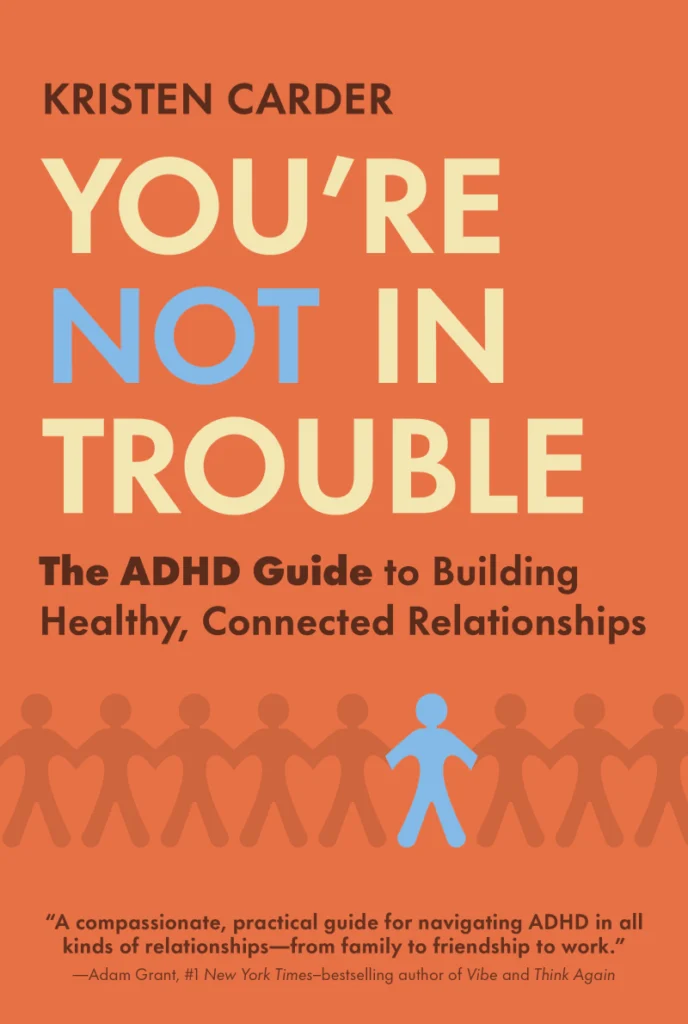
I will do my best to get to them. I also have a list, like I said, that I compiled from Instagram and my Focused Membership, and so put those questions in the chat, of course. Now my list is gone. Makes sense. That makes sense. That happens sometimes. Let’s go find it. Let’s go find it together. There she is. Okay, found her. When you put your questions in the chat, if you could make a really big like question, as in like write out the word question, so I know it’s a question, not just a comment. Sometimes the comments go really, really fast, and I might miss it. So if you have a question, write the word question out nice and big for me, and then write your question. That would be great. The first question that I have here is: If you were to go back and write your book all over again, what would you change about your process? This question had me really thinking. I got it yesterday from a focus member, and I was like, “That is such a good question. For those of you who don’t know, I just wrote a book. It’s coming out in October. It’s called “You’re Not in Trouble. It’s the ADHD Guide to Building Healthy Connected Relationships. And as a person with ADHD. Writing a book, well, I think for anyone, writing a book is not for the faint of heart. It is not easy. But as I was reflecting on the book writing process, I am happy to report there’s actually not much that I would do differently. There’s really not. I think I did a great job. I met all of my deadlines except for one. I was like a week late on one of the deadlines. I think that is first of all like an enormous, enormous accomplishment. But here’s the one thing that I would do differently. Are you ready? I would have author photos taken like right away as I started the book writing process. I didn’t realize, or I didn’t think it through, or nobody told me, or I just didn’t connect the dots that eventually I would need a very beautiful photo to go on the inside cover of the book. I didn’t even think about that, and so yes, we have a photo, but it’s kind of an old one. I’m just like, I wouldn’t have chosen that one exactly. I would say I’m like 10 pounds lighter. I have a lot fewer wrinkles. My hair is blonder. Like I just, I just wouldn’t have chosen it. I would have an up-to-date photo. That is the thing that I would do differently. And authors, when you sign your publishing contract, get your photo taken because you’re gonna need a photo. Why didn’t anybody tell me? I don’t actually fault myself for that. I feel like somebody should have said, “Hey, by the way, by the way, you’re gonna need to have a beautiful photo for the book, so make sure you have one in advance. Because by the time that they asked for it, they were like, “Can you send us this by tomorrow? And I was like, “Oh shoot! Oh shoot! So that’s what I would do differently. I would have authored photos Taken immediately. Next question: Is doing a live podcast a way of chasing new dopamine? Answer: Yes, 100% 100% It is a way to it is a way to solve a problem, which was oh shoot, I haven’t done new research that I want to, you know, like talk about on the podcast. I don’t have anything glaring on my mind. What in the world am I going to talk about? I know. I’ll try something brand new. I’ll try something in front of people while they’re watching me. I will see if I can do this, you know, like those ADHD challenges that we like to set for ourselves that create a little bit of that dopamine for us, especially getting in front of people. Yeah, that’s what this is. That’s what this is. Next question: Top five crunchy snacks. Do you know that I couldn’t even list five? I don’t know if that I’m super boring, but I couldn’t even list five. But here are my top four. Number one, hot Cheetos. Never going to not eat hot Cheetos.
Kristen Carder 13:12
Literally just ate hot Cheetos 30 minutes ago while I was eating my lunch here. Yes, I packed them in my little lunchbox. Hot Cheetos. Do you know the problem with hot Cheetos? Your fingers never lie. Your fingers tell the story that you ate those hot Cheetos. They leave they leave evidence because they literally turn your fingers red. So hot Cheetos number one, pretzels can’t resist a like cannot resist a good crunchy pretzels. My favorite are the Snyder’s snaps. If you’re in the Philly area, you know Snyder’s Snyder Snap pretzels are the best. Apples, I love a good crunchy apple. And again, this is just a Pennsylvania thing. Martin’s barbecue potato chips. If you want to do a Google, they are the best barbecue potato chips in the world. Martin’s barbecue potato chips-they are so freaking good. Okay, next question: When did you realize you were going to focus on different aspects of ADHD than most other coaches’ podcasts and channels, most other people I find try to get you through your day to day, and it seems like you try to explore how we got here, the lies we were told along the way, and how the past is keeping us tangled up and limiting us. I really appreciate that breakdown, by the way, of like what I do focus on, some other channels talk about the brain stuff behind what we do, but not many about the emotional journey that got us here. I will kind of like link this back to the dopamine question. I always talk about things that interest me, and I never talk about things that don’t interest me. That’s just the way my brain works. I have been. An interest-based nervous system, and so I’m going to talk about the things that, like, I’m curious about, and I will say that I’m not curious about productivity hacks. I’m just not. I’m not curious about like the 10 ways that you can declutter your home or get more done. I just that’s not interesting to me. What is interesting to me is the emotional experience of people with ADHD and the relational experience of people with ADHD, and how that impacts how that impacts our day to day. So the lack of self trust, the the lack of relational health, the interesting correlation it seems between ADHD and trauma and complex trauma and all of that like that is what lights me up, and I will say as someone who has struggled in her relationships from birth-that-that has probably been my biggest pain point, and so of course that’s what I want to talk about because that’s what interests me, and that’s what that’s where like a lot of my work has been. So so much of this podcast here is just the outpouring of my own personal work, right? So being dysregulated in my real life, like the emotional experience of being dysregulated, and then how that is impacting my work, how that is impacting my relationships, all of that. So I don’t have a better answer other than y’all. I just talk about what I find interesting, and if you can also tweak your work to the point where you are able to focus on the things that interest you most, I think that that is so important for us. Some of some of you are in corporate jobs. Some of you are, you know, entrepreneurs. We’re we’re in all industries in the workforce, but if we can really allow ourselves to allow ourselves to chase the dopamine, follow our interests, and as much as possible dive into and hyper focus on the things that we’re curious about in the workplace, I think that’s where we’re really going to shine. Yes, I totally agree. So your comments are saying like relationships are so hard. 100% This is exactly why I wrote the book because, in my own experience, but then in coaching people with ADHD, our relationships are a shit show. They really, they just are. And relationships, of course, impact our quality of life. And so, if our relationships are unhealthy or unsatisfying or disconnected or dysregulated or we’re experiencing so much rejection sensitivity, that’s going to impact our quality of life. We must, must, must make improvements in those areas so that we can improve our own quality of life. All right, this kind of goes along the same the same line.
Kristen Carder 18:14
Next question is: How does being raised with consistent nurture, emotional validation, support, and teaching around emotional regulation affect people later in life compared to people who did not receive those things. Big sigh here from me. Big sigh. Here’s the thing: when you’re raised in an environment with consistent nurture, emotional validation, support, and teaching around emotional regulation, here’s what you get: you get to build a healthy sense of self. You get to build the foundation of healthy self trust. You get to build the foundation of healthy, healthy entitlement, healthy. What’s the word I’m looking for? What is the word I’m? Hang on, everyone. This is a ADHD moment, a little brain fart of a moment. Self confidence. See, it wasn’t that hard. It was there. It was hard to find. You get. You have the luxury of building a healthy sense of self, healthy self confidence, healthy self trust. Imagine, yes, navigating ADHD, but having healthy self trust, having the ability to have a sense of self that is strong and supported, it really changes the way that you approach life because so many of us with ADHD. Who were not raised with consistent nurture, emotional validation, support, and teaching around emotional regulation, we find ourselves doubting ourselves constantly, doubting our own experience, self gaslighting, not trusting ourselves, not being able to emotionally emotionally regulate, being caught and trapped in shame spirals. One one of the things that happens when you’re raised with nurture and emotional validation is that you learn that you’re allowed to mess up and not completely lose your mind. You’re allowed to mess up and still stay connected to the people around you. So there’s a very big difference. It doesn’t mean necessarily that you wouldn’t have ADHD, but it’s like when ADHD shows up, you’re not completely broken by it. You don’t shame yourself, blame yourself, self judge yourself, right? And so it changes the experience of having ADHD. This is really at the heart of my work: is helping us to learn those things now, helping us as a community of people with ADHD to learn how to build our own self-nurturing, emotional validation, self support, and emotional regulation. So, if we can do that for ourselves now, then we can develop that healthy sense of self later in life. That self trust. We can do that now. I did that at age 40. I’m 45 now. I’m like only five years into it, right? So, it took me four decades to realize, oh, this was never built for me, so I need to build it for myself. Okay, loved that question. What advice do you have for remembering things? This is a this is a good one. There’s there’s a couple of things that I recommend when it comes to remembering things. First of all, we have to make everything external. We cannot rely on our brains to remember things. All right. When you have ADHD, you will most likely struggle with deficient working memory, and what working memory is, is it’s like that bulletin board in your brain where your brain can tack up things and hold it there to remember for long enough for you to accomplish the task. When you have ADHD, not only do you not have the bulletin board, but the sticky notes where things are written down are just like blowing in the wind. They’re just like flying everywhere, and so inevitably we’re going to forget so much of the things that we really truly care about and that we really truly want to remember. And so the key here is to make sure that you’re not relying on your brain to remember. That means you’re using a calendar. That means that you’re writing everything down and you’re keeping it in like a visible place. You have to make things very, very visible for yourself. You’re checking in with people and making sure that you’re on the same page, so like we have it scheduled at this time, correct? That’s called asking for reassurance, which I know can sometimes be annoying, but it’s also just very, very important that you are making sure that you’re on the same page with other people. I use Siri on my phone constantly to remind me, and I’ll even do that in the middle of meetings or in the middle of conversations.
Kristen Carder 23:43
I’ll say, “Wait a second, I need to set a reminder, because I have three kids. Especially, this is like a great example as a parent. My kids will say, “Like, hey, I’m out of shampoo. Well, how am I going to remember that, right? So, if I don’t have a running grocery list, which I don’t, I should, but I don’t. I’ll just pop it into my phone. Remind me to buy shampoo tonight at 9p.m. and then I will add it somewhere, you know, to the the order of groceries that I have, or make a new order, or whatever. So I’m constantly using external things to remind me. That is huge. You have to make things external and not rely on your brain to remember them. We have this thing that we do where we’re like, I should be able to remember it. I should be able to. I’ll remember it. No, cut it. Cut it out. Cut it out. You’re not gonna. You’re not gonna remember, and you shouldn’t be able to remember why. Why? Because you have ADHD, and when you have ADHD, you have deficient working memory, which means that you’re just you should not be able to remember. And if you approach your life in that way, okay, I shouldn’t be able to remember. I’m not going to remember now. What am I going to do about it? That’s when. Things start to change for the better. That’s when you start to develop a system that works for you. That’s when you make sure that you’re not just relying on yourself to remember the things, but that you’re creating some sort of system that works for you. And all of us are going to have different systems, and that’s totally fine. All right, next question: Advice for perfectionism. Who here struggles with perfectionism? Oh my gosh! I always cite Russ Ramsay when it comes to perfectionism in his book *Rethinking Adult ADHD* He states that perfectionism is the number one thought distortion of adults with ADHD. It is something that most of us struggle with, and and the way that I define perfectionism is we set the bar too high, and then we beat ourselves up for not meeting that expectation. We’re we’re constantly setting the bar too high for ourselves. For example, I should be able to remember this, right? Which I just talked about. No, you shouldn’t be able to remember it. That’s a form of perfectionism. Okay, so we’re setting the bar too high, and then we beat ourselves up when we inevitably don’t meet those expectations. So this person says advice on perfectionism, particularly the part where you get stuck on a detail so much, you forget what the initial task was about, or you give up the task completely. So I have a lot of thoughts on perfectionism. I’ve talked about it on the podcast, and I also have a free course. I believe, and Dan, maybe you can fact check this for me. I believe it’s at ihaveadhd.com/perfect. I’m pretty sure that’s what the URL is. It’s a free course on perfectionism if you want it. That is correct. Great, I love it when I’m right. Okay, particularly when you get stuck on a detail that so much that you forget the initial task. Most of the time, let me say this: most of the time, perfectionism is self-protective. Okay, so let’s just like take a moment here. Most of the time, when we are exhibiting perfectionism traits, it is a form of self-protection, meaning if I can get this right, then I will not be susceptible to criticism. If I can get this right, then no one will yell at me. If I can get this right, then I can protect myself from other people’s anger or thoughts or whatever it might be, and I want you to take just take a minute and reflect. Does that resonate with you? Perfectionism as a form of self protection. Now, sometimes that can be seen as I’m going to edit this, and I’m going to hyper focus on this, and I’m going to spend all of my time on tweaking it to the point where I never actually finish it and have to put it into the world. And let me tell you how this relates to my life. I had to let go of a lot of perfectionism when writing my book because I know it.
Kristen Carder 28:26
It’s not a perfect book. I know if I had spent another year on it, would it have been better? Probably. If I’d taken another year or two or three to write the book, and I had maybe consulted even more experts and done even more research and edited and tweaked and you know made sure everything was better and better and better. Would it have been a more Perfect book, probably. Right, and so perfectionism is a lot of times a delay tactic, so that we’re not having to put our work out into the world. And this is tough for us because we can kind of have this like moral high ground of like, well, I just want it to be good. I just want it to be right. I’m going to do this over and over because it, you know, anything worth doing is worth doing right. So I’m going to make sure that I’m doing this perfectly and I’m doing it right. But the thing is, it can often become a delay tactic, so that nobody actually has to read the vulnerable stories that I’m sharing in the book, and nobody actually gets to critique my work, and nobody actually gets to see. What I really think about things, nobody actually gets to criticize me because I’m still tweaking it and I’m still editing it and I’m still making sure it’s right. And so, a lot of time, perfectionism is self-protective. It’s helping me to hide. And so, when you get stuck on a detail, as this person is saying in their question, when you get stuck on a detail so much that you just forget what the initial task was, that’s probably self protection. I don’t even want to do the task because if I do it, then I have to be accountable to it. If I do it, then I may be open to judgment, and so I’m just not going to do it. I’m just gonna get like stuck in hyper focus. Okay, does that make sense? So I want you to think through perfectionism as self protection, and ask yourself when you are stuck in hyper focus, when you are stuck editing, when you are stuck delaying and tweaking and quote unquote making it right. I want you to ask yourself. Wait a second. What am I protecting myself from here? What am I? What am I protecting myself from? Because for me, I will tell you, I’m protecting myself from being seen, from being vulnerable, from potential criticism, from people interacting with my ideas in a way that perhaps feels uncomfortable for me, right? That’s that’s exactly what I’m protecting myself from. I wonder what your answer would be. Yes, this person in the comment in in the chat says I hyper focused yesterday on a thing for five hours, forgot to eat or drink or sip water, had to leave it and come back later. Yep, and I didn’t even get it done. Yes, yes, yes. There is a difference between the hyper focus, the the ADHD hyper focus that kind of like steals us away, right? And we get we just like get kind of lost in that glorious feeling of being in the zone, but I do wonder sometimes if we let ourselves go there so that we can just kind of hide from actually finishing the task, getting it done, and putting it out into the world. I remember the day, and it was not that long ago when I when my book went to print, and it was literally there was nothing else I could do to change it, tweak it, edit it, or make it better. Let me tell you, it’s a very uncomfortable day. It was a very uncomfortable day. It was like, oh, there’s nothing more I can do here. Whew, that is not super fun. All right, here is where I’m going to end with the questions that I have from yesterday from social media. If you’re not hanging out with me on social media, what are you doing? I love to hang out on Instagram at I Have ADHD Podcast. If you want to go find me there, I’m also on TikTok and Facebook at the same handle at I Have ADHD podcast, but your girl loves Instagram.
Kristen Carder 33:05
Okay, that’s where I spend most of my time, probably because I am an elder millennial, and that is just where we like to be. Most of us, not all of us, but most of us. Okay, and then I’m going to come to your questions in the chat. So if you do have a question, make sure to pop it into the chat. How to regulate emotionally to process troubling national and global news without despairing, y’all? This is so hard. How do I process my emotions while watching the news without despairing, sticking my head in the sand of “I’d rather not know” or avoiding news generally has worked for me, but for too long. I don’t want to choose ignorance, but all of the divisiveness is emotionally taxing. I would like to say same, and this is a real pain point for me. I want to be someone who’s informed, and I want to be someone who knows enough in order to make good decisions, and in order to like understand what’s happening in the world. And yet, it is so dysregulating, maddening, angering, distressing to see what is happening in the world, and so I don’t have a great answer. Mostly, what I have is solidarity and a warm hug for you because I really do not have a great answer. I will say that your experience is one that I relate to heavily, and I wonder if you all feel the same way. Where you’re just like, I want to know what’s going on in the world, but actually, I get really overwhelmed. I get extremely dysregulated, and as a person with high levels of empathy, it can often hijack my. So I can be feeling so deeply about an issue or an injustice or something happening across the globe that I’m distracted from my own life, meaning I’m not showing up the way that I want to with my family or at work or with my friends, and so what I’ve done personally is kept my news consumption quite small, and I agree with you that like sticking your head in the sand and avoiding it is maybe not the way we want to go long term, but also making sure that we’re consuming in small doses at a time of day that we know we have capacity, including the capacity to re-regulate. Right, re-regulating after hearing distressing news is is actually really important. So, do I have the emotional bandwidth to engage with this and recover from it, so that I can serve my community, because I truly believe that humans were not created to know absolutely every single thing that was happening all across the world at all times, and technology and social media has made it so. Now we do. Do you have a nervous system that can tolerate it? Is the question. Do you have a nervous system that can tolerate knowing all of the things that are happening? Do you want to limit it to your own local news, to the community that you’re living in, that you’re engaging with? That might be a solution for you where you’re like, okay, I want to know what’s going on, but I actually want to know what’s going on most in my own community. But what what we often do is kind of go from zero to 100 and say like, I’m either not engaging at all, or I’m engaging with everything all of the time, and I’m consuming all of this, like input and news, and now I’m dysregulated, and I’m carrying the weight of the world on my shoulders while trying to live my life, and it is so, so, so difficult. So, adding in some nuance, some gray area, and taking things in small doses, especially focusing on the issues that you care about most. You are a unique person with a unique personality and gifts and passions, and so I would encourage you to focus on the issues that matter to you the most, and let other people care about the issues that matter to them, so that we’re kind of carrying the weight as a community, and sharing that load together. Okay, all right. Let me go to the chat here, and I’m looking for questions. And you might want to repost them. The chat has been going crazy, which is really amazing. Oh, somebody says you don’t have wrinkles. Well, that’s adorable.
Kristen Carder 38:01
That means that the lighting and the camera and everything are doing what they’re supposed to do, which is so amazing. You can send the questions in via chat. Somebody just asked, “How was I supposed to send in a question? Emotional dysregulation to overwheel or CPU. Okay. Um. Oh, this is a good one. What are you giving yourself permission to do differently since your ADHD diagnosis? Gosh, that is such a good one. I’ll tell you the number one thing. The number one thing that I’ve allowed myself to do differently is not wake up early in the morning and work out or do anything productive. I am over that shit. I am not doing that. I’m not. I am not doing it. I am not doing it. There was this like like 2010 time frame were like all of the boss babes. You remember the boss babes, like Rachel Hollis and the like. The boss babes were like, if you want it badly enough, you’ll do it. If you if if you care about it, you’ll get it done. If you want rock hard abs, you just have to put in the work. And girl, I tried to be that person for far too long, and then when I really began to learn about ADHD, and learn about its impact on my life, and on my sleep, and on my nervous system, and how waking up at a time that works for me-we’re just still like seven, 730-but still, it’s not five a.m. like all of Rachel Hollis. I almost said no offense, but like yeah, offense intended. Where was I going with this? Oh, waking it up at up at a time that works for me, going straight to the coffee pot, or now my. Ag one, but like coffee pot slash ag one, sitting on my front porch and getting sun, the sunlight in my in my eyeballs. No matter what time of year it is, I sit on my front porch, I drink my my coffee, and I get that sunlight in my retina. That’s what I need to do for me. So that’s like a huge thing that I’ve given myself massive, massive amounts of permission for. Is girl, you do you do not have to get up early. You do not have to be productive right away. You don’t have to get up and force yourself to work out. You don’t have to do it. Get up leisurely. If you want to work out during the day, great. If you don’t, okay, fine. Who cares? I’ve just like really trashed the girl boss advice. I’ve thrown it into the trash can, and I’m proud of it. Is my camera on? No, your camera’s not on. Don’t worry. It’s so funny. That’s cute. That is so cute. Here we go. Managing ADHD and having ADHD child is so challenging. It really is. And here’s what I will say to you: prioritize managing your own ADHD because when you are regulated, when you are medicated, caffeinated, regulated, and ready to roll, as we say around here. You will be able to be the parent that your child needs. I know it’s so easy to focus on our kids at the expense of ourselves, and listen, I get it. I’m a mom of three, 100% with you. But what happens when we do that, is that we actually become less able to function, which means that we’re not able to support our kids in the ways that they need and deserve. So while it is counterintuitive to prioritize your own ADHD treatment and your own ADHD journey, that is so. That is so 100% the road to becoming the parent that your ADHD child needs. When you prioritize medication, if it is a good fit for you and if you choose to use it, or other supports for ADHD: exercise, nutrition, therapy, coaching, lifestyle supports. When you’re prioritizing that for yourself, then you get to be the person that your the the parent that your child needs. What your child needs is a parent who sees them, who knows them, who understands them, who empathizes with them, and who can help them learn regulation tools? There are three things that a kiddo needs. A child needs attunement, which is I see you, I hear you, your experience matters to me. A child needs unconditional love, and by that I mean unconditional acceptance.
Kristen Carder 43:03
I I see who you are, and I love you the way you are. And a child needs emotional regulation, co-regulation. Those are the three things, and those are really hard to provide for our kids when we are under supported for our own ADHD because then we become chaotic and dysregulated and unproductive and just like supporting someone else when our own ADHD is running the show. It’s almost impossible, and so the way to mitigate that is to support yourself first. I hate, I hate this analogy. But as they say, put your own oxygen mask on first. Like that is what is most important because it’s then that you are able to give your child what they need: attunement, Unconditional love and emotional regulation. Those are the three things that they need. They don’t need you to be a perfect parent. They don’t need you to have it all together. They don’t need you to remember everything perfectly. They need attunement, unconditional love, and emotional regulation. Okay, quick question. I’m an ADHD single mom, and I’ve just gone back to my demanding job after a year of burnout. Oh, bless your heart! I’ve got a kid with zero childcare support for the next five days. How do I cope? Oh my goodness! I’ve got my kid with zero childcare support. Listen, I think, my dear, that you’re going to have to just hang on for dear life. Managing a job while parenting children, and you didn’t name how old your kiddo is. If you want to let me know how old your kiddo is, that might actually make it so that I can give a little bit more specific advice. Oh. He’s four. Okay, four. I think that he is going to need to be on his iPad or watching TV quite a bit, and I think you’re going to need to forgive yourself for the fact that he’s having way too much screen time. I don’t know that there is any other way to cope other than allowing him to be safe and fed and loved, but very distracted, so that you are not having to be his source of entertainment. If there is anything that you can do to get outside support, if you have any family support, if you have a friend, if there’s anyone that you can ask for for help, I would encourage you to do that. But if not, I think screen time is going to be the answer. And I am so sorry, and I’m so sorry. Sometimes screen time is just the answer. Like parents in the chat are going to know that sometimes screen time is just answer. It’s not the perfect answer. It’s not the answer that we all want all of the time, but sometimes screen time is the answer. It just is. It just is. How do we forgive ourselves for the things we don’t get done? That is a really good question. That’s such a good question. When we inevitably don’t get things done, how do you treat yourself? And I don’t mean treat yourself like from Parks and Rec, that amazing clip where she’s just like treat yourself. How do you talk to yourself? How do you feel about yourself? How do you repair with yourself when you inevitably don’t get the things done, if your go-to is shame, blame, and judgment, what that is going to inevitably lead to is you getting less done. Is you. being disconnected from yourself and other people? Is you having a terrible emotional experience? It’s just what happens. If we can make a repair with ourselves, okay. I see you didn’t get this done. First of all, I understand it. I have compassion for you. I I know why you didn’t get it done. This is really hard. It’s been a so like for me yesterday, or like this week, I I had time to prepare for this podcast, but I just stared at the wall and could not think. I did. I stared at the wall and couldn’t think. And I will let you know that I have a lot of compassion for myself because I know why I did that. I was actually dealing with a lot of grief this week. And when you’re grieving, you can be very, very, very distracted.
Kristen Carder 48:00
Your brain doesn’t really show up for you the way that you would want it to, and so I know exactly why I procrastinated and didn’t prepare. Okay, so because I have that compassion, I can treat myself with kindness. I still needed to make a plan, but I didn’t do it in a way that was self-shaming, blaming, and judging. So you, there needs to be like this repair system that you have with yourself, just like you would with your partner or your child, where you know that relationships are built on repairs. They’re built on coming back to the person and saying, “Hey, I didn’t do that perfectly, and I’m really sorry about that. And I know how it impacted you, and I want to do it differently next time. But I want you to know that I’m sorry. Can can you do that with you? Can you have a repair system with yourself so that you’re staying connected and kind while trying to solve the problem, because a lot of the times the problem isn’t necessarily that we didn’t get it done; it’s that we then hop on the self-shaming train, and we can’t come up with a solution. We can’t come up with a now what solution of how to solve the problem, but when we can approach ourselves with kindness and connection and care and compassion, then we can solve the problem. Okay, I didn’t get it done. What do I want to do differently? How do we need to solve this together? The creativity can be there. The problem solving can be there because we’re not stuck in a shame spiral. I try to think about how and where I can lower my standards. I think that’s amazing, and not in a way that’s like I don’t matter, and so I can just lower my standards, and you know nothing matters. That’s not what it is at all. It’s hey, I have ADHD. Where can I cut myself some slack? Where can I give myself some? Race. Okay. Yep, I had to provide these for myself. I think this person is talking about unconditional love, emotional regulation, and attunement. My parents had no idea about ADHD. I’m 64, and ADHD wasn’t a thing. My mother had ADHD, but her doctor never told her that because he was very old-fashioned. Exactly. I know. I think about often like how privileged we are to live now and have so much understanding of ADHD, and think about our grandparents and our great grandparents, and their lack of knowledge, just because it just wasn’t in the zeitgeist. I think it’s so amazing that we have this knowledge now. Trying and failing so hard to not drag my progress to submit revised scientific journal manuscript. Luckily, the editorial office gladly granted deadline extension without feeling troubled at all. That’s beautiful. Accept that deadline extension. That’s incredible, amazing. Love it, love it, love it, love it. Um. Okay. Right, my friends. Yeah, so good. Okay, I was just making sure I got everything. That is heavy. Is it ever really enough, though? Maybe not enough, Atino, to be kind to yourself. Is it enough? Is self kindness enough? I definitely think that self Kindness is non-negotiable. We treat it like it’s just this added bonus, like oh, like if I want to be kind to myself, I guess I will. But no, no, that’s not at all. It’s not a bonus thing. There’s a so much research on self-compassion and how self-compassion not only keeps us connected to ourselves, but again, just like I said, allows us then to solve the problem at hand. It allows us to be creative and figure out what we need to do differently, so that we are making amends and we are like recalibrating and able to get things done. All right, I’m going to answer one last question, and then we are going to call it quits for today. This person says, “Topic using the term disability versus differently abled. It’s an interesting topic using the term disability versus differently abled, and the importance of not erasing our experience with fluffy words, the danger of erasing our disability with fluffy words, also the use of the word superpower and how it can be gaslighting. I’m curious for those of you in the chat. How do you feel when someone says ADHD is a superpower?
Kristen Carder 52:59
Some people really resonate with it, and I don’t ever want to take that away. If it makes you happy and if it makes you feel empowered, I’m never going to take that away from you. But I will tell you that in my experience, ADHD has been one of the most detrimental aspects of my life. It’s been so detrimental to my finances, my ability to work, my relationships, my ability to process information and make good decisions. ADHD has caused me so much pain. It’s cost me so much money. It has impaired my decision making. It has, for the first like 10 years after college, I could not work full time. Could not. I couldn’t work full time. I didn’t have the capacity, the understanding, the emotional regulation, the ability to be productive. I couldn’t work full. It’s cost me 1000s and 1000s and 1000s and 1000s of dollars. So I reject personally. I reject the idea that ADHD is a superpower. I know exactly why people use this term, and I’ll tell you who uses it. It’s parents, neurotypical parents, or people who don’t know they have ADHD. Parents who are not diagnosed, who have kids who are diagnosed, who are uncomfortable with telling their child that they have a disability. I’m just going to say it. That’s that’s where I see it the most is in when parents don’t know how to talk to their kids about ADHD, and so instead of telling them the truth, and the truth will set you free. Instead of telling them the truth, they say, “Don’t worry, babe.” ADHD is your superpower. This makes you amazing. And here’s what I say. Here’s what I always now. For those of you who don’t know, prior to becoming an ADHD coach and working with people with ADHD, I owned a a tutoring center, a learning center in my hometown, and I worked with students who had ADHD, and I worked with their family as a whole. And the parents would come to me and say, “The parents would come to me and say, ‘I don’t know how to tell my kid they have ADHD. I don’t want them to feel badly about it. And my response was always, “Honey, they already feel bad. They already feel bad. They already feel badly that they’re struggling in school, that they’re struggling to make friends, that they’re struggling to do the things that you tell them to do, that they’re not really following the rules, that they’re getting all. They already feel badly. ADHD is not going to the label is not going to make them feel badly. They’re already labeling themselves and you and the teachers, maybe explicitly or implicitly, are already labeling them. You’re already calling them disorganized or lazy or not reaching their potential or not living up to what we think they could do. You’re already labeling them. So the label of ADHD is not harmful. It’s a beautiful explanation of how their brain works and why their brains and body interact with the world the way they do. I’m getting fired up. Okay, so my friends, the label of ADHD is actually a beautiful explanation. Hey, so when when when parents would come to me and say, “I don’t know how to tell my kid they have ADHD. I don’t want them to feel badly about it. I just like maybe I shouldn’t tell them. I said, “Whoa! It was so great to be able to do this in a professional capacity. I was able to speak to these parents and say, ADHD is such a great explanation for why they’re struggling, and so what you’re actually giving them is a name for their struggle. And so here’s exactly how I would say it to them, Johnny, you know how you’re struggling in school. Yeah, you know how doing homework is like the worst ever, and we kind of we fight about it like all the time, don’t we? Yeah, I hate that. Yeah, I hate it too. You know how you are like always forgetting things, and you’re running late, and like life is just seems really frustrating. Yeah. Guess what? We figured out why you did. Yeah, we did. We figured out why you’re struggling. You have something called ADHD, and ADHD is a neurodevelopmental disorder that means your brain functions a little bit differently than everybody else’s. And guess what?
Kristen Carder 58:00
What we can help you now that we understand your brain. Like, what is bad about that? What is that? Oh, you mean I’m not just lazy? No, you’re not lazy. And listen, I want to apologize for making you feel badly about this. That’s actually on me. I’m I’m really sorry about that because I just I didn’t know you had ADHD, but I’m so glad that I know now because I will be able to support you. I’m your parent, and I’m going to be able to support you, and I’m going to be able to talk to the teachers about the ways that they can support you too, isn’t that great? Yeah, that is great. I mean, that is not hard. That conversation is not hard. That conversation is actually just so wonderful because what it does for Johnny or for whoever it is is it gives them a name for their struggle. Okay, so instead, this is what a lot of parents want to say. Listen, we found out you have ADHD, but don’t worry, don’t worry. ADHD is a superpower, and it means that you’re creative and smart and great. And don’t do that. Don’t do that. No, they may be creative and smart and great, but don’t give ADHD credit for that. Give them credit for that. Give your kid or yourself credit for being smart, for being creative, for being innovative, for being curious, for being energetic. Give yourself or your child credit for that. That’s what makes them amazing. Don’t give ADHD credit for that. ADHD sucks. Okay, like ADHD is not fun. Give your kiddo credit for that. They deserve the credit for that. And ADHD is just an explanation of why they’re struggling. And now we have a roadmap to help them, whether that is through medication or executive function coaching or. Or maybe an IEP or a 504 plan, or whatever the case may be. Now we have a pathway to help them, and it’s not because it’s a superpower. It’s because it is a disability. And what do we do with disabilities? We support them. We make sure that they have what they need to thrive in spite of it, no. I just, I’m just feeling big feelings. If it’s a superpower, why does it make me feel so terrible all the time? If it’s a superpower, then why does it ruin my life? If it’s a superpower, then why did I procrastinate preparing for this podcast? If it’s a superpower, what the heck are we doing here? I’m saying it’s not the language we’re going to use, not in this space. If it’s great for you, I completely understand. You get to do what you want, but it’s a no from me. Okay, this person got me all fired up. Thank you so much for being here. I absolutely loved every second of it. I was just talking to my producer that we definitely need to do these recordings, these live recordings more often, and 100 we’re going to. So I will talk to you next week. If you’re here, go ahead and hit that like button, hit the subscribe button, give us some love. That would mean the world to me, and I can’t wait to see you next week. I’ll see you. Bye bye. If you’re being treated for your ADHD, but you still don’t feel like you’re reaching your potential. You’ve got to join Focused. It’s my monthly coaching membership where I teach you how to tame your wild thoughts and create the life that you’ve always wanted. No matter what season of life you’re in or where you are in the world, Focused is for you. All materials and call recordings are stored in the site for you to access at your convenience. Go to ihavedhd.com/focused for all the info.
Transcribed by https://otter.ai