Kristen Carder 0:05
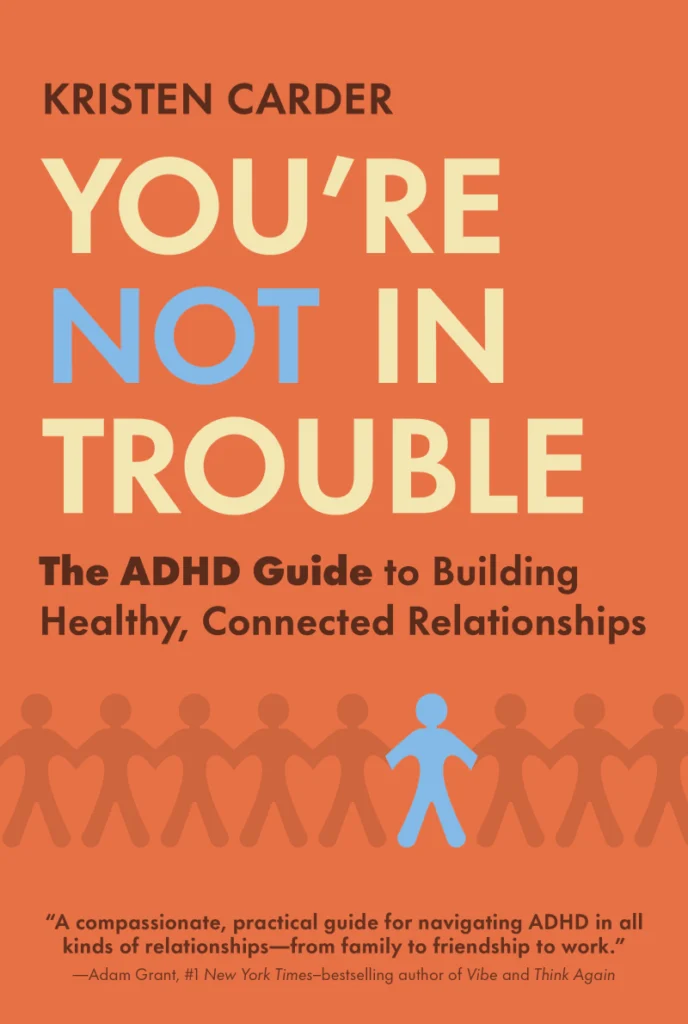
Welcome to the I Have ADHD podcast, where it’s all about education, encouragement, and coaching for adults with ADHD. I’m your host, Kristen Carter, and I Have ADHD. Let’s chat about the frustrations, humor, and challenges of adulting relationships, working, and achieving with this neurodevelopmental disorder. I’ll help you understand your unique brain, unlock your potential, and move from point A to point B. Hey, what’s up? This is Kristen Carter, and you’ve tuned in to the I Have ADHD podcast. I am medicated, caffeinated, regulated, and 100% ready to roll. Let’s go! This is the most unique podcast episode ever in the 450 plus episodes that we put out there. This one is extremely unique because I have never been interviewed on my own podcast, and that’s exactly what’s happening today. Dr. Ari Tuckman, the esteemed Dr. Ari Tuckman, is here today, and he is interviewing me about my book. This is a really interesting experience for me because Ari Tuckman is one of those ADHD experts whose books I read well before I was an ADHD coach. I was just researching ADHD for my little tutoring center that I owned in my town, and so many people were coming to me and asking about ADHD, and I was like, I need to learn more. And I have such vivid memories for some reason of reading his book in particular, and now I consider him a friend, and we have connected in so many ways. He’s been on the podcast so many times, friend of the show, and he’s here today to interview me about the book. I’m so excited for you to hear this. I’m going to be doing this a couple times actually after my conversation with Ari, you know, the holidays are coming up. We’re traveling to Indiana to see family. Like life is busy for me, just like it is for you. And I was thinking, how in the world am I going to run a coaching program, advertise for my book, and have a weekly podcast? Like, how am I going to do that over the holidays? And one of the things I thought of, I have been on so many podcasts recently promoting the book, talking about the book, and it’s been such a gift. I’ve loved every conversation that I’ve had, and I think I’m going to feature a couple of those episodes here on my podcast. So stay tuned for that. If you enjoy me being interviewed today, I think you’re going to get a little bit more of this in the coming weeks as the winter holidays are upon us. So stay tuned for that. I do want to let you know that I’m doing something really special. Actually, tonight, if you’re listening to this in real time, today is Tuesday, November 10th, and tonight at 7 p.m. Eastern. I’m hosting a book club. It’s just a pop-up book club tonight and next Tuesday, the 17th of November at 7 p.m. I’m going to host a book club to chat about you’re not in trouble. You can bring your book. You can bring your questions. If you haven’t purchased the book yet, that’s fine. You are still welcome. You’re still welcome to join us. You’re still welcome to come. I’m going to be hosting it on YouTube, and the link is in the show notes of this podcast. If you’re on my email list, I’ll also be sending you an email about that as well. I hope you join us. I think that is going to be a lot of fun. It’s going to be casual. Okay, people. It’s going to be quite casual. I’m going to be at home in my sweatshirt with my top knot messy hair. You might see my kids. It’s going to be casual. All right. I don’t have the capacity to like stay at the office and keep my makeup on. Okay, my hair is going to be a wreck. My makeup will be off. I’ll probably be in sweatpants, and I hope you will be too. Like, let’s just hang out casually, talk about the book. I will maybe do a couple readings from a couple different chapters, like my favorite parts. I will answer your questions, and we’ll just hang out and have a great time. So I hope you will join me for that. Again, if you’re listening in real time, it’s going to be tonight.
Kristen Carder 4:28
So go to the show notes and grab that link. Tuesday, november 10 at 7pm. Eastern, and Tuesday, november 17 at 7pm. Eastern. Come hang out, talk about the book, grab your copy or don’t. Whatever you want, it’s fine. You you’re allowed to hang out either way. All are welcome. I want to tell you a little bit about Ari Tuckman as he is going to be interviewing me. You’re going to hear that upcoming. Ari Tuckman is a clinical psychologist, sex therapist, author, and nationally recognized. Expert in the diagnosis and treatment of attention deficit hyperactivity disorder. One of Ari’s claims to fame is that he helps to put on the Chad conferences, children and adults with ADHD. Those conferences, he is he is like the man at the Chad conferences. He is everywhere. I went to my first Chad conference last year, and I am going again this year. So, if you’re going to be at the Chad conference this year, come find me. It’s going to be in Baltimore. It’s three days in early December. I will be there. I cannot wait. I will be speaking. I will be doing a book signing. I will be hanging out, so if you go, I hope to see you there. All right, here is my interview, meaning me being interviewed by Dr. Ari Tuckman. Please enjoy, and I hope to see you at Book Club tonight.
Ari Tuckman 5:54
Well, welcome everybody. I am super psyched to be here with my friend Kristen Carter and talking about her brand new, brand smacking new book, “You’re Not in Trouble.” There was much blood, sweat, and tears, and I think probably literally all three of those that went into this book. So I am looking forward to getting it out into the world, and you know, allowing you to, I don’t know, just make people’s lives a little bit better with it. So let’s start with this question. You might have noticed there are a few books out there on ADHD. I don’t know why do we need one more in in all of these crowded bookshelves. Why do we need one more book?
Kristen Carder 6:38
That’s true. There are a lot of books on ADHD, and there’s a lot of really good ADHD books out there. Where I think we are right now with ADHD is that we are coming to an understanding of it as like a society, and the books that have been published to this point have been so helpful, including your book, which I read, and I I’ve said this story to your face before, but just I want the listener to picture like 2015, 2016, Kristen Carter just starting to realize what it means to have ADHD, and going to the bookstore and just being like, I need to read something, and I grabbed a couple books, and one of those books was Ari Techman’s book, more attention, less deficit, and I have this vivid memory of myself laying on my bed, just flipping through this book, learning so much, and truly, like books like that have shaped our understanding and the culture of how we think about ADHD. What I don’t know that we’ve touched on yet, which I hope my book does, is ADHD like understanding it and viewing it through the lens of more than just productivity, more than just getting the things done, more than just like kind of triaging your life and making sure that like you’re getting out of bed, you’re going to work, you’re able to like make your finances not a giant shit show. Like all of the things in our lives that we’re having to triage first before we can think about anything else. But once the productivity and once like things are kind of calmed down a little bit, we have an understanding about ADHD. We’re medicated in whatever way works for us. We’re we’re treating it and we’re taking it seriously. What I have found in myself and in my clients is the biggest pain point is relationships. And what’s so crazy is that relationships do impact our productivity, right? Because when I’m distracted by a fight that I had with my kid or my husband or my best friend, I’m not getting anything done at my job, right? And so relationships where where we can kind of feel secure. Okay, I can go to work and I can keep a job and I can improve my finances. But why do I still feel like a child in my relationships? Why do I still feel so shaky, so insecure? Why am I having a fight with my kid, and then not being able to get anything done at work for the whole rest of the day? And so that’s what like I hope that this book really kind of unpacks and untangles that kind of next layer.
Ari Tuckman 9:13
So like when I read wrote more attention, less episode in 2009, you could write a book like that in 2000. You can’t write that book now, right? Like I call it. That’s a first book, right? It’s the first book you read on ADHD. What’s great about where the field is going is that we’re getting into all the rest, right? All the secondary things and the tertiary and all these other parts of life that we just weren’t able to talk about back when, so you know. And I think you’re absolutely right. Relationships are such a big part of our life, and your ADHD or whatever you got going right is going to affect how you show up in your relationships, and how you show up in your relationships is then going to affect how you’re managing your ADHD or the what. So yeah, and I love how I don’t know just sort of how deep you go on this into the nuance of it. Like, there’s it’s so easy to give generic bad advice or just boring generic advice, right? That’s like not that hard. But to give really kind of well thought out, insightful, actually useful advice, I think, is so much harder, and to do it in a clear way that communicates clearly what you’re saying that brings a bunch of heart. I think that that is so so much harder.
Kristen Carder 10:33
I appreciate that, and yes, when you mentioned like the weeping and gnashing of teeth, didn’t you know nobody writes a book easily. You just don’t, unless you’re putting it into AI and saying, “Write this book,” which apparently you can do right now. But I do really hope that it is clear and that people are able to kind of see themselves in the chapters and throw away what doesn’t apply to you, but be able to pick out the nuggets that really do,
Ari Tuckman 11:02
I think it’s also interesting because you talk in the book and in other places, but that you know everything you learned about ADHD and all the stuff that you did, right? All that ADHD-specific work that you did definitely made an improvement in your life. I mean, certainly, and yet also it didn’t like automatically transfer over into your relationship, son of a son of a bitch. It didn’t didn’t all just ta-da, right? It wasn’t like an automatic update in the background. So, so I mean, why not? What what was missing? What what got in the way of transforming all of your life all at once.
Kristen Carder 11:42
So much of our relational knowledge is built in our families. I don’t think that I know that. That’s obvious, and that like we know that.
Ari Tuckman 11:53
That’s our first classroom on relationships. Yeah,
Kristen Carder 11:56
100%. And when you grow up in a family like mine, which was highly neurodivergent, very dysfunctional, emotionally chaotic, productively chaotic. That original foundation of what it means to have a healthy relationship was never built. No amount of Strattera is going to help me build that relational foundation, and for anyone who resonates with my story, which is like growing up in a neurodivergent family, lots of undiagnosed autism, ADHD, lots of addiction, lots of dysfunction running amok. Those relational bricks, those that that like layer by layer foundation of relational experience and relational growth, was just never built. And so we can work on productivity, and on our ADHD, and on our understanding of our brains and our working memory and our time management, and we can do all of that without even touching the relational brick, without even touching the foundation of: Do I have self trust? Do I understand what it means to feel safe in a relationship? Do I understand boundaries? Do I understand? So all of the things that, in a healthy enough, safe enough environment, a child is taught when a child is prioritized and their reality is affirmed, and they’re not gaslit constantly, and their their needs are being met, and they’re not neglected. Right when there’s not dysfunction there, even an ADHD child can grow up with some really good relational foundation. But a lot of us, not all of us, but a lot of us, grow up in dysfunction, and so those relational foundations were never made. And so what is happening now is we’ve got a lot of grown-ups feeling like children when it comes to relationships and feeling like I’m in trouble, even when I’m a 45 year old woman in a marriage that I know is like pretty good marriage, but like why do I still feel like I’m getting in trouble when I forget to switch the laundry, right? And so like addressing those kind of like the minutia there, I think, is what I really hope this book addresses: is laying that foundation and that roadmap that was never laid for
Ari Tuckman 14:30
us. I mean, the hope is when you manage your ADHD better, you have fewer forgotten laundries, right, and fewer running late, and fewer whatever, right, and that that is definitely important, but it doesn’t automatically, it doesn’t inherently change that like knee-jerk flash of a moment feeling or assumption or worry when you still do it, you know, because you’re you’re still going to have your moments. But it’s sort of you know it’s kind of interesting. I always think of. Kind of like change versus accept, right? What are the things I can change? What are the things I have to accept, right? And there’s many things in life we have to accept. Some some things about us, and some things about our partner, and some things about the world and our kids and whatever. But in the book, you kind of strike, I think, a an important balance or a bit of a sort of both and, in the sense that, on the one hand, you’re very supportive of your readers to sort of to advocate for themselves, to ask for what they want and need, to feel like they’re allowed to ask, to I don’t know, nicely, respectfully, but perhaps firmly, you know, sort of pushing back when someone is not behaving respectfully, so like in that sense, I think you’re a very strong advocate for your readers and the importance of understanding ADHD and any other thing about who they are. But I think also you kind of practice what you preach here in the sense that in good relationships we can be honest with ourselves and with each other, and that means being honest about the things that nobody wants to hear. Right, the hard stuff. Being honest about like you’re great, I love your hair. Like that’s not hard, right? What’s hard is hey, this thing you’re doing really doesn’t feel good to me. In that, as much as ADHD is an important explanation, perhaps for things like oh that’s why I always run late, it’s definitely not an excuse. So like you don’t you don’t let your readers totally off the hook or to say it’s all everybody else’s fault, which I think is incredibly important because if it’s all everybody else’s fault, then you better cross your fingers and hope they do it different, because it means you have no influence, right? So, so how did you sort of think about that sort of both and of like, yeah, other people need to address their part, but also you, dear reader, right? You’ve got a part to look at here as well.
Kristen Carder 17:00
I’m not sure because I think the answer is just I try to approach the reader the way that I approach myself, which is, girl, you have some issues. We we gotta work on some stuff, and that doesn’t mean that you don’t deserve to be loved and accepted, and it doesn’t mean that you don’t deserve compassion from yourself and from others. And as someone with ADHD, it can be very hard to hold the nuance of both because we tend to be black and white thinkers. It’s much easier for us to be all or nothing. I’m either amazing or I’m terrible, but to hold the nuance of well, I am amazing and I am kind of terrible at the same time. But that’s not just a me thing. That’s an everybody thing, right? Like we’re all kind of great and awful at the same time. So what parts of myself do I really want to continue to work on, and what parts of myself am I just going to be like, you know what, I that is not for me. That is not my ministry. Like, for example, I no longer require myself to get up early in the morning. I used to force this on myself as like good people get up early. I want to be a good person. I should get up early, and I just decided that like getting up early is not my ministry. This is not for me, and I the strength
Ari Tuckman 18:36
you bring to the world.
Speaker 1 18:37
Yeah, it
Kristen Carder 18:37
is not, and it feels like a war crime, honestly, to my body when I’m having to get up, and my husband, I am very lucky in that Greg and I have been married for 22 years, and we have worked hard to accept each other. And one of the things that he has been willing to accept about me is, I don’t get up early. I’m not going to do it, and so that’s what he does. Right, like he gets up with the kids. I don’t get up until my kids have left the house. I just I don’t. And my kids laugh at me, and they joke about it, and they’re like, “Mom, well, you know, you’re not going to get up.” And I’m like, “Damn straight, I’m not.” So I have been able to hold that for myself, or I’m like I have strengths and weaknesses. I will say, listener, if you are partnered with somebody who is not as willing to accept you, who is not as willing to see the good and accept the bad, that can be really difficult because we often look to others to gage how we’re doing, and I really hope that this book actually gives people somewhere else to look rather than to look outside of themselves. Right to have kind of a roadmap for like how am I doing, and do I have to look at like how everybody else. Experiences me to see if they’re having a good time around me, then I’m a good person, and if they’re not having a good time around me, then I’m a bad person. And working that out is just really difficult. It’s hard, but it can be done. There are moments when you may need to look at your partner or your best friend or your parent and say, “I mean, you know who I am. Do you like me or not? Right? Like this, you know my flaws. Is this something that you’re willing to live with or not? Because I can’t keep doing this like song and dance of trying to pretend that I’m somebody that I’m not.
Ari Tuckman 20:40
I think that this example of getting up in the morning is a really good one, right? Because the thing of it is, if you had to force yourself, you could do it, not without a price, right? And obviously, when your kids were younger, I assume all your kids are taller than you by now, so like you don’t have to get up in the morning.
Kristen Carder 20:56
Yeah. So
Ari Tuckman 20:57
yeah, so like when you had toddlers, obviously you would just get up, but the issue. So the price is: if you force yourself to get up in the morning, you’re not getting as much sleep or as good sleep. You’re going to be crankier and less productive and less fun to hang out with when they do get home. So, like that is just the price. Now we may wish it to be different, but it’s you know like I mean, how my wife developed a shellfish allergy weirdly five years ago. We all wish that was different, and it’s not. So like, we don’t eat shrimp in front of her, kind of thing. So rather than sort of fighting it, rather than taking this moral stand that you should be up early because that’s kind of the right thing to do, it’s like let’s lean into our strengths. And although you didn’t say it. I have to make the assumption that there are other ways that you, you know, sort of balance a relationship and show it for your husband and show it for your kids. That kind of works out better for everybody, right? So it’s not forcing a square peg into a round hole.
Kristen Carder 21:55
Yes, that’s such a good point because I think that what I really want the reader to take away is like, what do I bring to the table, and what can I lean on as far as like, hey, these are strengths that I can really lean into and use to serve and support the people that I care about the most. So, for example, I do homework in bedtime. That is that is my role. I’m fine with it. I’m good with it. And just like sometimes I have to get up early because Greg’s traveling, sometimes he does homework in bedtime because I’m not, and it’s fine. We both know what we bring to the table. And imagine saying to your wife, like, “Well, it’s not my fault. You have a shellfish allergy. You know, me and our son, we’re gonna eat it anyway because, like, you’re not gonna ruin our vibe. Do you know what I mean? Like, that to me is just like, this is not how we treat each other, and it’s not how you treat her, obviously. But how can we also kind of expect that from our closest people, where it’s like, “Hey, these are some things about me that you are going to have to kind of adjust to, right?” And sorry, but even though you might be neurotypical, there are things about you that I have to adjust to too. Okay, so there’s this is the work of relationships.
Ari Tuckman 23:21
I mean, it is, and that’s like in any relationship, both people neurodivergent, both people neurotypical. You know, two men, two women, two whatever. It doesn’t matter. Two people from Brooklyn, one person from Kansas. Like, it doesn’t matter. There’s always going to be the differences and the friction points, and the important part is how do you handle it. So let’s talk a little bit on the other side of this. Hopefully, this doesn’t apply to people’s spouses, but perhaps in some cases it does. But what do you do with those folks who who are not willing to sort of to learn, to understand, to show up in a different way, right? You keep having the conversation. They whether they whatever they say in the conversation, stuff’s not changing in real life, or there’s too much behavior that just feels too problematic. So, so what do we do there?
Kristen Carder 24:17
Right.
Ari Tuckman 24:18
Is there a is there a sternly word of Yelp review I could use in this
Kristen Carder 24:23
case? Truly, I mean, I think that we have to tell ourselves the truth. I think that’s a big part of it. And again, I’ll speak to those of us who grew up without this like sturdy relational foundation. When you don’t grow up with that, and you’re not grounded in self trust, and you don’t really know if your perspective is the right perspective, it’s very easy to self gaslight, to make excuses, to identify yourself as the problem, and. I will tell you that it it is actually easier to see myself as the problem than someone else is the problem because I know what to do with me when I’m the problem. I’m very well practiced at being the problem, right? Since toddlerhood, I’ve been the problem, and so I know how to navigate life with me as the problem. What happens when I start to notice that my best friend or my partner is the problem, and and I think that’s what you’re naming is like, oh, they’re not accepting me. They’re not willing to see the good in me, even though I also bring this bad. They’re not willing to adjust in order to maintain connection with me. What happens when someone else is the one that is the problem? And and I will say, you start by crying, whatever that means to you. You start with the grief of like they’re not treating me the way I deserve to be treated, and this is really hard and sad. I’m like sitting with that, and I mean sitting with it for like a while, and then just kind of working out what do I want to do here. If it’s true, and it is that they’re not treating me the way that I deserve, how do I want to navigate this? It is never too late to renegotiate a relationship. We do this all the time in our lives, right? And think about like you have a son who is in first year or second year of college. Second year, okay. You have had to renegotiate your relationship with your son a million times, right? First, he’s a baby. Then he’s a toddler. Then he’s a little kid. Then he’s a big kid. Then he’s a teenager. Then he’s going off to college, and he thinks he’s a man, right? And you’re just like figuring out over and over how to renegotiate the relationship. It makes sense to our brains when it comes to our kids, but I I want us to think of it in terms of in like all of our relationships. So Greg and I have been married for 22 years. We started out as baby. I mean, I was 23 when I married him, and we have been different people over and over and over throughout the course of our relationship. It’s never too late to say, “Hey, this isn’t working for me. We need to adjust here. I’m feeling unseen. I’m feeling unaccepted. I’m feeling like you don’t even like me. Is that true? Can you set the record straight? You know, I’d love to hear that you do like me, but it feels like you don’t. So I just want to encourage everyone to grieve when you notice that you’re not being treated kindly, and then to be bold enough to renegotiate the relationship. This isn’t really working for me. I’d love to see us become healthier and more connected. Are you willing to work on that with me? And I know that’s like asking a lot, but I also know you can do
Ari Tuckman 27:59
it. I think what’s important is sort of the way that you said it. I’m feeling unseen. I’m feeling this. I’m feeling that. Is that true, or is that how you’re feeling? Or right? Because you’re not saying you don’t pay attention to me. You don’t care. Because as soon as you start doing that, now they’re going to debate. They’re like, “What? No, you’re full of it. You’re wrong. I do blah blah blah, or I wouldn’t this if if you didn’t do that, and yeah, now we’re off into an unproductive argument. So yeah, I think coming at it in a more like let’s check this, let’s actually talk about it, but there’s a vulnerability there. I am feeling unseen feels more vulnerable than you don’t pay attention to me.
Kristen Carder 28:42
Vulnerability is so difficult to access when you’ve been hurt or rejected over and over throughout your life. So a lot of us really do kind of rely on the more accusatory anger, frustration. I’m mad at you. We rely on that more because it it does feel more powerful, and it does feel more like we have some control and we have some like umph behind us. But it truly is the vulnerability that is more connecting and more honest, right? Like I’m really sad because I just don’t feel like you like me. That hurts. I feel like I have. I feel like like our relationship depends on me showing up on time. And if that’s the case, like I’m I’m not gonna measure up. So can can we like renegotiate that so our relationship depends on something else because I’m good at other things. Please, but that vulnerability is so tender, and so it can be really difficult to access. I totally agree.
Ari Tuckman 29:51
Yeah, I kind of give you advice of like you know make a request, not a case, right? The request is, you know, I would really appreciate. You could be a little bit more flexible about me being on time or whatever, however you say it. Versus, you know, you’re always so critical about me being late, right? Now, now we have a court case where we’re going to debate how critical are you actually? What’s the right amount of critical based on how many minutes? What’s the graph of like minutes to criticalness? So now, what about the people though? Who, again, hopefully not a spouse, but like the people who just they’re not going to go there with you, right? That if you are vulnerable with them, if you’re honest, all your efforts to try to get things back on track. You know, it gets kind of thrown back at you, or they can’t pick it up. They can’t go there with you to actually have like kind of a productive, restorative conversation about it. Because there are some of those people in the world too. So, what do you do with those?
Kristen Carder 30:58
Well, in the book, I talk about seeing your relationships through the lens of different tiers, and it’s in a chapter about prioritization and seeing tier one relationships as like our very closest, most vulnerable relationships. Those are maybe just a couple people, 234, and then tier two is like we like them, we love them, but we’re not sharing our deepest, darkest secrets with them. And then tier three is like acquaintances. We’re pretty emotionally guarded, but we’re kind and interactive. And then tier four is when we vote them off the island, and we’re just like, you know what, this is not healthy.
Speaker 2 31:41
We’re done. We’re done.
Kristen Carder 31:42
We’re done. And maybe we still have to see each other because we’re like we work together, or you go to my church, or whatever the case may be. But I’m not going to spend my emotional energy here anymore. So it’s not that I’m going to be mean. It’s not that I’m going to be disrespectful. But I’m just not going to spend my emotional energy. So when we encounter someone who is just truly unwilling to go there with us, not willing to accept us, not willing to offer compassion, and really just feeling like we are the problem, and if we would just get it together, then the relationship would be great. And the subtext of that is if we would just not have ADHD, if we would just not have any needs, if we would just not be so sensitive, right? So in that case, what I would really want the listener, the reader, to think through is taking that person down a tier or two. So if they were a tier one person, I just can’t have someone in my tier one who’s not accepting and compassionate toward me. Just can’t. I won’t do it. Personally, I’m not going to have it in tier two either. You can decide for you where you are comfortable with these types of people. You really do have to do like a self-reflection, an intake of what am I willing to tolerate? What do I want my relationships to feel like? What am I willing to kind of shoulder here? And that’s going to be different for everyone. I will tell you that my my limit is quite low. I have a low tolerance for people who are unkind, not accepting, and unwilling to be compassionate. I’d rather just be alone, truly, right? So that’s where I’m at. That’s not everybody’s vibe. And so what I would think through is like, what tier do I want this person to be in relative to their safety, their compassion level, their acceptance of me, and then kind of dole out your emotional bandwidth accordingly.
Ari Tuckman 33:48
Our therapist used the phrase “shrink the relationship down to the parts that were.” Yeah, that may be very little. It might be
Kristen Carder 33:58
totally
Ari Tuckman 33:58
that you say hello to them on this side of the soccer field, and then that’s it. Hey, how’s it going? Nice day. Good to see you. And and we’re done moving along, walking down the field, right? So, but yeah, I mean, you know, you’re not obligated to have somebody in your life if they’re not adding a bunch more. But also, it’s not a 5149. I mean, if someone is 90% good, but 10% is bad enough, like that’s it. We’re done. Game over. You know, like I, I don’t need that 10%. It doesn’t feel worth it to me. I’m going to put my inner, my limited time and energy into other people in relationships. So, so
Kristen Carder 34:37
true. And it’s so dependent on like your own individual tolerance when that’s allowed to shift and change throughout your life.
Ari Tuckman 34:46
Yep, absolutely. So, well, this was really fun, and it flew by in a moment. But I’m glad that we could do it. I’m really excited for you to get this book out there. I’m excited for the people who are going to read it. I think it’s going to really make a difference, and I don’t know. Just hopefully puts your name in front of more people who will, I don’t know, come to love and appreciate what you’re bringing to the ADHD community. So, all good stuff.
Kristen Carder 35:14
Thank you, sir. I appreciate it so much. I am so grateful for this.
Ari Tuckman 35:18
My pleasure. Glad, glad that we could do it, so go get them.
Kristen Carder 35:22
Well, Leah, a few years ago, I went looking for help. I wanted to find someone to teach me how to feel better about myself and to help me improve my organization, productivity, time management, emotional regulation. You know, all the things that we adults with ADHD struggle with. I couldn’t find anything, so I researched and I studied and I hired coaches and I figured it out. And then I created Focused for You. Focused is my monthly coaching membership where I teach educated professional adults how to accept their ADHD brain and hijack their ability to get stuff done. Hundreds of people from all over the world are already benefiting from this program, and I’m confident that you will too. Go to ihaveadhd.com/focus for all the details.