

Podcast Episode #101: I Think I Have Adult ADHD

Listen or Watch this episode on:

About This Episode

SO. You think you might have ADHD and you’re not sure what TF to do. Yeah, I get it. Here are 5 easy, actionable steps to take. 

If you want the printable symptoms list that I mention in the episode, here it is: [https://ihaveadhd.com/adult-adhd-symptoms/](https://ihaveadhd.com/adult-adhd-symptoms/)

[www.ihaveadhd.com](https://ihaveadhd.com) for more adult ADHD resources.

[Click here](https://www.instagram.com/i.have.adhd.podcast/) to hang out with me on Instagram.

See Privacy Policy at [https://art19.com/privacy](https://art19.com/privacy) and California Privacy Notice at [https://art19.com/privacy#do-not-sell-my-info](https://art19.com/privacy#do-not-sell-my-info).

Episode Transcript

This episode is sponsored by CURE Hydration. All right, I’m going to be real with you. Drinking water is boring. My ADHD brain is like, wait, we have to do this again? Like every day, multiple times. What in the world? And because I’m running from meetings to coaching calls to kid chaos, staying hydrated is not something I’m naturally good at. It’s not something I naturally think about. That’s why I’ve been obsessed with Cure hydration packs lately. Cure is a plant based hydrating electrolyte mix with no added sugar, only 25 calories, and it actually tastes good. The watermelon and berry pomegranate have been on repeat for me. I’m actually like really running low on those flavors, which is so sad. They’re refreshing without being too sweet or artificial. It feels like my water finally has a little bit of personality, which I enjoy. I really do. What I love most is that CURE uses a science backed formula that hydrates as effectively as an IV drip. So when I’m scrambling through my day forgetting my water again, CURE helps me to catch up fast. I throw a few packs in my bag and it makes drinking enough water simple. Which for my ADHD brain is basically a miracle. So staying hydrated isn’t just about water. You also need electrolytes. And that’s why I love cure. It’s clean, tastes great, and it actually works. And bonus, CURE is FSA HSA approved so you can use those funds to stay hydrated. The smart way for I have ADHD Podcast listeners. You can get 20% off your first order@curehydration.com ihaveadhd with the code ihaveadhd and if you get a post purchase survey, make sure to tell them that you heard about CURE right here on the podcast. It really does help to support the show. Don’t just drink more water, Upgrade it with Cure. Save over $200 when you book weekly Stays with VRBO this winter. If you haven’t seen your college besties since, well, college, you need a week to catch up in a snowy cabin, take a week long vacation and save over $200. Book now@vrbo.com. Welcome to the I have ADHD Podcast where it’s all about education, encouragement and coaching for adults with adhd. I’m your host Kristin Carter and I have adhd. Let’s chat about the frustrations, humor and challenges of adulting relationships, working and achieving with this neurodevelopmental disorder. I’ll help you understand your unique brain, unlock your potential and move from point A to point B. Hello, hello, what is up? This is Kristin Carter and you are listening to The I have ad today podcast episode number 101. I am medicated, I am caffeinated, and I am ready to roll. Guys, I feel like this podcast has really become a grown up. Like we’ve kind of graduated a little bit. We hit 100 episodes. We’re now the most rated ADHD podcast on itunes. We’re nearing a million downloads. Like, this is not a drill, people. This is not a drill. This is serious business. Today on the podcast, we are chatting all about what to do if you suspect that you have adhd. Now, I have a lot of people reaching out to me via email or Instagram, dm saying things like, I listened to an episode and I resonate with what you’re saying, but I’m not sure what to do with this information. And so this episode is for all of you lovely humans who are kind of shocked with how much you might be relating to what I’m saying. Or maybe, you know, you’ve been doing some research on the interwebs about adhd, or maybe you saw like a video or a Instagram reel or a TikTok or whatever about ADHD and you’re like, ah, that sounds exactly like me. And you’re just not sure. Like, okay, what do I do now? So this episode will be practical and actionable and hopefully it will help you guys make the decision on whether or not you want to go for an ADHD evaluation. Okay. All right. But before we get started, I want to address something briefly. I got a podcast review recently and I think it’s really worth talking about. So I’m going to take a minute to do that here. Thank you. By the way, for those of you who love this podcast and have rated it and reviewed it, it’s so kind and I’m so grateful to you. I know it’s a lot of effort, but for me it’s like Christmas morning. A major dopamine hit. Every time I get to hear your feedback about how much you love this podcast or how it’s helped you or changed your life. Like, I just want to hug ya. I just want to give you a hug. If you’re a first time listener, do not feel obligated to rate or review, but I would encourage you to make sure that you subscribe because even if you’re not sure that you have adhd, you might. And if you do, that means your memory sucks. Okay? It means your memory sucks. So you’ll probably hear this episode and then forget about this podcast. So make sure you subscribe and then it’ll magically appear in your podcast feed every week. Just like a. Just like a present. Okay. A present from me to you. Okay, so the review I want to talk about was so sweet and so kind, but there was something at the end that I want to address. So let me read it to you. It’s from B. Shap, and I love the way they titled it. The title is it’s like hearing myself talk, which is amazing. That’s a great title. So anyway, they say for the first time in my life, I started to understand what’s happening. Kristen’s stories are so relatable and eye opening. I feel feel like I have ADHD was just my throwaway line. I didn’t realize it was actually a problem that I should be treating. I’m so sad that Kristin isn’t doing one on one coaching, but hopefully she will have another solution besides a group. I feel like it’s so hard to start to seek help. Okay, so first, B. Shap, thank you so much for this really sweet, kind, encouraging, five star review. Like, I just really appreciate it and I know that it took time and effort and that’s not easy, especially for those of us with adhd. So I really honor you for that. Thank you for writing it. And second, I want to chat with you, Bishop, and any of you listening who have thought, man, I really would love to be coached by Kristen, but dang, I don’t want to do a group program. Your girl has some questions. Okay, here they are. Here’s the first question. Why? Why don’t you want to do a group program? Like, what do you think a group will be or won’t be? I wonder if you’re like, imagining a space where there’s like, chaos and people talking over each other and fighting for attention. I wonder if you’re imagining a space where you don’t get the help that you need because there are too many people there. Or maybe you’re worried that you’ll be overlooked. Now, if you think that your Type A Enneagram 8 manifest generator. Can’t even say it. Manifest Generator girl is going to lead a chaotic, crazy space like that. You are mistaken, my friend. Uh, what I’ve done is taken every single thing that I’ve wanted for myself for coaching and support and scaffolding and community and learning, and I’ve just like, packaged it into the Focus program, and I am in there a lot. I don’t want you to think that, like, I’m not in there. Like, it is my favorite place to be. I coach or teach at least two times a week. But I’ve also hired other certified life coaches with ADHD to coach and support as an extension of me so that everyone is served. You can get as much attention and focus as you want to get. That’s the truth. So, anyway, I want to speak to this because when people tell me that they want one on one instead of group, I’m like, why? I got a couple DMS about this this week. So this is why. This is, like, top of mind for me. Like, why do you want one on one? Do you want 50 minutes a week with me? Instead of hours upon hours, you want one call instead of three or four or five. You want to pay thousands of dollars instead of 1.99amonth. You want zero support between sessions instead of three courses, an active community, workbooks, a library of calls. Like, it doesn’t make sense in my brain. So anyway, this is the part where I acknowledge that you are a grown adult. Like, you are a human. You get to want what you want to want. Wow, Profound, Kristen. Thanks, guys. Yes, I know. Super profound. You get to want whatever you want, right? You get to do whatever you choose to do. No problem, 100% on board with supporting you in whatever you want. You don’t have to listen to me or agree with me. Absolutely, totally fine. But I would encourage you to just question, question whether or not you might thrive in a group setting. I invite you to just challenge your idea or perception of what you think a group might be like. Because for us, in focus, like, there’s hundreds of adults with ADHD getting support and enjoying it. Like, enjoying it. Building community and changing their lives as a result. So there it was. There’s my whole thing. I’m off my soapbox. I appreciate you guys reaching out, and we’re gonna get on with the show. Okay, so what do you do if you suspect you have adhd? I know it can be so overwhelming. And some of you are listening because, like, your partner is like, I think that you might have adhd. Could you please, please investigate? Some of you are listening because your parent or your best friend told you that they think you might have adhd. And some of you are listening because you just have this sense, this internal, like, nudge that something is up. There’s something unaddressed with your mental health, and you want to know more. For me, it was my dad who, like, lovingly nagged me for several years to seek A diagnosis. My dad has the gift of nagging. I think we like kind of think about women as having the gift of nagging, but in my family, it’s my dad. Yeah, he is. He’s got that gift. So he read Dr. Hallowell’s book Driven to Distraction in the late 90s. I think my dad was probably like mid-40s at the time. And I remember so clearly, which is shocking because I don’t have many clear memories, but that’s a whole nother episode. So I remember like we’re sitting around at the Jersey Shore. I think it was Kate May actually, like we have all of our chairs kind of in a circle and he’s reading the symptoms out loud. Maybe he like printed the symptoms off the end Internet or something. And we were all like howling with laughter because every single thing that he read out loud, every single symptom, we were like, oh my gosh, dad, that is you. At the time he had three teenage daughters, right? So we’re all just like, dad, that is totally you. It was so awesome. Shout out to my dad, by the way, who is both dyslexic and ADHD and has been so successful in his life, went all the way through school, got his PhD. The PhD did happen after he was diagnosed and medicated. I think that’s noteworthy. But anyway, totally, incredibly proud of my dad. So anyway, after he was diagnosed and medicated and he really felt different, like he saw a huge difference in his functioning and he saw the benefits of the medication and the treatment. He then started telling me that I had adhd. He’s like, I know you have it. I see all of these traits in you too now. Side note here, I was probably like 18 at the time. And when you’re an 18 year old girl, your dad knows literally nothing, right? So I totally ignored him, rolled my eyes, was like, whatever, dad. And remember too that like with adhd, you struggle to self evaluate. So I really did not have any concept of how the symptoms might be affecting me. Not only that, but developmentally we can be as much as 30% behind our same age peers. So if we do the math, there I was basically showing up as a 13 year old girl, which checks out. Like that totally checks out with how I acted behaviorally, emotionally, whatever. Kind of embarrassing. So dad nags me and nags me and I continue to ignore him. And now as I look back, I just really don’t think I could see a need for an evaluation or even for anything to change. Like I was still living with my parents My life didn’t hit rock bottom or anything, so to speak. I commuted the first year of college, so I still had, like, the safety net of being with my parents. And it wasn’t until my second year of college where I was actually, I lived away from home and I was double majoring, suffering from what I now know was anxiety, depression because of untreated adhd. It was then that I was finally like, huh, I think something’s. I think there is something going on here. And I remember calling my mom and just being like, I need. I need something. Like, I know dad has said he thinks I’m adhd. Can we get a diagnosis? Can we schedule an appointment? And by we, I meant her. Can you schedule an appointment for me, please? And she did, because she loves me. So all that to say if you suspect you might have adhd, but you’re not sure, and you totally don’t know what to do with that info. I get you. Like, if people have been telling you for years and you’ve kind of ignored them, I totally understand that. Like, if my memory serves me correctly, I put it off for about three years before I was finally ready to reach out for a diagnosis. So here you are, you’re listening to this episode. You’re like, I think I might have adhd and I don’t know what to do. So if you think you might have adhd, you’re not sure what to do next. I have five things that I would encourage you to do. I have five. So number one, review the symptoms with someone that you trust. So first review the symptoms on your own and then bring someone in to look at them with you. Okay? Remember, we’re not good at self reflection or self evaluation. You don’t have to bring someone into this. But honestly, I think it would be easiest and most helpful to you if you, like, brought in a close friend or your partner or your sister or whatever. If, if they can have eyeballs on the symptoms as well and help you to kind of evaluate. Like, does this sound like you? Is it, Is it not? That can be really, really helpful. And if you need a printout of the symptoms, you can grab that from my website, ihaveadhd.com, click on Symptoms. The symptoms are all there for you, and there’s a spot to click to print them. You can also listen to episode 100 of this podcast, which is all about ADHD symptoms, and maybe share it with a friend or partner or whatever and just see if they feel like the symptoms describe you right. So you can Ask questions like, do you notice that I show up this way? Does this sound like me? And if you feel like you identify with about half of the symptoms or more like, it’s totally 100% worth taking seriously, okay? So that’s number one. Review the symptoms. Bring in someone that you trust. If you don’t want to bring in, you know, another human, that’s fine. But I do think that that could be really helpful. So next, if you’ve reviewed the symptoms and you’re like, okay, yes, this sounds like me, I would 100% encourage you to seek out a diagnosis. I always, always, always, always, always, always believe that it’s helpful to have a clinical diagnosis. Even if you don’t, like, think that you want to take medication, even if right now you’re like, I would not do one thing about it if I got diagnosed, that’s fine. It’s still helpful, okay? Because information is power. All a diagnosis is is information. That’s it, my friend. You’re only getting information, so you’re not obligated to do anything with that information. You don’t have to take medication. You don’t have to go to therapy. You don’t have to tell one single soul that you were diagnosed, okay? But knowing you have ADHD is so empowering, gives you so much clarity, so much understanding. It gives you a lens through which to see your entire life. It answers so many questions. Like, okay, let’s just sit here for a minute. What kind of questions does getting an ADHD diagnosis answer? Like, some big questions, like, why am I always late? Why can’t I stay organized? Why do I explode at my kids, whom I love? Right? Why do I feel like I’m not reaching my potential? Why do I change jobs so frequently? Why can’t I ever follow directions? Why don’t I remember to do anything ever? Why? Why can’t I just relax? Why are friendships so hard for me? Why do I procrastinate the things that I want to do? Like, I want to do this, why am I putting it off? And where did all my money go this month? Like, questions like that, questions that can often just really impact our self confidence, our sense of self worth. Those questions are answered when you get diagnosed, okay? If you ever ask yourself those questions, an ADHD diagnosis would give you insights, clarity, understanding. I highly, highly recommend it. Okay? So the way that you seek out a diagnosis is going to depend on where you live in the world. So if you’re in the U.S. your primary doctor can diagnose you. They might not Be willing to, but they can. Okay, so also a clinical psychologist or a psychiatrist can take you through the evaluation process as well. In my opinion, and this is just Kristin Carter’s opinion, the best place to start is with whatever’s easiest, with whatever has the fewest barriers for you. Okay? So if you have a family doc that you know, then go to them and tell them, like, what you’re thinking about and what you feel like is going on, okay? They will either agree to evaluate you or they will refer you out. So make sure that if they do refer you that they do the work of telling you who, and maybe they can even make the appointment for you. I don’t know. That might be a big ask, but, like, lean on them for that support. Now, if you have a friend with adhd, ask them where they got diagnosed and go see their doctor. If you have a friend with kids who have ADHD and they see, like, a family doctor, maybe not a pediatrician, that would also be a decent option. Okay. You can always, of course, like, call places and ask if the clinician sees a lot of patients with adhd. You can ask the Google. Just do. Just do a Google. You know, you could do a Google. Those. Those options sound a little harder to me. They’re a little more, like, research involved, but they are options for you. You can always elicit the help of, like, a trusted friend, your partner, your spouse, your mom, whatever. Like, you can. You can for help, like, hey, I think that I really want to get diagnosed with adhd, but there are a lot of steps involved, and I’m overwhelmed. Can you please help me? That would be a beautiful way to rely on support in order to get what you need. Okay. Okay. So if you’re outside the U.S. obviously, I’m not an expert, but from what I’ve heard from my clients, the process can be a lot more complicated and take a lot longer. So I have international clients in focused, and, you know, some of them have waited on a waiting list up to, like, two years in order to even just have that initial conversation about adhd. And that appointment even tends to be quite short. So I know that can sound really frustrating, and I just want to say I’m sorry. That does sound really frustrating. There’s a lot that we could choose to see as unfair with every country’s healthcare system. So let’s take a moment for that. Right? But no matter where you are in the world, I really want to encourage you to be willing to let the process take as long as it takes, just because it might Take a few months or a few years doesn’t mean it’s not worth starting. It is worth starting, my friend. Future you will be so grateful that you started the process. When you’ve completed the process, you’re gonna be so thankful and grateful, okay? So do your future self a favor and get that process started. If you do suspect that you have adhd, okay, so you’ve looked at the symptoms. You say, like, wow, I really do identify with a lot of. You’ve done the work of scheduling an appointment number three. My third suggestion is prepare for the appointment. Okay? Once you have your appointment scheduled, I would just love for you to do, like, a teeny, teeny, teeny, teeny, teeny tiny bit of prep for it, okay? If you have adhd, you have a sucky memory, my friend. It’s just not so good. So the doctor will start to ask you questions, and if you don’t have notes to look off of, you might struggle to answer those questions fully, which might lead you to giving, like, a less than complete picture of what you’re actually dealing with. And that’s not going to be helpful to you. It’s not going to be helpful to the doctor. Like, you really want to give them a full picture of your struggle. Okay? So I would highly recommend that you print out a list of symptoms from my website. I have ADHD.com, or at least screenshot them and save them on your phone. Or you could, of course, buy Dr. Barclay’s book, Taking Charge of Adult ADHD. It’s available on Amazon. And with whatever list you have, circle the symptoms that you identify with, maybe make some notes of how they’ve shown up in your life. Have a few talking points. Know what you want to communicate. Okay? And again, if you need help with this, ask someone for help. Ask a friend. Like, hey, this person told me to, like, prepare for the appointment, and I just need you to sit down with me for 10 minutes so I can do that. Please, please, would you help me? And, yes, you have kind humans in your life. I really hope you have kind humans in your life who will say, like, yes, of course I want to help you. Okay, so you’ve reviewed the symptoms, and you’re like, wow, a lot of this really sounds like me. You’ve scheduled an appointment with a clinician to at least get the ball rolling with an evaluation. You’ve begun to prep for the appointment. You’re like, okay, I’ve got my notes. I’ve circled the symptoms. Like, I have my talking points. I am ready to roll Number four, this is so important. Keep your clinician’s limitations in mind. Before we get into this, I really want to put out a disclaimer. I love doctors. I love psychologists. I love psychiatrists. I’ve been mostly helped and rarely harmed by my care providers. I am so grateful to them. But they are not all created equally. They do not all have an understanding of ADHD as it presents itself in. Well, frankly, in children or adults. Okay. Whoever is evaluating you is just a human person. They’re just a human person with their own biases. ADHD is a really subjective diagnosis, in my opinion. There’s no, like, blood test that you can take. I know Dr. Amin is doing brain scans, but they’re not widely accepted by the psychology community as diagnostic tools. So anyone that tells you that, like, it’s an easy and objective diagnosis, they’re freaking wrong. They’re freaking wrong. Whoa. She went there. She went there. Yeah, I did. I totally went there. Okay. It’s not an easy diagnosis. Okay? Unless your doctor says, specializes in adult adhd, you just really need to understand that they likely have a very, very, very limited knowledge of the disorder. I would suggest that they have good intentions. They have great intentions. No doctor gets into medicine thinking, like, I want to screw people up, I want to mess this up. Nobody does that. So I truly believe that our doctors have really good intentions, but they’re probably working with a limited knowledge of the disorder. Okay, so let me give you an example of why that might be. The most typical way for doctors to evaluate for ADHD is to take you through several questions in the DSM 5. And those questions, you’ve got to know, they were developed for diagnosing ADHD in children. I just. I said that very dramatically, but it’s because it’s so frustrating to me. So the questions that they use as diagnostic criteria for adults, those questions were developed for diagnosing ADHD in children, not adults. So, like, the whole system is flawed here. The whole freaking system is flawed. Now, I’ve heard Dr. Barclay say, and I’ve read in his book Taking Charge of Adult adhd, that, you know, he’s really hoping and working toward the next iteration of the DSM to include diagnostic criteria for adults. So I don’t know where they are in that process, but I really do hope and pray that things change when it comes to diagnosing adults. So all this to say, the more information about adult ADHD that you can bring with you, the better and the more grace and compassion that you can have for the clinician. Diagnosing you, the better. Okay, that was deep. That was deep. But I know you can handle it because you’re my people. Okay, here’s my fifth suggestion. Fifth and final suggestion. If at first you’re not diagnosed, try, try again, my friend. If you’ve reviewed the symptoms extensively, gotten feedback from family and friends, maybe listened to a bunch of episodes, you’ve scheduled an appointment, you’ve gone to the appointment armed with your knowledge about adult adhd, you truly suspect you have adhd. You identify with the symptoms, but the clinician says, no, you don’t have adhd. My advice to you is go somewhere else and try again. I’ve heard a lot of stories of people not getting diagnosed for the dumbest reasons. Okay? Most of the time it’s something like, well, you did so well in school when you were a kid. There’s no way you have ADHD or something like, you’re a successful lawyer, you can’t have adhd. I’m just going to tell you that that’s some bs, okay, that’s some actual bonafide BS right there. ADHD has nothing to do with your iq. You can be smart and successful with adhd. Like, duh, Obviously that’s not even. It’s like, okay, the question is like, at what cost? What does the behind the scenes of your success look like compared to your peers in school? Like, you might have all A’s, but compared to your peers, did it look the same? Did your study habits look the same? Did your stress level look the same? Did your anxiety levels look the same compared to people in grad school or your colleagues at work? Like, does it look the same? Because if you have adhd, it doesn’t look the same. You might have the success, but the behind the scenes is like chaotic and stressful and there’s a lot of procrastination and anxiety and putting things off and feeling like a failure. Okay? So, okay, okay. Now if the clinician has something else to offer, like some other diagnosis or maybe they want to see you for a follow up, right? Like they validate your struggle. They want to determine what is holding you back. Great, like I can totally understand that. But if they’re straight up dismissing you because of your success, success, or your IQ or your gender or your race or your age, like thank them for their time and move the heck on to someone who will take you seriously. Okay, remember, remember, remember, whoever is administering the evaluation, they’re just a human. They’re just a human with a human brain. So we put people on pedestals I’ve talked about this before. Nobody wins when we do that. But I know we do this with doctors, right? Okay, don’t. Don’t put your doctor on a pedestal. Okay? Yes, they have an admirable skill set, but they are just people. There’s a person. There’s human person with blind spots and biases. There’s that bougie word again. Not even sure if I’m saying it right, but I’m going with it. Okay? If you continue to research and you truly feel like ADHD describes you and you feel like you’re inhibited by the symptoms, but you’ve seen maybe two doctors and they haven’t approved the diagnosis, then what I would do is I would just get curious. I would just start asking yourself, and maybe, you know, doctors, if it’s not adhd, then what is it? Right? Like I’m being held back by something. So. Sure. If it’s not adhd, help me. Help me to figure out what it is, all right? And that kind of thought process, I would follow that through until you have some answers and some support. Okay? So there. There it is. Those are my five suggestions if you suspect you have adhd. So let’s just kind of, like, review them since all of our memories totally suck. Number one, review the symptoms. Remember, you can print them from my website. I have adhd.com. number two, seek a diagnosis. Number three, prepare for that diagnostic appointment. Even if it’s just a tiny bit, even if it’s just in the notes app of your phone, prepare just a tiny bit for that appointment. Number four, keep your clinician’s limitations in mind. Give them respect, give them grace, but know that they are just a human person. And number five, if you truly believe you have ADHD and at first you’re not diagnosed, try, try again. All right, my friends, that was a whole lot of fun. I hope you enjoyed this episode. I will see you next time. Bye. If you’re being treated for your adhd, but you still don’t feel like you’re reaching your potential, you’ve got to join Focus. It’s my monthly coaching membership where I teach you how to tame your wild thoughts and create the life that you’ve always wanted. No matter what season of life you’re in or where you are in the world, World Focused is for you. All materials and call recordings are stored in the site for you to access at your convenience. Go to ihaveadhd. Com Focused for all the info.

Related Episodes

Kristen Carder

Episode 418: Tired of Feeling Tired? How to Rest When You Have ADHD

Kristen Carder

Episode #416: ADHD and Money: In This Economy?!

Lindsay Gibson

Episode #414 Good Enough Parenting: What NOT to Do (with Dr. Lindsay Gibson)

Stop Struggling Alone.
Start Thriving With FOCUSED.

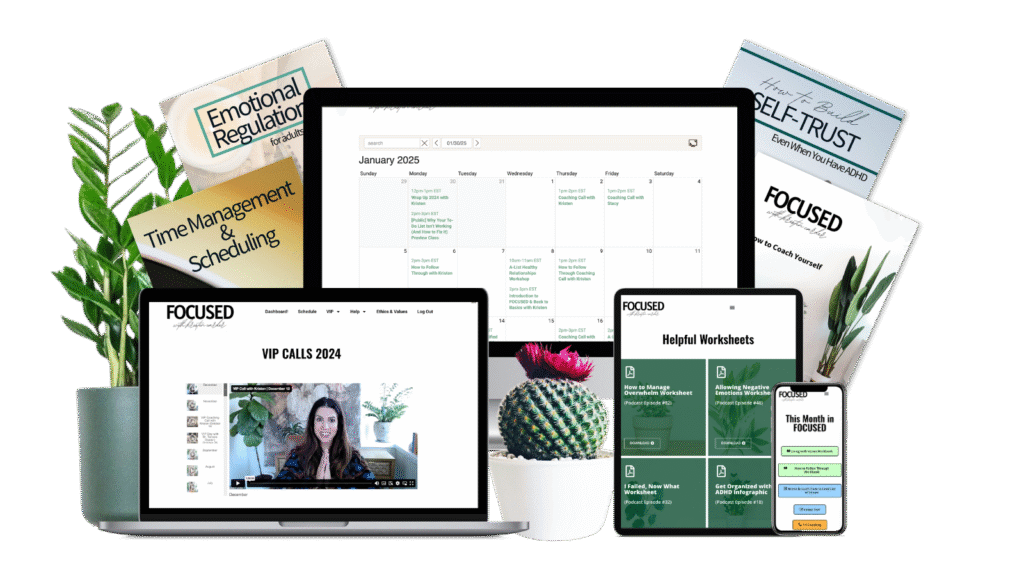
A proven coaching program designed specifically for adults with ADHD who want to gain clarity, build confidence, and take control of their lives.

Join a community of hundreds of ADHDers

Learning About My Brain...

Changed Everything

Hi, I’m Kristen Carder—ADHD expert, podcast host, and certified coach who’s been exactly where you are. Diagnosed at 21, I spent years cycling through planners, courses, and systems that never quite worked. Everything changed when I discovered the power of understanding my ADHD brain and the transformative impact of community support.

Now, after 15+ years of research and experience, I’ve helped thousands of adults with ADHD thrive. I’m here to show you how understanding your brain can transform your life, just like it did for mine.

ADHD Tips That Actually Make Sense

Follow @i.have.adhd.podcast and join our Instagram community for daily strategies, relatable content, and real talk about ADHD