

Podcast Episode #107: Coaching Call with Kristen

Listen or Watch this episode on:

About This Episode

Do you struggle to manage your impulsivity in order to follow your calendar? Do you feelings of fear and shame ever hold you back from doing what you need to do?  Do you struggle to believe that you’ve done enough so that you can relax? Do you have trouble accepting yourself and your ADHD? Well then today’s episode is for YOU! 

[www.ihaveadhd.com](https://ihaveadhd.com) for more adult ADHD resources.

[Click here](https://www.instagram.com/i.have.adhd.podcast/) to hang out with me on Instagram.

See Privacy Policy at [https://art19.com/privacy](https://art19.com/privacy) and California Privacy Notice at [https://art19.com/privacy#do-not-sell-my-info](https://art19.com/privacy#do-not-sell-my-info).

Episode Transcript

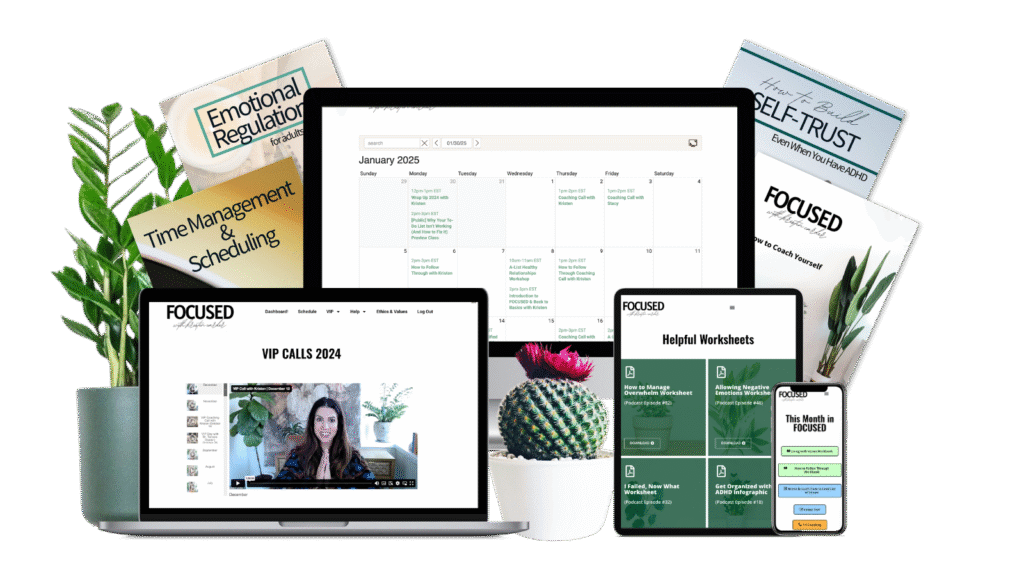
This episode is sponsored by CURE Hydration. All right, I’m going to be real with you. Drinking water is boring. My ADHD brain is like, wait, we have to do this again? Like every day, multiple times. What in the world? And because I’m running from meetings to coaching calls to kid chaos, staying hydrated is not something I’m naturally good at. It’s not something I naturally think about. That’s why I’ve been obsessed with Cure hydration packs lately. CURE is a plant based hydrating electrolyte mix with no added sugar, only 25 calories, and it actually tastes good. The watermelon and berry pomegranate have been on repeat for me. I’m actually like really running low on those flavors, which is so sad. They’re refreshing without being too sweet or artificial. It feels like my water finally has a little bit of personality, which I enjoy. I really do. What I love most is that CURE uses a science backed formula that hydrates as effectively as an IV drip. So when I’m scrambling through my day forgetting my water again, CURE helps me to catch up fast. I throw a few packs in my bag and it makes drinking enough water simple, which for my ADHD brain is basically a miracle. So staying hydrated isn’t just about water. You also need electrolytes. And that’s why I love Cure. It’s clean, tastes great, and it actually works. And bonus, CURE is FSA HSA approved. So you can use those funds to stay hydrated. The smart way for I have ADHD podcast listeners, you can get 20% off your first order@curehydration.com I have ADHD with the code I have ADHD. And if you get a post purchase survey, make sure to tell them that you heard about Cure right here on the podcast. It really does help to support the show. Don’t just drink more water, upgrade it with cure. Welcome to the I have ADHD podcast where it’s all about education, encouragement and coaching for adults with adhd. I’m your host Kristin Carter and I have adhd. Let’s chat about the frustrations, humor and challenges of adulting relationships, working and achieving with this neurodevelopmental disorder. I’ll help you understand your unique brain, unlock your potential and move from point A to point B. Hey, what’s up? This is Kristen Carter and you are listening to the I have ADHD podcast episode number 107. I am medicated, I am doubly caffeinated and I am ready to roll. How are you? How are you? The sun Is shining, the birds are chirping. It is just a beautiful spring day here in Pennsylvania. I’m so glad that you’re here with me and that you decided to press play on this podcast episode. It is going to be a super valuable hour of ADHD coaching for you today, my friend. Every couple of months I like to share a focused coaching call with you for a couple of reasons. First and foremost, listening to someone else being coached is crazy transformational. And my number one goal with this podcast is is to help you move from point A to point B, right? So no matter where you are, no matter what level you’re at, I want to help you make positive changes. That’s it. That’s my goal with this podcast. So sharing these focused coaching calls with you is all about that. I want you to listen to these four people who are coached and notice how you are exactly like them. How do I know that you’re exactly like them? Like I don’t even know you, right? Like how dare I be so presumptuous? But, but here’s the thing. I know the human brain, I know the ADHD brain, I know my brain and I’ve observed hundreds of my clients brains. We’re all the same. We are all the same. Like here’s what today covers. Managing your impulsivity in order to follow your calendar. Feeling your feelings in order to do hard and scary things at work. Believing in yourself and your work so that you can rest and relax and developing self acceptance around who you are and your adhd. So like not tell me that doesn’t apply to you, right? Like seriously, I know all of these four things do. So I know it will be super helpful to you today. The second reason why I want to share this call with you is because I know a lot of you listening are super interested in joining focused. I get emails about it and DMs about it frequently, like at least a couple times a week. But you’re not quite sure what coaching is or maybe you’re not quite sure if a group program is right for you. And these are totally valid questions. And so I want to give you a taste of what it’s like to be in the membership so that you can make an informed decision based on some solid data. Okay? So my friend, as you listen to this call, I want to encourage you to to put yourself in the shoes of the person being coached. Notice the coaching that I offer. Answer the questions that I ask. Allow your brain to be open to new ways of thinking and new ways of processing information. And I guarantee you that you will get real transformation out of this hour long session. Enjoy. How’s it going? So fun to have like so many of you who can just join us like at 1pm on a Wednesday. It’s so good. We are so lucky to be able to be in this room together. All right, we’re going to chat. Tell me what you need. Do I put my video on? You’re perfect. You did it right. Hi. I have the wrong notebook in front of me because adhd. How are you? I get it. I’m good. I. Yeah, I’m so excited to be here and to just learn everything. I have my notebook too. Oh my gosh. Are you new around these parts, my dear? I am. I just joined like a few days last week, I think. I think amazing. So good. I’m so glad you’re here. What can I help you with today? Do you have something on your mind? I. I guess it’s just kind of like a multitude of things and it’s, it’s. I’m sure that there’s lots of resources for me to go through, but. Yeah, in the direction. Go ahead. I was just writing down before the call like, like what do I think my biggest struggles are and my like if I had to narrow them down and I actually kind of feel like it all stems from like the in the moment pull, like organization, accumulation of things, time management, follow through. So I guess my biggest, my biggest struggles right now that I want to tackle are with work. I work from home full time for a e commerce company and I also started a birth, my own birth doula business. So like you did, right? Like I can’t get my dishes done but I can start my llc. Okay. Um, so I guess I just wanted to pick your brain about like what I should start with as. As far as like really nailing down like time management and kind of fighting that like in the poll. Tell me about the poll. I guess it’s just like when I’m sitting and working, I’m like, oh, like, like even this morning I was like, I should get my daughter’s summer calendar ready instead. So I stopped working and did her calendar. Even though I have like a month left where I could actually do that. But just like that tug of like not wanting to focus on what has to be done. Okay, this is perfect. So here in Focused, we call that pull. We call it an urge. Okay. Okay. Which you can call whatever you want. But I just like that’s kind of like the term that we use for it. It’s an urge. Okay. And so an urge is a feeling. And the best way that I can describe it is like, an intense desire. It kind of, like, whooshes over you. Oh, I want to go do that. Yeah. Right. And that urge is caused by a thought. So this morning, your thought about your daughter’s calendar was what? Just that I should print it and do it. I should print it and do it because it’s, like, one of those things that’s also stressing me out in the back of my mind because I’m like, okay, I know I have, like, these weeks figured out, but I don’t have this figured out. Like, so I just want Done. Yes. Yeah. And so there’s probably a bunch of thoughts at play here. Like, if we could just check this off, then I don’t have to hold it in my brain anymore. Yeah, right. And, like, I could just do it now. It won’t take that long. Like, all of these kind of, like, combinations of thoughts go into, like, the feeling of an urge. And from that urge, you took action, right? You’re like, let’s do it. So instead of working, you did your daughter’s calendar. This is just, like, you are speaking our language. Like, just so you know you’re in the right place. Like, everyone’s like, me too. Okay? So what I want you to know is that as someone with adhd, we actually don’t have an easy time putting the brakes on those urges. So for those of us with adhd, which is, like, everyone in the room right now, there’s 38 of us here, like, for all of us in this room, we have an urge. And the way that our brain naturally works as ADHD is like, gotta act on it. I gotta act on it right this second. Like, clearly this urge means I gotta act. Everyone experiences urges. This is a normal thing. Right. A neurotypical will have a much easier time being like, okay, yes, I want to do this, but it’s also, like 10am on a Wednesday, and I have a job to do, so I’m, like, going to do my job first. Right? Like, a neurotypical will have that stop and think moment. And so the work that we do here as we gain awareness is you noticing that urge. So what I want to know from you, you called it a pull. No problem. Where did you feel it in your body? Ooh, like, physically in my body. That is so interesting. I don’t know. I think, where did I feel it in my body? Oh, my gosh. I love that question. I don’t know. I Mean, I feel like the easiest answer is my head, but. But. So let’s create an urge right now for you, because we can do that, guys. Let’s practice identifying urges. Okay? So let’s create an urge. Let’s create. Have you eaten lunch? I did, actually, and I was so proud. First of all, you get a gold star, and you totally win. So something that you might have a craving for, what might that be? And it doesn’t even have to be food. Ice cream. Yeah. Ice cream. Or not working. Yes. Like, wouldn’t it be awesome? It’s so beautiful today. Wouldn’t it be awesome if we just took the whole afternoon off? Yes. That’s called our best friend. And we’re like, hey, let’s meet at the park before the kids get home from school or whatever. Right. Like, you fill in the blank. Where do you feel that urge in your body? Stomach. Yes, I kind of feel it. Like, it is kind of, like, in that. It’s like a butterfly kind of like excitement, like. Yes. Yeah. This will be so fun. This will feel so good. Right? Okay. So what naturally happens as an adhder is you feel that flutter, and it might have even just been the excitement of, like, I won’t have to think about this anymore. Mm. Right. Like, it’s gonna feel so good to get this done. And you feel that, like, that little, like. Yeah. Urge in your body. The important thing as you’re developing this awareness is you feel the urge, and instead of taking action, you say, oh, there’s that urge. I just felt. I just felt it. I felt an urge. I see what’s happening here. Right. I just created this desire for myself to totally negate my schedule today. Yeah. And then giving yourself the chance to make a logical decision. Does this make sense for me to totally. Yeah. And do you feel like the key to. I mean, I feel like this answer is obvious. Is just, like, being consistent with that, because it’s also, like, I know that I can do. I can acknowledge my thoughts, but then it’s like that extra layer of, like, fighting to keep that acknowledgement there instead of. You know what I mean? Letting the urge. Yeah. So, like, consistent is not a word that we’ll ever strive for around these parts, but that makes me so happy. Oh, yeah. We’re never. That’s a trash word for all of us. We don’t like it. Oh, my gosh. It’s so great. It’s a huge no. It’s a huge no. Okay. But what we do really value is persistence. So I’m going To prioritize noticing the urge, and then I’ll probably forget about it for three weeks. And when I realize I forget. I’ve forgotten. I’m just going to be like, oh, my gosh, I totally have forgotten to pay attention to this. How can I make it obvious for myself so that I remember rather than what I’m assuming, if you’re anything like me or most of the people here, rather than what we used to do, which is like, I’m never going to be consistent. I can’t believe I forgot again. It’s been 17 days since I did this last time and I’m. I’m never going to be able to do this. Right. Yeah. Like now it’s just like, oh, oh my gosh, I haven’t even thought about this. I need to, like, I need to figure out a way for my brain to be able to think about it. So what do I want to do? Put a note on my fridge? Put a note on my laptop? Like, set a timer once a day, like, and that those, you know, those action items of like, timers and reminders and notes, those will change and they’re different for everybody. That’s why I always say, like, I don’t have the tips and tricks for you. I’m never, like, I don’t know, like, an app will work for you for a little while and then you’ll forget about it and then it’s time to go find something else. Right. Like, it’s not, it’s. I don’t know, I don’t know. Right. But the key is bring it to your awareness. One of the good ways to do this is a practice that you can incorporate, which is like a thought download. So like, if, you know, like, okay, every day I want to spend X amount of time working, I’m going to do a thought download before work. So that could be like a quote, unquote. Well, no, I’m not even going to say it. A persistent practice where it’s like, I’m going to thought download everything, you know, and, and that’s what I teach in the time management book as well, is like thought download everything and then decide on purpose, what do I want? Love that. Because what we’re used to do, what our, what our brains do by default is just hop from urge to urge. So what we do is we’re just pulled by our different urges, which is why we just, like, we’re just kind of hopping around instead of, like, staying steady with something, which is fine because we can still be super successful by hopping Around. But we do make it harder for ourselves sometimes. Right? Like, then you’re like, okay, well, great. I just lost an hour and a half to this calendar. Like, yes, it needed to be done, but so does my work project. So, like, ah, yeah. What are your thoughts? I’ve been talking a lot. I wanted you to talk a lot. Okay. I’m excited. I feel like I have some good, like, starting points, I think just like kind of like stepping out for a second and then. Yeah. Just practicing that. I also, I just thought of this too. I was wondering if anybody else experiences like just exhaustion from fighting that all the time. I mean, I’ve heard that, like, sleep issues are prevalent with adhd, but I feel so exhausted. Like, yeah. Even just like taking out the trash when I’m supposed to. I’m like, okay, I did something when I was supposed to do it and it felt like a big deal. Yes. You know, oh my gosh. I make my husband high five me with the dumbest stuff. I’m like, I just. Whatever. I just clipped our son’s fingernails. I’m like, praise me. High five. Like, give it up. And at first he was like, I don’t really understand what’s happening, but the more that I do it, and now he offers them to me, he’s like, oh, my gosh, you emptied the dishwasher. Get over here, get over here. High five. Right. Like, stuff like that is. So here’s what I want to say. First of all, yes. And then secondly, a lot of times when we’re experiencing that exhaustion, it’s because we’re trying to push against and fight against those urges, and that is exhausting. What I would encourage you to do is learn to allow it, open up to it. Oh, I feel what’s happening right now in my body. I don’t need to be afraid of it. I feel it. Like, oh my gosh, I want to so badly. I’m going to take a minute and really feel that. And now I’m going to go decide with my brain what I want to do. Okay. Right. That I’m not sure, like, what you’ve been able to kind of dive into so far. The self coaching workbook is probably a great place to start, but then time management, it sounds like that whole workbook. I mean, it’s gold. Awesome. All right, love. Okay. I’m so glad you’re here. You’re welcome. See ya. Okay, loveies, I have my list now. Hi. Hello. So busted. Tell me. Well, I was answering a text from my wife about getting on logging Onto the kids, like, school email account. So you were like in the background all of a sudden. I heard. I was like, dude, your hand was raised, my man. I know, I’m on it. All right, So I am obsessed with making the model that’s going to do the thing right now. And it’s like, I just, I feel like it’s, it’s like turning me into sort of a crazy person that way. It’s like, I should know because that’s all I do is thought work. But I’m still obsessed with trying to find the right model. And when I do that, it’s just gonna, you know, load this logjam up. Okay. Say more words about that. When you find the right model, what will happen? What is your brain telling you is the pot of gold all the like, kick, put your feet up. And now you can enjoy, like, hanging out with your kids on the weekend because, like, you finally, like, you figured out the secret sauce. It’s, it’s, it’s that. Is that enough? What else? I’ll be successful. I’ll enjoy hanging out with my kids on the weekend. I’ll put my feet up. There’s, you know, there’s, there’s all that self concept validation in there too. I’ll be validated. Yeah, yeah, you get, it’s like, I feel like I’m believing all that self concept stuff. So, like, let’s have the world show up that way too now. Oh, that’s interesting. Yeah, I’m just making a little note here. Okay. Yeah, Great. So, my friend, here’s what I want you to do. And you’re not going to love it. I want you to forget about that model and instead work on the model where you feel successful. Work on the model where you enjoy hanging out with your kids. Work on the model where you allow yourself to put your feet up and relax. Work on the model where you know you’re 100% validated. What your brain is doing is. It’s like, when we get there, then I’ll be successful. If I can just get there, then I’ll enjoy hanging out with my kids. Right. But like, so are you hearing it as separate? Because I feel like that is why I’m like, I, like, I see that happening. It’s like, oh, I’m putting that happiness out there. So that’s what I mean. Like, there’s gotta be the secret model that is like, gonna unlock that need for. Yeah. To like, bring it right here. I don’t know, does that make sense? I mean, because I love when My mind does this because I feel like what I’m trying to say in a backwards way is like, but I’ve already done that. Kristen. Yes. So are you enjoying hanging out with your kids on the weekends? It’s not a hundred percent. It’s like there are moments and then go into like, oh, geez, I hope this week, you know, like, business wise, like, your brain goes, yeah, it’s definitely business wise. Maybe I should re listen to, you know, the business coaching thing because there’s some good stuff in there. And if I do that, then what? Then I’ll figure it out. What if you have it figured out? Oh, that made me really sad. Wow. Why would that make me really sad? Wow. What if that’s the secret model? I’ve got it figured out. Oh, yeah. Crap. This feels like the very first coaching thing we’ve ever did together. It’s like, baby, spending all that kindness, energy out onto the world. It’s like, don’t forget that. You know that part, right? So it’s like, do have it figured out. Yeah. And even when we have stuff figured out, we still learn. Right. And we still make changes and we still evaluate and adjust, but we do it from an energy of, I got this. Gotta figure it out. We don’t do it from an energy of like, well, I better go figure this out. Like, yes, I want to hang out with my kids, but also I need to go figure this out. Giving yourself permission, like, okay, I’ll give myself permission to relax for like two hours and then I gotta go. I gotta go figure this out. Subtext. Because it’s not working or because I don’t understand, you know, because there’s something I’m missing. What’s coming up for you so I can hear that again. You know, I think it’s like, what’s coming up is just like, oh, my gosh. Like that. That feels really true. And it’s like, I guess it’s like sitting in the realization of, like, oh, this is the experience of what I hear other people talking about, which is like, at that moment, it’s like, this is actually what, you know, trust and faith in life looks and feels like. Not what you thought it was going to look and feel like. Yes. Because our brain wants to be like, well, I’ll believe it when I see it. Yeah, totally. That’s what’s coming up. Yeah. Yeah. And. But the secret to life in general. But then also, what’s the secret? Ready? Believing ahead of time. I believe ahead of time. Like, I’ve got it figured Out. So one of the thoughts that I. Speaking of urges, right, to kind of bridge the last conversation that I had with. I used to have an urge, probably, oh, my gosh, 50 times a day, to go into my Stripe account and see if we had any new members. Did anybody sign up? Did anybody sign up? Did anybody sign up? Maybe now. Maybe now. Well, I just made an Instagram post. Maybe now. I just sent an email. Maybe now. I. It’s 1:00pm Maybe now. Like, no reason at all, right? Like, I urge, urge, urge. And when I really saw what was happening, what my brain was doing is, is it. Is it working? Is it working? Is it working? Is it working? It was that constant question, is it working? You better go figure it out. You better go check and see. Is it working? And so the way that I worked through all of that was I chose a thought that I loved, which is, I have a business that works. People want what I have to offer. I have a business that works. People want what I have to offer. And every time I felt that urgent, is it working? Go figure it out. Go look, go see. Has anybody joined? I don’t know. How are our numbers? How are we doing? Is it. Are we. Am I success or am I a failure? Is it working or is it not? I would like. I have a business that works. People want what I have to offer. And, like, that’s true, right? Like, I already had, like. And it’s true for you too. People want what I have to offer. It’s working. So maybe for you, the thought is more like, I’ve already got it figured out. I just need to take the next step, right? For me, it was like, I needed to know that in the background, things were working and I didn’t always need to have my eyeballs on it. And actually, that was probably holding me back from it really working even better, right? Like, because we know the model. But for you, it’s probably something like, I’ve got it figured out. Got it figured out. I can get to it on Monday because I’ve got it figured out. Got it figured out. Yeah. Wow. Mm. So then your work moving forward, like, as you kind of graft that thought into yourself, your self concept, your body, like, all the things, right? Your work is to find the evidence. How is it true that I’ve got that? I’ve got it figured out. How is it true that it’s like, it’s working? How is that true? Like, your brain’s gonna be like, well, when we see $100,000 in the account, that’s how we’ll know. It’s like, no, no. How is it true right now? Like, I have X amount of clients. I signed X amount of clients in 2021. Right. Your brain wants to set all of these parameters for you and say, like, you’re allowed to rest when you’re allowed to feel successful, when you’re allowed to be validated. Like, you will be validated as a coach when xyz. And the work is like, I can rest whenever I want because I’m a human. Humans deserve rest. I’m successful now because I’m doing what I love to do. The luckiest human on the planet. What was the last one? Oh, I’m validated as a coach because I get my clients results. And here’s the evidence for that. This client. This client, you know, this breakthrough. This breakthrough, like creating actual hard evidence for your brain because your brain’s going to assault you. As you know, creating that evidence to go back to is everything. Yes, I said a lot of words. I think I’m in a talkative mood today. So anything coming up for you? Well, it just all rings true. And I think, like, you know, this is proof of why coaching is so powerful. It’s like, I could say if I was coaching me, I would say the same exact thing, but for some reason, the coaching space puts me in a spot of like, I’m going to listen to this, I’m going to hear this. Yeah. That’s why we all need coaches. None of us are exempt from having a human brain. Right. Like, I have the same exact human brain that you guys do. Like, all the drama, all the weirdness, it’s just why I have a coach. So she can be like, true. All right, Love you have your work. Watch this back. I think it’ll be really powerful for you. Oh, there. You’re welcome. All right, let’s go. Hello. Hi. Hi. How are you? Hanging in there. How are you? I’m so good. How can I help you? Oh, I need some help with work. And it’s a pretty complex situation with a lot of factors going on in there. So I’m going to try to make it as succinct as possible. But if I start to ramble, please cut me off. I’ll be like, hello. Okay, so I am a solo researcher for my organization. It’s a pretty big organization and I am in the middle of a pretty big high profile project that includes a lot of qualitative work. So this, like, talking to people face to face interviews, and we were supposed to be Done with this project in April of 2020, but with COVID you know, everything going on, we had to cut back on in person research and pivot and find solutions for remote research, which we did it honestly, it feels like we’re on plan X at this point. And things keep getting in the way, but it never feels. Things keep getting in the way, but we’re on a clear path now. And I’m feeling a lot of guilt and shame around. Around this right now because we had to loop in our agents who sell insurance to our customers to help with recruitment for these interviews. And I can’t bring myself to call the customers. For some reason, I’ve really been putting that on the back burner. And at this point, it’s been almost two months since I’ve gotten a really good list of customers who seem willing. I mean, they, their agent said that they would be willing to participate, but I can’t. I can’t do it. Why? I think a lot of it stems from. I don’t. I hate asking for things. Even though I know somebody else already asked them for me. I still have to call and ask them to make sure I don’t want to be a burden. We work in the senior market, so there’s a lot of technology barriers that we have to overcome and just to get people onboarded. Oh, there is another one. I used to cold call customers for interviews in the past, and it was fine for the most part, but one interaction with a customer I think really stayed with me. It was very aggressive, hostile conversation. So I think that’s kind of lingering maybe a little bit. And maybe I’m afraid, yes, to call customers because I don’t want to get that reaction from them again because it was really. It was something. Okay. So I just want you to know that when you or any of us feel guilt and shame, we will always procrastinate and hide and avoid. It is just the natural. That is like the way that we operate. So just know that, like, even though I know that’s not what you’re going for right now, it’s not what you want to be happening, it still is very normal that that is what’s happening because of the shame and the guilt. So just know that like, okay, like you can add some, like, normalizing into that, you know, which might take off at least a little layer of it. Like. Okay. Of course I’m avoiding this because I’m feeling so much shame and guilt and it sounds like fear. Yeah, yeah, yeah, yeah. Okay. So let’s, let’s Break it down. The fear sounds like it’s coming from. I don’t want to have a hostile conversation again. Yes. That’s probably the biggest one. And I think there’s also a fear of what happens if I don’t do this. Like, what happens if I don’t call and I get in trouble. So I’m afraid of getting in trouble for not keeping up, you know, which is so ironic because instead of just like, oh, well, I’ll just call. The brain’s like, no, keep hiding. You won’t tell me where the shame is coming from. Is it from, like, I hate asking for things. I don’t want to be a burden. I think the shame is mostly coming from the fact that this. This is a huge project and it’s taking so long to get going, and here I am wasting more time. I’m wasting time. Yeah. Is that the primary shame feeder, do you think? Yeah, I. I would. Honestly, I think maybe the guilt is more. Is stronger than the shame. Tell me about that. I’ve had nothing but, like, incredible support and, you know, like, strategizing sessions with my colleagues. They’ve been fantastic. Like, whatever they can do, we can do. They’re very understanding. Like, this is not your fault. It’s been a year. We. Nobody could control this. Right. It’s not on you. But the fact that we keep trying multiple things, and we found something that worked. We found something that got us participants interested. Nice. And I’m not doing it, so I feel really guilty about the inability to do it and procrastinate. So I have help, and I’m still not doing it. Yeah. Yeah. Okay. So I just want you and everyone else who’s participating to understand that when you feel these different feelings, like, if you could take just a minute to separate out what’s actually causing the fear, what’s actually causing the guilt, what’s actually causing the shame. It just gives you so much more clarity and so much more power. So much more. Rather than having this, like, big cloud of negative emotion that you’re just like, I just feel terrible. And, like, I. I don’t even know, but, like, all I can do is play Candy Crush on my phone and not do the thing. Right. It’s really, really good to lean into. Like, okay, like, yes, I feel terrible, but what exactly am I feeling? And what are the thoughts causing? So for you, there’s fear around having the conversation, and ironically, fear around not having the conversation. Right. So contradictory. Yeah, but this is just the way our brains work. So what. What your brain has Done. Is put you in an impossible situation. Because that way. Right. Because you’re totally stuck. Because if you do take action, well, we might get yelled at. And if you don’t take action, well, we might get yelled at. So either way, you’re screwed. Yes. Yes. Yeah, that’s exactly what it feels like. Like, it’s a lose, lose either way. Okay. So I just want you to know that that’s just your brain being a jerk. Yeah. It feels like reality. Yeah, totally. It feels just so true. It feels like. No, this is. This is just the truth. Like, obviously. Right. But your brain is just being a jerk. It’s keep. It’s trying to keep you safe. It’s trying to be like, let’s just hide. Let’s go get, like, a good snuggle and be, like, very lethargic and safe and not do anything that could cause harm. But. But you know better. I do. That’s the frustrating part. Yeah. But here’s the thing. In order to do the thing you want to do, you’re going to have to allow fear to be present. So what your brain wants to do is like, okay, we’re going to solve for the fear so that we don’t have to do this and feel afraid. And what I’m saying is let’s not. Because that’s not working. Let’s just instead open up to the fear. What does fear feel like? Okay. Yeah, I have a really hard time. I’ve been trying to be a lot more intentional about trying to isolate where my feelings are in my body, but it’s so hard. I agree. It feels like everything. Worst at it. It’s almost feels like it’s impossible. Yeah. Because it feels like everything is all here. Okay. So. And it might be. It might just be that I just carry all my emotions. I will tell you, like, I. I’ve definitely improved, but I am not good at it. I am not good at it. I’m really not. I can distinguish between, like, very strong emotions. Like, shame has a really distinct feeling for me because that. Yeah. Yeah. Feels terrible. So I can be like, oh, okay, there’s shame. But generally speaking, I. I’m really not good at it. But that doesn’t matter. Yeah. So, like, if for you, fear. Fear just feels like a tight constricting, like, intense. That’s fine. And if you’re like, yeah, but like, shame also feels that way, that’s fine. If you’re identifying, though, in your mind, like, okay, this is shame. This is fear. It’s perfect. That’s all that matters. It’s going to be different for all of us. Right. There are some people in this room who are so in tune with their emotions, they just know how they know. But for the majority of us, I think we really struggle to identify them in our body. And part of that is adhd, and part of that is just, like, I was never taught. So I’m learning now right alongside of you. That’s really helpful to hear. Okay, good. I’m glad. Yeah. Because. And here’s another thing. You don’t have to be super good at it in order to get results. You can just be like, I’m willing to feel like absolute crap in order to take action. Yeah. That’s. It’s. It’s very hard for me to. Yeah. Just take action when I’m feeling. Yeah. Even when. When I’m allowing the feelings to be there, it’s still so hard to do it. And that’s. I think. I don’t know, maybe I just need to practice doing it when I feel and just accept. Yeah. So, like, what would it be like to make a phone call today feeling absolutely terrible with your voice shaking? Maybe you’ve written out a script and you just take the action because you’ve decided it’s the right action, not because you feel good, but because you’ve decided it’s the right action with your brain. I would probably want to quit when, as I’m dialing the phone number. Mm. And it might be hard, you know, to get started at first, but I could see the fear really dissipating after, you know, you get into the groove of the conversation, which usually happens. And. Yeah. Then it would be fine. And what if every single time you made a phone call, you had that initial kind of, like, wall of awful of like, I know that I’m going to have to experience these intense emotions of fear and shame. Yeah. Just letting them kind of sit there. Yeah. Like, even. This is so weird, but, like, this would help me, like, labeling. Like, here’s fear. All right, let’s go. Here’s shame. Like, I got my two besties. I’m ready to rumble. Like, let’s go. Because they are your besties right now. Right. They really are. They don’t feel good, but they are. They’re hanging with you. They’re my toxic besties. They are. And what’s so important is that you realize that, like, them being present isn’t a problem. Yeah. Because I think it’s a big problem for me. Or I’m making it into a big problem. Exactly. Like this Means I shouldn’t take action. This means I shouldn’t do the thing. This means I have to delay so that I can work this out so that I can make the phone calls. Feeling good? Yes. Yeah. Yeah. And so what I’m saying is, like, they’re gonna be there. There’s no, like, mental jujitsu that you can do to, like, get rid of the fear of making a phone call and talking to these. I mean, you sure, you probably could coach yourself out of that, right? But, like, also, you need to make some phone calls today, so, like, let’s just do it. Scared. Yeah, that’s. That’s helpful. It’s annoying, but helpful and kind of oddly comforting in a way that, you know, yeah, there is going to be there. So cute. You’re like, your coaching is really helpful and annoying. And I’m like, I know, but in a really good way. That’s so great. It is annoying because it’s like, wait, I thought I could feel better. I thought I could just, like, yes, but no. Like, what if you just don’t feel better and you still do the thing that you want to do that you know will get you the result that you want to get? Yeah. Yes. I’ve tried to, like, thought download before I make a call, which does help, but again, just kind of repeating what we’ve. What we’ve already been talking about. I think my thought is, okay, I did the thought download. I identified the emotion. I identified the thought. Why am I still feeling it? Why is it still here? Why are you still here? I did the work. Like, why aren’t you leaving? Yeah, why? Why do you want it to not be there? Oh, it’s so uncomfortable. Yeah. And what’s the problem with that? Nothing. Really. Isn’t that annoying. I know, but it’s good. It’s something I needed to hear. Yeah. I don’t know. You can read it so many times, but it feel. It hits different when it’s being asked of you. Oh, this is so helpful. Totally, totally. I know. This is so helpful for the whole group. I heard. I mean, I saw she wrote in the chat. Well, looks like I’m getting coached today. Like, this is so applicable. So I just. Thank you for bringing this up and go get the result that you want. Feeling like crap. That’s okay. You can do that. Yeah. So good. So much. Welcome, honey. So, yeah. All right, guys. This is so fun. All right. I know. That was really, really relatable. All right, listen, I only have, like, seven minutes, so we’re going to speed Coach. Hi there. Hi. How are you? I’m okay, thank you. How are you? I am so good. I’m so glad to be talking to you. So we have seven minutes. What I would love to know is get right to the juicy problem. Oh, my gosh. Is that a note card? Is that a. Yep. And I’ve been coached for the last, I don’t know, 50 minutes to there. Everything is applicable. So we got. We got through some of it. So perfect. So I think for me, like, I know I had ADHD for a long time and just. I joined Focus in, like, the last month or so. Nice. And so this is my first kind of foray into the fact that there’s these things that just are difficult, and it’s just part of me, and I have to find different ways to work on them. And I think in Canada, which adds a layer because we don’t look at it as a disorder or any kind of development thing. It’s really more just, like, anxiety. So I think I’m just really struggling in, like, how much I just accept that I am who I am and how much I work to be different. And I think I know that the answer is really just, like, I need to decide that. Right. It’s like finding that balance that works for me. It’s different for everyone, but I’m, like, constantly striving and struggling, trying to find that balance. Tell me about the striving. Tell me about the striving and struggling. Well, a lot of it is, like, tied to that idea of, like, being exhausted because I just am. Like, my brain won’t stop trying to find ways to get better at relaxing and recharging and, like, enjoying the moment when I’m in it, and then also still not letting important things slide. So how I know that there’s time management work there too, but it feels like it feels insurmountable or unachievable. It feels like there’s just what’s unachievable. Like, the idea of balance. So the idea that, for example, I can let my job slide a little to make my family a priority and then swing back and, you know, because I feel like I always ebb and flow too far. Like, it’s like this pendulum. I’m way over in the job sliding, and then I get, like, a bit of a fear to, like, go too far into the job because I don’t want to let my family slide. Right. So what if we just accepted that Pendulum? Yeah. Yeah. I keep going back to this, like, infinity kind of symbol of ebbs. And flows and the. But I. I find I get stuck. It’s like I’m. It’s like I’m. I’m. I don’t know, physically or mentally struggling to actually get the flow. Define flow. I guess if you think about some things are positive and some things are negative. Like, it’s like to flow back into the. To get the positive. Yeah. I don’t know if it’s the positive. Think about, like, energy, productivity. Like, I’m either go, go, go, or I’m, like, inactive or inactive, not doing. So I don’t have a lot of, like, middle ground. But you. You think that’s okay to just go. From my eyes, I see it like a roller coaster. Like, it’s not healthier. Like, I should be more balanced, like, more stable. And that’s where you’re like, suffering is coming in. Yeah, yeah. Because you’re like, the way that I operate naturally. It’s not healthy. Yeah. Yeah, but the way that you operate naturally is just the way you operate naturally. Like, I am 100% the same. I don’t even know what somebody would mean by middle ground. I am either all in or all out, all hot or all cold. I’m either, like, in productivity mode or I’m, like, wrapped up in. On a blanket in my hammock swing. Is there. What, What’s. What would even be the middle ground? I don’t even know. My house is either, like, all clean or all messy. Yeah. Yeah. And at the end of the night, usually I’ll go through and tidy it up, and sometimes I just don’t. Right. Like, I think that your. I think that you should write down. We call it. So you just joined focus, like, within the last few weeks, when you hit month four, you’ll get the relationship work, which is so fun. And in there, I describe the concept of the manual, which is like, the way that we think other people should act. But you also have a manual for yourself. You have an operating manual where you’re like, here’s what you should be doing. You should have balance. You should understand the ebb and flow and be able to hop out of one thing and range. You should, like. I think it would be interesting to write down all of your shoulds. Yeah. And then notice them. And it would also be interesting to ask yourself from that long list of shoulds, how many of these shoulds, you know, things that I’m listing that I should be able to do, how many of these are actually impaired by adhd? But the things that I’m holding over you know, and saying like, you should be able to blah, blah, blah. I think that’s your first step is just identifying the manual that you have for yourself, the rulebook, the like, hey, if you’re going to be a good person, if you’re going to be balanced, this is what you have to do. This is what it looks like. What about the idea of sort of like, try harder or give in more like. Or like, try harder work. Work harder on yourself or be gentler on yourself. I guess maybe they can coexist or. Have you done the self concept workbook yet? No, but it is on the top of my list, the self conversation. I think that, that, that will answer your question. Okay. Yeah, it really will because I take you through. I take you through a whole journey on that workbook and that question is answered in there. Okay. All right, my love. Thank you. We did it. I’m so proud of us. I am. Thank you, honey. All right, you guys, this has been the best as usual. Peace out. Have the best Wednesday. I will talk to you so soon. Bye. Hey, adhder. I see you. I know exactly what it’s like to feel lost, confused, frustrated and like. No one out there really understands the way that your brain works. That’s why I created focused Focus is my monthly coaching program where I lead you through a step by step process of understanding yourself, feeling better and creating the life that you know you’re meant for. You’ll study, be coached, grow and make amazing changes alongside of other educated professional adults with ADHD from all all over the world. Visit ihaveadhd.com focused to learn more.

Related Episodes

Kristen Carder

Episode 418: Tired of Feeling Tired? How to Rest When You Have ADHD

Kristen Carder

Episode #416: ADHD and Money: In This Economy?!

Lindsay Gibson

Episode #414 Good Enough Parenting: What NOT to Do (with Dr. Lindsay Gibson)

Stop Struggling Alone.
Start Thriving With FOCUSED.

A proven coaching program designed specifically for adults with ADHD who want to gain clarity, build confidence, and take control of their lives.

Join a community of hundreds of ADHDers

Learning About My Brain...

Changed Everything

Hi, I’m Kristen Carder—ADHD expert, podcast host, and certified coach who’s been exactly where you are. Diagnosed at 21, I spent years cycling through planners, courses, and systems that never quite worked. Everything changed when I discovered the power of understanding my ADHD brain and the transformative impact of community support.

Now, after 15+ years of research and experience, I’ve helped thousands of adults with ADHD thrive. I’m here to show you how understanding your brain can transform your life, just like it did for mine.

ADHD Tips That Actually Make Sense

Follow @i.have.adhd.podcast and join our Instagram community for daily strategies, relatable content, and real talk about ADHD