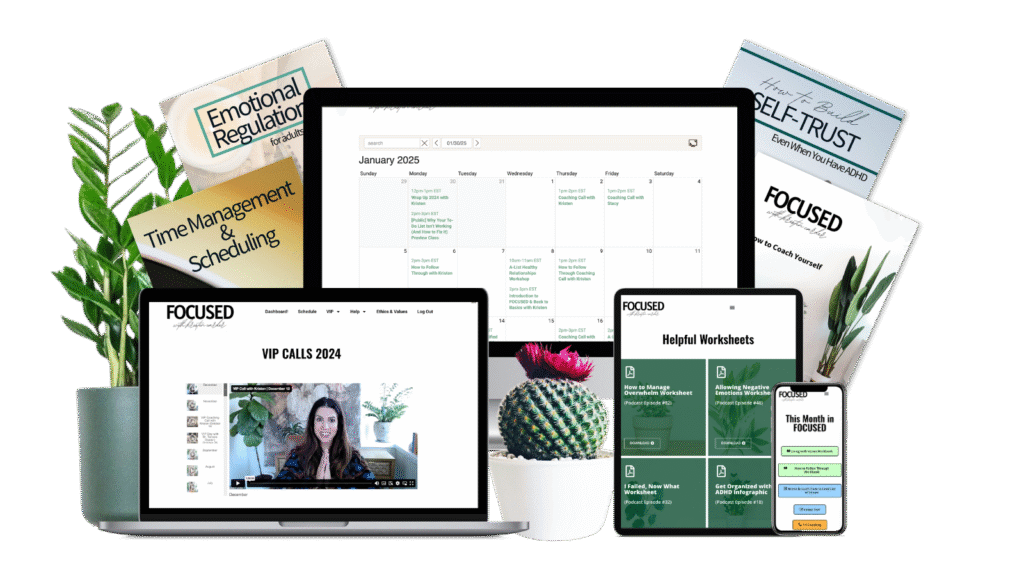
Welcome to the I Have ADHD podcast, where it’s all about education, encouragement, and coaching for adults with ADHD. I’m your host, Kristen Carter, and I have ADHD. Let’s chat about the frustrations, humor, and challenges of adulting relationships working and achieving with this neurodevelopmental disorder. I’ll help you understand your unique brain, unlock your potential, and move from point A to point B. Hey, what’s up? Happy New Year, my people. You are listening to the I Have ADHD podcast, episode number 38. I am your beloved host, Kristen Carter. I am medicated, I am caffeinated, and I am so ready to roll. It is another gray day in Pennsylvania. I want to tell you a little secret. I recorded this entire podcast yesterday, and then my computer got really mad at me because it’s overloaded on storage and something went wonky with the recording, and I’m doing it again today. Sometimes we give our best effort and things get screwed up. What that used to do was paralyze me. I would throw in the towel, I would say, forget it. This isn’t worth it, it’s not gonna work. Now I understand the concept of massive action, which is just simply taking action until you get the result that you want, no matter what. And so here I am today in my bathrobe, sitting here with my coffee, my water, looking out the window at the gray sky in Pennsylvania, and just thinking about how sometimes we have to do things a million times until they’re done. I don’t know if you ever have that experience or if it has been paralyzing to you when things get hard, or when um you just feel like it should be easier. And I just want to offer to you that it shouldn’t be easier. It’s hard. Life is hard, being a human is hard, it shouldn’t be any easier than it is. It’s just, this just is the way it is. So here I go again, round two with this podcast. Today we’re gonna talk about priorities and we’re gonna talk about it in the context of vision. And I think this is extremely, extremely important. As I have been coaching over the last year and interacting a ton with adults with ADHD, I am realizing, realizing, let’s try that word again. I am realizing how much we struggle with prioritizing. Now, of course, this is largely in part due to our underdeveloped frontal lobe and our poor executive functioning skills and also um impulsivity, right? But what I have found is that we really struggle to put things in any kind of order of importance because what it feels like to us is that everything has an equal level of importance. Now, a neurotypical human, human who does not have ADHD, can pretty easily throw things into order of priority. For example, my husband is very, very good at this, and I often lean on him for this in my own life because when I have a million things to do and I don’t know where to start, what used to happen is I would become completely paralyzed and I would just avoid my list altogether and not get anything done. I’m sure you cannot relate to that at all. What I know now is that my brain struggles so much with ordering things into priorities. And so when everything feels like it’s screaming at you at the same volume, when everything feels like it’s just as important, just as important as everything else, it’s very difficult to decide where to start. It’s very difficult to decide what to focus on. I’ve been reading Tony Robbins um lately, some of his work. And uh first of all, he’s incredible. And second of all, he um is all about harnessing the power of our focus, um, laser focusing on one thing specifically and putting all of our energy to that thing. That is so hard for those of us with ADHD. We do not like the boundaries of constraining to, you know, one or two or three priorities in our lives because what happens is we look around and we’re like, oh my gosh, what they’re doing looks so amazing. I should probably do that too. Oh my gosh, over there, that looks so much fun. I should probably do that too. And we just add into our lives so many things that are really not relevant to what we actually want and where we actually want to go long term. And so today’s podcast, as we embark on 2020, as we set out on this journey together, today’s podcast is all about setting priorities and living with vision over the next year. It’s so important for those of us with ADHD, especially, to get extremely clear, laser focused on our vision and our values. Okay? This doesn’t happen naturally. It’s not just going to happen by default. You have to make a conscious effort to do it. One of the great ways to do this is to hire a coach or a therapist to really hold you accountable to your vision and values. Okay. How in the world do those of us with ADHD prioritize vision and values when everything we’re doing and everything we want to do and everything everyone else is doing seems important and fun. Okay? So the first thing that I want to offer you here is that this is just how your brain works. As an adult with ADHD, you are not going to naturally easily order things in priority. You are not going to naturally weed things out that are not important. This is just like ground zero baseline. Once I accepted this about myself, my life got so much easier. For some reason, my brain thinks that scrolling Facebook, taking a shower, packing a lunch, eating breakfast, and all that’s involved in getting my kids out the door in the morning are all of equal importance. And in the past, this led me to completely shut down. It led me to major inaction. It led me to sitting on my bed in my bathrobe, just staring into space, and therefore constantly being late and stressing out my kids because I’m like, we’re late, we’re late, when really it was my fault that we were late. So when scrolling Facebook, taking a shower, packing lunch, eating breakfast, and getting the kids out the door in the morning are all of equal importance. How in the world does someone like me choose one and just start? So if we think about that like goofy example that I think is very applicable to most of us, if we think about that in terms of a vision for our future, of a vision for our lives, your brain is basically telling you that everything in your life must be a priority. So how in the world do you clearly define your goals, your vision, where you want to go? Do you notice this in your own life? Do you stare at your to-do list and have no idea where to start because everything on your list feels like so important and like a siren screaming at you, beep, beep, beep, beep, beep, beep, beep, beep, beep. So you just basically get overwhelmed and shut down. Do you look around at what everyone else is doing and say, oh my gosh, that looks like so much fun. I should do that too. Oh wow, that looks really important. I should do that too. Oh, what about that? What about that? And you’re just constantly jumping from one thing to the next. Okay, great. This is normal. This is ground zero, my friend. This is our starting point as adults with ADHD. We have an underdeveloped frontal lobe, we have very poor executive functioning skills, and by the way, one thing I didn’t mention earlier is that our working memory also really sucks. So, even things that we’ve defined as being important to us or priorities in the past, um, really hard to remember them. Real hard to keep those around in our everyday life. So if we accept this about ourselves, if we know that this is totally normal and nothing has gone wrong here, it’s just the way our ADHD brain is literally supposed to be functioning. We can then start to address these issues and work with them. Because we can for sure improve in these areas. For sure. But the first thing that we want to do is just kind of notice it. Notice how you want to jump from one thing to the next. Notice how you look at the people in your life that you respect and you say, oh my goodness, maybe that should be my priority. Look at what they’re doing. Maybe I should give my time to volunteering, like my best friend does. Maybe I should give my time to, you know, helping my family out, like my husband does. Like all of those different things can be really wonderful, but what we need to decide is what we want. We need to decide what we want our lives to look like. So the only way that I know how to prioritize like the little stupid menial everyday tasks and the hundreds of decisions that we have to make that we’re like, oh, I don’t know. And so we end up not making a decision because we’re afraid we’re making the wrong one. And then we, oh, I’m gonna do a whole podcast on decisions, okay? But anyway, the the only way that I know how to prioritize the small everyday things is really to start from 30,000 feet in the air. And what I mean by this is that I can’t make those small everyday decisions about what I should do or what I want to do if I don’t have a strong sense of my overall vision and where I want my life to go. And honestly, I don’t even know how to create a vision before I address my values. So that’s where we’re going to start. Okay? That’s what we’re gonna do. And this is gonna be different for all of us, and it’s totally fine. It’s what makes life so much fun. So I want you to spend a few minutes thinking about your values. Deep down in your core, what do you value? What’s important to you? What moves you? What don’t you ever want to live without? Is it your job or your career, your family? If it is your family, which family members specifically? Because a lot of us have a lot of family. So is it like your great uncle Rick? Does he make the list? Or is it just your immediate family? What else is important to you? Your health, your finances, your faith, your friends, maybe a specific hobby or passion that totally lights you up. Seriously, make a list of your values. And I suggest constraining to five values. Now, this is the part where you might start to sweat because constraint does not come naturally for adults with ADHD. So choosing five values when everything seems important can be very uncomfortable. But I think it’s extremely important to only choose a couple, all right? Five is what I whittled mine down to. Okay. Mine are my immediate family, like my husband and my three kids. And then secondly, well, these aren’t not necessarily an order of priority, I guess. Like the other top 10 relationships in my life. Um, financial freedom. It’s very important to me. Church ministry, you know that I’m very involved in my church. And then also, and this is the only way that I knew how to say this, but one of my values is something that I’m really just feel like I’m created to do, and that is exhortation. I don’t know, that’s kind of a churchy word. I don’t know if that means anything to you, but when I looked up cinnamon synonyms, not cinnamon, because that’s a spice, but when I looked up synonyms, um some synonyms were appeal, urging, encouragement, incitement, advice, can’t uh counsel. So that is honestly what I feel like I’ve been put on this earth to do to help move people from point A to point B. Um, and so that is a very strong value of mine. Now that can come out in many different ways. For me right now, it’s coming out in this podcast, it’s coming out in my one-on-one coaching, it’s coming out in the focused uh coaching group that I have. So there’s many different ways that that value like presents itself in my life, but it is a top value of mine. So I do encourage you to kind of choose one that is kind of like what you feel like you were put on the earth to do. If you don’t know yet, it’s totally, totally, totally fine. Okay, so if you’re having trouble choosing your values, here’s what I want to encourage you to do. I want you to encourage, I want to encourage you to just decide. Just decide, make a choice. Okay. Now again, we are gonna have a whole podcast on making decisions because I think that’s a very important skill for us to develop. But I just want to say that you know what your values are. So look inside and trust yourself and then make a decision. Don’t beat yourself up over the decision. Totally have your own back. Refuse to shame yourself, don’t look for validation from anyone else. Just validate your decision for yourself. It doesn’t have to be perfect and it doesn’t have to be permanent, but you do need to decide, okay, what’s important to you as you look ahead to 2020 and even the years beyond that. What do you value? What are your core values? Okay, so once you’ve made your list of five values, understand that your vision is going to come directly out of these values, okay? Obviously, it makes no sense to have a vision that’s not connected to your core values, right? So this is why we start with values. What’s important to me? Who am I at my core? What do I value? And then from that list, we create a vision. Now, a vision is a picture of what you want your life to look like. It’s the end goal, it’s the destination. So read over your values again, keep them close. And as you look out over 2020, what do you want your life to look like? How do you want to see those values woven into your vision? Really picture it. Literally see images of what you want for yourself in 2020. How do you want to live out the values that you have? For example, my immediate family is at the top of my list, my husband and my three boys. And I have a vision, a picture of a family that is authentic and honest and real and enjoys being together. I have a picture of a family who laughs together and is kind of snarky. And I see us being together a lot without screens attached to us. I picture deep conversations. And so one of the ways that I see this unfolding in the next year is to spend quality time with them each day. Now, it might not be long and every day kind of looks a little bit different for us, but I want to at least sit down and connect with each of them every single day. This might look like a snuggle, it might look like asking questions or eating a snack with them, but I want to look them in the eyes, I want to tell them I love them, I want to make some sort of connection every single day. Another one of my values is financial freedom. Now, this term obviously means something different to every human, but I know what it means to me. And so my vision for this goal is that I will continue to build my coaching practice that serves educated professional adults with ADHD. And if I want to get even more specific with this vision, if I want to see it more clearly, if I want to picture it even more vividly, I have this very specific picture of me continuing to coach my 15 101 clients each week, which I absolutely love doing. I never ever want to stop. And then I want to enroll 20 new members into the focused group coaching program each month. By the way, I just realized that I haven’t mentioned that program yet. So I want to take a minute and chat about it now. I am so pumped. We are finally started with Focus. So last month in December, it was just an idea. It was just a vision, really, of what could be. But now that it is officially January, we are getting started and it is amazing. So each member gets a workbook. Um, every month they get a new workbook, and then we have three coaching calls each week, and we also have a community, and it is so, so awesome. I am actually shocked at how many people chose to join in December. So you have to sign up and pay the month before we start because then you’re starting with the entire month ahead of you instead of kind of like starting in the middle of the month. And um I’m so excited about how many joined because these people that joined in December were literally just opting into an idea. It wasn’t even a thing, it was my vision of what could be. Now it’s a reality. Now we’re actually doing it. Now we’re having the coaching calls and they all have the workbooks in their hands. But in December, when I was having consultation calls with them, they were just opting into my vision, which is so fun. So this just goes to show that if you have a clear picture of what something can look like, you can make it happen. So, anyway, if you are interested in some coaching, some support and community, go to ihaveadh.com slash focused to learn more. Okay, so take a clear vision that you’ve clearly and vividly defined for yourself. And that’s very important. You have your values and then start to imagine what you want your life to look like. So, getting back to prioritizing, this is how we measure what is a priority and what isn’t. We define our values and then we set our vision. And then, of course, we have to write it down and hang it up and put it all over our phones and our walls and set reminders and do all the things because our working memories are complete trash. But there are ways to work around that, right? So set reminders in your phone about what your vision is, about what you want your life to look like. I love to create specific goals for each of my pictures. So define the value, set the vision, create goals. I think that is a very powerful exercise. So this is how we are able to determine what is a priority and what isn’t. If you feel like you’re kind of floundering, like when someone asks you to do something, you don’t know whether to say yes or no, it’s because you have not clearly defined your values and your vision. Because if you have your values clearly defined and your vision mapped out for yourself, you know exactly what to say yes and no to. Because anything that’s in line with your vision, it’s an easy hell yes. And anything that’s not in line with your vision and values, it’s an easy hell no, right? It just really is that simple. So, for example, if someone asks you to be on the board of their nonprofit, this is such an honor, but how in the world do you decide? Well, now that you have clearly defined vision and values, you know exactly how to decide. You know exactly whether or not to say yes. Is sitting on this board of the nonprofit in line with your vision and values? Is it going to move your picture of what you want your life to look like forward, or is it gonna take away from it? Now, it’s such an honor to be asked to do something like that, right? And so I think that what happens is we really struggle when opportunities arise that are like awesome opportunities. How in the world do you tell someone, no, I don’t want to sit on the board of your nonprofit? That’s a very difficult thing to do. But if you know that being on this board is gonna take away time, effort, energy from your own vision, value, goals, then you know what you need to do. You need to say no. Even if it’s a noble cause, even if it’s such an honor to be asked, if something’s gonna take away time, effort, energy from your vision and values, I encourage you to always decline. Saying no is so hard for us. You can go back to, I think it’s episode 33 and get some very practical tips on how to say no. Um, it can be very, very difficult for us, especially when something is bright and shiny and seems magical and amazing, and it’s a great opportunity. We struggle so much with that because the dopamine in our brain is going crazy. It feels so good, but I’m telling you that it is um it is magical when you can laser focus yourself on what you want your life to look like and then set those guardrails or boundaries for yourself. And no matter what comes your way, you know exactly what to say yes to and exactly what to say no to. Now I am a recovering um doer, and by doer, I mean I I wanted to do everything. What would have been a better word for that? I’m not sure. Like I was just a junkie. I would go from one thing to the next. I mean, I’m ADHD and I’m hyperactive. My brain craves dopamine like crazy. So I would just go from one event to the uh to the next, one cause to the next, without any consideration of whether or not it was moving me forward. And I’ll be really honest with you, it wasn’t. Most of the things that I was choosing to do really were not moving me in any sort of direction. I was kind of just spinning around in circles. I was having fun most of the time, and I was doing things that were worthwhile most of the time. I was a good person, I was kind, but I wasn’t on a clear path of growth. I wasn’t on a clear path of vision and moving in a direction where my life was like evolving and becoming what I was supposed to become. But now my vision is so clearly defined that it is super easy for me to say no. It is super easy for me to say no. I say no to so much, like actually almost everything. And I tell myself no all the time, also. I heard a comedian once, um, Tim Hawkins, I don’t know if you know who that is, but anyway, I heard him say that he gives his kids the gift of no. And that was so hilarious to me because of course, as a mom, I have to say no to my kids all the time. And now sometimes I’m like, I’m giving you the gift of no. But also I give myself the gift of no a lot too. No matter how good or noble something is, if it’s not in line with my vision, my values, and where I want to go in life, then it’s a no from me, dog. Prioritizing is like a muscle. At first, we’re super, super weak. I did not trust myself to do it correctly. I was constantly looking for validation from other people. Do you think this is the right thing? Do you think this is the right thing? Instead of just trusting myself, going inside of myself and just knowing, like, okay, this is good. Yes. Um, I always thought I was missing out, right? So, like when you try, when you start prioritizing, when you start saying no to things, you feel like you’re missing out. You’re all like shaky and weak. And um, but as you do it more and more, you see the positive effects, you see how it is propelling your own vision forward, and then you become stronger and more confident, and you do it more often, and it’s like this snowball effect that is absolutely amazing. So, speaking of the fear of missing out, let’s chat about FOMO for a second. When it comes to prioritizing vision and values, I think we ADHDers suffer severely with FOMO. Um, that is something that we really struggle with. We do not like to feel like we’re missing out. Our brains are constantly telling us that like that thing that that other person is doing is so much more magical than what we’re doing. But here’s what I want to offer to you if you want to evolve to the next level, to the to the next version of yourself, you gotta let the FOMO go. There are always going to be trade-offs in life. So many of us resist prioritizing because we don’t want to have to give anything up. So we think if we don’t prioritize, we don’t have a vision, then we can just do everything. Like, oh, if I just don’t set these boundaries for myself, then I’ll be able to do everything. But that’s just not the way that life works, my friend. If we don’t prioritize, we end up really doing nothing very well. So I want to say start thinking of everything in trade-offs. No matter what, you’re always missing out. So just be really comfortable and happy about what you’re choosing to miss out on. Decide powerfully from a place of clarity. And then have your own back. Realize that no matter what you decide, you are missing out on something. Okay, so for example, your cousin asks you to join a bowling league. You don’t bowl. It’s not connected to a value of yours, it’s not in your vision, but it sounds like a ton of fun. So what do you do? Well, in my opinion, you say no. Now, of course, you’re going to miss out, right? You’re going to miss out on bowling and beer and time with friends. But unless those friends are in your top 10, it’s a no. Because if you say yes to bowling with your cousin and his friends, what are you saying no to? What’s the trade-off there? Remember, there’s always a trade-off. Which part of your vision and your values will you be saying no to? Maybe it’s self-care, maybe it’s sleep, mending, maybe it’s spending time with your family, maybe it’s two hours of writing your book or inventing or podcasting. Your yes to that fun, shiny, magical bowling league is for sure a no to something else. There’s always a trade-off. So I just realized as I was like writing this out that I totally have redefined FOMO for myself. I used to look at all of the fun, magical, shiny things that people were doing around me. And I would be so afraid to miss out on those things. I would think, oh, maybe I should do that. Maybe I should do that. Oh, I want to be with them over there. And I just I perceived everything as being like so spectacular, right? But now I have a major fear of missing out when it comes to my own vision. I have a major fear of missing out on my own destiny, on what I am supposed to become, on what I’m called to do. Nothing, and I really mean this, nothing sounds better to me than seeing the vision that I have for my life come alive. So I see now why it’s so easy for me to prioritize and say no, because I’ve clearly defined this vision. I’ve attached to it and I’m like, yes, this is where I’m going. This is what I want. My vision is clear, laser focused. It’s so easy for me to prioritize. So listen, if you’re struggling with priorities, define your values. Develop your vision. What do you want your life to look like? What do you see for yourself in 2020? Everything is not a priority, but your ADHD brain is going to tell you that everything is of equal importance. Just know that. Just know that that is your sneaky, sneaky brain offering to you something that is just not true. You don’t have to believe everything you think. So when you are deciding what’s important, sometimes you can totally line it up against your vision and values, and it’s a clear answer yes, or it’s a clear answer no. Sometimes things just need to be done. Like, for example, in the morning, when I am trying to get out the door and I’m tempted to scroll Facebook and I have to take a shower, I have to eat breakfast, I have to pack my lunch, and I need to get the kids out, you know, all ready and everything. In that case, everything seems of equal priority, and I just need to start somewhere. In that case, we just need to make a decision and go for it. And I will for sure record a podcast about decisions in the next couple weeks or months or sometime. We’ll have a podcast on decisions so that we can talk about those decisions that really don’t align with our priorities. And we’re like, I don’t know, doesn’t, you know, this is not a part of my vision, but it needs to get done. Does that make sense? Okay, cool. So clearly define your values, picture what you want your life to look like, write it down, set reminders, put it in visible places, remember that your working memory is complete trash. So you’re not going to remember it unless it is everywhere for you to see, ingrain it into your soul, and then bounce every decision that you have, every opportunity that comes your way off of your vision and values. If it propels your vision forward, it’s a yes. If it takes away from your vision, it’s a no. I hope this was really helpful. And listen, if you want more support, if you’re interested in coaching, if you’re interested in community, I would absolutely love to chat with you about my monthly coaching program called Focus. So head over to IHADHD.com slash focused to set up a consultation. I cannot wait to chat with you. And I’ll see you guys next week. Bye.