

Podcast Episode #97: Build Your ADHD Scaffolding

Listen or Watch this episode on:

About This Episode

Scaffolding is a system, structure, or framework of SUPPORT. Dr. Russell Barkley says that humans of ADHD must have a scaffolding of support around them if they’re going to succeed, and I agree with him 100%. In this episode you’ll learn what a scaffolding is, why we resist it, and how it can help us get the results we’ve always wanted.

[www.ihaveadhd.com](https://ihaveadhd.com) for more adult ADHD resources.

[Click here](https://www.instagram.com/i.have.adhd.podcast/) to hang out with me on Instagram.

See Privacy Policy at [https://art19.com/privacy](https://art19.com/privacy) and California Privacy Notice at [https://art19.com/privacy#do-not-sell-my-info](https://art19.com/privacy#do-not-sell-my-info).

Episode Transcript

This episode is sponsored by Cure Hydration. You know that moment for me, it’s around like 2 or 3pm when my ADHD brain just decides we’re done for the day. We’re done here. The afternoon slump hits, the lights go off upstairs and suddenly answering an email or doing basically anything feels like climbing a mountain. That’s when I reach for Cure Energy. It’s a clean plant based energy drink mix made with 100 milligrams of natural caffeine and electrolytes so I get the focus and hydration boost I need without jitters, without a crash and without that like I drink battery acid vi that some of the energy drinks have. The peach tea and acai berry flavors are my current go tos. Crisp, refreshing and they don’t taste fake y’. All. They don’t taste fake. I’ll drink one before recording a session or when I need to get help through like that afternoon drag. And honestly I I drink it anytime. My brain just needs to cooperate. What’s wild is that Cure Energy is only 25 calories and has zero added sugar. It actually helps me stay hydrated while giving me energy. Okay, I love coffee, but coffee could never Staying hydrated isn’t just about water. You also need electrolytes. And that’s why I love CUR Cure. It’s clean, it tastes great and it actually works. And remember, Cure is FSA HSA approved which is amazing. You can use that money to pay for cure and for I have ADHD listeners you can get 20% off your first order@curehydration.com I have ADHD with the code I have ADHD and if you do get a post purchase survey, make sure to tell them that you heard about CURE right here on the podcast. It really helps to support the show. Don’t just drink more, Upgrade it with Cure. Save over $200 when you book weekly. Stays with VRBO this winter if you need to work, why not work from a chalet? If you haven’t seen your college besties since, well, college. You need a week to fully catch up in a snowy cabin. And if you have to stay in a remote place with your in laws, you should save over $200 a week. That’s the least we can do. So you might as well start digging out the long johns because saving over $200 on a week long snowcation rental is in the cards book now@verbo.com. Welcome to the I have ADHD podcast where it’s all about education, encouragement and coaching for adults with ADHD I’m your host, Kristin Carter, and I have adhd. Let’s chat about the frustrations, humor, and challenges of adulting relationships, working and achieving with this neurodevelopmental disorder. I’ll help you understand your unique brain, unlock your potential, and move from point A to point B. Hey, what’s up? This is Kristin Carter, and you’re listening to The I have ADHD podcast, episode number 97. I am medicated, I am caffeinated, and I am ready to roll my people. Oh, my word. I haven’t been on here for a solo show in what feels like forever. And I’ve got to say, I’m so glad to be back. I’m so glad to be back. Today we’re going to be talking about the idea of building your ADHD scaffolding. Why it’s important, why we resist doing it, and the specifics of how it will help us. I first learned about the idea of scaffolding from the esteemed Dr. Russell Barkley, and I very much look forward to sharing practical ways that you can build your own scaffolding, even if you’re on a budget. Now, I need to share with you that February was the hardest month ever. And I really just gave myself space to just let it be hard. I didn’t really try to fix it. I didn’t try to coach myself into it being more productive. I just allowed the month of February to be heavy. I’m wondering if you allow yourself the space to have off days or off weeks or off months. As you know from listening to this podcast, I’ve been on a long, long journey of self acceptance. And a huge part of accepting myself is allowing myself the space. Space to be and feel imperfect. So before we get started today, I just kind of want to give you a picture of what it looks like for me to give myself space, because I think this can be useful to you. So in February, it’s a hard month. Lots of stuff going on in my personal life. I want to clarify that, like, Greg and I are good. We are very much in love, and our marriage is 100% intact. I just feel like suspicions will arise if I don’t make that very, very clear. But there are a lot of other things going on in our lives. A lot of uncertainty, and it was just heavy. Brought up a lot of stuff from the past. I just had some stuff that I was carrying around with me. And so here’s what it looked like for me to give myself space. I took a lot of things off my schedule. I had Four one on one clients that just kind of like naturally phased out of their one on one package because it ended, time wise at the end of February and the beginning of March. And I intentionally didn’t fill those spaces. I didn’t take any applications. I just did not fill that space. So that gave me four hours in my week back, which was really amazing. I allowed myself to take naps. Like, I laid in my bed in the middle of the day. I really did. I don’t really sleep, but I was able to just like, rest. I allowed myself to start my days at 10am instead of 9am so instead of like forcing myself to rush and be ready to work, ready to perform at 9, I gave myself the gift of time and allowed myself to start at 10. I started seeing my therapist weekly, which I think I’m gonna record an entire episode about, because I. I think that I learned some really important things about the differences between therapy and coaching. And I want to share that with you guys. I barely wrote any emails. If you’re on my email list, you probably noticed that I took a break from actively making offers and selling focused. Of course. Like, our ads were still running and we still welcomed a lot of people into the program. But those of you who are entrepreneurs know that selling takes a ton of energy. It just, it takes a different, special kind of energy. And I just didn’t have it and I didn’t force myself to find it. I also decided not to force myself to show up for a solo podcast show. Okay, so creating a solo show takes a ton of creativity, high level thinking, and a reserve of energy that I just refuse to force myself to access. Are you noticing a theme? I really did not force myself to do anything this month. Yes, I showed up for my clients. It was amazing. Yes, I showed up and focused and coached. It was so good. But I didn’t force myself to, quote, unquote, be productive, to create new content to sell. And all of this is very new. This allowance of like, hey, you’re going through some stuff, Take a break, it’s fine. You don’t need to force yourself to do this. And I liked it. I really liked it so much. I want to highly, highly recommend it. If you have the ability to clear things away from your schedule when you’re in a heavy and painful time, I would highly recommend it. I could have easily told myself that I couldn’t. I can’t do that. We won’t make enough money. My email list will think I’m inconsistent. Spoiler alert, I’m super Inconsistent. Okay, so, like, I could have made up these stories. Like, I can’t. I can’t. But I didn’t. I really allowed myself the space to take a break. So I just want to encourage you, whether you’re in a heavy space right now or, you know, if you move into one in the future, I just want to invite you to give yourself the gift of. Of space to feel like crap. It’s just a lovely gift that you can give yourself. So I know February is like the shortest month of the year, but it legitimately felt like four years to me. Maybe that’s just my timeliness talking, but I’m not joking. It felt like the longest month ever. So now it’s finally March and my friends, the fog is lifting. I’m gaining clarity. I’m feeling relief. I am so happy to be with you today. So happy. If you’re a longtime listener, you know how much drama I’ve had to work through, like, regarding recording these podcasts. But, you guys, I’m telling you, I missed it. I missed you. I feel so connected to you, my people. I just, like, banged my microphone because I’m pumped. I’m just glad to be back as the real me. So, hey, glad you’re here. Glad you pressed play. And as we get started with this episode about building our scaffolding, I have to let you know that if you’re listening in real time, it is the perfect month to join Focused. And if you’re a new listener, Focused is my monthly ADHD coaching program for professional adults with adhd. And it’s freaking awesome. This month we’re doing a special workbook bonus. So if you join in March 2021, you’ll be mailed not just one, but two of my amazing Focus workbooks. They’re so good, so powerful, so impactful. They’re the kind of workbooks that you can go through over and over and over and get results for yourself every single time. I also had one of our members. She’s been in for a year, so she’s an A list member. She’s an artist, and I had her create some beautiful artwork centered around the phrases that I say in Focused all the time. I’m not gonna say them right now because it’s a secret and it’s gonna be really, really fun, but it’s like a gift. I’m just so excited to give all of my members this gift. And maybe the most important and exciting thing about March in Focus is that I’m teaching a three class series on perfectionism, a research study done in 2016 showed that perfectionism is one of the most frequently endorsed distortions of adult adhd. We all struggle with perfectionism and we are going to really dig into why we’re perfectionists and how we can overcome it. So, my dudes, if you’ve been thinking about joining, if you’re like on the fence, today is the day to take action. Now, my brand new client, Katie sent me this message on Tuesday and she said, I just joined Focus yesterday and I already want to cry with how much care you’ve taken in setting new members up for success. The ability to download the whole call schedule at once. Amazing. The automatic text reminders. Omg. It’s as if you know how to support my ADHD brain. I feel so overwhelmed with the support already. I’ve never taken my ADHD seriously until now and I can’t wait to learn how to thrive. So, first of all, this makes my heart so happy. And secondly, I always say that Focus is a program built by an ADHD, me for an ADHD you. And so that’s just one example of how this plays, plays out. So this leads perfectly into our conversation about scaffolding, because Focus is just one example of scaffolding that you can use for yourself to help you grow and reach your potential. I first heard the term scaffolding used in context of ADHD years ago when I was doing research for my learning center that I owned. I want to say back in the day, but it was like last year. That’s crazy. Okay, moving on. So Dr. Russell Barkley speaks of the idea of scaffolding in several places. This is his idea, not mine. It’s in a few of his YouTube lectures in the book Taking Charge of Adult ADHD, which I highly, highly, highly, highly recommend. Now, Merriam Webster defines scaffolding as a system, structure or framework of support. And I love that. I’m going to read it again. A system, structure or framework of support. So when I think of scaffolding, I think of New York City. How many of you have been to New York City? I spent a good part of my formative years in New Jersey, including my high school years. And I can’t believe this, but as a teenager, my friends and I would take the train into New York. So maybe like once or twice a year, we’d take the train in by ourselves, no parents, and we’d hang out for the day. And now as a parent in 2021, this totally blows my mind. But my guests is like, in the 90s, I guess it Wasn’t a big deal. Okay. So one of the times that we were in New York, my friends and I hung out outside the MTV building during trl. Who knows what TRL is? Total Request Live with Carson Daly. And we actually got to introduce the Backstreet Boys song. I think it was from their second album. And it was probably one of the highlights of my life. It was so much fun. So shout out to all of you who were in high school during the 90s watching TRL. Amazing. Okay, I digress in a big way. Let’s get back on track. So if you’ve been to New York City, or even if you haven’t, I know you’ve seen pictures. There’s always construction being done on the buildings, and there’s always scaffolding set up. Like, many of the sidewalks are just kind of tunnels underneath scaffolding. It’s pretty cool and weird at the same time. But the point of scaffolding is to support the structure, to support the construction, to. To support the growth of the building. Okay. And that’s exactly what scaffolding can be like for our ADHD lives, too. It’s a support. It’s a structure. It’s a framework to help us grow. Now, I haven’t heard Dr. Barclay say this, but it’s my opinion that our growth as ADHDers will only go as high as our scaffolding. Okay? So picture it. Our building. If we are a structure, if we are a building, we will need scaffolding, and we will only grow as high as we allow our scaffolding to go. And we never outgrow our scaffolding. We never graduate from needing support. This is a lifelong thing, my friends. ADHD is not going to go away as we age. In fact, it will probably become more difficult. Okay. And I don’t know about you, but I definitely want to keep performing at a really, really high level, into my 40s, 50s, 60s, 70s, and beyond. So I want us to all think about scaffolding as, like, it is just 100% necessary. We don’t get to age out of it. It’s not something that we do for, like, a minute. Like, oh, I’ll just, like, take this medication for a month or two, and then I’ll be good. Like, it doesn’t work that way. We’re going to need scaffolding for the rest of our lives. So I want to talk about the different types of scaffolding. And regardless of your budget, I really think there are ways that we can be resourceful and utilize the different avenues available to us no matter where we are in the world, no matter what our socioeconomic status, I really, truly believe that we can take advantage of resources. I’m going to have an episode in the upcoming months about resourcefulness, and I’m going to have one of my clients on who has just a wealth of knowledge about the resources available to all of us in, like, living in the US And I think that’s going to be really helpful. But for now, I want you to consider, how can you be resourceful regardless of your income? How can you be resourceful so that you can begin to build your scaffolding? Because some of you have plenty of money to invest in yourselves. That’s great, but others of you don’t. And I know that. I honor that. I see that. So for this episode, I want you to think outside the box, because I do believe that there are ways that we can be resourceful and construct our scaffolding with or without money. Okay? Now, before we get into the specifics of it, I do want to say that all of us humans are different. I’m simply going to present some options for ways that you might want to support yourself. You’re an adult human. You know what’s best for you. So I’m going to present my ideas here, and I invite you to filter them through your perspective, your identity, your culture, your socioeconomic status, and all that goes in to making you you. Okay? So you decide what is good and what you would like to take action on. Maybe not everything is for you. If it doesn’t feel aligned with you, it’s totally fine. It’s totally fine. It doesn’t have to be for you. But here are my thoughts, here are my ideas. So I would say that the very first level of scaffolding that none of us should skip, none of us, we have ad. None of us should skip this level of scaffolding. And if we do, the other levels are going to be shaky. They’re not going to really support us. Level one is a proper diagnosis, okay? It’s the very foundation and basis of your scaffolding. You need to be diagnosed if you suspect that you have ADHD and you’ve tried to go through the diagnosis process, and maybe you are a high performer. And so people that you’ve spoken to kind of give you the side eye, and they’re like, what in the world? You’re crazy. There’s no way you have adhd. Or they say you got good grades in high school, you can’t have adhd. Or they say You’ve held this great job. You’re a lawyer, you’re a doctor. You can’t have adhd. I want to tell you that that is complete bs. Find another opinion. Please understand that you know you best tune in to your internal authority if you really have researched ADHD and you suspect that you have it. By the way, there’s a symptoms list on my website if you want to grab that or if you want to just like, look through and really see if it resonates with you. Because if you suspect that you have it and people dismiss, you know that that has been a lot of our experiences. I have talked to so many people who were dismissed the first or second or third time that they sought a diagnosis. Okay? So I encourage you, I empower you. Get a second, third, fourth opinion, whatever it takes, because you know yourself best. And ADHD is like a subjective diagnosis. It really is in the eyes of the clinician. And so choosing the right clinician is very, very important. Now, how do we choose the right clinician? You guys, that’s a whole other episode. But I just want to encourage you that if you have been dismissed prior, it doesn’t mean that there’s not anyone who won’t diagnose you. Okay? So a proper diagnosis is key, which leads into the next section of the Level 1 scaffolding, which is proper treatment, in my opinion, medical treatment. There is so much research to show that medically treating ADHD is the number one predictor for success for a adults with adhd. It is the best way to start your journey. It is the best way to build your scaffolding. It might take a while. The only way to know if a medication works for you is to take the medication and see if it works for you. So the medication journey can take up to a year. And that’s okay, let it take a while. Because what’s really important is that we find a medication that makes us feel amazing, that feels good, that we feel like we’ve put on a pair of glasses and we have clarity and we can see, we can function. It is so much better when we have that clarity. Okay. It doesn’t solve everything. Of course it does not solve everything, but it certainly helps. It certainly helps. And also I will offer here that there is, is a certain percentage, I believe it’s about 10%, that don’t find a medication that feels great in their bodies. Okay. And if that’s you, I see you. I’m sorry. I’m sure that’s really frustrating and hard. And in those cases, I personally recommend that people seek out natural treatments, see a naturopath. But in my experience, because I’ve done the natural journey, I was extremely crunchy. I’m a recovering crunchy mama. And for those of you who are crunchy, you know what that means. And everyone else who’s like, wait, what are you even talking about? It’s fine. Just let it go. I did the whole, like, supplement naturopath, all that stuff for a time, and it helped, but it did not help nearly as much as my medication has helped. So level one scaffolding, the very foundation of your scaffolding, I really believe, is a proper diagnosis and proper treatment. Okay? So level two of the scaffolding is therapy and coaching. Okay? Now, they can be done in conjunction, but I do recommend that if you have trauma, which most of us do, Most of us do, I highly recommend that you see a really good therapist. And there are now so many options available to us with therapy. There are inexpensive ways to see very qualified, good therapists online. And I just highly recommend that you open yourself up to the idea of, like, is there any trauma in my life that I might need to process before I begin? Or in conjunction with, like, a coaching journey, Because I did quite a bit of therapy a couple years ago, and now I’m back in therapy. And as we grow and kind of peel away these layers of ourselves, I think that therapy is a piece of our scaffolding that we can utilize over and over and over. There are different types of therapy. I just want to say that I know that not all therapists are created equal, just like not all coaches are created equal. And that’s okay with my therapist. And again, I want to record an episode about this soon with my therapist. There’s a lot of processing childhood stuff. There’s a lot of giving language to why I’m feeling the way I’m feeling now, okay? And that is very, very, very helpful. Another resource that could be In a level 2 scaffolding is cognitive behavioral therapy, which is very similar to some coaching, but it’s amazing. It deals with thoughts, feelings, actions, results. You may have someone in your area who practices cognitive behavioral therapy and maybe even specifically for adhd, and I highly recommend that you take advantage of that because I think it would be very helpful. And then there’s mindset coaching, which, in my opinion, is extremely beneficial. I benefited so much from coaching when I was first starting this journey, and I will tell you that my results have expanded exponentially because of the coaches that I have worked with. Again, not all Coaches are created equal. I highly recommend that you work with a coach who works on mindset. That, to me, is very, very, very important. So not just someone that’s giving you strategies, but someone who understands the human brain, understands how your thoughts are creating your feelings, your feelings are driving your actions, your actions are producing your results that you are seeing in your life, and someone who can walk you through that process in a very loving, loving way. And there’s so many options for coaching now. It is really fun to watch this resour. There’s individual coaching, there’s group coaching, there’s masterminds, there’s memberships, there’s all sorts of ADHD coaching available. And I would highly recommend that you find someone that gives you results ahead of time. Find someone that you can learn from for free, who you are getting transformation from for free before you invest in their coaching. I made the mistake of joining a coaching membership a couple of months ago because I was passionate about the topic and I really wanted to learn about the topic that they were studying. But I didn’t spend enough time making sure that the coach herself was giving a lot of transformation away for free. I didn’t take time to learn from her in advance, I do have to admit, and actually this was in February, which those of you who have been with me for a long time know that feelings, the way that we feel is going to affect the action that we take, right? So in February, I’m feeling not great. And I took action that really didn’t serve me. It was impulsive action. I joined this membership. I was like, oh, my gosh, this topic is amazing. I really want to learn about it. This seems like a safe space to learn. And I’ve been so disappointed. Oh, my gosh, I’ve been so disappointed. It’s been really tough to be in this membership. And what I realize now is that I didn’t get results ahead of time from this person. I gave them my money before I got results ahead of time. So I don’t know if that makes sense to you, but at least in the coaching sphere, getting results from people first, seeing their stuff, getting transformation, and then being like, yes, that’s my person, that’s who I want to learn from. I’m already getting transformation for free. I’m happy to pay to join, you know, to sign up for their coaching or join their group or whatever. I think that that for coaching is a very good predictor of success. Okay, so we’re at level two right now. Therapy, cognitive behavioral therapy, coaching. Some of you might Want to do therapy first, especially if you’ve had a lot of trauma, I highly recommend that. But doing coaching in conjunction with therap, I mean, that’s what I’ve been doing and I absolutely love it. Okay, so now we’re going to move out of kind of like the foundational structural part of the scaffolding and we’re going to move more into daily life scaffolding. And this, this I think, in my opinion is what I see as being the hardest for people because it really takes a next new level of being honest, of accepting yourself, of validating your own adhd, no matter what your spouse or your friends or your parents say about it. Okay? And knowing yourself best, tuning into your internal authority and believing, trusting that you know yourself best. So this part is, is a little bit next level. And I just want to put that out there and we’ll talk about in a minute about why we resist creating a scaffolding. But I just want to say, like, this next level, this was not something that even I was able to implement until recently because I had all of these thoughts of like, I should be able to do this on my own. And until I really, truly saw the way that ADHD affects every single aspect of my life, I saw it, I embraced it, and then I validated it for myself. I didn’t wait for Greg to say, hey, I see that you’re struggling here. How about we move some money around in our budget so that we can support you in this area. If I waited for him to do that now, he is a very good man, but he would never do that. That’s just not the way he’s going to operate. So there was a part of me that wanted to wa for someone else to validate my own struggle and to say, like, hey, it’s okay that we invest here. I’m willing to give up XYZ so that I can make this easier for you. But I had to step into my authority of being like, my ADHD is affecting every area of my life and it is so hard. And I want to outsource and build my scaffolding. And it’s okay if my friends think I’m crazy, because I kind of am. It’s okay if like my mother in law or my mom or like whoever thinks that I’m being frivolous. Like, that was one of my thoughts, like, if I pay for a meal service, like the people in my life are going to be like, that is so frivolous. But to me, the amount of energy, time and Effort, cursing, crying, ruminating, anxiety that goes into having to put food on the table every single night for dinner. It was so overwhelming that I now truly believe that paying for that meal service is not frivolous. Okay, so let’s start there. Like, meal prep. For me, this was a big one. It was the first thing that I outsourced. I first did this by bartering. So my dear friend and client, Charisse, she lives locally, and she cooks amazingly, and so we bartered. She cooked for my family three meals a week, and I offered her coaching in exchange, and it was so awesome. And so this is what I mean when I say that you don’t necessarily have to have money in order to build your scaffolding. So I was vulnerable enough to say, hey, I really suck at meals. I really suck at doing this. I need help. And I believe that she’s the one that came up with the idea of bartering for coaching. And I was like, I am totally in. Okay, so something that I am really good at, something that comes easily for me, something that I have zero drama about, which is coaching. And then I outsourced the meal prep, which I have all the drama about. And I was like, I am totally getting the better end of the deal. And she was like, I am totally getting the better end of the deal. And it was, like, the best thing ever. So you don’t have to have money in order to outsource. Okay. So there are so many areas that we could build our scaffolding, an outsource in this, like, daily life level of scaffolding. So meal prep, of course, is one of them. We can outsource and build scaffolding with, like, help with the kids, whether we’re switching, you know, like, time with a friend. So, like, I need two hours to myself to get this project done, because I cannot think with my kids here. And so you kind of trade babysitting with a friend or you hire a babysitter, or you ask your partner to take the kids. It’s a very vulnerable position. And this is one of the reasons why this is, like, the third layer of the scaffolding is that I think in this layer is where we have to be the most vulnerable, because we have to say to people, hey, I’m not super good at this thing. Hey. These basic, simple tasks are difficult for me. So, like hiring a cleaning service or trading something that you’re good at. Let’s say you’re a web designer. Like, hey, I will design your website if you give me, like, 20 hours of cleaning My house. So like once a week you come for an hour and a half and you clean my house and we’ll barter that way. Or you hire a paid service, of course, right? Laundry, you can outsource, you can hire a professional organizer. I’ve had a lot, lot of clients hire professional organizers. And this is such a great way to help yourself to build that scaffolding, to not require yourself and force yourself to do something that you are really just terrible at. Of course there are times when we want to take care of something ourselves. But notice when you’re telling yourself, I should be able to do this, so I’m not going to ask for help. Another area is like bookkeeping or financial planning, personal training, you know, like your health and wellness. Maybe getting a wellness coach, somebody that can help you prepare good meals for yourself, or personal trainer. You all know that I’m in a yoga membership with DHD Yoga and I, I love it. And having that accountability during the pandemic, you know, not able to go to a yoga studio, but having the accountability of like, I know every Wednesday night, 7:00pm PM, there’s a yoga class. And I, there’s just something to be said for having that scaffolding in my life. So there are countless ways that you can support yourself and build your scaffolding. And I would offer to you that it’s going to look different in every season. This, this layer of scaffolding, right? Like the diagnosis, the treatment, the therapy, the coaching, like, maybe that looks the same in every season of your life, but, but this next layer of like daily life scaffolding that will probably look different as the seasons change in your life. If you don’t have kids, it’s going to look very different from if you do choose to have children in the future. So that kind of. Or even like different jobs. Another area that I want to suggest, and this is something that, it’s a role that I’ve heard of, but it’s a layer of scaffolding that I have not implemented yet, is hiring a personal assistant, like for your family. So someone who’s going to manage like the appointments, they’ll schedule all of the doctor appointments. They will order your groceries for you. They will set up like, hey, my kid is going to want to play soccer in the spring. Can you make sure I don’t miss the soccer deadline? This is a dream of mine. Like, this is next level. This is peak ADHD scaffolding in my mind. Like, and maybe there’s another layer beyond this that I’m not Even thinking. But, like, if I have the base layer of the diagnosis and then I have the layer of the treatment, and then I have the layer of the therapy and then coaching and then the daily life stuff, and then the next layer of, like, I’ve heard Amy Porterfield call it, like, a family concierge, which sounds super bougie, which I am, like, totally fine with. This is the dream, like, having someone who’s going to organize the family calendar and send text reminders and like, hey, don’t forget to, like, get your kid out of school at this time because, like, your kids have a half day today. Don’t forget, like, those kinds of things that I find to be some of the most frustrating and shame inducing to be able to build scaffolding around that I think would help me to reach my potential in an entirely new level. So stay tuned. I mean, I have no. I have no, like, plan to implement this role in my life, but it is kind of a dream of mine, for sure. I just want to remind you that, like, we’re only going to go or grow as high as our scaffolding, but so many of us resist it. We resist creating a scaffolding for ourselves. We don’t think we need it. We tell ourselves, like, like, you don’t need this. You should be able to do this, right? Especially with the most, like, basic levels. The. The daily needs, like, the basic things. Like, you should be able to do your own laundry. Kristen, why are you outsourcing it? Which I don’t outsource. Like, my husband is so methodical and amazing with the laundry. So luckily I have a partner that supports me in that. But the basic needs, I think it’s very difficult for us to outsource that. And the lie that we should be able to do it on our own I think is what holds us back. It just holds us back, right? A lot of us, and this was me as well, we don’t believe we deserve it. It. We’re still holding our past mistakes against ourselves. And so we’re like, you know, well, I was impulsive with my spending last month, so I don’t deserve to have this support this month. We have a lot of shame stories around what we do and don’t deserve. A lot of us are afraid it won’t work. And I wonder if this is you. So, like, if I get a diagnosis and treatment and it doesn’t help, then what. What does that mean about me? And so you’re afraid maybe to take action because you’re afraid that it’s just going to be another area in which you fail, another area in which you don’t measure up, right? We have so much evidence for failure. And a lot of times we’re like, I’m not going to take advantage of this support. I’m not going to join focus or whatever, because, like, I’ve tried things in the past and I’ve failed, and so I don’t want that pain again. And a lot of us tell ourselves that we can’t, or. Or we listen to others when they tell us that we can’t. And so that looks like. Like, oh, I could never pay someone to clean my house, right? Or someone judges us because we have someone clean in our house. So they’re like, why don’t you just do it yourself, right? Like, why do you have to pay someone to do that? I would never pay someone to do that. And then we kind of take that on and we’re like, yeah, why do I have to pay someone? I guess I’m not as good as, like, my neighbor who can parent her kids and go to her job and clean her house. Like, I guess I can’t. I guess I shouldn’t do that either. But I just want to say that, like, at some point, if we want to level up, if we want to reach our potential, we have to just decide that we can. We can outsource these very basic tasks. We can build our scaffolding to look like. Help with all of this basic stuff. And I think that when you take a survey of the people who are really thriving with adhd, really feeling like they’re meeting their potential, they have a lot of support in the very basic needs area. Like, so much support. So no matter where you are with your scaffolding, I invite you to just question, could I add in more? Could I add in a higher level of scaffolding? What areas are really holding me back? Where am I not reaching my potential? What can I take advantage of? Do I need to process trauma with a therapist? Do I need to learn some new patterns with a cognitive behavioral therapist? Do I want to set goals and learn how to reach them with a coach? Like, where are you at with your scaffolding? What are the areas where you see that your building is beautiful? It’s perfect, but maybe it’s not growing as high as you want it to? Okay, are you picturing New York City with me, with the beautiful architecture that’s there? Like, that is you. You’re perfect right now just the way you are. But if you want your structure to go Higher. If you want to be achieving more, if you want to feel better in your own skin, if you’re not quite satisfied with where you are right now, then the question is not what’s wrong with me? That’s the wrong question. The question is, where do I need to implement more structure, more framework, more support? Where do I need to build my scaffolding? Higher. Okay, I’ve leveled up, like, a lot in the last year or two, and still I’ve needed to implement scaffolding, more scaffolding, and especially in the last month, right? Like, going back to my therapist and being like, hey, I’m back. Like, new layers here to process, and that’s fine. This is never ending. I want to empower you to have that same perspective where it’s like, we don’t grow out of this. This is never ending. And we can take advantage of the different resources available to us at the different times in our lives because you are 100% worthy and deserving of getting the support that you need. You are valuable simply because you’re created and you exist here in the world. Like, existing is enough. You’re good just the way you are. And if you want to make changes in your life, the best way to do that is to build your scaffolding so that you can reach your potential. This has been so fun. I’m so glad to be back with you. I will see you next time. If you’re being treated for your ADHD, but you still don’t feel like you’re reaching your potential, you’ve got to join Focused. It’s my monthly coach membership where I teach you how to tame your wild thoughts and create the life that you’ve always wanted. No matter what season of life you’re in or where you are in the world, Focused is for you. All materials and call recordings are stored in the site for you to access at your convenience. Go to ihaveadhd.com focused for all the info.

Related Episodes

Kristen Carder

Episode 418: Tired of Feeling Tired? How to Rest When You Have ADHD

Kristen Carder

Episode #416: ADHD and Money: In This Economy?!

Lindsay Gibson

Episode #414 Good Enough Parenting: What NOT to Do (with Dr. Lindsay Gibson)

Stop Struggling Alone.
Start Thriving With FOCUSED.

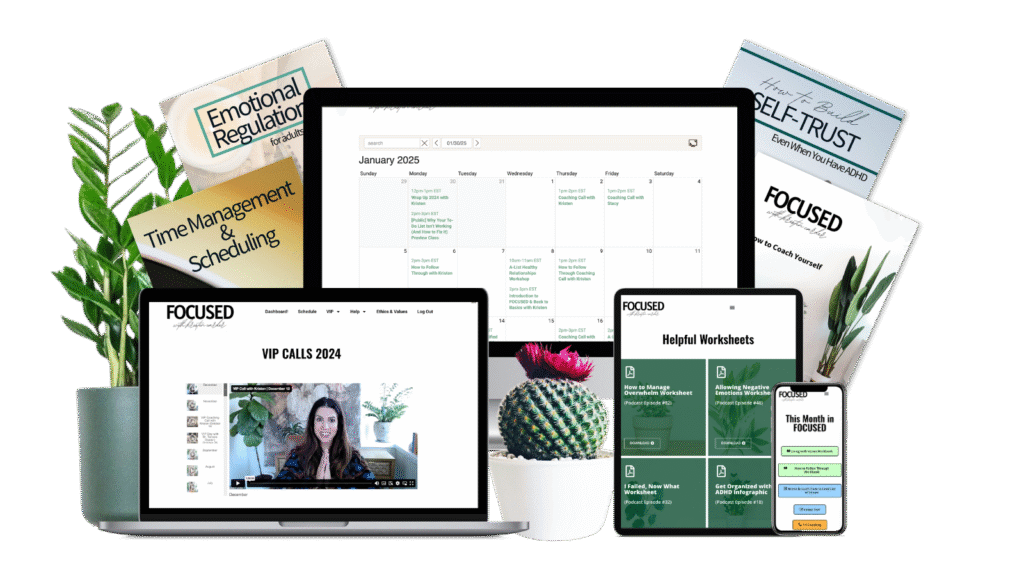
A proven coaching program designed specifically for adults with ADHD who want to gain clarity, build confidence, and take control of their lives.

Join a community of hundreds of ADHDers

Learning About My Brain...

Changed Everything

Hi, I’m Kristen Carder—ADHD expert, podcast host, and certified coach who’s been exactly where you are. Diagnosed at 21, I spent years cycling through planners, courses, and systems that never quite worked. Everything changed when I discovered the power of understanding my ADHD brain and the transformative impact of community support.

Now, after 15+ years of research and experience, I’ve helped thousands of adults with ADHD thrive. I’m here to show you how understanding your brain can transform your life, just like it did for mine.

ADHD Tips That Actually Make Sense

Follow @i.have.adhd.podcast and join our Instagram community for daily strategies, relatable content, and real talk about ADHD