


Episode #329: ADHD 101 for Neurotypicals: Why Your Loved One Struggles with the ‘Easy Stuff’

Listen or Watch this episode on:
Kristen Carder

About This Episode

This one’s for the ADHDers and the people who love them.

In today’s episode, I do the heavy lifting of explaining ADHD—what it is, why it matters, and what it really feels like to live with it—so you don’t have to.

If you’ve ever wished your partner, parent, friend, or co-worker just got it, this is the episode to send them.

Inside:

  1. Why ADHD is so hard to explain (even for ADHDers)
  2. The top 3 things people with ADHD wish their loved ones knew
  3. The top 3 things they need from you
  4. What it means when someone with ADHD shares this episode with you

Whether you’re an ADHDer or a neurotypical ally, this episode is all about building bridges, deepening connection, and fostering real, loving understanding.

???? Press play, then pass it on.

???? Research of the Week: www.ihaveadhd.com/research

???? Voicemail shoutouts included!

This Episodes Recourses:

Take the ADHD & Relationships Survey Here

Want help with your ADHD? Join FOCUSED!

Have questions for Kristen? Call 1.833.281.2343
Cozy Earth

Episode Transcript

Kristen Carder 0:05
Welcome to the I have ADHD podcast, where it’s all about education, encouragement and coaching for adults. With ADHD, I’m your host, Kristen Carter and I have ADHD, let’s chat about the frustrations, humor and challenges of adulting, relationships, working and achieving with this neurodevelopmental disorder, I’ll help you understand your unique brain, unlock your potential and move from point A to point B.

Hey, what’s up? This is Kristen Carter, and you are listening to the I have ADHD podcast. I am medicated, caffeinated, regulated and ready to roll. Let’s go. Let’s go. How are you come on in. This is gonna be a special episode. This is something that I don’t usually do, but this specific episode is designed not just for you, ADHD or ADHD, curious listener, but also for the people in your life who love you. So in the next hour ish, I’m going to be doing the heavy lifting of explaining ADHD, why the diagnosis of ADHD matters. What, what like we would love our neurotypical friends and family to know so that you can send this to the people in your life who you love, that loves you, that you wish would just maybe understand you a little bit better. Maybe you don’t know how to explain ADHD, and it is really hard to talk about it. It’s kind of confusing. There’s a ton of research, but there’s also like information overload out there about ADHD, and it can be really awkward. I hear from ADHD ers all the time that relationships are one of the hardest parts about having ADHD. This is actually why I’m writing a book on how to have healthy, healthy enough relationships for adults with ADHD.

This is even though I’m a general life coach, and I coach people all over the world about all kinds of different ADHD related topics. Relationships are my like passion project. They’re my area that like I just get so into because relationships matter so much. So many of us are lonely, so many of us feel misunderstood, so many of us ADHD ers just wish that we could connect better with the people in our lives, but it’s kind of clunky. It’s hard. We don’t know how to do it. And I hear over and over, I mean, I’ve coached 1000s of people with ADHD, and I hear so often, like, I wish my friends or my parents or my partner would really understand me and really see me for who I am, someone who’s really trying, someone who’s doing their best, someone who’s struggling but trying to make progress. And so I’m hoping and praying in this episode that I can do the ADHD experience justice and that I can help to give language to the ADHD experience so that the neurotypical people in your life, your friends, your family, your partner, the people that matter the most to you, but just be able to have a little bit more understanding about your experience, about what it’s like to have ADHD and what you’d love for them to know about you Before we get into that specific thing, I have a request. The research of the week this week is my research, the research that I am currently conducting for my upcoming book. So I talk about it all the time. You know that I’m writing a book, and part of that project, I’m writing a book on how people with ADHD can have healthier, healthy, ish, healthy enough relationships. And as a part of that, I’m conducting research, and the reason for that is there’s very little research on ADHD and relationships, and the small amount of research that’s out there is centered around romantic relationships for 88 years, but we all know that, like, yes, romantic partnerships are a big part of our lives, but they’re not the only relationships that we care about.

We want to have friends, we want to have great relationships with our parents. We want to have great relationships with our own kids, with our colleagues, the people that we work with, and so I’m conducting research right now, right this second, on the experience of people with ADHD in their relationships, and I would love you to take part. So I partnered with an organizational psychologist, a long time focused member who is now my. A research consultant, research assistant, and she’s helped me to create a very comprehensive research survey on the experience of ADHD ers in the relationships. Please. I would love you to take this survey. You can go to I have adhd.com/research to grab the survey, it’ll take about probably 10 to 15 minutes, and it’s going to give so much information about the experience of ADHD ers in their relationships. And this is a huge part of my book. All of the information that we collect, all of the data that we collect, is going to be included in my book, and I can’t I just cannot wait again. Go to I have adhd.com/research to take that survey. So far, we have over 400 submissions, and that’s amazing. I would love to be in the 1000s upon 1000s. So please, please, please, take part in that research survey. Okay, we’re going to start off with a voicemail. I forget this person’s name. I am so sorry. It’s because I have poor working memory. I have ADHD. Let’s find out what her name is. When we press play on this voicemail, we’ll learn it together. Let’s go.

Caller 6:22
Hi. My name is Anna. I’m a Jersey girl. I was diagnosed with ADHD in early adulthood, and I’ve been in counseling. I recently started getting medication, and I’ve been working through all these issues, like you were talking about shame and you’re talking about friendships and hyper fixating triggers. So my question is kind of around all that with friendships and even like situationships that have ended, and I’ve literally had to go no contact, but sometimes you’re saying, like you have friends that are just taking and so that that kind of happened a lot to me, and I would become hyper focused and trying to always please the people around me, and I still am that way with my really good friends and close knit friends, but I find that the friendships were that I don’t have any more that I’ve completely like, cut off because they were just not good friends, and, you know, did not appreciate me, and kind of just brought negativity in my life. I’m having a hard time like letting go and having peace from it. I feel like that’s like a hyper fixation where I am constantly revisiting the reasons why we’re not friends anymore and kind of validating my decision to not be in contact with that person anymore, and going through all the things, seeing, remembering what I did wrong, and then that kind of triggered me into like a spiral of shame to like, Did I mess up? And even though I’ve gone through this over and over, it’s like ruminating, I guess, too. So I guess I wanted like advice on, how do you spell? How do you let go? I think my problem is letting go like I know for sure these people I don’t want in my life anymore, but how do I let them go so they’re not constantly coming back up in my mind and kind of like intrusive thoughts and triggering me and all these things, you know, again, I think I just want peace in my life.

Kristen Carder 8:22
Oh, honey, yes, at the end of the day, I just want peace in my life. So Anna, thank you so much for calling in. I’m really sorry for forgetting your name, but it’s a beautiful name, Anna, I’m so glad that you called in, and I think you just illustrated my point so perfectly that like friendships for adults with ADHD are so difficult, that’s a big part of the book that I’m writing. Is like, how to have these, like connected, good friendships. And I totally understand the ruminating and the difficulty letting go. I was really struck when you said letting go, that’s what I’m struggling with. And I thought that was so insightful and really self reflective. So good on you, Anna, for just noticing that about yourself that that is primarily what you’re struggling with. And as I’ve listened to this voicemail from you a couple of times, and what’s hitting me over and over, and I really wonder if you feel like this is the main issue. What’s hitting me over and over is I wonder if you’ve actually spent time grieving the loss of these relationships. Because what I have found is that when I haven’t done the work of grieving the loss of like, really recognizing that even though this wasn’t a healthy relationship for me, there’s still a big loss in my life without this person. There’s the loss of connection, there’s the loss of the things that we used to do together. There’s the loss of the dopamine that I used to get when they were around. There’s the loss of whatever it is I wonder if you’ve really named that loss, because as I was saying, what I found is if I am kind of pushing grief to the side and not allowing myself to name the loss and really feel it and really grieve. It just keeps coming back like a flood. It just keeps coming back like intrusive thoughts, like rumination. Because what that is for me, and I’m wondering if this is what you’re experiencing, is an invitation to grieve, an invitation of like you haven’t wrapped this up yet in your body. You have not named I have even though it was my choice, I have let go of these friendships. I have let go of these situationships. And that’s sad that hurts me, even though it was the good and right and healthiest thing for me, it’s still really sad. And so what I’m gonna invite you into Anna is actually some grief, which is not sexy, and I’m so sorry, but I think what’s going on here is that you haven’t maybe taken the time to name those specific losses and grieve them and whatever that looks like for you. It might be crying, it might be just sitting with the really big emotions of it. It might actually even be like napping and letting your body process it like while you’re in your bed, which I have done hours and hours and hours and hours of grief, work in my bed, napping. I’m not joking, because grief feels like a heavy weight.

Grief, for me, when I was in deep grief, was like carrying around 100 pound weight on my chest. It was exhausting to exist with grief, and I wonder if, in an effort to avoid grief, avoid those yucky, big, sad feelings, if you’re just kind of pushing it away, but then they’re coming. They’re like, knocking at your door constantly, and it’s coming back as rumination. It’s coming back as intrusive thoughts. It’s coming back. It’s like, I can’t get this person off my mind. I think what you need to do, honey, is grieve. I wonder, listener, if you relate to this just like you know, knowing that you’ve made the right choice, knowing that, like this relationship is not healthy for me, I need to let it go, and then feeling like I should just be over it, because I’m the one who decided to let the relationship go. I’m the one who decided that this isn’t right for me. So why am I not just getting over it? Well, I think that there’s a step missing. There’s a step missing in all of this, which is like, this is really sad, even though it was my choice, it’s still a loss, and I’m I’m heartbroken, and I’m gonna name that, and I’m gonna identify, I’m gonna validate that, and I’m going to really allow myself to grieve it. So Anna, I I think I have a hunch I would love you to call back and let me know, really, because you know, if we were sitting face to face, I would want to hear from you. Do you think that it’s possible that there’s some grief work here, some intentional naming of loss, some intentional feeling, big sad feelings that will then kind of like, wrap this up for your body, wrap this up for your brain, wrap this up for your nervous system, so that you can truly let it go. In my opinion, I think that is maybe what’s happening here.

So I’m gonna invite you into that work. I hope that it’s very, very helpful to you. I commend you for knowing yourself, for being in counseling, for for identifying unhealthy relationships, and for letting go of relationships that are just not right for you, where you feel like you’re always in the position of giving and that it’s not reciprocal. It’s not back and forth, it’s not this. There’s not mutuality there. I commend you for that. So listener, if you would like your question answered on the podcast, call 833-281-2343, I would love to answer your question. This number is also in the show notes, so you don’t have to remember it, you can just hop on over to the show notes. Again. It’s 833-281-2343,

I would love to answer your question on the podcast.

If you have ADHD, then you probably struggle to sleep. You’ve probably spent many nights getting hot and then cold, and then hot and then cold. And then frustrated, and then overwhelmed, and then your nervous system just kind of freaks out. Listen to what’s helping me lately, cozy Earth. Cozy Earth’s bamboo sheets and bamboo pajamas are temperature regulating and guaranteed to give you a comfortable night’s sleep. It may sound disingenuous how much this has affected my life and made things better for me. Personally, I am obsessed with cozy Earth, and when they say that their sheets and their pajamas are temperature regulating, they’re not lying. I have found it to be true, and I’m a woman of a certain age where I need temperature regulating, if you know what I mean, what’s so great about cozy Earth is that there’s 100 night sleep trial, meaning you can try them during the hottest nights of the year, and if you’re not in love, you can return them hassle free, but you’re not going to want to, but you can, you can. There’s a 10 year warranty on all bedding products, and that is a decade of cool quality sleep. Listen, ADHD or luxury should not be out of reach. Go to cozy earth.com, and use code. I have ADHD for 40% off, best selling temperature regulating sheets, apparel and more. You’re going to feel the difference the very first night. Like I said, temperature regulating is no joke. It’s no lie. It’s not just a marketing ploy. It is the truth. I have three amazing pair of these bamboo pajamas. I cannot stop buying them. I have a beautiful bathrobe. I have the bamboo sheets. I am now obsessed with cozy Earth, and you can be too. Go to cozy earth.com. Use the code. IhaveADHD for 40% off. You’re gonna feel the difference the very first night. All right, my friends, here’s here’s what we’re gonna do today. Here’s where we’re going today.

Okay, we’re about 15 minutes in, and what I would love is to take some time to explain the ADHD experience as clearly and as compassionately and concisely as I can, so that your neurotypical, friends, family members, partner, I don’t know why I wanted to make that plural, will have a concise explanation that’s just like right there, that you don’t have to do the heavy lifting of that, and we’re gonna talk about what most ADHD ers wish their neurotypical friends and family knew, what neurotypical friends and family can do to support ADHD ers. So that’s where we’re going with this episode. If you are a neurotypical friend or family member that has like been sent this episode, I just want to say thank you. Thank you so much for being here. Thank you so much for listening. Thank you so much for taking part, for having the patience and the courage and just the interest in listening and in participating in this, your ADHD person is sending this to you because they love you, they trust you, they want to be connected to you. This is not and I told you so. This is not a shaming process. This is not one person is better than another person. None of that. All this episode is, is to foster understanding, is to foster connection. That’s all that we want to do here. This is not a gotcha moment where, where an ADHD is gonna be like, See, I told you so blah, blah, like, that’s not at all what this is. All we want to do today is encourage understanding and connection between an ADHD person and a neurotypical person. Okay, and I’m gonna just do my best to be the bridge between the two. And of course, I can’t speak for everyone’s experience. I’m gonna try, but I will be speaking in generalities. I know that this is a global audience. We have listeners in 145 different countries. Okay, that’s what the iTunes, or what is it called, Apple podcast data tells us like, that’s huge. That’s huge.

So I know that I can’t speak for everyone. This is a global audience, but I have coached 1000s of people, 1000s and 1000s. We’re up to 5000 people. And so in general, I can speak to you know, like, what living life with ADHD is like, and I just ADHD, or want you to understand that like you’re probably gonna need to add your own specifics to this, okay, because I will be speaking in very general terms. So don’t be afraid to add your own specific nuances, experiences, your own takes and neurotypical friends and family ask your ADHD loved one about their specific experience. Like, okay, Kristen was talking really in generalities, but like, tell me more about your specific experience. Oh, my gosh, an ADHD or would love to tell you, okay, the point here again is to foster connection. That’s the whole point of relationships. Anyway. To feel connected. We’re all so lonely. We are all so lonely. And actually, the research that I’ve been talking about, the research that I’m currently conducting now, this is like three weeks in advance. I’m recording this in July, so we’ve only gotten about 400 submissions in but when I tell you that most people, most people who are taking the survey are are saying that they’re lonely. That breaks my heart, that breaks my heart, that’s why, a big reason why I wanted to create this episode as a connector, as a point of connection between a neurotypical and an ADHD. Er, okay, so welcome in. I’m so glad you’re here to the ADHD listeners, to the neurotypical, friends, family members, partners who are invited to listen today. Welcome. The fact that you’re here says so much. It tells us that you care deeply, that you’re curious, that you’re willing to learn and grow in understanding that means everything to us.

Okay, so I’m going to start here. ADHD is actually very difficult to talk about. It’s complex. It’s nuanced. It makes it really difficult to explain, even for people who understand it well, even for people like me, even for people like I have been working solely with adults with ADHD for the last six years. This is not like a trend for me, this was well before, like the influencers on Tiktok, which God bless all the tiktokers. But like this was well before, it was trending on social media, well before, and yet, I still find it hard to talk about. I still find it hard to explain. So if you’re a neurotypical, like a typical person with a typical brain, and you’re just like, I don’t really get this ADHD thing. And your friend or family member who has ADHD kind of sucks at explaining it to you, where you’re just kind of like, I don’t really get it. Like, what are you even saying?

Welcome to just the conversation, because that is a lot of people’s experiences. Okay, so we struggle to explain ADHD because it is hard to talk about. And one of the reasons why it’s hard to talk about, and I’m gonna start right here, is because ADHD does not create new problems. My friend and colleague, Dr Ari Tuckman, says this often. He said it here on the pod more than one time and and I quote him all the time, because ADHD doesn’t create new problems, it exacerbates the universal problems. So when your loved one with ADHD says, well, ADHD means I still go to focus and I’m distractible and I I suck at remembering things, and sometimes my emotions get the better of me, and you as the neurotypical are like, Yeah, I mean, like, we all do that. And then there’s silence and crickets, and your ADHD person gets like, defensive, but doesn’t know what to say back. And then you feel like, What are you even talking about? Like, we all struggle to remember things. We all struggle with being distracted. We all like struggle with this kind of stuff. Like, what are you even saying? I want you to know that ADHD does not create brand new problems. It’s not like with ADHD come these problems that no one has ever experienced, ever in their life. What it does is it makes the universal problems debilitating. So every single human gets distracted, once in a while, every single human is impulsive, once in a while, every single human is forgetful, once in a while.

But for someone with ADHD, they have had to show that these symptoms are actually debilitating. They’re holding them back in their life from the basic things that they want to do, but also from the big things that they want to do. They’re making their life extremely difficult, and not just in one area of life, but in several areas of life. So if somebody that you love has an ADHD diagnosis, that means that they have talked face to face with a clinician, and they’ve talked about all of their life experiences, and they’ve been able to articulate that they that these symptoms have held them back prior to age 12, that they notice symptoms and consistently throughout their lives, and it’s been debilitating to a debilitating degree. Now that might not be what you observe my lovely, wonderful neurotypical friend or family member, and that’s okay, because we. We hide it from you. We hide the dumpster fire from you as much as we can. But just know that the symptoms that we’re going to talk about, yes, they are symptoms that everyone experience from time to time in their life, but for someone who’s been diagnosed with ADHD, it’s to a debilitating degree across three or more areas of their lives since childhood. Okay? Now, while there are a lot of similarities between people with ADHD, the experience is different for everyone. ADHD is a spectrum. Deficiencies vary the level of severe severity, like how bad it is, also varies, and not everyone experiences it in the exact same way. So again, I want to refer you to your ADHD, loved one who sent you this lovely little podcast, and ask them about their experiences. Ask them about the nuances of it for their diagnosis. Okay, I want this episode to be a conversation starter. I want this episode to be a conversation starter between ADHD er and neurotypical person, where it’s like, I’m going to talk about some very basic things. I’m going to try to simplify ADHD and and make it so that, like it’s understandable by everyone. But I invite you in your relationships to talk about the specifics for you. Okay, so the first thing that we ADHD ers want you, our neurotypical friends, to know is that ADHD is real. We want the whole world to know this. We want to shout it from the rooftops. We want to just like, have billboards and like write, like Sky writing and like at the beach, you know how, like, the airplanes pull the banners at the beach. Like, we just want everyone to know that ADHD is real, okay? It’s not imaginary. It’s not a personality quirk. It’s not a made up diagnosis. It’s a medically recognized disorder of self regulation. Now, not everyone loves the word disorder, and that’s okay. We if you don’t love the word disorder, you’re going to use the word condition. Okay, condition. But if you are like me and feel quite validated by the word or descriptor disorder, and then use the word disorder. Okay, so ADHD impacts attention, behavior and emotions.

The umbrella is it’s a self regulation disorder of attention, behavior and emotions. We struggle to regulate attention to a debilitating degree. We struggle to regulate behavior to a debilitating degree. We struggle to regulate our emotions to a debilitating degree. Okay, neuroimaging studies, including functional MRIs, show that the prefrontal cortex in people with ADHD often exhibits reduced activity and delayed maturation compared to neurotypical brains. That’s important for you to know, okay, since this region of the brain is heavily involved in executive functions, things like planning, prioritizing, impulse control, emotional regulation and working memory. These differences mean that we’re often operating without the full set of tools that help adults manage life. So neurotypical if you feel like your ADHD loved one doesn’t act like an adult. This is why. Okay. These differences mean that we’re often operating without the full set of tools that help adults manage life. Okay, at best, this is frustrating, and at worst, it can be completely debilitating. So if your ADHD loved one has had multiple jobs, multiple partners, multiple like failures, multiple car accidents, multiple years in debt or with under earning like this is why executive functions are the mental skills that keep us afloat in daily life and when they’re compromised like they are With someone with ADHD even so called basic tasks like keeping house, doing the laundry, paying the bills or maintaining relationships, can feel like trying to summit Mount Everest without proper gear. So if we’re all on a trek up Mount Everest, I want you to think about the neurotypical brain having the proper gear for the climb, for the summit, if you will. But understand that the ADHD brain does not have the same set of tools, or they have the tools, but the tools are broken or rusty, or just like we can’t find them, we can’t find. Random. They’re in the they’re in the fridge with my keys, right? We can’t, we can’t find the proper tools. So it makes the quote unquote easy things of life, very, very, very, very, very, very hard. Okay, executive function deficiencies are a key part of ADHD, and they include task initiation, like getting started, even on easy things. Do you notice your loved one struggling to initiate, struggling to get started, struggling to do the basic, simple things that they promise to do? Yeah, that’s an executive function, deficiency, emotional regulation.

This is a big one, getting really, really reactive and having emotional reactions that really don’t fit the situation where you’re just like, What the heck? What are you doing? What’s going on here? Working memory issues, so like forgetting everything all the time. Self Awareness, this is a big reason why your neuro, your neuro divergent, your ADHD, loved one makes the same mistakes over and over. I’m so sorry. It’s not because they don’t care. It’s because they really struggle to self reflect and have the self awareness to be able to look back on their behavior and make changes for the future. That’s an actual executive function deficiency. And then a group that I like to call opp organization, prioritization and planning, which is like a cluster skill that work against us in so many ways. How disorganized is your ADHD, loved one? How much do they struggle to prioritize and do things in the proper order. And how is it when you try to plan something with them, is a hard is it frustrating? Do they resist it? Yeah, that’s because of these deficient executive functions. So I want you to understand that ADHD is a real diagnosis, and when someone that you love comes to you and they say, Hey, I’ve been diagnosed with ADHD, the only, the only acceptable response is, Oh, wow. Tell me more.

It’s not. Let’s just list a couple unacceptable responses. You don’t have ADHD, you’re just forgetful. We’re all forgetful. You don’t have ADHD, or other responses like ADHD isn’t real. Every or the eye roll. Everyone’s diagnosed with ADHD these days. I do have several episodes like busting those types of myths. I’m not going to get into them here. But when someone you love comes to you and says, Hey, I’ve been diagnosed with ADHD, a great response is, oh, wow, wow. Tell me more. What does that mean for you? What? What’s the plan? How can I help? How can I support? Oh my gosh, that’s what we want. So bad. Okay, so first of all, we want you to know, we really want you to know that we understand that, like, yes, ADHD is real, but we know it’s annoying. Okay, we understand it’s annoying. It’s it’s annoying, because, like, everyone struggles with this stuff, right? Everyone struggles with this stuff from time to time. And it’s really easy to watch your ADHD loved one struggle and be like, Yeah, we all struggle. I struggle too. I don’t know what your problem is, and I just want to say, please understand that in the brain and body of someone with ADHD are so many deficient executive functions that it really does make these like adulting tasks so difficult.

And sure, like Ari Tuchman says, ADHD doesn’t create new problems, it just exacerbates the universal ones. And it would be really cool of you to just check in with your ADHD loved one and say, like, hey, which of these, like, universal problems does ADHD exacerbate for you the most? What do you think is your biggest struggle? Tell me about it. All right, tell me about it. So remember, in order to get a medical diagnosis, we had to prove that we struggle with these things to a debilitating degree across multiple areas of our lives, since childhood. Okay, so this is not nothing, and if you have the urge to dismiss the diagnosis, even unintentionally, I just want to say I understand that, because I think it is actually really hard to to intellectualize and to really comprehend. ADHD, I’ve done so much research in the last my gosh, I’ve done so much research, and I’m still learning, and I’m still. Deepening my understanding of it. I’ve spoken face to face with all of the experts, and I still struggle sometimes to verbalize what ADHD is and make sense of it. So I understand neurotypical, friend that you might feel like the diagnosis doesn’t really matter and it’s not really a thing, but please understand on the receiving end of that your ADHD loved one can feel really invalidated and really dismissed, really demeaned, and it can, it can be really painful, and sometimes that makes us feel really, really defensive, especially because we do struggle to explain it, and then that can create a lot of conflict, okay, and and I know that it’s hard to accept, and we’re going to talk about that as the episode goes on, but I’m just asking you, both ADHD or and neurotypical, like, if we can Just come from a place of vulnerability and not dismissiveness. If we could just ask questions out of curiosity, that would be so helpful in moving the connection and the conversation forward, so we’re not trying to make excuses for bad behavior. And I think that’s really important to note, we’re not trying to excuse ourselves for participating in the family life.

We’re not trying to excuse ourselves for not getting things done, but we are trying to explain why it is so hard for us. Okay, so ADHD is not an excuse, but it is an explanation. It does give you an understanding of why things are so hard, not that I shouldn’t be held accountable to be an adult. I’m still an adult. I still have to pay my bills. I still have three kids to take care of. I still have a mortgage to pay. But ADHD explains why some of that is so hard for me, why some of it takes so long, why I have a pile this big, this tall on my counter for the listening audience? I would say it’s at least a foot high, just a pile of mail that I have resisted opening since probably April. I haven’t opened any of it. I have not opened any I’m not. I don’t want to. It feels too hard, and I just don’t want to do it. Okay? Why? Opening mail is easy? It shouldn’t be a big deal. Kristen, you’re a podcaster, you’re a coach, you’re successful, and you can’t open your own mail. Yeah, that’s exactly what I am saying. Okay, so, and I’m not making an excuse. I’m not saying, like, well, I shouldn’t be held accountable. And if there’s like a parking ticket in there, which I’m sure there is, and actually, as I’m talking about this, I just remember there’s like, a jury duty summons, so I got to go look at it tonight. But let’s say I miss jury duty. I wouldn’t be like, Oh, I just have ADHD. Like, oh, well, I would be like, Okay, what are the cons? Like, I have to accept the consequences, whatever they are. Am I going to jail? I hope not, but it does explain why it’s so hard for me.

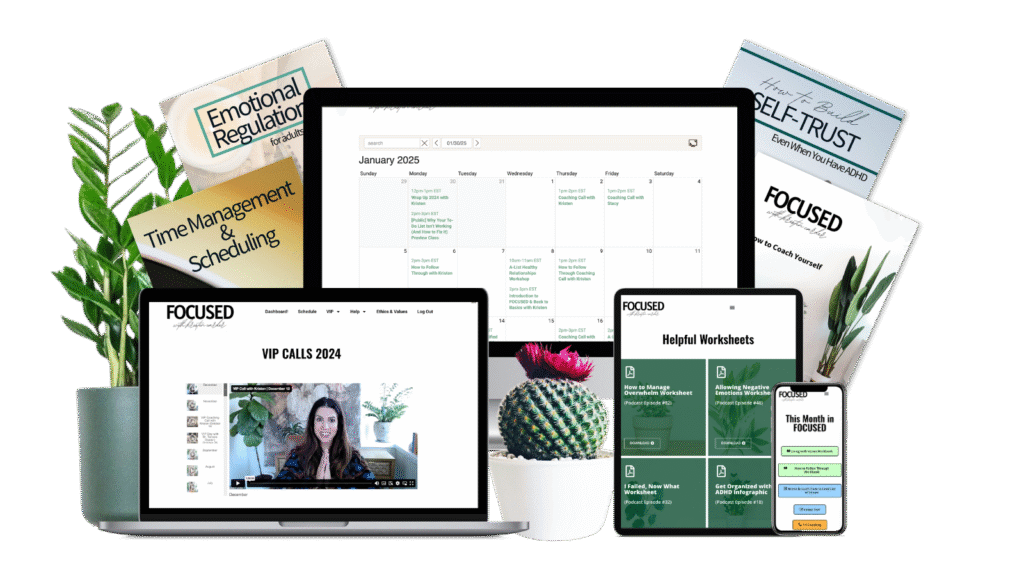
Okay, everyone with ADHD knows what to do to improve their lives. You go to bed at a reasonable time, you wake up early, you make a list, you cross things off the list in order, blah, blah, blah. Like, yeah, we know what to do, but ADHD is not a disorder of not knowing what to do. It’s a disorder of knowing exactly what to do but not being able to get yourself to do it. That’s why I created focused. It’s an ADHD coaching membership for adults with ADHD. I’m a life coach with multiple certifications, and since 2019 I’ve coached over 4000 adults with ADHD from all over the world. I know what it takes to help an adult with ADHD go from Hot Mess express to grounded and thriving. I’ll teach you how to understand your ADHD brain, regulate your emotions and your behavior and accept yourself, flaws and all. And with this foundation, we’ll build the skills to improve your life with ADHD. And not only do you get skills and tools and focus, but you’re surrounded by a huge community of adults with ADHD who are also doing the work of self development right alongside of you. Dr Ned Hallowell says healing happens in community, and I have absolutely found this to be true. So if you’re an adult with ADHD who wants to figure out how to be motivated from the inside out and make real lasting changes in your life. Join hundreds of others from around the world in focused. Go to I have adhd.com/focused to learn more. That’s I have adhd.com/focused to check it out. Next up, I do want you to know, dear sweet love. Lovely, wonderful, neurotypical that we adore. Your ADHD person doesn’t have a lack of willingness that they’re struggling with a lack of ability. Okay? So it’s like it’s not a lack of willingness when you see them struggle, when you see them not get things done, when you see them resist the gigantic pile on the counter. It’s not necessarily a lack of willingness, it’s a lack of ability.

This, this is a spectrum disorder, so yes, the level of impairment varies, but common impairments include poor working memory, which is like, out of sight, out of mind. If you ask me to do something and I say, Yes, I’m probably going to forget to do it. Time, blindness. Difficulty, not just with, like, being late, which, of course, is part of it, but like, really just understanding the passage of time, disorganization, difficulty prioritizing, emotional dysregulation, impulsivity, distractibility, it’s so much the struggle is very real and it’s exhausting. And even if it seems like it’s just simple tasks, it actually takes way more brain power and effort, like a Herculean effort for us to do the simple things that a neurotypical person,

just like might be able to do easily, which is partially why you may experience your loved one as being like lower capacity or overwhelmed or exhausted after doing what looks like simple stuff. All right, so we understand that that might be confusing, but please, please, please, like, really, weave this into your soul. It’s not a lack of willingness, it’s a lack of ability. We’re really struggling Lastly, in this section, like, what we want you to know? We want you to know that we know it’s hard for you. We know we’re very aware that we’re hard to live with, that we can be really hard to be in relationships with, that we’re hard to work with. And like, on behalf of all of us, I acknowledge that. I acknowledge how hard it is for you as a neurotypical person existing in the world next to an ADHD person, I can I know it’s hard. I have a neurotypical husband. He tells me how hard it is, or has told me how hard it is, it’s hard. What I want you to know is that we’re not doing it to you. We don’t want you to take it personally. We’re not trying to hurt you. We’re not trying to, like, be offensive to you. It actually, and I don’t mean this in an offensive way, but like, it has nothing to do with you. So like when we forget the thing, it’s not because we don’t care about you. It actually has nothing to do with you. It has everything to do with our brain when we explode and our emotions get the best of us. I mean, we deserve to be held accountable for that, but also that has everything to do with our brain and the way our body is reacting and how we don’t have the skills required to self regulate. That’s something that we need to work on. I’m not saying it’s not again, not an excuse, an explanation. Okay, we’re not trying to be offensive when we leave a mess. We’re not trying to say, I don’t give enough about you. That’s not what we’re trying to say. We just forget like we struggle to remember the impact. We struggle to understand how much we’re impacting you, and that doesn’t that’s not to diminish the impact, but I just want you to know that like we are really struggling. Okay, we we wish that we could do better for you. We do like we’re in this weird place of like, trying to accept ourselves, trying to accept our brains, but also we want to be convenient to live around.

We want to be convenient to be in relationships with. We know that it would go better for you and for us if we could just do everything right. We know that, but it’s hard. We do not have the skills and just surviving a day can take immense effort. Basic adulting tasks are often the hardest. Just getting out the door in the morning and then doing our jobs and then coming it’s just like we are exhausted. So please know we know it’s hard for you and. We want you to know it’s hard for us. It’s really hard to be us. It’s really can be really hard to have a neurodivergent brain. Can be really hard to exist as an ADHD person, especially a person of intelligence, who knows they have so much potential, who knows that like, if they just applied themselves, they would succeed. It’s just like, I know, but I do not have the executive function skills available to me to do those things. All right, okay, let’s talk briefly about three things that people with ADHD need from their loved ones, if you’re willing, if you’re not willing, it’s all good, like you don’t owe us anything. But hopefully you love the person that sent you this this podcast. Hopefully you want to deepen your understanding of the person who sent you this podcast. Hopefully you want to grow and be more connected.

I mean, that’s why you’re listening, right? So three things that we would love to have from our neurotypical loved ones. Number one, and this is a this is a grouping understanding, patience and empathy. Oh, if you could see these things about us that I know annoy you. If you could see them as symptoms, not as character flaws, that would be so helpful that would change everything. If you could see these things, the forgetfulness, the explosiveness, again, we have to take responsibility for ourselves, so I’m not saying that we don’t incur consequences, but if you could see them as symptoms, the forgetfulness, the explosiveness, the impulsivity, the distractibility, the inability to prioritize and plan, all of the things that go into having ADHD, if you could see them please through the lens of a medical diagnosis and see them as symptoms and not judge our character because of it, that would change everything for us. That would make the biggest difference ever. Oh my gosh, it would. It would heal so much in us if you were willing to see them as symptoms. That doesn’t mean you excuse them, that doesn’t mean that we don’t acknowledge the impact, but if they’re seen through the lens of symptoms and not character flaws, not personal attacks on you, that would be so helpful if you would be willing to practice some empathy, even when our experience doesn’t match your experience. Brene Brown says empathy is listening to someone’s story and believing them even when it doesn’t match your own story. Just because something is easy for you doesn’t mean it should be easy for me. I have a neurodevelopmental disorder that impairs my attention and my ability to regulate my behavior and emotions. So it’s really difficult. Things become very difficult for me, even very easy, things like going through the pile on my counter or doing my laundry or consistently doing the dishes like those are the easiest things in my life, right, wrong, wrong, those are the hardest things for you, for me. So just because it’s easy for you, our dear, neurotypical, loved one, doesn’t mean that it should be easy for us. It’s not easy for us. Okay, us at each Dears, what we would love. Number two, what we would love, what we need from you is less judgment and more acceptance.

Oh my gosh, if we could just build acceptance into the conversation, it would change everything. We just want to be accepted for who we are. We know we’re not perfect. We know we struggle with annoying stuff. We know and we’re sorry, and if we could change we would, but we are looking for unconditional love and even more so maybe unconditional acceptance. Again, this doesn’t mitigate consequences. This doesn’t mean we are not held accountable, but can you see us through a lens of a medical diagnosis? Can you see us through the lens of symptoms, and can you give us some unconditional acceptance? All right, it’s not that we don’t ever get held accountable, but we do want to exist without being micromanaged or constantly judged. We don’t want to have to walk on eggshells. We don’t want to have to worry constantly that our symptoms are going to break the connection that we have with you. We want to be connected to you right now. I know that you don’t do this, but some neurotypical people mock or belittle ADHD strategies like setting reminders to eat or having overly structured routines, or I don’t know why you have to do X, Y, Z, or I don’t know why you have to go to therapy, or why we’re paying for coaching or any of that.

But I really want to encourage you to understand that these types of tools are scaffolding. If you can picture like scaffolding on the side of a building, it’s what’s helping to build the structure. It’s like there to support as the structure is being renovated and built, we’re like your ADHD loved one is listening to this podcast because they’re interested in in growing. They’re interested in self development. They’re interested in making changes and evolving and improving, and those strategies and the money they spend on coaching and therapy and ADHD medication and like a planner and an app to help and like the the Apple Watch, the noise canceling headphones, like all of those, the weighted blanket, all of the things, it’s scaffolding. It’s support, okay? It’s helping to keep us afloat. So supporting these strategies can be so helpful to us. So so so, so helpful. And then just some number three, like last thing is just like, subtle and gentle support your ADHD, loved one might not ask directly for help that’s maybe something that they need to work on. Is like naming their needs. It’s a big part of the book that I’m writing is like helping people with ADHD to understand what they need and speak that to the people in their life that love them the most. Because I just really think that that’s where so much healing and growth is going to happen, but they might not be able to verbalize it, but if you neurotypical, would not mind, like some participating in some simple acts, like helping with lunch, reminding about trash day, saying, like, Hey, can I help you get out the door?

I noticed that you’re rushing. Do you need anything? Gosh, that goes a long way. That goes a long way. Just simple support, or support for the simplest tasks would be so helpful if you you might feel resentful because you watch your ADHD person like excel at work in the hardest areas of their lives, and then they come home and it’s just like a dumpster fire, or their car is a dumpster fire, or like the behind the scenes of their life is a dumpster fire. And if that is just like, not a metaphor for ADHD, I don’t know what is, but if you’re willing to help support in those quote, unquote, easy areas that can go such a long way, because ADHD ers often excel at hard things like careers or creative endeavors, but they really struggle with basics like laundry and appointments and forms. And listen, if you’re not willing or able to help, that’s okay, but would you support your ADHD or in maybe paying for help, maybe paying for a cleaning person, or paying for a Personal Organizer, or paying for an assistant to come, like, once a week on a Saturday and just like, make all the returns and open all the mail. If I could have an assistant open all of my mail, oh my gosh, that would be so incredible. It’s, it’s totally fine. If you’re like, I don’t have the capacity or the desire, and I am not here to like baby a grown adult, that might be your attitude, and that is totally fine. That’s, I mean, it’s understandable, but if you would at least support them getting help from someone else, that would be incredible. So like, what if you said to your ADHD loved one, like, Hey, I noticed that you really stress out about cleaning. What if we had someone come clean once a month? Just relieve them of that. Hey, I noticed that you get really stressed about dinner prep. How about we order meals from Hello Fresh? This podcast is not sponsored by Hello Fresh, but I would love it to be. So let’s work out a deal. Hello Fresh. But you know, I’m saying, like, let’s figure out a way to make those quote, unquote easy things that maybe your ADHD er is responsible for. Let’s let’s make them let’s give them some support. Let’s make them doable. Let’s see the ADHD person through a lens of symptoms, through a lens of struggle, through a lens of a neuro developmental condition.

That is a legitimate medical diagnosis that requires a level of support that you probably don’t need, and that’s beautiful. But can we validate the experience of the ADHD person and help to give them what they need so that they can thrive. When an ADHD person has what they need, a medical diagnosis, treatment, therapy or coaching, lots of time in nature, lots of support at home, they thrive so much they just like can do anything. It’s such a beautiful thing to watch. It’s such a beautiful thing to watch, but withholding support, belittling a diagnosis, diminishing or demeaning a struggle, that’s when things get really, really, really hard, and where we struggle to evolve, because we’re just not able to get what we need. All right, listen, if an ADHD person sent you this episode, it means that they trust you. It means that they love you, and they want to connect with you more deeply. They want to be close to you. They want to be understood by you. They feel safe with you. You should take that as a huge compliment. I hope I explained ADHD in a way that was understandable for you. I hope that ADHD or you feel seen, and you feel you feel like I did your experience justice. That’s that’s all that I was hoping for today. And again, I know that I can’t speak for everyone. I spoke in very general terms today, so make sure that as you’re speaking together, that you’re explaining your specific, nuanced situation and the intricacies of of your experience and how and how you experience. ADHD, listen. The goal isn’t to be perfect. The goal isn’t like a perfect relationship with no conflict. That’s not at all the goal, the goal, with this episode, is a conversation starter. It’s understanding, it’s compassion, it’s connection, better communication and like a springboard to understanding, so that you can have conversations with your loved ones from from a place of just like gaining more knowledge and understanding about each other, right? So I do encourage you to have a conversation, to talk to your loved one to the best of your ability. If you can drop defensiveness, I know, I know we feel so defensive. I know I feel it too. I really do. But if we can drop defensiveness to like as much as we can, and allow ourselves to be vulnerable, accept the person in front of us, whether ADHD or neurotypical, accept them for who they are, offer unconditional love, unconditional acceptance, even when it’s inconvenient, and we’ll all be better for it. Thank you for being here. I loved every second of this. I will see you next week.

Bye, bye. A few years ago, I went looking for help. I wanted to find someone to teach me how to feel better about myself and to help me improve my organization, productivity, time management, emotional regulation, you know, all the things that we adults with ADHD struggle with, I couldn’t find anything. So I researched and I studied and I hired coaches and I figured it out, then I created focused for you. Focused is my monthly coaching membership where I teach educated professional adults how to accept their ADHD brain and hijack their ability to get stuff done. Hundreds of people from all over the world are already benefiting from this program, and I’m confident that you will too go to Ihaveadhd.com/focused, for all details.

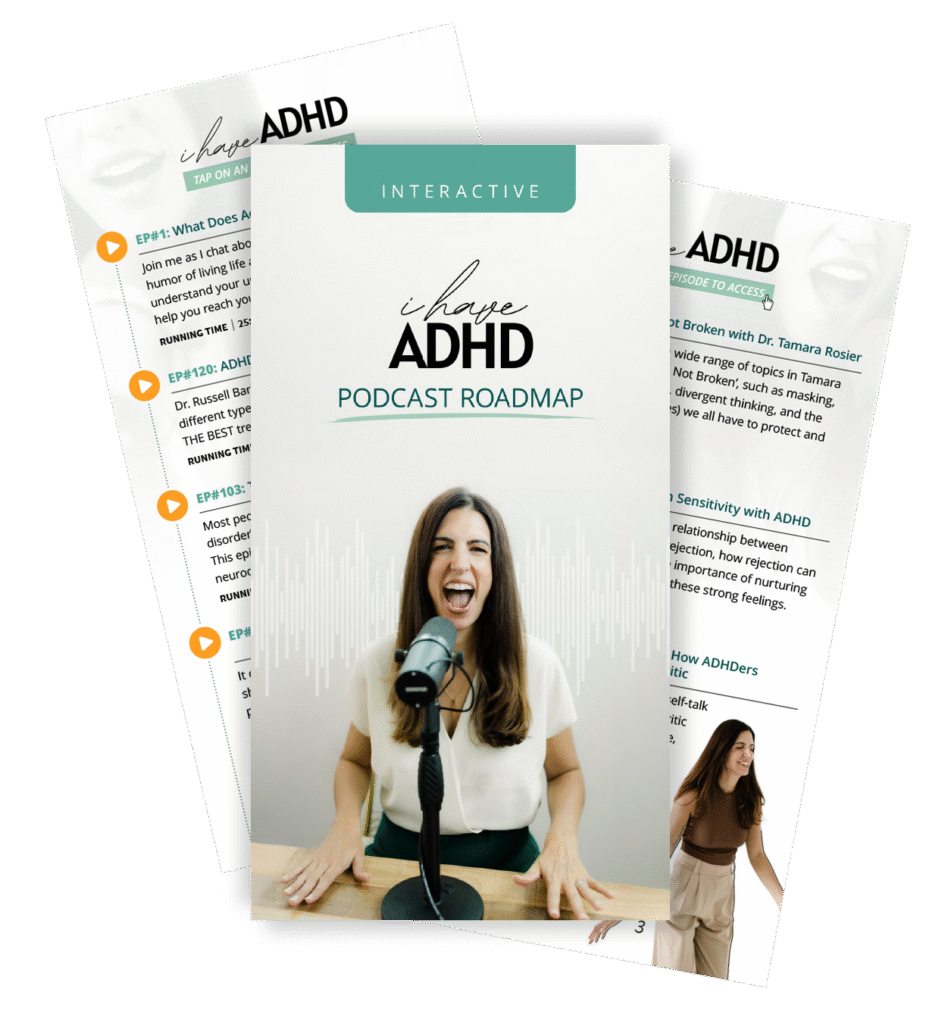
Get The Best of the podcast now with our Podcast Roadmap.

This is a clear and easy podcast roadmap so that you can know for SURE that you’re hearing the very best of the I Have ADHD podcast.

Related Episodes

Dr. Russell Ramsay

Episode #412: How ADHD Steals Your Self-Trust and How to Get It Back with Dr. Russell Ramsay

Kristen Carder

Episode #410: The Exhaustion, The Book, and The People Who Are Mad at Me

Kristen Carder

Episode #408: I Surveyed Over 2,100 Adults with ADHD—Here’s What Broke My Heart

Stop Struggling Alone.
Start Thriving With FOCUSED.

A proven coaching program designed specifically for adults with ADHD who want to gain clarity, build confidence, and take control of their lives.

Join a community of hundreds of ADHDers

Learning About My Brain...

Changed Everything

Hi, I’m Kristen Carder—ADHD expert, podcast host, and certified coach who’s been exactly where you are. Diagnosed at 21, I spent years cycling through planners, courses, and systems that never quite worked. Everything changed when I discovered the power of understanding my ADHD brain and the transformative impact of community support.

Now, after 15+ years of research and experience, I’ve helped thousands of adults with ADHD thrive. I’m here to show you how understanding your brain can transform your life, just like it did for mine.

ADHD Tips That Actually Make Sense

Follow @i.have.adhd.podcast and join our Instagram community for daily strategies, relatable content, and real talk about ADHD