



Kristen Carder 0:05
Foreign Welcome to the I have ADHD podcast, where it’s all about education, encouragement and coaching for adults. With ADHD, I’m your host, Kristen Carter and I have ADHD, let’s chat about the frustrations, humor and challenges of adulting, relationships, working and achieving with this neuro developmental disorder, I’ll help you understand your unique brain, unlock your potential and move from point A to point B. Hey, what’s up? This is Kristen Carter, and you’ve tuned into the I have ADHD podcast. I am medicated, caffeinated, regulated and ready to roll. I am so glad to be here with you today. Thanks for joining me. Come on in. Come on in. Get cozy. Get cozy. Do what you’re doing. Don’t forget water, food, medication, all of the things. I hope that you’re having a great day. I imagine you using this episode as a body double as you’re going about your business. That’s how I use podcasts. They save my life. They let me get all of the things done. And I hope that this episode is the same for you. Today.
We are talking about medication myths. We’re talking about ADHD medication myths. This has been on my heart, my mind, my soul, to chat about for the last couple months, because I’ve seen more and more just absolute BS out there regarding medication. And the stuff people say about it is wild, the stuff, the claims, the claims that are made about medication for ADHD are absolutely wild, and we’re gonna be addressing we’re gonna be addressing it today. We’re gonna get right into it. We’re gonna waste no time. I understand that you may be hesitant to treat your ADHD medically with medication, and I don’t blame you. I don’t blame you. ADHD is really downplayed in the culture. Is very misunderstood. There’s a real lack of education when it comes to medical professionals even understanding adult ADHD. Think about how adult ADHD wasn’t even a recognized diagnosis until the 1990s I believe it was 1994 in the US and 2008 in the UK. ADHD in adults was not recognized until the mid 90s in the US and 2008 in the UK. So we’ve got, like some some Everest to overcome here, right? Like, there’s a lot that we need to overcome, as far as misunderstanding, misconception and really a downplaying of the disorder. What I hear so often is like, yeah, like, you have ADHD, but it’s your superpower. It’s totally fine. It’s not a big deal. Like, it’s, it’s seen as this, like nothing diagnosis, like Ah, just means you just struggle to focus. It’s no big deal. And I have done many episodes on the dangers of ADHD, why we should take it seriously, why it’s not your superpower, etc, etc, etc. We’re not talking about that today. We’re doing we’re not talking about that today. Today we’re talking about medication hesitancy and the myths surrounding ADHD medication, because I understand that even with all of the scientific evidence that we’ve explored over the last 300 episodes on this podcast, it’s still completely valid if you feel uncertain or hesitant about taking medication for ADHD, and my goal is not to pressure you into a decision that doesn’t align with you and your values or your comfort level.
That is never, ever my goal, but I do think it’s important for me, as someone with a platform who is talking about ADHD and educating people on the disorder, it’s important for me to to help present evidence so that you can make a really clear minded decision, okay, and and with that, requires me to address some of the most common myths and misunderstandings about ADHD medication, because there’s a lot of inaccurate information out there. There’s just so much inaccurate information just floating around out there, and I’m not claiming to know everything about everything. I understand that I’m going to get it wrong sometimes that like my perspective is not the only perspective, but I am reading studies constantly. I am reading all of the books I’ve spoken face to face with all of the ADHD experts. Dr Russell Barkley, Dr Russell Ramsey, Dr Ari Tuckman, Dr Tamara Rosier, all of the big name ADHD experts out there with credentials and whose books are sitting on your shelves probably collecting dust. Know if. Sense, I’ve spoken to them face to face. So like I do believe 100% that I have a deep, deep understanding of ADHD and of like, the difference between actual research on the disorder and then society’s opinion, society’s opinion of the disorder is not the same as what the medical research tells us.
Okay, and so we’re making those distinctions today, and my hope is that this really empowers you to just have more understanding, to be able to combat some of those myths. Because, like, you know, your auntie at the at the, like, family picnic, saying, like, well, I can’t believe that you take medication for ADHD, because that’s basically meth, which is really, literally the first one we’re going to talk about today. Or, I can’t believe you medicate your your ADHD child, because it’s going to turn them into a zombie. Like, I hope that this episode gives you a little bit of fuel, a little bit of confidence to be able to combat those myths when you want to. And also, for those of you who are considering being treated for ADHD, but you’re just not sure, you’re just like, I don’t know, like, I’ve heard people say that that you know it’s bad for you, or that it’ll be addictive. Like, I don’t want to get addicted to Adderall, so maybe I shouldn’t take it like all of these myths are what we are going to be talking about today. I am already fired up. I’m going to try to tone it down just a tiny bit. I’m going to try to keep my voice at this level, instead of the very high level that it gets, like a ring up there when I get very, very passionate about the topic, but this is a topic that I am so passionate about because the research is so clear that medication is by far gives us the best outcomes for ADHD treatment, and that 90% of people or more respond positively to ADHD medication.
So, like, it’s just the research is so clear, I will cite my sources in the show notes, and I have a shit ton of sources for you. So like, if you are a source, nerd, head right to the show notes to look at the sources. I’m not going to take the time to, like, cite them with every single myth that I’m going to debunk here, but the sources will be in the show notes for you. Okay, so let’s get into it. This is the one that gets me the most fired up. And I was like, Where should I put this one? Maybe it should be last but, like, we’re just gonna get it out of the way. It’s gonna take the longest time. It’s going to make me the most angry, and we are just going to get it out of the way. Okay, so we’re going to start here, something that I’ve seen circulating here in there, on podcasts, on and then, of course, podcast clips, is that ADHD medication is basically meth. ADHD medication is basically meth. There are so many options of places that I can grab clips of people saying this, but the two that we’re gonna we’re gonna do today is we’re gonna start with Joe Rogan, and then we’re gonna go to the skinny confidential. So let’s start here with a clip from Joe Rogan. He’s talking to Cody Tucker. This is what he says.
Joe Rogan 8:20
We look at that and we say, that is so nuts that people take meth. Why would you do that? And yet, what percentage of kids today are on
Cody Tucker 8:29
Adderall, which is the exact same thing, just a slow release, a delayed release, meth?
Kristen Carder 8:37
Wrong, absolutely wrong. Is not the exact same thing meth and Adderall are not the exact same thing. So let’s break this down, although stimulants like Adderall and vitamins and the street drug methamphetamine, share some chemical similarities, the compounds are not the same, okay? Prescription ADHD medications are carefully formulated, FDA approved and taken in controlled doses to treat specific neurological symptoms. In contrast, meth is often illicitly manufactured, far more potent, rapidly absorbed by the brain and highly addictive. Okay? The drugs may sound the same, like if you’re talking about methylphenidate and methamphetamine, oh, they sound the same. So they must be the same. They are not the same. The chemical compounds are different, okay, the way these substances act in the brain and the body, especially in terms of dosage delivery, long term effects, they differ drastically. They differ drastically. So let’s get into the nerdiness of it all. We’re gonna get into some really nerdy stuff here, because this needs to be said. Okay, taking medication like Adderall. The compound for that is, and I have to blow this up so much because I can’t barely read it, C 9h, 13, N, versus using the street drug methamphetamine, which is a similar compound, but it’s not the same. Methamphetamine is C, 10, H, 15, n, okay, so they they look similar, they sound similar. They are not the same. It’s like the difference between table salt and bleach. Now let’s talk about the chemical compounds for table salt and bleach. Table salt, the chemical compound is N, A C L, table salt, N, A C L and bleach. Okay, the compound there for that is N, A, C, l, o, oh, my gosh, they look they look so similar. They must be the same. No, is, is it? We’re talking about chemical compounds here. Now, I got a C in chemistry, so I am not the one. I am not the one that should be breaking this down. But if nobody else is going to do it, I guess I’m just going to have to do it. I got a C in chemistry, y’all, 10th grade, montgomery high school, Princeton, New Jersey, C in chemistry with Virginia Boehner as my teacher. I’ll never forget it. I didn’t enjoy it. Okay? These compounds, Adderall, C 9h, 13 N, and the street drug, methamphetamine, C 10, H 13 N, they look similar, okay, but amphetamine, which is the compound used in stimulants and methamphetamine, they only differ by one extra carbon and two hydrogens. Okay, now, if you don’t have a chemistry brain, like I don’t have a chemistry brain, you might be like zoning out, but just hear me, hear me on this. They only differ by one extra carbon and two hydrogens, but that makes a vast difference in what they actually are.
Now, table salt and bleach only differ by one oxygen atom. Table salt and bleach only differ by one oxygen atom, but that tiny chemical difference makes a huge functional difference. So we would never say that table salt and bleach are the same because the compounds look very similar. We would never say that. We never say, like, oh well, that they’re just they’re basically the same. No, they’re not basically the same. They’re actually very, very different. Just like amphetamine and methamphetamine are not basically the same, they are very, very different. One helps to regulate brain function, which is amphetamine, the other hijacks the brain function, which is methamphetamine, right? One belongs at the dinner table, table salt. The other belongs in the laundry room, which is bleach, okay. One supports focus, amphetamine, the other causes addiction and long term brain damage, methamphetamine, very different substances. Okay, okay, are you with me? Are you getting it? So I understand that it can be really intimidating when someone says to you, you take Adderall, you know, that’s basically meth, or you’re giving your child ADHD medication, you know, that’s basically meth. My child’s ADHD medication is literally called methylphenidate. And I remember having that pause moment of like, Oh my gosh. Like, is this, okay, methylphenidate? Is this? Is this a problem? Should I be worried that I’m giving my child meth? And then I look into it deeper, and it’s like, no, it’s very, very different. Okay, this is it. It’s really important that you understand, so that, first of all, you can feel secure. If you choose to take ADHD medication, or you choose to medicate your child, you are not, quote, unquote, basically giving yourself or basically giving your child meth. No, you’re not okay. You’d never say that salt is bleach, just because the compounds look similar. You would never say that Adderall is meth because the compounds are different, okay? You you just, you’re never gonna do that. Okay, so, oh, chemical similarity does not mean functional similarity. Let me play another clip. This is from a podcast called The skinny confidential, which is a very. Very popular podcast, and Michaela Peterson was on and just spewing some nonsense, and I just makes me so angry. Go ahead, let’s play that. If
Skinny Confidential Host 15:11
there’s a parent who’s listening that wants to put their kids on Adderall, or has put their kids on Adderall, what, what is your experience? And is there anything that you would
M. Peterson 15:19
caution I mean, Adderall is like meth, so, I mean, they have a fancy name for it, but it’s basically meth. So no, probably kids shouldn’t be taking that, like, look into diet, at least cut out all the processed foods and maybe all the ingredients that are already banned
Kristen Carder 15:31
in Europe. No, that’s not, no. I mean, sure, take out processed foods. Love that for you, that may actually make a difference in the presentation of symptoms, but it’s not going to cure ADHD and Adderall is not basically meth. They are chemically different. The compounds are not the same. Okay, we are we’re you. We need to dig a just a time. We need to use our brains just a little bit more here. We need to not be fooled, and we need to make sure that we are understanding science a little bit better. And like I said, I got a C in chemistry, so I get it. I get it. If you’re like, oh, meth and meth, methylphenidate and methamphetamine, they must be the same. No, they are completely different. Remember, the chemical compound for Adderall is C 9h 13 N, and the chemical compound for methamphetamine is C 10 H, 15 N, completely different. Chemical compounds, completely different, completely different. Okay, it’s really I just wanna pull you in. I wanna give you a squeeze. I just wanna say ADHD medications are not basically meth. An illicit drug is completely different than an FDA approved medical treatment for ADHD, it’s not the same. Please, remember amphetamine and methamphetamine, the way these two Substances Act in the body and the brain, especially in terms of dosage, delivery, long term effects, they differ drastically. The compounds are different. Saying ADHD meds are basically meth is grossly misleading and, gosh, it just, it adds so much stigma to medically treating a real disorder. Okay? It ignores the vast difference between medical treatment and illicit street drug abuse. It, I just, it’s infuriating. It, we need to please stop, okay, we need to please stop and and we need to stop having people on our podcasts who are spreading inaccurate information. Okay, everyone with ADHD knows what to do to improve their lives. You go to bed at a reasonable time. You wake up early, you make a list, you cross things off the list in order, blah, blah, blah.
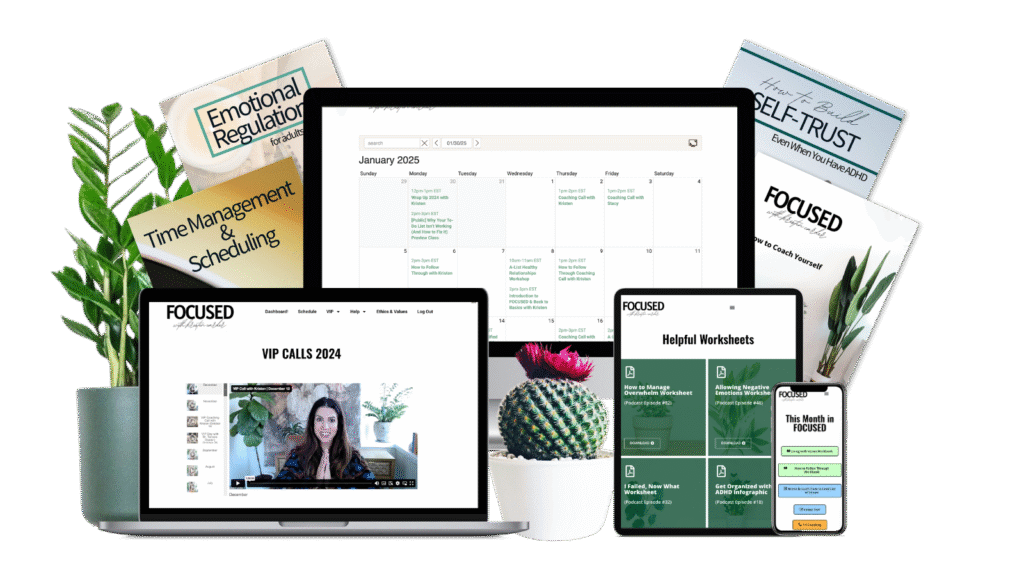
Like, yeah, we know what to do, but ADHD is not a disorder of not knowing what to do. It’s a disorder of knowing exactly what to do but not being able to get yourself to do it. That’s why I created focused. It’s an ADHD coaching membership for adults with ADHD. I’m a life coach with multiple certifications, and since 2019 I’ve coached over 4000 adults with ADHD from all over the world. I know what it takes to help an adult with ADHD go from Hot Mess express to grounded and thriving. I’ll teach you how to understand your ADHD brain regulate your emotions and your behavior and accept yourself flaws and all, and with this foundation, we’ll build the skills to improve your life with ADHD. And not only do you get skills and tools and focus, but you’re surrounded by a huge community of adults with ADHD who are also doing the work of self development right alongside of you. Dr Ned Halliwell says healing happens in community, and I have absolutely found this to be true. So if you’re an adult with ADHD who wants to figure out how to be motivated from the inside out and make real lasting changes in your life, join hundreds of others from around the world in focused go to I have adhd.com/focused to learn more. That’s I have adhd.com/focused to check it out. All right, let’s move on. We got through it. We got through it. I was worried, but we did get through it. The next thing we chat about, and we’re going to just fly through this one. There’s a myth that ADT medication turns people into zombies, and usually this is talking about children, all you’re just going to turn them into a zombie. And now listen, I am. I don’t want to diminish any of your experiences. If you were medicated as a child and you did feel like it altered your state in a negative way or took away your personality, that is not a good thing at all, and that’s a valid experience for some of you. But when the medication is properly prescribed and dosed, the vast majority of people with ADHD report feeling more alert, more present and more like themselves for the first time ever, okay, that flat, numb or like, disconnected feeling that some have described and maybe you’ve experienced if you were a child who was treated for ADHD, and maybe like the doctor, just like, did not prescribe a good fit Med, or your parents asked to, like, continually increase the dosage beyond what your body could tolerate. It it’s it’s not a good thing that flat, non disconnected feeling usually means the dose is too high, or the medication is not a good fit. Okay, so I’m not saying that that cannot happen. What I’m saying is that if that does happen, it’s not a good thing. We need, we need to make a change. Okay? That’s not something that we’re going to accept.
We’re not just going to say, like, oh, you know, this turned me into zombies, so now I’m just like, throwing medication out the window for good instead, like, how about we take a look at change in dosage, or change in medication? Okay? Because when used appropriately under medical supervision, ADHD medications are designed to support focus and regulation, not erase your personality. There’s this also this myth, which I’m not going to talk about. You know, I’m I’m not highlighting it today, but we could, like, have a parenthetical statement here about the myth of like, if I take ADHD medications, it’s going to I’m not going to be funny anymore. My personality is going to be gone. I’m not going to be the life of the party anymore, and like that is absolutely not true. If you are on a good fit medication, at the right dosage for you, your brain and your body, you’re gonna be more like yourself. You’re gonna have more to offer the world. You’re gonna feel more present, more alert, more regulated, more ready to like be the life of the party. It is not going to erase your personality. If it ever were to erase your personality, that is a huge indicator that it’s the either the wrong medication or the wrong dosage. Okay, so
we’re doing this is a two for this is a two for myth buster. Okay? Because we’re busting two myths at one time. If you ever feel unlike yourself on a medication, that’s a sign to work with your doctor to adjust your treatment. But it’s not a sign. It’s not an indication that you should give up on medication entirely. That’s not what we’re going for. It’s like, oh, this is simply not a good fit for me. Remember the stat that Dr Russell Ramsey gave us in his book, what is the book? What is the book? Wait for it. It’s going to come to me rethinking adult ADHD is that 90% of people who embark on an ADHD medication journey find a positive outcome, find a good fit medication. Okay, so that stat does not suck. That’s pretty great. Let’s move on to the next myth that we are going to bust. And this is a big one. This is a big one. This is also one that loves to circulate the internet, that ADHD medication is addictive. You’re just going to get addicted to it. This just addictive. I don’t want to start Adderall because I’m going to be addicted to be addicted to it. I don’t want to I don’t want to start Concerta or Vyvanse or atomoxetine or whatever it is. I don’t want to start it because it’s just I’m going to get addicted to it. And what I want to say to that is this, no one with ADHD who takes a doctor prescribed dosage, gets addicted to medication. It just does not happen now stimulant misuse, like crushing your Adderall and snorting it. Yeah, that’s gonna be a problem that will absolutely lead to an addiction. So like, let’s not sell the pills to your friends and have them crush it and snort it. Okay? So like, if we could all just agree to be cool, just be cool, then we won’t become addicted. Okay, but research shows that when taken as prescribed by somebody with ADHD, these medications are not addictive, and they do not lead to later substance abuse issues like that is what the research tells us. In fact, they have been shown to reduce the risk of substance abuse in patients with ADHD. Over time, I did a whole episode on this, a whole episode medication for ADHD. ADHD, prescribed by a doctor, taken at a good dosage for your brain and your body, has been shown to reduce the risk of substance abuse in patients with ADHD. All right. In fact, I wanted to read here from you, from Dr Russell Barkley’s amazing book, taking charge of adult ADHD. And this is on the section on medications, and we’re talking about abuse of stimulants. So here’s what he says. The question is, why are stimulants frequently abused? What he says is, in those who have typical levels of dopamine in the brain, so a neurotypical human, the boost afforded by the stimulants provides a pleasant sensation of speediness. But that’s not all.
The stimulants increase dopamine in the regions of the brain known to increase the likelihood of drug addiction, some of the same regions the prefrontal cortex and the cerebellum, where the drugs do so much good for people with ADHD, some of these regions serve as the reward centers of the brain, determining how pleasurable or reinforcing certain stimuli or experiencing experiences will be. Increasing the activity in these centers can result in increased sensations of euphoria, interest or other reward related experiences. These pleasurable altered states of consciousness are most likely to occur when stimulants are taken intravenously or snorted into the sinus passages as a powder, allowing the drug to enter into and then clear from these brain regions rapidly. This is the rapid alteration in conscious sensations that creates the euphoria, or other pleasurable sensations. Remember, he’s talking about neurotypical brains. He’s not talking about ADHD brains. Okay, so he goes on to say, why don’t adults or children with ADHD get hooked on a stimulant the way that a neurotypical might answer because, mainly, the drugs are taken orally in pill or capsule form, and thus enter and leave the brain very slowly. One of the things that I love to say about ADHD medications, and like this, is the, this is what we say. This is a this is a community, an ADHD community thing, if, if meds were so addictive, if ADHD medication was so addictive, why do I forget to take it? Why do I forget to put in a refill? Why do i Why can’t I remember whether or not I took it this Oh, did I take my addict my medication this morning? I can’t even remember if it’s addictive. Why am I forgetting to take it if it’s addictive, why am I like, three weeks past my refill date and like, oh yeah, I gotta call that in. Oh yeah, I gotta call that in. Do you think someone addicted to heroin is like, Gosh, I wonder if I shot up this morning or not. Gosh, was that? Like, too harsh? I’m so sorry. I’m so sorry, but like, that’s that is how that like, think about what you are saying. People think about what you are saying. Okay, stimulant misuse, of course, will lead to addiction. Of course, of course, it will, but when taken as prescribed by someone with ADHD. The medications are not addictive. They do not lead to substance abuse, and in fact, they have been shown to reduce the risk of substance abuse in patients with ADHD over time. Okay, all right, that was a good one.
If you have ADHD, then you probably struggle to sleep. You probably spent many nights getting hot and then cold, and then hot, and then cold, and then frustrated, and then overwhelmed, and then your nervous system just kind of freaks out. Listen to what’s helping me lately, cozy Earth. Cozy Earth’s bamboo sheets and bamboo pajamas are temperature regulating and guaranteed to give you a comfortable night’s sleep. It may sound disingenuous how much this has affected my life and made things better for me. Personally, I am obsessed with cozy Earth, and when they say that their sheets and their pajamas are temperature regulating, they’re not lying, I have found it to be true, and I’m a woman of a certain age where I need temperature regulating, if you know what I mean, what’s so great about cozy Earth is that there’s 100 night sleep trial, meaning you can try them during the hottest nights of the year, and if you’re not in love, you can return them hassle free, but you’re not going to want to. But you can. You can. There’s a 10 year warranty on all bedding products, and that is a decade of cool quality sleep. Listen, ADHD or luxury should not be out of reach. Go to cozy earth.com. And use code. I have ADHD for 40% off, best selling temperature regulating sheets, apparel and more, you’re gonna feel the difference the very first night. Like I said, temperature regulating is no joke. It’s no lie. It’s not just a marketing ploy. It is the truth. I have three amazing pair of these bamboo pajamas. I cannot stop buying them. I have a beautiful bathrobe. I have the bamboo sheets. I am now obsessed with cozy Earth and. You can be too go to cozy earth.com. Use the code I have ADHD for 40% off. You’re gonna feel the difference the very first night.
All right. Next up, this myth is I must stop taking my ADHD medication while I’m pregnant or nursing. And the answer to this is like, not necessarily because of the lack of research in this area. It’s always been thought that pregnant and nursing mothers should discontinue their ADHD treatment while, you know, while doing their thing. But here’s the thing, a new study published in November of 2024 may prove otherwise. I’m going to link it in the show notes. We’ll also show it on the screen here, and also episode 208, of the podcast. I break down the whole study, but essentially it follows 16 point 5 million women and their babies through pregnancy, nursing and like, the first 10 years of life, I believe. And it showed that there were no like elevated risk of birth defects, which is incredible. Here’s the thing, you’ve got to decide with your doctor what’s right for you. And keep in mind how severe your ADHD is, okay because it’s it’s a real cost benefit analysis here, going off of the medication, what is going to be the cost for me if I could go back and have a do over knowing what we know now, with the latest research, I would have absolutely chosen to be medicated during my own pregnancy and nursing experience. 100% hindsight, of course, is 2020, and I think when you’re pregnant and nursing, you never really fully grasp how bad it is in the moment, how hard it is, how how just awful life is in those moments. Like it’s beautiful, but it’s also so hard, and you’re just kind of like in survival mode and getting through it. But when I look back on that time in my life, I have so much compassion for myself and for what I went through, and I would absolutely if I could have a do over I would absolutely be medicated. I absolutely would I have linked this study in the show notes so you can go check it out. Okay, here’s a myth that I think is really interesting. The myth is
I’ve functioned without medication for this long, so I must not need it. Like, I don’t really need to. Like, you may be listening to this and you’re like, Listen, I’m like, 60. I’ve lived six decades not being treated for ADHD. Like, what’s the point? What’s the point? And here’s the thing, just because you can function without ADHD medication doesn’t mean that you don’t need it, or you don’t deserve it, or that your life wouldn’t improve and your relationships wouldn’t improve, and like everything about your experience wouldn’t improve if you decided to take it. Many people with ADHD learn to push through their symptoms by working twice as hard, by masking their struggles, sacrificing sleep and health and well being just to keep up. Okay, that kind of quote, unquote, functioning often comes at a hidden cost and high levels of burnout. That’s not the same as thriving. Right? Medication isn’t about weakness, and it’s not about like, ah, like, what big difference is it gonna make? It’s like giving your brain the support that it needs to work more efficiently and sustainably. You don’t have to be completely falling apart to justify treatment. One of the things that I would hear family members say is, like, I’m already 65 like, what’s the point? I’m already 70. I self development, or like, treating my mental health. It, it doesn’t matter. And I just want to say, like, it does. It matters to the people around you. If nothing else, it matters very, very much to the people around you. And just know that like just because you can get by, my question always is, at what cost? What is it costing you? Is it costing costing you your your sleep? Is it costing you your ability to function in other areas. Is it costing you, your job, your relationships, your like, even like, speeding tickets and impulsive purchases and like, what’s the cost? This is a really important question only you can answer it all right. Next, taking ADHD medication will give me an unfair advantage. That’s so cute. No, taking ADHD meds isn’t cheating. It’s just an attempt to level the playing field and and it doesn’t even do that, okay? ADHD affects the brain’s. Ability to focus, regulate emotions, follow through. It makes everyday tasks harder than they are for a neurotypical human. Okay, so medication helps to reduce those barriers so that you can access your full potential, not gain an unfair advantage. Glasses help people with poor vision, see more clearly, but they’re not going to give you X ray vision. All right? And ADHD meds are the same, okay? So glasses help you see more clearly, but they’re not going to give you X ray vision.
And in the same way, ADHD medication is just a legitimate evidence based tool that supports a real medical condition, but it doesn’t offer you a leg up on anyone else. You’re, you’re not cutting corners if you take ADT medication. You’re you’re just trying to level that playing field. You’re just trying to get to the same starting point as everyone else, and it’s questionable as to whether or not it’ll even get you there, but at least it’s a support, at least it’s a step in the right direction, at least you’re meeting your brain where it is and giving it some of the help that it actually needs. All right, let’s move on here. Here’s a myth. If one medication doesn’t work, none of them will. Now I know that there are some of you listening who’ve tried a medication, didn’t really see a difference, or didn’t feel good on it, and then you’re like, Well, I guess medication doesn’t work for me. HD, medications don’t work. Or maybe you’ve medicated your child and it did turn them into a zombie. It wasn’t a good fit for them. It did become something that was just like, oh, this is this is not enhancing his life. This is like taking away from him, and so no ADHD medication doesn’t work. It’s not for him, or it’s not for me. I’ve talked to so many people who try one medication, they don’t feel much benefit, or they experience like bad side effects, and then they assume that all medication just doesn’t work for them. But I want to say here, no, no, please don’t. Please don’t give up so easily, different medications, like stimulants and non stimulants, are going to affect the brain and body differently, and just because one doesn’t work doesn’t mean that none of them will quite the opposite. And I’ve already quoted this stat, I think twice in this episode, over 90% of people who take ADHD meds will have a positive response to at least one of the medications currently available in the United States. That stat does not suck, and I have a citation for that. You can go find it in the show notes. I’m going to read it again. Over 90% of people will have a positive response to at least one of the ADHD medications currently available in the US. That’s huge. Now I understand that the process of finding a good fit medication is annoying.
It’s annoying, it can be long, it’s costly. It it requires you to exert a lot of executive function energy. I understand that, but it is well worth the effort. Okay, it is well worth the cost of all of the executive function that’s required. It’s well worth it. I always advise my clients to give the process of finding a good fit medication about six months to a year. And if that makes you want to cry, come here, I’ll give you a squeeze. I understand. I understand that feels like a long, long time, but just know that, like it takes a while you have to. There’s no way to know whether or not it’s gonna work without just taking it, seeing how you feel, seeing how your behavior adjusts or doesn’t right, seeing what the effects are, right, and just know, like on the other side of this process is the potential, amazing potential, for improved functioning, productivity, stability, regulation, better decisions and more connected relationships. So there’s a lot of benefit if you’re willing to go through the process.
All right, the last one we’re going to talk about today, the last myth that we’re going to talk about, talk about today is this one. Here’s the myth, once I find the right medication, all of my problems are going to be solved, all of them, they’re all going to be solved. All of my problems are going to be solved. And I wish this was true, I do. I do. I wish this was true. But pills do not teach skills All right, so finding the right medication can absolutely be life changing. It’s going to improve your focus, it’s going to reduce impulsivity, it’s going to calm some of that internal restlessness. That’s a really good thing, but medication alone usually isn’t enough to build the routines, habits. And emotional regulation needed to navigate daily life in a really healthy way. I’m sorry. Okay, so many adults with ADHD who are medicated still struggle with things like organization and time management and emotional regulation and self trust, and that’s just kind of the way it is. That’s why we need a multi modal approach, which means we’re not just relying on one thing to be the silver bullet that’s going to solve all of our problems with ADHD. Like there is no one silver bullet, medication is by far going to give us the best outcomes. But there also needs to be other things that we incorporate, like therapy and coaching and education and diet and exercise and lifestyle support. Okay, so it’s a combo deal. It’s not just about medication. This podcast was about medication. I understand that, but I also want you to know that I know that medication is not going to solve all of your problems. Okay? It’s not gonna solve all my problems and not gonna solve all your problems.
There’s there needs to be a multi dimensional approach to our ADHD treatment, and the way that we’re really gonna thrive is, yes, by finding a good fit medication. And that’s kind of the foundation. And then from there, can we enter into a therapeutic relationship. Can we get some coaching? Can we make sure that we’re improving our diet and exercising and sleeping? For the love of God, we need to sleep. We gotta improve our sleep hygiene, and we gotta make some really good lifestyle accommodations so that at the end of the day, we really are thriving, even though we have this condition. Okay, medication will lay the foundation, but it’s how you build on top of it that’s going to continue to transform your life. All right, I really hope that this episode helped to bust some of those myths that either make you feel badly about taking medication or have hindered you have have stopped you from actually pursuing medication as a treatment for ADHD. Medication is not a cure all, okay, but it does provide clarity and focus and regulation that’s necessary to engage in the rest of the ADHD treatment modalities, like the therapy and the coaching and the diet and the exercise and all of that. Okay without the medication, those other things can feel nearly impossible to start, let alone maintain.
Okay? So my dear, I hope this is helpful. I hope it was inspiring to you. I hope that it allows you to have a little bit more clarity and remember all of the studies that I mentioned are linked in the show notes. The Show Notes gonna be crazy this week, so go there and click on all the nerdy things if you are if you are a nerd like me, I hope you enjoy it. I can’t wait to talk to you again next week. Bye, bye. If you’re being treated for your ADHD, but you still don’t feel like you’re reaching your potential, you’ve got to join focus. It’s my monthly coaching membership, where I teach you how to tame your wild thoughts and create the life that you’ve always wanted, no matter what season of life you’re in or where you are in the world focused is for you. All materials and call recordings are stored in the site for you to access at your convenience. Go to Ihaveadhd.com/focused for all the info you.