


Episode #332: Stop Adding to the Planner Graveyard: One Tool to Improve ADHD Time Blindness NOW

Listen or Watch this episode on:
Kristen Carder

About This Episode

You’ve tried planners and reminders, but time still slips through your fingers. This episode explains why ADHD makes “now vs. not now” so hard—and what to do about it. In plain English, I break down the executive functions behind time blindness and share the quick story that shattered my own drama cycle (spoiler: the dishes took seven minutes).

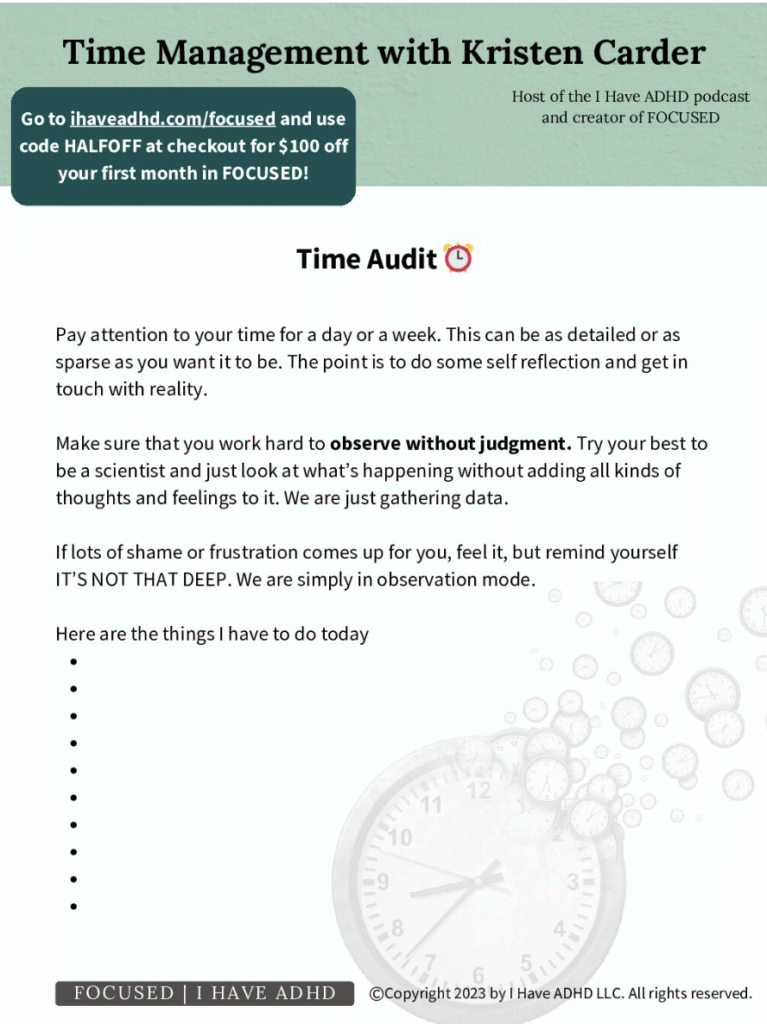
Then I give you the one tool that can change your week fast: a shame-free Time Audit that replaces schedule fantasy with reality so you finally start (and finish) what matters. If you’ve ever felt “bad with time,” don’t miss this—your whole approach could shift in a single day. Grab the free template here, and literally improve your time blindness TODAY. 

This Episode’s Resources:

Want help with your ADHD? Join FOCUSED!

Have questions for Kristen? Call 1.833.281.2343
AG 1 by Athletic Greens

Cozy Earth

Episode Transcript

Kristen Carder 0:05
Welcome to the I have ADHD podcast, where it’s all about education, encouragement and coaching for adults. With ADHD, I’m your host, Kristen Carter and I have ADHD, let’s chat about the frustrations, humor and challenges of adulting, relationships, working and achieving with this neurodevelopmental disorder, I’ll help you understand your unique brain, unlock your potential and move from point A to point B. Hey, what’s up? This is Kristen Carter, and you’ve tuned into the I have ADHD podcast. I am medicated, caffeinated, regulated and ready to roll.

Welcome. Come on in. Come on in. Get settled. Get comfy. Grab your water. Grab a snack. Grab all the things that you need to do while you’re listening to this podcast, because we are going to have a great time together. Today. We’re going to be talking about time management for the ADHD brain, and I think that like, if we could solve the time management issue for ADHD ers, we would be so happy and so rich. But I don’t think that it’s actually something that can be solved, but it’s definitely something that can be improved. Today we’re talking about, why is time management harder for us than it is for neurotypical people, and what can we do about it? Because we’re entering the season where we really start to think about time management a lot. So right now, it’s September, we’re like, the seasons are changing, the kids are going back to school, and it feels like the start of the year, even if you don’t have kids. I think a lot of us are programmed that this is just like a new season, a new start, because, you know, we all went to school, we all had that like fresh start feeling in September ish, and this, for me, is when I start thinking about my time, who and what I want to give my time to, how I want to manage my time. And so I thought this would be a really great time for us. No pun intended to have this conversation. Time management isn’t just about buying the perfect planner. I don’t know if you know that, but it’s not, it’s not just about buying the perfect planner. How many times have we thought if I could just find the right system, if I could just find the right planner? Or maybe you have a planner graveyard? Do you? Do you have a planner graveyard? The Graveyard of the planners that are, like, started but not finished, or you like, bedazzled them and made them pretty the beginning of the season, then long forgotten three weeks into it. It’s not just about the planner or setting reminders or anything like that. For people with ADHD, it is a completely different ball game. While the rest of the world thinks of time as something that they can really track and organize. Our ADHD brains experience time in a totally different and unique and often frustrating way. I like heavy on the frustrating way. I like to think of it as time blindness.

We we struggle to conceptualize the passage of time. And it’s not just about time management or like, being like, Oh, I’m late sometimes, or where did the time go? It’s like we struggle to even notice how time passes, how to predict how long something is going to take. We’re talking about all of that today, and the reason for our struggle is that it really comes down to executive functions, and we’re going to go in. Going to go into them today on different podcasts at different times. I go through all of the executive functions. This is one of those podcasts because I need to say it over and over. I know I need to say it over and over. We’re 330 something episodes into this, and I know that for my people, and you are my people, I need to say this over and over. How do I know that? First of all, because I need to hear it over and over, because I am you. We are the same, and it is so easy to forget that our brains, management skills, the behind the scenes system that helps us to plan and prioritize and start and stop and follow through and do all of the things that allow us to manage our time, they are deficient, right? And when you’ve got ADHD those executive functions, they’re just not running smoothly, so showing up on time and meeting deadlines or even just starting that one task that you’ve been putting off that you know is not going to be that hard, but you just can’t get yourself to do it. It can feel really impossible. So today, we’re really going to be digging into the why, why time management is harder for us. What’s really going on behind the scenes of our executive functions, and most importantly, what you can do about it. I have a resource for you today. When I started this podcast back in the day 2019 ish, late 2018 early 2019 I had a resource for, like, almost every episode, and a lot of you have emailed me to be like, where’s that resource on Episode Four? I’m so sorry I don’t know where it is, because I have ADHD and I didn’t have a team at the time, and those resources are probably lost in the ethers, but this one will be saved for you forever. So even if you’re listening to this episode two or three or five or 10 years later, it’s going to be here for you. Okay, so if you’ve ever beaten yourself up for being bad at time management, for being bad with time for for just like sucking at all things time. This episode is going to change the way that you see yourself, I hope. And it’s going to give you a practical tool to work with your brain instead of against it. I can’t wait. I’m so glad you’re here. I hope you’re ready for it. But before we get there, let’s take some voicemails. I’m loving hearing your voicemails. I think it’s it’s really fun to hear from actual listeners, from from those of you who are calling in and asking questions. It’s the best. I love it so much. So the first person we’re gonna hear from is Alex, and he have, he has a question about the different types of memories. So let’s hear from Alex.

Caller 6:19
Hi Kristen. This is Alex from up north, and want to say how much I really appreciate your generosity and giving what you can with podcast and giving your website. So my question is, as a person with ADHD, how is it that I could have photographic memory do so well at remembering photographically some things while forgetting all the stuff that I do forget again. Thank you for for all you do and look forward to next time. Thanks.

Kristen Carder 6:59
Hey, Alex, thanks so much. This is really, really kind. I appreciate your kind words. So we want to talk about memory, and how is it that you can have a photographic memory and still suck at remembering the things that you need to do? I think it’s a really valid question. A true photographic memory is pretty rare, and it refers to the ability to recall images and texts, or like scenes with extreme accuracy. And that’s really amazing, Alex, that you have that ability and the the ability to remember like a mental photograph. That’s incredible, but it is very different from the type of memory that we ADHD ers struggle with, which is working memory. So photographic memory is very visual, obviously, and it’s usually associated with long term memory. And a lot of us ADHD ers don’t necessarily struggle with long term memory. This is why, when I owned a tutoring business, and I would talk to parents of children, they would say, I don’t know why they can remember all of these, like wild details about, you know, three years ago, but they can’t remember to turn their homework in two completely different types of memory. And so I think that understanding that there are different types of memory is going to be really helpful to be really helpful to you, Alex, to kind of cut down on that frustration. So first of all, lean on your photographic memory when you can but understand and we can cut down on some frustration here if we understand that working memory is very different. Okay, so working memory is not necessarily about storing images. It’s about temporarily holding in your brain and processing information that you need to do something with just for the short term. It’s not it’s not like the really important memories that are going to be stored into your long term bank. It’s about holding in your brain I need to pick up milk on the way home, like your partner texts you, and they’re like, Hey, you stopped the store. We need milk and bread.

And you’re like, Yes, I got you. I am so willing and ready to do that. And then your brain does not hold that information in your in like, in front of you long enough for you to actually do the thing. So you get home and your partner’s like, where’s the milk? And you’re like, I forgot. And then they’re like, don’t you love me? Don’t you care about me? Don’t you care about our family? And you’re like, Yes, I do. I just forgot the milk. Okay, so, like, that’s the difference, is that the photographic memory is more geared toward long term and and being able to recall images and scenes like a photograph, whereas your working memory, which is the part that US ADHD ers really suck at, is is more like a bulletin board, if you can think about like a cork board, where you just kind of. Pin something up temporarily, like I just need to remember that milk and and you only need it for 10 minutes. You only need that information for 10 minutes that that cork board is broken, that sticky note is gonna fly away. It’s just not gonna stay there. Okay, so working memory is all about temporarily holding that information just just for long enough for you to complete the task. This is a big reason why we often are hopping from task to task to task to task, because we’re struggling to hold in our mind what we’re doing, why we’re doing it, the purpose behind it, the need for it. It’s just not staying I’m using my hand, if you’re watching on YouTube your girls talking with their hands, and I’ve got my hand, like, right in front of my face, like it’s just not staying there in front of my face for me to work with it and complete the task. And so it kind of just like, flies away because your brain’s like, That’s not important. We don’t need to store that. Unfortunately, it is important, and it causes a lot of fights in my experience, okay, so I would just encourage you, Alex, when you can lean on your photographic memory. So take a stop and think when you’re transitioning, what was I doing? What do I need, and remember it in pictures, if you can. I think that would be really, really helpful to you. All right, that’s great. Thank you so much for calling in. We’re going to hear from another friend, and this is from Lori. Let’s hear from Lori.

Caller 11:39
Hello, Kristen. This is Laurie. I’m from California, and I’ve been listening to your podcast and all your previous podcasts on every drive I take. It’s been really beneficial. I’m just learning at 68 years old that I have ADHD. It’s really a crazy thing to look back and see why a lot of things happened and maybe how I can change it. So what time I have left? Yeah, I do have a question. I’m thinking about investing money I don’t really have at the moment, but to get an internship in bookkeeping, and I’m just wondering if some of the ADHD could handle running their own bookkeeping business, if I could keep focused, if I could keep up with it. I did it in the past for one client, but it would, it would really suit me to try to do this, to work from home, instead of going back to the eight to five jobs I just got laid off, the business wasn’t doing well after 18 years. So now I’m kind of looking for what will fit best. But I just kind of wondered if I would be able to be successful, whether I would be too disrupted. I just kind of wanted to get your take on that. Thank you.

Kristen Carder 12:56
Well, thanks for calling Lori, and I think that’s a great question, and obviously I don’t have an exact answer for you. I can’t predict the future. I only know you from this one phone call, but I just want to say that, like anybody with ADHD can be successful at anything they want to do, as long as they have enough support that that’s really what I want. The takeaway from this call to be that like, yeah, you absolutely can be successful if you’re willing to give yourself enough support, if you’re willing to accommodate your ADHD, if you’re willing to treat your ADHD, if you’re willing to, like bring in people to help you, if you could have an assistant, if you whatever the case may be for your particular endeavor, absolutely you can be successful. But I want you to really understand, and this is for everyone, that it’s not just like easier to be an entrepreneur. You’re choosing between hard and hard. Okay, you’re choosing between an eight to five job, which is hard, and you’re choosing between that and like starting your own business, also hard. So I want to really encourage you to take any fantasy that you might have that’s like, Oh, this is going to be so much easier. It’s going to be so much better. I’m going to have so much time you’re just trading. You’re really just trading hard for also hard. Okay, so I want you to be really cognizant of what is going to be difficult for you as a bookkeeper, as a work from home bookkeeper. So there are going to be certain things that you’re going to be so good at, and you’re going to be like, This is amazing. I’m so good at this. This is what I’m meant to do. This is great. Then there’s going to be other things, like, how do I manage my time? And. How do I stay on top of this? How do I stay focused?

Those are things that you’re going to have to figure out and accommodate. So in my opinion, can you do it? Yeah, you absolutely can do it, especially if you’re willing to accommodate yourself, treat your ADHD and give yourself support. So as you’re going through the process, and I love that you’re saying you’re going to invest in some mentorship, I think that’s amazing. And the question is, are you willing to continue to ask for help? Are you willing to continue to give yourself the support so that you can, so that you can, like thrive in this position, because you know when you have an eight to five you already know this. You’re you’re given a job description, you’re given things that you tasks that you must complete. You’re given deadlines. There’s accountability. It’s a very different vibe when you’re working for yourself and like interfacing with clients on your own. Of course, there’s deadlines. Of course, there’s accountability, but there’s a lot of self motivation that needs to be involved. There’s a lot of self accountability that needs to happen. And if you find that you’re not really good at that, then what I would really encourage you to do is hire accountability. So like, hire an assistant to kind of help to keep you on track. That changed everything for me, when I was willing to invest in what I call a frontal lobe, like I literally am paying my team to be my frontal lobe, so that I get to show up and do the parts of the job that I’m actually gifted at and good at doing, and then the parts of the job that I’m really not good at, the scheduling, the replying to emails like my my Felicia, that’s who she is. She literally like, face to face on a zoom call will be like, we need to go through your inbox. And I’m like, No, don’t make me do it. And she’s like, we’re doing it. So like, if you can hire someone like that, who will, who you can kind of train to be an accountability person for you, that is so invaluable. And then everything that we talk about today Lori is going to impact you, because we’re talking about time management. And so much of entrepreneurship is figuring out time management for yourself, truly figuring out how to manage yourself within the construct of time. So I really think this episode is going to be super helpful for you. I’m really glad you called in Lori, and if you want me to answer your question on the podcast, you can call in and leave a message.

The number is 833-281-2343, again, that’s 833-281-2343, everyone with ADHD knows what to do to improve their lives. You go to bed at a reasonable time. You wake up early, you make a list, you cross things off the list in order, blah, blah, blah. Like, yeah, we know what to do, but ADHD is not a disorder of not knowing what to do. It’s a disorder of knowing exactly what to do, but not being able to get yourself to do it. That’s why I created focused. It’s an ADHD coaching membership for adults with ADHD. I’m a life coach with multiple certifications, and since 2019 I’ve coached over 4000 adults with ADHD from all over the world. I know what it takes to help an adult with ADHD go from Hot Mess express to grounded and thriving. I’ll teach you how to understand your ADHD brain, regulate your emotions and your behavior and accept yourself, flaws and all. And with this foundation, we’ll build the skills to improve your life with ADHD. And not only do you get skills and tools and focus, but you’re surrounded by a huge community of adults with ADHD who are also doing the work of self development right alongside of you. Dr Ned Hallowell says healing happens in community, and I have absolutely found this to be true. So if you’re an adult with ADHD who wants to figure out how to be motivated from the inside out and make real, lasting changes in your life, join hundreds of others from around the world in focused go to I have adhd.com/focused to learn more. That’s I have adhd.com/focused to check it out. Hey, before we transition to the meat of the episode, I would love to just shamelessly ask you that if this podcast has been helpful to you at all, ever would you please, Like, Subscribe, follow, rate, do all the things. Maybe you’re listening on Apple podcasts, you could press that five star rating button. It takes four seconds. It takes four seconds to. Find it and just press that five star rating button. Maybe you have more capacity and you’d like to leave some kind words in a review. That means so much if you’re watching on YouTube. Pressing the subscribe, just that little subscribe button means so much, guys, we got to 10k 10k subs. This is a huge deal for us. Huge deal, big, huge and and I couldn’t do it without you, and those of you who are willing to take the time and the executive function to go find the right button to click. If you could do that for us, it would mean so much, and it would also mean that more ADHD people will find this podcast so it is, yes, it’s for me. Yes, it’s for my dopamine. Yes it’s it’s for my ego. A tiny, tiny, tiny bit, I will admit that. But also, what it really is, is for the ADHD community, because the more ratings, the more reviews, the more likes and subscribes and shares and all of the things, the more interaction that you give the more the algorithms are going to feed it to people who need it.

Okay, so I, I implore you that would mean so much to me and to the show and to the ADHD community. If you would like, subscribe, rate, review all of the things. Thank you so much. Okay, let’s talk about time management. Let’s talk about the executive functions that impact your ability or inability to manage time. Now we already talked about working memory when I was responding to Alex’s voicemail, but I’ll go into it here. Okay, so working memory is extremely important when it comes to time management. So verbal working memory is the mind’s voice which keeps you on track and focused. It’s your inner monolog. A lot of us ADHD ers are on either one end of an extreme or another. Either we have a really loud, chattery inner monolog that won’t shut up. And so it’s really disorienting, because it’s just like yapping at us all day long, or we don’t hear anything. We’ve got nothing. And I’m curious, like, take a moment to reflect. Is your inner monolog yapping at you all day long, or do you literally not have anything in your mind, like that, that mind’s voice. For me, I don’t have the mind’s voice. I’ve tried to develop it over time, but most of the time when I need to keep myself on track, I’m talking to myself out loud because I don’t have the inner monolog, so I just talk to myself out loud. Okay, Kristen, we’re doing good. Keep going. This is what we’re doing. Don’t forget. This is important. Keep going. Okay, then there’s non verbal working memory, which is the mind’s eye. This is different from a photographic memory. It allows you to imagine the finished product, so it’s not necessarily a memory of something that you’ve read or seen, which is the photographic memory that Alex was talking about, right? But this is allowing yourself to imagine the steps that you need to take to get the job done, imagining the finished product and visualizing like the roadmap in your head to get there. Okay, so that’s where, that’s where a lot of us are weak, and this is where we struggle to conceptualize time. This is what I mean when we’re like when I when I said earlier, like we don’t even realize or conceptualize the passage of time. Okay, and so this is why it’s hard to understand how like five minutes can feel like 17 hours. And 17 hours sometimes can feel like five minutes. It’s like, it makes no sense, okay? And it also makes it really hard for us to predict how long something’s gonna take. Oh, that’ll just take five minutes. Seven hours later, we’re like, I’m I’m past the deadline, and now I’m in trouble. Okay? So that is working memory. There’s a skill set of organization, planning and prioritization, and that cluster of skills is an executive function that it it’s so frustrating that this is one of the main things that we struggle with, because this allows us to prioritize and sync sequence and plan out.

Okay, here’s what I need to do next. Here’s what needs to happen first. When you think about time management, so much of our executive function impacting Time management is this cluster set of skills. I mean, it’s kind of like a cluster fuck, like not an actual great cluster. Do you know what I’m saying? Organization, prioritization, planning, like so much of time management, is wrapped up in that, and since it’s deficient, it makes it so difficult. Where do I start? What like I have 100 things to do today. Where do I even start? And so our brains. Often just resist the mountain of things that we need to do because it just feels way too overwhelming to organize, prioritize and plan. Okay, whew, that’s a big one. Inhibition, this is where impulsivity comes in when you think about time management and inhibition. Inhibition is the skill that allows you to delay short term pleasure in exchange for long term reward. I’m going to say it again. It’s a really boring way to say it, but I believe it’s the way that Dr Barkley put it in. And he’s the goat, so we’re just going to use his words. It’s the skill that allows you to delay short term pleasure, what’s going to feel good right now in exchange for long term reward, and it allows you to stay on task and resist the impulse to do something else, resist the impulse to pick up your phone, resist the impulse to go get a snack, resist the impulse to divert your attention to something that feels better, to something that is more fun. Okay, um, when it comes to time management, again, this is one of the main reasons why we’re hopping from task to task, because we maybe jump in to a task and then it’s not fun. And we’re like, screw this. This is not fun. I don’t want to do this. I’m moving on. I’m going to go do something that feels better in my body, and your ability or inability to inhibit that impulse is going to determine how successful you are at time management, self motivation is a big you know, I’m saying so much of ADHD is connected to self motivation and that it’s really a dopamine issue. So the dopamine that a neurotypical will experience doing like the most mundane tasks, is not something that we get to enjoy, all right? Because our reward system is broken, we have fewer dopamine receptors in our brain. This is a big reason why people take medication. It’s because medication impacts your receptors, ability to grab onto that dopamine.

Okay, and so this is something that is often remedied with medication for most people. So the dopamine that allows you to get started on something that is a non preferred task, something that you think is stupid, something that you know is going to be hard work, something that feels just like this is so dumb. I always bring up, like, expense reports. And listen, I’m not even someone that’s ever had to do an expense report, but I’ve coached people who who have, okay, so that’s something. And I just know that those of you in corporate, you have these tasks that are just like they seem so pointless to you, and so you just put it off and put it off and put it off and put it off, and then all of the sudden, it’s the end of the month or the end of the year, and you’ve got to do all of it at one time. This used to be me with my taxes, before I had the wherewithal to hire someone else to do my bookkeeping and taxes. Hire Lori, by the way, because Lori is going to do your bookkeeping for you, apparently, right? But before I had the money or the ability to hire someone to do that for me, that was on me. So as an entrepreneur, every like, what was it April, I would just be scrambling to do my finances, my bookkeeping, my records, my taxes, for the whole year, because it was just like a stupid task that I felt was pointless, that I didn’t want to do throughout the year. Very, very little return on investment when you’re doing your bookkeeping, you know, in January, you’re just like, I don’t really care. That’s not great financial advice. Don’t listen to me. It was the wrong way to think about it. But you understand what I’m saying. The example of, like, denying myself that the short term pleasure of doing a task that feels good, that would have been real helpful. Okay, that would have been real helpful. So self motivation and dopamine are a whole thing the next we’re going to talk about two more executive functions. The next one we’re going to talk about is emotional regulation. And I think that most of the time, emotional regulation is actually the most crucial skill that affects our time management, because our emotions fuel our actions. And if we can’t regulate our emotions, we can’t regulate our actions, and our actions are what lead us to either manage our time well or not manage our time Well, right? And so if we can get a handle on emotional regulation, this is why I have an entire course in my coaching program on emotional regulation. Because. Because it is one of the most important skills for humans, for humans, and especially for those of us with ADHD. So most of the time we don’t have necessarily a time management issue. We have an emotional management issue. I’m just going to go ahead and say that so much of our time choices, our calendar choices are are due to our emotions, and if we can get a handle on our emotions, then we can make better executive decisions around our time. For example, when you are afraid to let someone down so you say yes to something that you truly do not have time for, and you screw over your entire day because you’re too scared to say no to someone. That’s not a time management issue, that’s an emotional regulation issue, that’s that’s an issue of like, I need to just be able to feel this fear and tell them no, anyway, I need to be able to look someone in the face and say, No, I’m sorry I’m not able to do that for you so that I can stay on top of my plan that I already made for my day. So a lot of our time time management, and I’m putting that in air quotes, a lot of our time management struggles are actually disguised as they’re they’re actually emotional regulation struggles. So let me say it this way, a lot of our emotional regulation struggles are disguised as time management issues. So we blame it on time management when really the root issue is I’m not able to manage my emotions. I’m not able to do this scared. I’m not able to say no to someone because I feel guilty.

I’m not able to make myself do this task that doesn’t feel good. I’m not able to handle the boredom that comes with following through on what I said I was going to do. So much of our time management problems are actually emotional regulation problems. Well, that was a word, that was a word, I think that that was, that was important, okay, the last one we’re going to talk about is self reflection. And this is, this is why you continually make the same mistakes over and over. I’m so sorry. I’m so sorry. Get in here. Let me give you a hug. Let me take you by the hand and look you in the eyes and say I’m so sorry, because I know that you’re making the same mistakes over and over, and you’re you’re pissed about it, you’re annoyed, you’re mad, you’re like, Why do I keep doing the same thing over and over? It’s because of a lack of self reflection. It’s not because you’re a bad person. It’s not because there’s something morally wrong with you. It’s not because you, like, have a flawed character. It’s because your executive functions are deficient, and one of those executive functions is your ability to self reflect, to look at what you’ve done and say, Okay, this worked well, but this didn’t work. I need to make an adjustment. Okay, it’s really hard for us, ADHD ers to see when we’re living in fantasy? Yeah, I have plenty of time to get that done. That’s no problem. Yes, I would love to do that for you. I have plenty of time we don’t see these fantasies. It’s hard to correct our mistakes. So we make the same mistakes over and over. It’s really hard for us to evaluate self reflect and adjust our behavior accordingly. All right, so this is not nothing self reflection, emotional regulation, self motivation, inhibition or like, impulsivity, organization, prioritization and planning that cluster of of skills, and then also working memory, all of those executive functions to varying degree for different people, like all of us, are going to experience these to varying degrees of severity. There they are deficient, and so that means it directly impacts our ability to manage our time. And so yes, it is harder for you than it is for neurotypicals. I want to just Can we pause here together? It is harder for you, it’s harder for you, and I want that to not make you feel badly about yourself. I actually want that to like, spur you to feeling compassion for yourself. Oh, this is hard for me. It actually should. Would be hard for me if time management wasn’t hard for me, I probably wouldn’t have ADHD.

Probably like that’s a key component right of the ADHD struggle. Now not to say that if you’ve worked at it, and you’ve done a lot of healing work, and you’re supporting your ADHD, and you’re medicated, caffeinated, regulated that you can’t manage your time. So maybe some of you have made extreme progress in this area. I know that I have. I’ve made a ton of progress in this area, but I still can’t predict how long something’s gonna take. I still have to lean on my neurotypical team or my neurotypical spouse or my neurotypical BFF to say, like, do I actually have time for this? Is this going to be too much for me do even just like I told you, we were at a water polo tournament in Texas, and I traveled with a mom friend, and it was like, so fun. We had the best time. But I leaned on her to tell me what time to show up. I just, I never, I was like, What time should we leave for the airport? My brain doesn’t, my brain doesn’t do time math. It just doesn’t what time like? Okay, they have to be at the pool at nine tomorrow. What time do we need to leave? She was the one that I leaned on for all of that time math, because my brain does not do it well, so it is harder for me, and that’s okay. It’s not a moral failing, it’s just a fact. Okay, how you doing? You okay? You okay? You take a deep breath like, how does it feel for you? For me to say this is actually harder for you, it should be hard. And like, we need to accept that it’s hard, because accepting that it’s hard, and maybe even accepting like this is harder for me than it is for everyone else. Is actually the pathway to making amazing change. Because if I just tell myself, why is this so hard for me? This shouldn’t be so hard everybody else can do it. Why can’t I?

That’s not going to lead me to make a change. What that’s going to lead me to is to think I just need the right planner, I just need the right system, I just need the right app. Then I’ll be able to do it like everyone else, instead of saying it’s not about the planner, it’s not about this system, it’s not about the app, it’s actually about my brain and how my brain is functioning. And so I need to make some big changes here in order to support myself and in order to do this.

Well, all right, my friends, it is time to shout out long time supporter of the show AG1, I’ve got a story to tell you. I get refills from time to time, from ag one, which I’m so thankful for. But because I just, like, I got a box that looks familiar, and I just, I let it sit, I let it sit on my mud bench for weeks, which is kind of embarrassing, but whatever, I let it sit there for a long time, and when I finally opened it, I squealed with delight, which is, I mean, it called attention. My husband was like, what’s going on? AG1 has new flavors. When I opened the box, I was given three brand new, beautiful, exciting flavors. They have citrus, Berry and tropical. This is a big deal because after drinking years of the original which was fine, fine, fine, fine, we’ve got some options now. There’s more options. I’m obsessed with this. I’ve been on an aging one streak for a long time. You already know this about me. It’s one of the few habits that I have added into my life, and actually stuck with for years, and this has just made it even better. My favorite is citrus. The favorite new flavor that I’ve tried is citrus. It’s sweet and tangy. It’s like lemon and orange had like a wellness baby. It’s delicious. And if citrus doesn’t float your boat, there’s also Berry and tropical and of course, the OG original, which is kind of like a pineapple vanilla, but it’s very, very subtle flavor. Okay, so if you’ve tried green powders before and you weren’t into the taste, these flavors might just change your mind. There’s no sugar added, no artificial sweeteners, and they’re still packed with 75 vitamins, minerals, prebiotics, probiotics, super foods to support your energy, digestion, immune system and to fill nutrient gaps. And each year, who among us does not need to fill nutrient gaps? My goodness, I have been using this product for years, and it is not. Magic Fairy Dust. It’s not a silver bullet, but for me, it’s like nutritional insurance. It helps me feel like I’m starting the day doing one good thing for my body. I notice a difference I truly do in my gut health, in my energy, in my bloating or not bloating, depending on whether or not I’m being consistent with it. It is simple and quick. If it wasn’t I wouldn’t do it. If it wasn’t easy, I wouldn’t do it. I say this every time. It’s the truth. If it wasn’t easy, I wouldn’t do it. I really encourage you, if you’ve been thinking about trying AG, one now is the time, because when you use my link, you’re going to get a free welcome kit, which is a value of $76 so each new subscription comes with obviously, just like the 30 day supply of ag one, but then also five free 81 travel packs, a shaker bottle, a metal canister, A metal scoop and a bottle of vitamin d3, k2, now listen, I’ve been using the metal canister and metal scoop literally for years. I think we’re going on three years now, and the original canister and scoop that they gave me, like in in the initial pack, is still going strong. I just I run it through the dishwasher between refills, and it’s amazing. So this stuff is not messing around. Give the new AG, one flavors a try today. Go to drinkAG1.com/ihaveADHD to get started. That’s drinkAG1.com/ihaveADHD. Check it out.

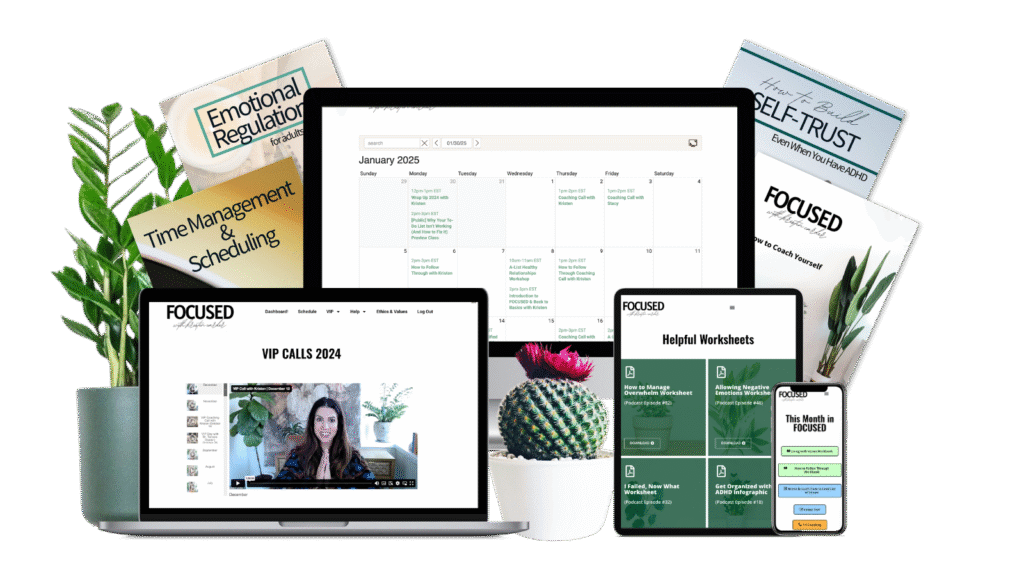
Okay, so I’m going to give you a resource within my focused ADHD coaching program. We have when you join, you get five courses immediately. So five courses are immediately available. It’s way too much content, but here we are. So you get how to build self trust, how to coach yourself, emotional regulation, time management, which we’re gonna we’re talking about today, obviously, and self concept and how to quiet the inner critic. I love that course. My gosh, that course is so good, but time management is one of the courses that you get immediately. And within that time management course, I created a time audit, and I’m going to give you that time audit for free. We’re going to talk all about it in in the rest of the episode today. How to do a time audit? Why to do a time audit? Why time audits can change your life. And then you can go to, I have adhd.com/time to grab that free resource that’s I have adhd.com/time, and you can grab the free resource, and it is a time audit for you. Okay, so it’s essentially and it’s very simple, but it just allows you to figure out what you need to do, what your priorities are, and then actually track the time of how long it takes. Now, if that sounds like some boring neurotypical BS, I totally understand. But hear me out. Hear me out, hear me out, hear me out. We struggle to determine how long things take, yes, and we struggle to self reflect and evaluate. So we’re never really figuring out how long things take. And I’m going to give you an example from my own life forever, since I was a child. But then, you know, left my parents home, married Gregory Carter, and have always had drama about doing dishes. Have always had drama about the dishes and my body, I would have a full body response to doing the dishes. And if anybody is listening to this, like, I can just imagine, like a neurotypical listening to this and just being like, what is the big deal? Like, it’s freaking dishes. I understand. I understand from your perspective, how this may sound childish, and perhaps it was, but for me, it was like it felt like a big task. It felt like it was going to take all of my energy. It felt like it was going to take so much time. And I just I couldn’t, I couldn’t Okay, and so I would have all of this resistance, and then the dishes would pile up, and then the task would get bigger and longer and eventually, eventually, and this was well into my 30s, I finally said to myself, maybe I should time myself doing the dishes. Maybe I should, maybe I should time myself so by that time I have three kids, there’s a lot of dishes, right?

Family of five, maybe I should time myself unloading the dishwasher and reloading everything, so I can know how much time it’s actually taking, what it’s actually costing me in terms of time I set the stopwatch. I. Unloaded the dishwasher, I reloaded the day’s worth of a family of five dishes. The kids were all at home at the time, and it took me seven minutes, seven seven minutes, when I finally realized that dishes, and this is like the full shebang of dishes, not just like throwing a dish in the dishwasher, but like unloading and loading a full sink. It. It took seven minutes when I realized that I understood that I did not mean did not need to be dramatic about it anymore. Seven minutes I can give. I’m hitting my mic because I’m getting fired up. I can give seven minutes to the dishes. That’s actually not as costly as I thought it was. So I had all this drama around doing this task because I felt like it cost me so much time. I just don’t have time. I don’t want to spend my time that way. It’s because it’s going to be so costly. Seven minutes, that’s a pretty low cost. I don’t think I’ve had drama about dishes since then. It totally relieved me of all of the drama, because seven minutes, whatever, like, you can do anything for seven minutes, just do the dishes take seven minutes and so then my self talk, instead of this is gonna, this gonna take forever. I’ll do it later. It’s gonna take forever that was my, that was my original, like unfiltered, uncoached self talk was, this is gonna take forever, just, I’ll do it later. Instead, my self talk changed to, it’s just gonna take seven minutes. Let’s just get it done. Seven minutes is not that long. You can do anything for seven minutes. And so the drama around doing dishes really has dissipated. And I just, I do them all the time now, and I don’t care. It’s not a big deal, because it takes me if it’s a small like, if I don’t even have to unload, it’s like three minutes. And if I do have to unload it, it’s still, it’s still in the seven minute range. But that’s fine. I can do it for seven minutes. So that’s a very dumb example, but it actually changed my life of how a time audit allowed me to have a clear perception of what something was costing me. Okay? And so the purpose of a time audit is to pay attention to your time for maybe a day or a week or even just like, maybe you’re just like, Okay, I’m gonna audit my time this morning, like, for just four hours.

I’m just gonna see how long things take me it can be as detailed or as sparse as you want it to be, and I would use it around the things like the areas in your life where you want personal growth in the area of time, okay, so you don’t need to audit absolutely everything, but like, where are you struggling? Where do you want to make a change in your life so that you can either drop some drama or change some behaviors or stop making the same mistakes over and over. Okay, the point is to do some self reflection and get in touch with reality instead of like, we’re usually on two ends of the spectrum. So like, for example, with the dishes I was in, like the doom and gloom, it takes forever. It’s like, I don’t have time for it. That’s doom and gloom. It wasn’t reality. In reality, it takes seven minutes, okay? But other times we think this only, this is a fast task. This is only going to take me a moment. I have plenty of time for it, and then you audit your time, and you’re like, Oh, this is more time costly, more expensive than I realized. So a time audit allows us to live in reality, rather than either in doom and gloom or in fantasy. Okay, the thing about a time audit, though, is that it is an opportunity for shame and self blame and self judgment to really creep in, because we can often be like, I can’t believe how long this takes me. It shouldn’t take so long, but I just, I want to invite you to just be a scientist. I just want you to observe. You’re just gathering information. So just for the time, audit blocks turn off. Just do your best to turn off that shame, blame self judgment, and just try to gather totally non emotional information. Just gather data about what’s happening without adding in all kinds of thoughts and feelings and drama and and like judgment to it okay. We just want to observe. And we just want to see, like, what is reality here? What’s. Actually happening, because if lots of shame or frustration comes up, first of all, that’s normal, and I’m sorry, and like, take some time to, like, breathe through it and be nice to yourself, but also just remind yourself it’s not that deep. It’s not that deep. We’re just we’re just looking at how long this is taking. It’s not that deep. We can deal with deep shame, blame, frustration, like all of that some other time. But with this time audit, it’s not that deep. We’re just we’re just gathering data. Okay, so if you notice, like, a wave of shame, or if you notice that you’re starting to judge yourself, you can pause and like, breathe, take care of yourself, but then remind yourself it’s not that deep. All right, we’re just in observation mode. We’re just gathering data. We’re just figuring out how long something takes, okay? So we’re just gonna track your tasks. We’re just going to even observe, like, how long do you need to recover from something which we’re going to talk about next week? Our capacity, that’s going to be really an important episode. I can’t wait for you to hear that, and it relates so much to this conversation. But how long does something actually take, and then how long do I need to recover from it in order to move on to the next task.

A big theme, as we are observing our patterns and observing our time and and doing these audits, a big theme is going to be, I’m not a robot, turns out I am a human. Just turns out that I don’t just like robotically go from one thing to the next thing to the next thing and just like, get stuff done all day long. Turns out I’m a human Oh, turns out I have ADHD. So how like knowing how long things take and how long transitions take, that’s going to help you make a much more realistic plan for your time. Okay, so again, you can go to, I have adhd.com/time, to grab that free resource. It’s a time audit. It’s going to, you can print it out, or you can just like whatever. I don’t know what you can do with it, but however you want to use it and tweak it for your specific situation. I give you full permission to do that and begin to just observe without judgment, a big part of this. And I just want to remind you of that self reflection piece, a big reason why we continually make the same time mistakes over and over, why we’re continually late to the same event over and over. The way, I was late to church every single Sunday, as if I had not been going to church since I was a fetus. Like going like every Sunday, it felt like the first time, as if I didn’t know what time I needed to leave or what time I needed to get there in order to be in my seat, like when church started, which is actually true. Like, I didn’t I remember, and I think I just told this on the podcast recently. I remember pulling into church at 11 when church started, and being like, oh my gosh, I’m on time, and then realizing, no, I still need to park, and I still need to, like, find my seat, and so actually, I’m going to be like, five to six minutes late. Like, these are the things that our ADHD brains just do not compute. And so a time audit is going to be extremely, extremely helpful to you, so you can go to, I have adhd.com/time to grab that free resource, and we’re going to continue this conversation next week, but this time audit is a great place to start. So if you’re like, Yes, I need to make some changes. I need to do some things differently. I don’t I clearly do not understand how long things take. Go to I have adhd.com/time, grab the time audit that will be so helpful to you, and we are going to continue this conversation next week. I cannot wait. I will see you then.

Hey, ADH, dear, I see you. I know exactly what it’s like to feel lost, confused, frustrated, and like no one out there really understands the way that your brain works. That’s why I created focus. Focused is my monthly coaching program where I lead you through a step by step process of understanding yourself, feeling better and creating the life that you know you’re meant for. You’ll study, be coached, grow and make amazing changes, alongside of other educated professional adults with ADHD from all over the world. Visit Ihaveadhd.com/focused to learn more.


Free ADHD Time Management Download

Get a practical, ADHD-friendly resource to start managing your time today—and unlock access to Kristen’s live masterclass, too.

Related Episodes

Kristen Carder

Episode #408: I Surveyed Over 2,100 Adults with ADHD—Here’s What Broke My Heart

Kristen Carder

Episode #406: No Meds, No Shame. Here’s How I’d Support My ADHD Without an Rx

Jenna Free

Episode #404: There’s No Rush: Getting Out of Fight-or-Flight with Jenna Free

Stop Struggling Alone.
Start Thriving With FOCUSED.

A proven coaching program designed specifically for adults with ADHD who want to gain clarity, build confidence, and take control of their lives.

Join a community of hundreds of ADHDers

Learning About My Brain...

Changed Everything

Hi, I’m Kristen Carder—ADHD expert, podcast host, and certified coach who’s been exactly where you are. Diagnosed at 21, I spent years cycling through planners, courses, and systems that never quite worked. Everything changed when I discovered the power of understanding my ADHD brain and the transformative impact of community support.

Now, after 15+ years of research and experience, I’ve helped thousands of adults with ADHD thrive. I’m here to show you how understanding your brain can transform your life, just like it did for mine.

ADHD Tips That Actually Make Sense

Follow @i.have.adhd.podcast and join our Instagram community for daily strategies, relatable content, and real talk about ADHD