Kristen Carder 0:05
Welcome to the I have ADHD podcast, where it’s all about education, encouragement and coaching for adults. With ADHD, I’m your host, Kristen Carter and I have ADHD, let’s chat about the frustrations, humor and challenges of adulting, relationships, working and achieving with this neurodevelopmental disorder, I’ll help you understand your unique brain, unlock your potential and move from point A to point B. Hey, what’s up? This is Kristen Carter, and you’ve tuned into the I have ADHD podcast. I am medicated, caffeinated, regulated and ready to roll. Thanks for being here. Thanks for pressing play on this podcast. There’s like millions of podcasts out there, and the fact that you are listening to this podcast not an accident. I’m so happy. I’m so grateful to you for just like your engagement and your time. It means so much to me. I’m so glad that you’re here. Are you out for a run? Are you in your car? Maybe driving around like, what are you up to? I’d love to hear it. I am excited to chat with you today. We are continuing our conversation on time management, and we’re going to talk about something that we don’t usually talk about as it pertains to time management, which is capacity. And I brought props. As you can see, I brought props today because that’s where we’re that’s where we’re going. We’re headed. If you’re listening only, that’s totally fine. I love my OG podcast listeners. Thank you. Thank you for who you are and what you do. But if you want to head over to YouTube to see, you know, jars full of pasta, you’re welcome to check out the props over on YouTube. And while you are wherever you are, whether you are on Apple or Spotify or YouTube, would you hit that LIKE, SUBSCRIBE rating, five star rating button, whatever it is on your particular platform? Would you engage with the show in some way to send some love to Kristen Carter and my team and even Dan, the guy behind the camera, this impacts all of us and our ability to keep producing the show for you. So thank you so much for being here. I appreciate you. We are going to start off with a voicemail today. When I heard this voicemail, my blood boiled. My blood boiled. Guys call in with stuff like this because I want, I want to rant about it. I want, I want to stand up for you. I want to, I want to hear your stories like this. We’re gonna hear from Tristan, and you’ll know why I’m triggered. Let’s go roll roll the tape.
Caller 2:43
Hi Kristen, I wanted to call and leave you a message. You’re actually one of the first people I thought about when this happened to me, and I wanted to share it in the case that it’s happened or does happen to others. So ADHD medication can be tricky, especially if you’re dealing with stimulants. I get that I think most of us do. However, the pharmacy locally here told me that they cannot release any medication prior to 30 days, so at the 30th day, so I’ve been, you know, it takes a lot of accommodations, as far as making sure that that’s a smooth transition for me personally. But yesterday I called and it was the 29th day, because the pharmacist that was there the day prior so they would have it ready. Well, this pharmacist told me that they wouldn’t, and they wouldn’t until the 30th day, and when I started to show a little bit of frustration. This is a true story. The pharmacist says, Well, everyone has ADHD, oh. I was like, Oh, wow. So this was yesterday. Now it’s the following morning, and I’m still bothered so significantly by someone who would make such a comment in that role, just in general, but someone who, who has a doctorate degree is behind a pharmacy counter to say something like that. It just, it just shows, unfortunately, the stigma that it still goes along with this. So I just wanted to to let you know that this took place, and to share with anybody else, if this has ever happened, what does happen? Obviously, not everybody has ADHD or that comment wouldn’t have been made, so we know. Anyways, all stay strong. Thanks. Kristen, bye.
Kristen Carder 4:33
I mean, what in the actual hell I cannot believe that a pharmacist would say everyone has ADHD, I’m so glad that you called to tell this story and that you like the fact that you thought of me makes my heart so happy. It makes my heart so happy. Like, are you enraged? Listener. Am as I am. Are you enraged? Because we should be we should be bothered by this. We should be angry about this. This is not appropriate. It’s actually extremely ignorant and to have someone in a position of power, in a position where they should have knowledge about mental health in some capacity, if they’re distributing medication, the fact that they would say, Well, everyone has ADHD, I’m just dismissing you essentially the like parenthetical statement is like, so I don’t know why you even are giving me a hard time about getting your medication on time. I don’t even know why you’re bothering and making this effort to get your medication because everyone has ADHD, I’m going to dismiss your diagnosis. I’m going to dismiss the struggle that you are going through, and I’m going to imply to you that this medication is unnecessary, like, absolutely ridiculous. Thank you for sending this in, because I just, I want to be angry with you. I want to be angry for you, and I want us to show all of our listeners like I want you guys to really understand that we need to stop. We need to stop accepting this from people like, how about we all decide in advance what we’re going to say to someone the next time they make this comment to us. How about that? How about we just take a stop and think and we say, Okay, the next time someone says to me, Well, everyone has ADHD or something like that, a dismissive an ignorant, dismissive comment like that. What do I want to say back? Because I need to have something locked and loaded, because in the moment, I would have no idea what to say. I would be so caught off guard. I would be so like dumbfounded that that a pharmacist would say something like that to me, and I wouldn’t have a response. I wouldn’t know it. I would just freeze. So let’s get a response, locked and loaded.
Okay, so for me, what I’m thinking through is the way that I want to respond to that is what an interesting thing to say. What do you mean by that? I’d like to put it back onto them. What an What an interesting thing to say. What What do you mean by that? What do you mean? Everyone has ADHD, what do you what exactly are you saying? Hello. I’m curious what you want your response to be, but I do think that us ADHD ers, as like a general community, need to have something locked and loaded, ready to go, ready to go. Oh, everyone has ADHD. So you’re distributing this medication to everyone. Hello, yes. Is that what you mean by everyone has ADHD. What exactly do you mean? I just I want us all as a community to grow from this. Because if a pharmacist is going to say that to an ADHD or space, no one’s off limits like anybody can say it, right? So let’s go ahead and like I would, if that had happened to me in the moment, I wouldn’t have known what to say. But let’s go ahead and prepare ourselves for that happening, because clearly, it’s going to continue to happen. Clearly, this is a stigma that has not been eradicated, clearly that we have more work to do, and I think part of that is us owning our authority here, and not allowing people to get away with saying stupid shit, like we need, like, no more, no more. So I just listener, I want you to have something locked and loaded. Tristan, I’m so glad that you called in, like, Girl, I am so glad because I hope you feel validated. I hope that I can, just like, stand with you in solidarity and say I’m so sorry that that happened to you. But also, let’s all learn from this and have something locked and loaded ready to go. We’re not going to be unkind, we’re not going to be disrespectful, we’re not even going to be rude, but we’re not going to accept that from other people anymore. We’re done. We’re all done with it. We’re all done. This is not even the point of the episode, but I just want to, I just want to rant on it forever. This is so inappropriate.
Anyway. Call in with the crazy shit that people say to you. I want to hear it like this. Could be a new theme for our voicemails where you just call in and tell me the dumb things that people say, and then I get to get angry on your behalf, and I get to just right. Rage about it here on the podcast, and then we all get to learn and and figure out, okay, how do we want to navigate these scenarios? Because when you are caught off guard in the moment, it’s so easy to just smile and nod and like, okay, like, I don’t, I don’t know what to say to you, but like, let’s start prepping for these conversations in ways that allow us to show up with authority, not with disrespect. I’m not saying being rude, although that is a rude thing to say, Hello. So maybe we just match energy. Maybe we just match energy a little bit, but locked and loaded for me, is what an interesting thing to say. What do you mean by that? Putting it back on the person, calling them out, calling them out, and putting it back on them to explain themselves. Because I’m not going to explain my I’m not. I’m not. Ooh, you feel it? Do you feel it coming through the microphone? I’m not gonna do any explaining. I don’t have anything to explain. I’m not gonna explain how everyone does not have ADHD. That’s not on me to explain. That’s like scientific fact, but I will put the burden on the ignorant person to explain themselves. What do you what do you mean by that? What are you trying to communicate to me?
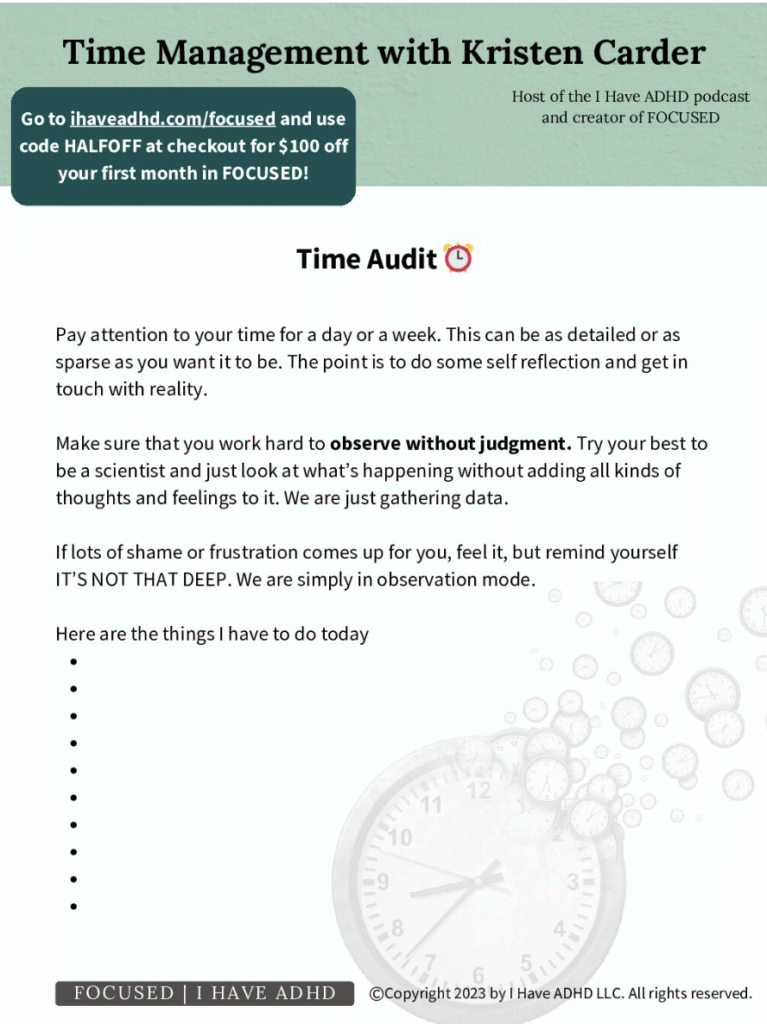
Okay, we’re moving on call in with the crazy stuff people say to you, 833-281-2343… 833-281-23430, we’re gonna get to another voicemail later as we talk about this conversation on time management and capacity, listen, time management is a whole thing for us, and we’re continuing our conversation today. If you didn’t listen to last week’s episode, it’s a really, really good one. We talked about why time management is harder for people with ADHD and what we can do about it. I gave you a free resource. It’s a time audit. You can find that at I have adhd.com/time it is still available to you. You can go download it right now, but yeah, time management is one of the biggest struggles for adults with ADHD. And we all know the feeling of being buried under too many commitments, endless to do lists and a calendar that looks great on paper but doesn’t translate, doesn’t actually work in real life, and the time audit that resource is going to help with this. That resource is going to help with Wait, why does my calendar look good on paper, but it doesn’t actually work for me. Okay? So go to I have adhd.com/time to grab that free resource. Most of the advice out there, it focuses on systems and apps and habits and planners. And while those things, of course, can be helpful and can be supportive, they don’t address the deeper issues underneath, like, why do we struggle and what do we need to improve upon in order to make change positive change in this area and one of the main things after coaching adults with ADHD, 1000s of adults from around the world. I lead a global coaching community. It is incredible. And what I have noticed over and over and over is that time management issues often come down to capacity issues. Okay? We talked last week about a really important component, which was emotional regulation. And I still stand on emotional regulation being a huge, huge, huge issue with time management. But if I were to pick a second thing, it would be our capacity, because the truth is that every single one of us has limits. We have a certain capacity that we are able to work with. We have mental limits, emotional limits, physical limits, and instead of respecting those limits, we plan our lives like we should be operating as robots at full speed, 24/7, and ADHD, or we need to stop. Okay, we need to stop. We need to embrace our humanity and listen.
If that’s something that’s hard for you, I would actually encourage you to engage in either coaching or therapy, because a lot of us are trying to not be human. A lot of us are trying to operate out of perfectionism as a protective way, as a way to protect ourselves, as a way to shield ourselves from. Rejection from getting in trouble, as if adults can get in trouble, like, that’s not a thing, but we think it’s a thing. Our bodies think it’s a thing. And I wonder even if, when Tristan heard the pharmacist say, Well, everyone has ADHD, if there wasn’t also a wave of like, Am I in trouble? Because I think for those of us who grew up as ADHD ers, especially if we were undiagnosed, especially if we were in families that didn’t understand us, and then especially if we were in a dysfunctional family, we have this feeling like we’re constantly just like, one bad decision away from getting in trouble, from losing everything. And so a lot of us are using the coping mechanism in order to, like, mitigate that getting in trouble thing, that rejection sensitivity, thing, we’re trying to operate as if our capacity is unlimited, as if we don’t have limits, as if we don’t have any boundaries around what we can and can’t do. Okay? So I think emotional regulation is a huge piece auditing your time and like living in reality, how long does something actually take? Huge piece. And I would say capacity is another missing piece in the time management conversation. It’s the reason why a color coded calendar doesn’t fix burnout, okay, and why productivity hacks actually don’t work if you’re already running on empty, because once you understand your capacity, how much you can really give on any given day. You can finally build a schedule that works for your brain and for your life you can. You can finally build a schedule that works for your brain and for your life, instead of against it. So many of you are trying to work against your capacity. You think I shouldn’t have to take breaks, I shouldn’t have to have transitions. I shouldn’t be hungover after, you know, working so hard for so long, I shouldn’t. And when I say hungover, you know what I mean? Right? Like, I meant mentally and emotionally hungover, not like drunk, hungover, like, I traveled this weekend for a podcast interview. It was so great, and I was planning to write my book The day after, like, I tried to write on the weekends, and I was planning to do some writing this weekend. And then my flight got delayed, and it got delayed and it got delayed, and it got delayed, and I ended up getting home at 3am 3am and I knew that, like there was not going to be any writing happen, happening this weekend. There’s just not, I don’t have the capacity, because I just spent all of my mental, physical, emotional energy on this trip, and so much was stolen from me because the stinking flight delays and finally getting into my house at 3am I knew I would have nothing left. I didn’t even try. I didn’t even tell myself I should write. I was like, it’s not happening, because I know myself and I know my capacity. So in this episode, I’m going to share what I think is a unique perspective on capacity, and I think it’s going to change, or I hope, I hope it changes the way that you approach time management. And as you can see, I brought props because we’re going to be talking about it. Okay? We’re going to talk about what capacity is, how ADHD brains misjudge it, and why learning to like leave margin in your schedule is one of the most compassionate and powerful things that you can do, and it actually helps you to sustain your productivity over time. Okay, it helps you to sustain your productivity over time.
Your Capacity is the maximum amount that you can produce in any given day or hour or week or month. So if you just take any block of time, your capacity is the maximum amount that you can produce the problem and I’m, I’m, I’m using hand gestures here to show you this clear jar. It’s a vase. I usually cut hydrangeas and put it in that, but I washed it out and brought it today so that I could use it. This is like I would call it a medium sized vase, and it is full to the brim, almost overflowing of bow tie pasta. My very favorite type of pasta, okay, this is my family’s go to. Is the bow tie pasta full to the brim, okay? This is like on the best day. This is what I can give all right, on the on my best day. When I have the most capacity and I can fill it to the top, this is the best I can give. All right, the problem is that we treat our lives like we’re always going to operate with this much capacity. We treat our schedules like we’re always going to have this much to give, like we can always produce exactly this much day to day to day to day. So I plan my week. Well, I don’t anymore, but perhaps you do plan your week or your month, thinking, Okay, I work eight hours a day, and you know, last week I was able to get this much done, so next week, I’ll be able to get the exact same amount done or more. But the problem is that is not realistic. That’s not realistic when we are filling up our schedule to max capacity. That means if anything changes, if anything happens, if anything even bumps the schedule in any way, it’s overflowing, and all of the sudden we’re behind. And remember, last week, we talked about self reflection and how we continually make the same mistakes over and over and over again. Part of that is we’re just not willing to live in the reality that life happens, kids, illness, unexpected projects, broken cars, a really bad mental health day, a delayed flight. Reality hits, and I think one of our flaws, and I’m speaking very generally, so please give me grace here. I’m speaking generally and just talking about us, ADHD ers like as a whole, one of our flaws is not wanting to actually accept the reality that life happens. So we want to plan our schedule as if I have this much margin, this much capacity, this much ability to produce all day, every day, no matter what, no matter what the weather, no matter what my brain is doing, no matter what my mental health is, no matter what the family drama is, no matter what my kids need, no matter what how my body feels, I will be able to produce this much at all times. And if I don’t, then I shame myself, blame myself, judge myself, and spiral and now I have all this added drama. What like? What’s wrong with me? Why can’t I do it? I’m behind. It’s really, it’s really sad. I hate to see us do it. I hate to see us do it.
Really. The thing that’s wrong, quote, unquote, wrong with us is that we’re trying to schedule at max capacity every day, and we need to stop. We need to allow margin for interruptions. For those of you in the listening audience, I’m taking out some of the pasta, and I’m allowing for some margin. Okay, so that there is some space so that interruptions can happen, or a child can call and say, Hey, I need this thing, or I can get sick, or I can feel depressed and I don’t fall behind. Okay, okay. Okay, are you with me on this? Everyone with ADHD knows what to do to improve their lives. You go to bed at a reasonable time, you wake up early, you make a list, you cross things off the list in order, blah, blah, blah. Like, yeah, we know what to do, but ADHD is not a disorder of not knowing what to do. It’s a disorder of knowing exactly what to do but not being able to get yourself to do it. That’s why I created focused. It’s an ADHD coaching membership for adults with ADHD. I’m a life coach with multiple certifications, and since 2019 I’ve coached over 4000 adults with ADHD from all over the world. I know what it takes to help an adult with ADHD go from Hot Mess express to grounded and thriving. I’ll teach you how to understand your ADHD brain, regulate your emotions and your behavior and accept yourself, flaws and all. And with this foundation, we’ll build the skills to improve your life with ADHD, and not only do you get skills and tools and focus, but you’re surrounded by a huge community of adults with ADHD who are also doing the work of self development right alongside of you. Dr Ned Hallowell says healing happens in community, and I have absolutely found this to be true. So if you’re an adult with ADHD who wants to figure out how to be motivated from the inside out and make real, lasting changes in your life, join hundreds of others from around the world in focused go to Ihaveadhd.com/focused to learn more. That’s I have adhd.com/ Focused to check it out, just because I have 24 hours in a day, just because on my very, very, very best days, I can get a certain amount of things done. We call those unicorn days, by the way. We call those unicorn days, okay, those are the days where you’re like, I cannot believe how much I’ve got done. That’s a unicorn day. Okay, that’s that is not every day. The problem is, we look at those unicorn days and we say, oh, that’s the standard. I should be able to get all of this done every, every time I show up to work. But no, that is not accurate. That’s a unicorn day. That’s not a normal day. A normal day you feel like crap. A normal day you’re distracted. A normal day you don’t want to work. Okay, just because you have this capacity doesn’t mean that you should stuff it and fill it to the brim every single day. Okay? Because some days you show up with this much capacity. And for the listening audience, I’m holding up like a small clear glass someday, you show up with a tiny bit of capacity. Some days, like the night before, you didn’t sleep, or you got into a huge fight with your teenager, or you’re worried about your parents health, or something is going on with your husband’s job, and it’s really distracting to you. Some days you’re showing up with a limited amount of capacity, and then you’re trying, and I just really wanna make a mess here and try to spill all of this into this cup.
But how about we just imagine it, instead of me making a mess? Okay, we’re trying to take this schedule, which is just so full, and fit it into a much smaller capacity, because some days you show up with a lot of capacity, but that’s pretty rare. Other days you’re going to show up with a limited amount, and some days it’s going to be a medium amount, right? And and the thing is, we don’t really get to predict that. We don’t I don’t know tomorrow what my capacity will be, but I need to make a really smart schedule for myself so that I know that I’m getting the important things done. And here’s where priorities tie into this. Because even with a limited capacity, and if you really understand that, you’re like, Okay, I know that my capacity is limited, I can only get like. I need to leave room for for error. I need to leave some margin. If you don’t know what’s essential, if you don’t have your priorities locked in, then you’re just gonna fill this stuff up with things that don’t matter, all right? And that is a major challenge for those of us with ADHD, because we struggle to prioritize, everything feels urgent. All tasks are blaring at us at the same volume, saying, do me, do me, do me. We have this thing. I don’t know if you have this thing, but I have this thing, and I’ve really worked to overcome it, but I used to just, no matter what I was doing, I would feel like I was doing the wrong thing. It was like, no matter what I was working on, my brain would tell me, that’s not right. You should do something else. That’s not right. You should do something else. And I would just hop from task to task to task to task, because my brain was like, this isn’t the right thing. You’re doing the wrong thing. And it wasn’t until I got really clear on my priorities, what matters, what is actually essential to my job, what am I gonna regret not doing when the day’s over? Like, what is the one thing that I’m gonna be like, I really wish I did that, or I’m really gonna get in trouble for not doing that, or this is really gonna have a negative impact on my job or my home. What is the one thing that you’re gonna regret not doing that’s the priority? Or what is the one thing that your boss says you have to get this done? There is a deadline that is the priority. Okay? So the I can do it all fantasy and the planning for for unicorn days that this, it’s breaking our schedules, it’s breaking our time management, and it’s making it so that we are just not functioning at we’re just not functioning. Great, okay, a lot of us are just not functioning. Well, what I would love to see for you is to figure out, what are my priorities, and can my priorities actually fit into this small capacity? Okay, so we’re gonna fill this guy up like, here’s what actually this is gonna be loud and messy. Here’s what actually has to get done. All right, I’m gonna fill it up over here. I’m Yeah, all right, so I’m holding up a small cup of pasta. Here’s what actually has to get done. These are the essential items. These are the things that I know I have to do. It’s this much now. Some days, I have capacity for more. And every once in a while. Well, I get so much done, I surprise myself and everyone else right? And those are the those are the big jar days. But if I can boil down my priorities to fit into a reasonable capacity, then I can still do the essential things on the days where I feel like crap, all right, and I have had those days. I went through a pretty long season where I was in deep grief. I went through a pretty long season where I was in deep grief and it was not fun, and I I had such limited capacity to the point where I lowered my business goals. I really wasn’t doing any selling. I was just really focusing on two things.
I was making sure that a weekly podcast was published. This was before the YouTubes, okay? This was before you and me on youtube were connected, I was making sure that there was a weekly podcast published, and I was showing up to support my clients and focused. So that meant a couple live calls every week and showing up in Slack to support the community. Those are the only two, just two things, that I was really committed to and and that was essential, and it allowed me to keep going and keep moving my business forward and take care of the clients that I had, and we have a great retention rate and focus, because once people get in, they absolutely love it. And I’m so so so happy about that. But a big part of my job is selling. A big part of my job is selling. And I did not do hardly any of that during this year long period. What I did was I went on rage hikes and I took a lot of naps like those were the two big things, I was probably working three to four hours a day because I had 100 pound weight of grief that I was carrying around with me, and I did not have the capacity to do anything other than what was actually extremely essential in my business. So emails, launches courses. I wasn’t on Tiktok. I was barely doing anything on Instagram. This was back when I had like, probably 20,000 Instagram followers, and people would say, oh, you should be doing more. And I would just be like, I don’t, I can. I can’t, and I won’t, because my capacity is so small right now, and it went on for an extended period of time. It was at least a year. My capacity is so small right now that all I can focus on is what’s essential. And I want to ask you, my dear listener, do you know what is essential?
A great book that I’ve recommended on here a million times is Essentialism by Greg McKeown, fantastic book, Fantastic and he talks about choose three things. That’s it, three things, and I didn’t even have the capacity for that. I had to choose two. I did not even have the capacity for three things. When it came to work, I only had capacity for two things. Weekly podcast and show up in focused that was it all right. So the book essentialism, again, I’m going to say it Essentialism by Greg McKeown, fantastic. And then he wrote a second book called effortless, both of them, so ADHD friendly, even though he, to my knowledge, doesn’t have ADHD if you can figure out for your job, like in the context of your job, what are the most essential tasks? What are the tasks that I must get done, no matter what the ones that drive the bottom line, the ones that my boss cares about most, the ones that are the most important in my job description, which ones are the most important, so that on my low capacity days, where I only have this much to give, I’m still getting done what matters most, and I’m going to stop scheduling my life as if I’m always going to have tons of capacity, tons of margin, because When I do that, I inevitably will get behind right because and pause as I fill this up, if I am just filling my highest capacity days to the absolute top, and I’m saying, This is how it should be.
This is how I should be able to live. I should be able to do all this all the time, and then something bad happens all of the sudden, I’m trying to add in more, or my kid calls me and says, Mom. Need you to pick up me up from school. I’m sick, and I’m adding in more, and it’s just gonna get messy. It’s just gonna get too messy. And then, sure, I might have a great day where this works, but it is not sustainable. It’s not sustainable. I promise you, it is not sustainable. So, and you already know that, like, Look, can we pause here? You already know it doesn’t work because your schedule isn’t working, because you’re you’re falling behind because you feel like I have too much to do. I have too much to do. Do you know what? I don’t feel I don’t feel like I have too much to do. I don’t I don’t ever feel like that anymore. I don’t ever feel like, gosh, there’s just not enough time in the day. I don’t I used to, for decades, feel that way. But then I I figured out what was essential. I figured out what actually is important. I figured out what needs to be done. I figured out the priorities that was not easy, that took some therapy and some coaching. All right? So I’m not saying, like, oh, this should be easy for you. It’s not. It’s not easy, but work with someone who knows how to help you with this. Okay, figure out what is essential. Have a meeting with your boss, look them in the face and say, Tell me the top three priorities that you have for me, like, what are the things that like if I weren’t to do them, it would be a real problem. Or tell me the things that move your bottom line the most. Or tell me the things that I’m most helpful with. What do you want me to make sure that I am doing? What are the priorities here? And if they just say, Oh, I don’t know, pin them like, You got to pin them down. Like, really, really, really, get clear, because everything can’t be important. And I need you to hear me say that everything can’t be important. This right here, this big jar overflowing with pasta. This is how we schedule when we believe that everything is important, and then we show up the next day with less capacity. And then we try to fit all of this, all of these tasks, all of these appointments, all of these commitments, all of these times that you’ve said yes, we try to fit it into a smaller capacity day, and we get behind. It doesn’t work. Our brain doesn’t cooperate. We We need time to stare at the wall, and we haven’t built in time to stare at the wall, right? And so we’re just like, I don’t know what to do, and now I’m behind. And now I’m like, oh, there should be, I wish there were more hours in the day. We need to we need to stop. Okay. Now there are different types of capacity, mental capacity, emotional capacity, physical capacity, and we’re all dealing with different things being thrown at us. Maybe you’re struggling with your mental health right now that’s taking more of your capacity.
Maybe you are like I was in deep grief, and that’s taking more of your emotional capacity. Maybe you have chronic pain and your physical capacity is really depleting you. Okay, there are so many things that can go into these three different types of capacity that can really limit our ability to be consistently productive. This is why we need to plan for limited capacity. This is why, if we can think through our week, what are my hardest days? What are my easiest days? Where can I build in recovery? Where can I build in, like, literally hours to stare at the wall when I recorded the podcast in my office. Back in the day before this gorgeous studio was at my disposal, I would go into my office and I would plan for the whole day being taken up by the podcast. Now it was it took me so much effort to write the podcast, to record the podcast, and I knew I also needed to stare at the wall. I knew that I would just need time to scroll on Instagram, to stare at the wall, to go for a walk, to do absolutely nothing. And so my my entire work day was write the podcast, record it, which only takes 45 minutes to an hour. Like, think about it. Think about all of the shoulds, like, you should be able to do this faster. It shouldn’t take so long. This is only an hour. What’s the big deal? It would literally take me the whole day, and then I would be hungover the next day, emotionally, mentally, even physically tired from the effort that it took, so I needed to plan for my next day to be a little bit lighter so that I could only do what was essential, see, only do what was essential, but still keep things moving forward. The problem when we work at max capacity over and over and we force ourselves to pretend that we’re. Bots, and we’d be dazzle our planners, and we just like, hot glue gems onto the planners, and just like, make this beautiful fantasy plan. The problem with that is that eventually it’s not sustainable, and then we have to cancel everything. I know that you have done this. We have to cancel everything, and we have to recover, and we have to then we’re now actually getting behind, because we’re spending hours or days recovering from going at max capacity. And if we can just really know what’s essential, and when we have extra time, add some in, but still leave margin for error, still leave margin for rest, still end the day at a reasonable time. Hello. No matter what is happening, we’re going to end the day at a reasonable time so that we can rest and recover. We’re going to listen to a voicemail now, because this relates so much to what I’m saying, we’re going to listen to a voicemail about saving your capacity. Why would I save my capacity for tomorrow? If I’m into it today? Okay, let’s hear from this very kind listener.
Caller 41:13
Hey, Kristen. This is Brittany. I just got done listening to, well, I’m almost done listening to your 10 Tips for going from barely coping to high functioning, and your like your tips for ADHD. So I just finished listening to number seven, where you were talking about not finishing your list and stopping working so that you have capacity to work the next day. And as he said, for a couple of other tips in your list that like, this is a take it to the bank one, and I’m just sitting here in my car, like, does that work? Though? It just doesn’t seem like it should work. You know, I I just feel like that momentum and the excitement that we get as people with ADHD, that’s what kind of like fuels those hyper fixating like work sprees, if that makes sense. And so I don’t know. I just kind of feel hesitant to try it, because I don’t know, I get a lot done when I’m doing that. So, yeah, I just, what do I do? Like, what? What are my steps? How do I keep it interesting and spicy the next day? You know, thank you. Love you.
Kristen Carder 42:31
Bye. Love you too. Brittany. I mean, really, Love you too. This is such a valid question, and do you see how it plays right into this. Why would I stop if I’m in a hyper focused session, why would I ever stop myself? Why would I ever inhibit myself? Why would I ever put the brakes on that and limit it? And I just want, I wish Brittany was sitting here with me, right? Because I would ask Brittany, how’s it working for you? How is it the next day when you show up to work? What’s it like for you? What’s your experience like? So let’s say you’re hyper focusing all day long. It goes into the evening, then you’re not really unwinding. You’re going to bed really late. Your mind is still kind of in the Chugga. Chugga. Like going, going, going, going. You don’t really sleep very well that night. You wake up the next day, you have to go back into work. How is that for you? What’s that experience like? Are you able to get work done? Are you able to get back into it? Are you able to pick up where you left off, if the answers to that are yes, well, don’t listen to me. Don’t, don’t listen to me. If your answers to that are Yeah, I just, I’m able to just, like, hop back into it, pick up where I left off and get going. Great. But I think what you’re actually describing Brittany is I get into it. It’s really fun. I have a great time. Then when I’m you know, when I turn it off for the night, I have a hard time getting back into it the next day. And I want to offer to you that’s probably because you worked beyond your capacity. You spent tomorrow’s energy already on today. You’ve you’ve borrowed tomorrow’s energy, and you’ve spent it today. And so now you’re not able to consistently show up to work and perform because you’ve already spent you’ve like, um, overdrafted. I love it. You’ve overdrafted on your energy, right? And so we can’t pretend that that doesn’t deplete us. We can’t pretend that there’s not a cost. We can’t pretend that we’re not hung over when we get in at 3am as if that doesn’t have an effect on us. This the next day. So when you’re overdrafting your energy, your capacity, and you’re saying, oh, I’ll just borrow from tomorrow, like, Look, I just, I barely touched this thing and it overflowed. It’s making a mess, and that’s because I’m spending too much on today. I’m spending too much, right? And so now, tomorrow, I’m going to show up.
I’m going to have limited capacity. I probably am not going to know what’s essential, because I’m trying to do everything, everything, everything, everything, I’m going to just kind of look around and say, I don’t know where to start. And so part of this, my response to you is like, first of all, if it’s working great and you’re never hung over, and you never are burnt out, and you’re never in the cycle of do too much and then go into the cave and get behind because you’ve had to cancel everything. If your life is like perfect that way, great. Don’t listen to me. It’s totally fine, but, but, but, but, if you notice, yeah, I get in those hyper focus phases, and I love it so much, and I keep going in it because I don’t trust myself to go back to it tomorrow. And then I overdraft on my energy, and I spend all of my capacity for the entire week just today, and then I’m wondering why I can’t get anything done the next day. Then maybe we just take a look at it, and maybe we say, hey, this isn’t actually working out well for me. I need to figure out what’s essential. I need to figure out how much margin do I need in order to recover. I need to figure out how do I actually get back into something and and generate those feelings of excitement? Because what a lot of us do is we kind of fall victim to the hyper focus, and we’re like, oh my gosh, it’s here. It’s here. It’s magically here. I didn’t plan for it, but it’s here. So I need to ride the wave. I need to enjoy it while it lasts. I need to use all of it because I never know when it’s gonna come back again. Instead of trusting myself, I will get this done tomorrow. So like this weekend, when my flight got in at I think I landed at 1230 and then it wasn’t until 115 that I left the airport, and then I got lost on the way home, because I cannot drive at 1am like, who can do that? Pulled into my house at 3am I knew there is no way that book writing is going to happen this weekend, like I’m going to be hungover for 48 hours it’s going to take this is a 48 hour recovery situation. But I also didn’t shame myself about that, because I know that I’m going to pick it back up when it’s time again. So this Brittany, I think, is, is actually a self trust issue. This is like deeper than just hyper focus and capacity.
This is, do I trust myself to do the important things in my life? Do I trust myself to follow through on what’s essential for me. Do I trust myself to make it happen for me tomorrow and not feel like I have to do it today or it’s never gonna get done? Okay? Oh, it’s so good, y’all. This is an important conversation, and I’m just going to end with some reflection questions, because I think that we covered a lot of ground. I hope the capacity illustrations were helpful to you. I hope, hope, hope that I encouraged you to give yourself a little bit more self compassion. So here are a couple questions that you can just kind of sit with. First, do you expect yourself to run at max capacity every day? And I would add to that, if so, how’s it working? How’s it working out for you? Second, do you know what your bare minimum, your vital, essential priority tasks are for those low capacity days like that? Right there, if you could just figure that out, what are? What’s the bare minimum priority for those low capacity days, it’s going to change everything. So those are just the two questions. Do you expect yourself to run at max capacity every day, like a robot, 24/7, and if so, how’s it working? How’s it working for you and next, do you know what your bare minimum vital priority tasks are for when you’re having those low capacity days, so that you can still move things forward and not get behind, but you’re not having to output all of this all the time. All right, this has been fun. Thank you so much for. Being here. Don’t forget there is a free resource for you at I have adhd.com/time I can’t wait to talk to you next week. I’ll see you. Then, bye. Bye, hey, ADHD. Er, I see you. I know exactly what it’s like to feel lost, confused, frustrated, and like no one out there really understands the way that your brain works. That’s why I created focus. Focused is my monthly coaching program where I lead you through a step by step process of understanding yourself feeling better and creating the life that you know you’re meant for. You’ll study, be coached, grow and make amazing changes alongside of other educated professional adults with ADHD from all over the world, visit Ihaveadhd.com/focused to learn more.