



Kristen Carder 0:05
Welcome to the I have ADHD podcast where it’s all about education, encouragement and coaching for adults. With ADHD, I’m your host, Kristen Carter and I have ADHD, let’s chat about the frustrations, humor and challenges of adulting, relationships, working and achieving with this neurodevelopmental disorder, I’ll help you understand your unique brain, unlock your potential and move from point A to point B. Hey, what’s up? This is Kristen Carter, and you’ve tuned into the I have ADHD podcast. I am medicated, caffeinated, regulated and ready to roll. How are you welcome? Welcome to the show. I’m so glad you’re here. I absolutely love the fact that you press play on this podcast. Thank you so much for spending the next however long with me. I always think about what you’re doing like right now I’m just here in the studio, but I imagine you listening while you’re doing the dishes or driving in your car, going for a run, or maybe folding laundry, where you’re just like, this is the most mundane, menial task that makes me feel like I want to die, and so I need a body double. I need a podcast in my ear. And if that is what is happening right now, I absolutely love that I am the exact same way. I was just talking to my husband about that yesterday, how it’s not that I want to tune out of real life like my life is great, but when I’m just doing random things, I cannot not have something in my ear. I literally, yesterday, listened to a five hour and 50 so almost six hour minute video on YouTube. I am all about the long form content. I know some of you are like, Why is this podcast so long? How does she expect ADHD or to pay attention for so long?
That is why we have the bite sized clips, my friends. That is why we have the teeny, tiny clips that you can choose to listen to on the days when you’re just like, I can’t handle a whole hour, but I love long form content, and so if you do too, and if you’re just like, please keep me company while I am doing the tasks around the house or around work where it’s just like, there’s just stuff I have to do, but I want a buddy. I’m so happy to be your buddy. What’s up? Welcome, welcome. Welcome. While you’re here, if you want to press that like button, that Subscribe button, that like ratings button, that five star ratings button, that would do me a huge favor. It means so much to me. It means so much to the show. So thank you so much for that. It is a three second activity that you can do that says, hey, I’m listening. I appreciate your work, and that means a lot to me. So thank you so much. Today is a solo app, and it’s random. We’re going in 100 different directions, so you’re going to need to buckle up, like, Get comfy, get cozy, and just come along for the ride. We’re going all over the place. We’re going to do some voicemails. I’m going to share some research, and then we’re going to react to a Wall Street Journal article about ADHD medications that just it sent. It sent me. Okay, it sent me, and I found a reel that kind of like highlights the main parts of the article. So we’re going to dissect that reel together. It’s going to be a good time. I want to remind you that I do have a symptoms. Download for you if you are exploring ADHD, if ADHD is just something that’s like on your mind that you’re kind of trying to figure out, Is this me? Like, do I have ADHD?
Like, Will someone please tell me? I cannot tell you whether or not you have ADHD, but I do have a symptoms list on my website that I think really highlights the main aspect of ADHD, and it gives you real world examples of what these symptoms look like in your life, in your day to day. So you can go to I have adhd.com for that freebie it is. It’s totally free to you. If you don’t want to download it, the symptoms are all there for you. But if you want a printable that you can kind of like, not kind of, I don’t know what else I can’t Oh, you can print it out. If you have access to a printer. You can circle stuff. You can highlight it. You can make sure that you are kind of like engaging with those specific symptom, so that you have something to talk about. If you go to a clinician and ask for an evaluation, I think that would be really useful to you. So my website is I have adt.com if you want to check that out, we’re going to start with some voicemails. I love your voicemails. I love that you call in if you want me to answer your question on this podcast, the number is 833-281-2343, be 32812343, it’s a very fun number. It’s always in the show notes, so you can go pick it up there if you don’t have anything to write down on right now. Like, why would you I have no idea. But anyway, okay, so let’s first hear from Kristin. I love that we share the same name.
Caller 4:59
Hey, Kristen. Then My name is also Kristen, which makes listening to your podcast perfect, because it makes it seem like you know, someone’s talking directly to me all the time, and it really keeps my ADHD attention. So I appreciate the fact we we share the same name. I’m calling today because I just listened to a podcast I just started listening this past month and about executive function and all of those types of things. And I am a very straightforward ADHD planner. I put all these plans into place, and then, you know, have listened to your podcast about the doing part, and that’s where I really, really struggle. And I find myself throughout the day, I think I’m overwhelming myself with my own planning. So like constantly, you know, kind of monitoring my plan, like checking to make sure that all of my alarms in place are in place to leave on time, and just constantly, you know, dealing with the time blindness and trying to put systems in place that I’m not late places, and I’ve done a really good job about it, but I’d like to be able to trust myself more and trust that my systems are working. So how do you trust yourself once you’ve gotten some pretty good systems in place, so that you don’t have to continuously, exhaustively, make sure that you’re constantly planning throughout the day to account for all that time blindness. Thank you so much. And thank you for your podcast. It’s amazingly helpful.
Kristen Carder 6:32
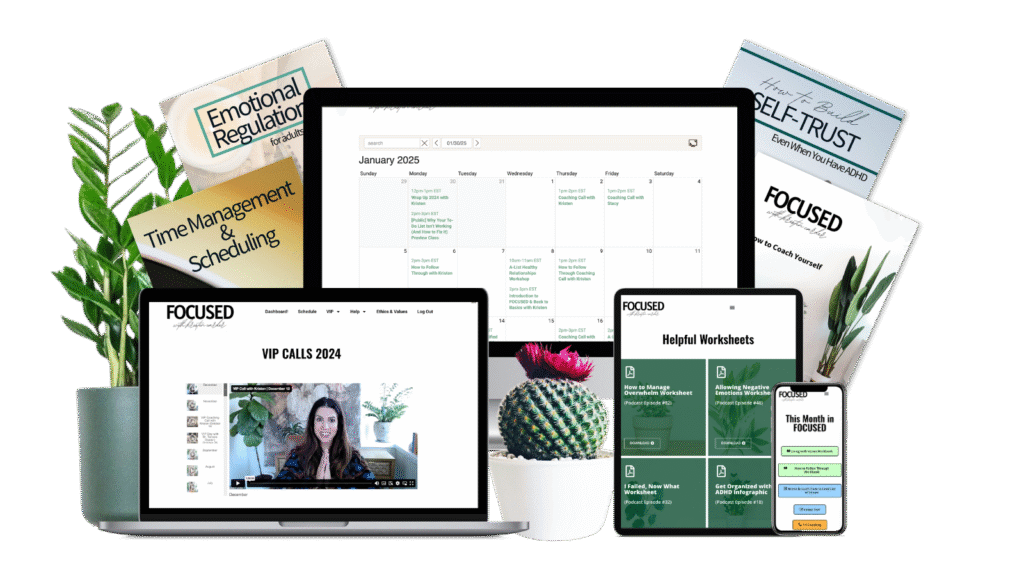
Oh, thank you for calling in Kristen. This is so great. I think self trust is one of those aspects of ADHD that we really don’t talk about a ton, because when you’re first learning about ADHD, you are just in triage. You’re trying to plug all of the holes in what feels like a sinking ship. You’re just like, oh my gosh, I need to get to work on time. I need to figure out this time blindness. I need to make systems so that I remember things, and you’re learning so much about yourself and about your brain, and maybe you’re being treated for ADHD, so things are really shifting and changing. And it’s not until a little bit later that you have the ability, once you’ve kind of triaged the sinking ship, so to speak, once you’ve kind of triaged that, that you’re able to think more broadly. This is often when we start to think about our relationships, and improving our relationships and self trust is one of the aspects of relationships. We’re improving with ourselves. We’re improving the relationship that we have with ourself. I have a whole course on this. If this is something that you really want to dive into, I created a course in my focused ADHD coaching program called How to build self trust, and I go into huge amounts of detail about how self trust is actually built, why ADHD ers kind of like missed that developmental skill, and what we can do about it now. So it comes with a workbook and a bunch of video classes. If that’s something that’s interesting to you, join focus, you get access to it immediately.
But for our conversation here, Kristen, what I want to say to you, my dear, is that you’re doing a really good job, and that’s the first part. The first step with self trust is recognizing what you are doing right and maybe even creating some concrete evidence for your brain. Hey, I am doing a good job here, like you just listed for me. I’m creating some alarms. I’ve created some systems. I actually do a good job at following through on those systems. I can recognize that about myself. So that’s step one. We’re building the evidence bank that I can do things correctly. Then next, as you’re going through your day, what your brain is really asking for, my dear, what your brain is asking for is reassurance. Wait, did it? Did I set that alarm? Wait, am I set up for for the next step? Wait, am I going to get out of here on time? Wait, there’s this like underlying anxiety and questioning constantly, am I, am I going to be able to do it? Am I going to mess up? Is it going to be okay, right? Chatter, chatter, chatter, chatter, just like the endless quest for reassurance. And so your job, Kristen, is to reassure yourself you’re good yet. We don’t need to check I already set that alarm. Chill. I’ve got you what what I hear here is that your inner child is really anxious and really questioning, am I going to be okay? Mama? Are we okay? Are we good? Is it going to work out? Is it going to work out? And what you need to do is from you to you, offer that reassurance. Reference I got you we’re covered. It’s gonna be okay. Instead of reassuring by double checking all of those different systems that you know you already put in place, offer that reassurance. So this comes with some emotional regulation. This comes with some self compassion. This comes with like, Okay, I’m gonna just take five seconds here, and instead of checking and rechecking and checking again, I’m going to allow that anxiety to be present, and I’m gonna reassure myself, Hey, we’re good. I got you. Hey, I hear you. I hear that you’re anxious. I hear that you’re questioning it. We’re good. I’ve got you Okay, so lots of reassurance. The next step, and this might take a little work on the front end, is, what, what will I do if, in the case of like, the alarm doesn’t go off, how am I prepared to take care of myself. Because so much about self trust is knowing that if the shit does hit the fan, which it, of course, it’s going to at some point, if and when that happens, I will be able to take care of myself.
The world is not going to end. No one is going to die if the alarm doesn’t go off, right? So it’s it is setting up the alarms in the first place, which it sounds like you’ve got that down. Then it’s reassuring yourself, hey, the system’s in place. I’ve got you. And then it’s also bringing in this deep, rooted trust of when something goes wrong, I will take care of it. We don’t need to panic. I know what to do when something goes wrong. I have the capacity and the mental fortitude and the ability to solve that problem. So I don’t need to worry all day long. What if? What if? What if? What if? What if? Because the answer to the what if is, I’ve got us I’m going to take care of us. You don’t need to worry. I’ve got us covered. If something were to happen, I will absolutely take care of it. I know what to do in the case of emergency. All right, so that’s a three fold, or a three pronged approach to self trust, just for this little situation. But like I said, if you want more, come and join focus. Grab that self trust. Course. Binge it. It will change your life. Love it. Thanks for calling in Kristen. I appreciate that. All right, next we’re going to hear from Alan. Alan has got two questions for us, so we’re going to do kind of we’re going to do this in two parts.
Caller 12:48
Yeah, hey, Christian. This is Alan Lennon, actually. Lennon calling from Chicago, Illinois. I’m in my late 50s, and came across your podcast. It’s really good. My question really is, is the fact that I struggle in meetings, not keeping my mouth shut, meaning I have to say something you know just about every meeting. And maybe it’s about, you know, trying to teach somebody or share something that somebody hasn’t learned. And so that’s, that’s kind of difficult. It just kind of seems just, I can’t control it.
Kristen Carder 13:33
Okay, let me pause you right there, because I want to address this before I get to your next question. So here’s the thing, my friend, this is a self regulation issue, right? So someone’s talking in a meeting, and your brain is just flooding you with we got to say something. We got to teach them something. They don’t know this thing. And I’m interested if you could kind of transport yourself there, to that meeting right now, I’m wondering what’s happening in your body, because I’m going to guess, and this may or may not be true, I wish you were sitting face to face with me, because then we could have a conversation about it. But what I’m guess, what I’m going to guess, is that you feel a sense of like urgency, like I got to get this out. I got to say it. I gotta and and your body starts to build up with this really intense energy. And the thing that is so important is that you gain authority over that big intense energy in your body. That is your job, sir, that is your job to start to first believe that it’s possible to have authority over that big, intense emotional energy that is building up in your body, that your thoughts are going, I got to say something they don’t know this and and and then this, like big emotion is crazy. Gonna hear that like all this energy is coming up and there’s this urgency, like, I gotta go, I gotta get it out.
Your job is to say I can control this. I can’t. I can. I will control this. I will not let my thoughts and emotions control me, because that’s where we start on this journey, is that our thoughts and emotions really dictate and control our actions. And when we don’t have authority over our thoughts and emotions, then we have no authority over our actions, right? We’ve got you’re just like, I can’t help it. It just like, it bursts out of me. And the key here is to begin to believe that you actually do have authority over your thoughts and emotions. And so what that looks like, my friend, it practically in real life, is letting the emotion be in your body, and you doing I’m gonna give you a couple suggestions here. We can start to breathe very deeply, and imagine your body expanding to create space for that big energy, that big emotion, that urgency, that need to say something, that is still going to be there. We’re not talking about getting rid of it. It’s still going to be there. But what you’re going to do is you’re going to breathe really deeply, and maybe you’re going to count to four, so you’re going to breathe in, 1234, and you’re going to breathe out, 1234, and you’re going to focus on your breath and your counting instead of what the other person is saying, right? Because sometimes it is appropriate for us to speak up, but sometimes we speak up about things that are none of our business, because we don’t have authority over our thoughts and emotions, and so your job is to start to do the work of I do have authority.
I will have authority over this, and I will begin to regulate this so much that, like maybe I’m not going to say anything in a meeting, and I’m going to wait until afterwards to really decide, is this something I need to address now, eventually, you’re going to get so good at this that you will be able to do it in real time, and you’ll be able to know when you do need to speak up and when you don’t need to speak up. But I would suggest to you that at first, we’re just going to practice not speaking up. We’re just going to practice being quiet. We’re going to practice not always having something to say in response to someone else. We’re going to allow that emotion to be in our body. We’re going to we’re going to breathe and we’re going to count. Another option for you is to have some sort of fidget and try to direct that energy toward a fidget. For me, I like to chew gum that is a very regulating, very sensory, friendly, pretty, pretty widely accepted, although my husband hates the sound of me chewing gum, but that is another story for another day. So having a body movement accessible to you. Maybe we’re playing with a pen. Maybe we’ve got just something in our hands. Maybe we’re chewing gum, whatever the case may be for you, where we’re directing we’re noticing the body energy. We’re creating space for it, and we’re directing it somewhere else that is not our words. Okay, so your job is to really begin to have authority, because what worries me, and that’s a little bit too strong, it’s I’m not actually worried, but what concerns me is the belief that you can’t control it, because you are responsible to control what comes out of your mouth, right? And so that’s where we need to start. Okay, let’s get to the next part of your question.
Caller 18:43
Another thing that probably the worst thing about understanding my career journey is that I also tend to be very defensive when I get criticized. So if I get criticized something, I feel like I have this desire to fire back and say the reason why I did this was that, or I did this because of that and and that need to sort of prove myself is pretty intense, so I didn’t know if that was a trait with ADHD, and it’s something you can talk about on your podcast. Thank you.
Kristen Carder 19:19
I’m so glad you called my friend. I really, really am so that need to prove yourself and to defend yourself. I just want to validate that and say for those of us with ADHD that really struggle with being defensive and really feeling like we need to prove ourselves, we come by that, honestly, we come by that honestly, you’re in your late 50s, you, I’m going to guess, were pretty recently diagnosed, maybe within the last 10 years. You spent decades likely being really misunderstood, right? Really misunderstood. And so now. Now when, when it’s kind of like death by 1000 cuts, when we’ve been misunderstood, when we’ve been mischaracterized, when we’ve been criticized for things that were like we didn’t mean to or just it was a symptom of ADHD, which is not an excuse, but it is an explanation, and all of it’s just like we develop this wound that says nobody understands me, and I need to explain myself so that people will understand me, because it feels horrible to be misunderstood and like, get in here. Let me give you a hug.
I know how that feels. I support so many people with ADHD, who also know how that feels, like it feels horrible. Anybody listening to this podcast, I think, will really relate to that wound of like, I’m just nobody gets me no matter what I say or do, like it’s completely misunderstood or misconstrued. I don’t have the ability to just like, have people understand where I’m coming from, and so I just want to point that out as, like, valid. You’ve come by it very honestly, and it’s a wound. It’s not just this, like, trivial, like, oh, that’s just ADHD. Like, this is a wound from probably a lifetime of misunderstanding, correction, criticism. This is very related to rejection, sensitivity, and I just want to say, Oh, I’m so sorry. So this is actually another emotional regulation issue. This one is a little bit deeper, and you might want to reach out for some like, specific support on this, whether it’s trauma informed therapy or trauma informed coaching, because this one is a little bit deeper, because it’s it’s touching on this misunderstanding wound, or, like, being misunderstood. It’s touching on some rejection, sensitivity. It’s touching on like, am I enough? Who am I? What’s the foundation of who I am? Is it really like that? What’s the word I’m looking for, like, thin or cracked? Is the foundation of like, my identity that fragile? That’s the word I’m looking for, that I have to, like, defend myself over and over. So this is a little bit deeper my friend and I just want to really encourage you to reach out for some, like, more structured support. But if that’s not accessible to you, what I do want to point you to are my episodes on emotional regulation and and figuring out, how do I hold this in my body again? This is like, very similar. How do I hold this in my body without reacting back? How do I hold someone’s feedback in my body without defending, explaining, minimizing, dismissing. How do I do that? And it really takes a deep level of emotional regulation to be able to say, I receive that. It doesn’t feel good, but I hear what you’re saying, and I need some time to think about it. I need some time to munch on it for a little bit, and I’ll circle back to you when I’ve had some time to sit with this, okay? And again, this is where we pause, we breathe, we allow that pain, that wound, to be in our body.
But we we really regulate our response to it, okay? And so it’s like creating space, deep breathing, maybe some head nodding, maybe some eye contact, and having, having a phrase locked and loaded for yourself, so you’re not grabbing or grasping for straws, but maybe there’s a phrase that you can say in response. I appreciate you sharing that with me. I’m gonna sit with that for a little while. I’ll get back to you after I’ve had some time to process. Do you see how that’s not over, explaining, being defensive, reacting, throwing it back onto the other person that’s saying, I hear you. I appreciate you sharing that with me. I’m gonna sit with it. Okay? That allows you to go away and have a freak out in your own office, right? Like I felt terrible. I hate that guy. You can go do that in the privacy of your own office. I’m gonna sit with this. I will come back to you after I’ve had some time to process. All right? I hope that was really, really helpful to you again, if you want your question answered on the podcast, the number is 833-281-2343, okay, we’re going to move on to some research that a focus member recently posted in our focus community. I find this to be very fascinating and highly. Highly validating. So this research study shows that women with ADHD experience perimenopausal symptoms earlier and more severely than neurotypical women. So women with ADHD experience perimenopausal symptoms earlier and more severely than women without ADHD that first of all, I mean, yes, absolutely yes. And then second, it just, it’s so validating, and I’m so glad that it’s being studied and shared. So let’s just very briefly talk about what perimenopause is. So perimenopause is the transitional phase before menopause, and typically it’s going to start in early 40s, but as this study shows us, for women with ADHD, it often starts in mid 30s, which is absolutely wild. Okay, so the most common symptoms, if you’re kind of like, Wait, what are you even talking about? The most common symptoms of perimenopause include irregular periods, like lighter, heavier or skipped periods, hot flashes, night sweats.
Can confirm vaginal dryness, mood swings, sleep disturbances, fatigue, weight gain, and like cognitive fog, like brain fog, okay. And of course, there are, there are more symptoms, there are other symptoms, but that’s just kind of like a very, very quick snapshot. Okay, so let’s look at this study. I’m going to obviously link it in the show notes for you the name of the it’s posted in the National Library of Medicine, and it is called perimenopausal symptoms in women with and without ADHD, a population based cohort study, and it says that women with ADHD had higher total perimenopausal symptom scores than women without ADHD, the difference was most pronounced among women aged 35 to 3935 to 39 that’s young i i know there’s like, a lot of talk, if you’re like, on the side of Instagram or on the side of Tiktok that I’m on, there is a lot of talk about perimenopause and how it can start like, you know, earlier for some but when I went to my OB and was like, Hey, is she an OB? I think that’s actually when you have babies, like, whatever doctor is the girl doctor? I went to her because I’m not having babies anymore, and I was like, I think I’m experiencing some of these.
She was like, No, I don’t think so. Anyway, I’m gonna fire her immediately. But let’s move on. So I what the point of what I’m trying to say is that I don’t think that we’re looking for these perimenopausal symptoms early enough in women with ADHD 35 to 39 years old, the prevalence of severe perimenopausal symptoms was significantly higher among women with ADHD compared to those without, both overall and on all sub dimensions. So the conclusion, as the study writes, I’m just reading directly from the study, women with ADHD have higher prevalence of severe perimenopausal symptoms. These symptoms present at an earlier age than among women without ADHD, indicating an earlier onset age of perimenopause in ADHD, this is wild. I just had a friend tell me that she started using MIDI health as a platform where you meet with a clinician and they, if it’s appropriate, will prescribe like, hormone replacement therapy for you or whatever it is that you might need. So they’re not a sponsor of this podcast, although I would be totally open to it. I will also post a link to MIDI health if that is something like, if your gynecologist also looks at you and is like, No, you’re too young. Or no, I don’t think so. Or like,
Kristen Carder 29:09
if they dismiss you deny, gaslight, all of the things that we are so used to as women, or just as people with ADHD in general, if that happens to you, and you want a clinician that will really hear you and understand you and give you the care that you believe that you need. I really recommend reaching out to MIDI health. Now I only I haven’t used it myself, and I’ve only heard from one friend who’s used it, but it seemed very simple, very easy. She spoke directly to a clinician and was prescribed medication the same day. So she is very happy with it. I trust her. I’m passing it on to you. We’ll link it in the show notes, but just be on the lookout for those symptoms. I’m going to read them again. So if you’re a woman with ADHD, you are, you know, maybe. In your 30s, or approaching your 30s, you’re going to want to be on the lookout for symptoms of perimenopause, including irregular periods, like lighter, heavier or skipped hot flashes, night sweats, vaginal dryness, mood swings, sleep disturbances, fatigue, weight gain and cognitive brain fog. All right, I thought that was so interesting, and I really, really hope it is helpful to you. Okay, let’s move on to what I think is going to be a very fun part of this episode. I came across this reel, and then a focus member posted the Wall Street Journal study, and I was like, Oh my gosh, I need to react to this on the podcast, because I I think it’s really important that we continue to break the stigma of mental health and ADHD and not allow fear mongering, oh my gosh, to control our medical decisions. So we’re just going to go through this. I’m going to interrupt it quite a bit, because, literally, I want to react to every single thing she says. But let’s just go ahead. Let me see. This is the Wall Street Journal.
Speaker 3 31:19
Millions of kids are on ADHD pills. For many, it’s the start of a drug cascade.
Kristen Carder 31:30
Stop. For many, it’s the start of a drug cascade. Dun. Dun, dun. I mean, right off the bat, it’s ominous, right? Like, oh no, that’s terrible. This is so bad. I just I can’t, okay, continue.
Speaker 3 31:51
Millions of kids are on ADHD pills. For many, it’s the start of a drug cascade. For Danielle gansky, it started when she was seven years old, after a psychiatrist diagnosed her with ADHD. She was prescribed Concerta, a stimulant, but it made her agitated, moody and angry, so another doctor put her on Prozac.
Kristen Carder 32:10
Stop. Why? Why are we going on Prozac after a stimulant? So here’s the thing, I’m not a clinician. You know that this is not medical advice, this is this podcast. Is never medical advice. These are my what I’ve learned along the way, my reflections, my opinions and hopefully information for you to take to your doctor and have educated conversations. But here’s the thing, if you’re if you or your child is put on a stimulant and it makes them angry or agitated or restless or not able to sleep. Clearly, that’s not the right medication for them, right? I’m very confused, and we don’t get enough information from this journalist, but I’m very confused why the doctor went from an ADHD medication to one that is not, to a drug, Prozac that is not prescribed for ADHD. We’re either not getting enough of the story, or this doctor is incompetent, okay, but I just struggle, okay, let’s continue.
Speaker 3 33:22
Actually, she was put on Lorazepam for anxiety. Over the years, she was always on two and sometimes three or more psychiatric drugs at once. The pills made her irritable or sleepy, but whenever she complained, doctors would up her dose or try another medication. By her late 20s, she had taken 14 different kinds of psyches.
Kristen Carder 33:40
Stop by her late 20s, she had taken 14 different psychiatric pills. That’s a that’s not great, and so I do want to give a lot of empathy to Danielle. Danielle is the person we’re talking about here, right? She starts off being diagnosed with ADHD and put on ADHD medication. Then she’s put on Prozac and Lorazepam and all of these different drugs. By the time that she’s in her late 20s, she’s been on 14 different psychiatric drugs. That’s a problem. That’s a big problem. I have never in all of all of the time that I have spent researching ADHD, talking to experts about ADHD, and supporting 1000s of people with ADHD, I’ve never heard a story like Danielle’s story, so I’m not diminishing this one story, nor am I saying that this never, ever happens, but this is such an outlying example of what happens for someone who is diagnosed, and this, in my opinion, is really negligent. And journalism, because what this is saying is like, oh, man, we diagnose our kids and we put them on ADHD medication, and it’s the start of a drug cascade. Done, done, done. And then we use Danielle’s story, which is a very sad story. This is she was not treated properly. Right by her late 20s, she had taken 14 different psychiatric drugs. She said, Hey, I don’t feel good. This doesn’t make me feel good, and she’s continued to be prescribed drugs. That is a problem. Absolutely. It’s also not just on the doctors, like her parents consented to trying all of these different medications. I would also say that there’s some responsibility to bear there as well, but to highlight Danielle’s story, which is wrong and bad and terrible, to highlight that as an example of what happens for kids who are prescribed ADHD medications? That’s that is not, that is not the prime example. That is not the norm. This is an outlying, extreme example. Oh, my goodness. Okay, is there more? Let’s see. Let’s see what’s left.
Speaker 3 36:18
Clinical trials have shown that ADHD medications are safe and effective for many patients.
Kristen Carder 36:24
Stop. Why isn’t? Why isn’t that? What’s highlighted clinical trials have shown that ADHD medications are safe and effective for people with ADHD. Great, that’s good. Listen, I don’t I don’t work for the pharmaceutical companies. I don’t get paid by the pharmaceutical companies, but I am here to say that in my experience, what the research shows and anecdotally from so many people that I have supported ADG, medication is helpful. It’s a good thing. It can be a life saver for some, and it has been proven and highly researched over decades and decades to be safe and effective for children with ADHD okay continue on.
Speaker 3 37:12
Less is known about the impact of multiple psychiatric drugs on young children. Studies show that 10s of 1000s of kids who take prescription medication for ADHD also wind up on other powerful psychotropic drugs for one in five kids who take them, ADHD drugs are just the beginning. Children
Kristen Carder 37:30
Stop. ADHD drugs are just the beginning. Okay, here’s the thing, sure, one in five children who are initially prescribed medication for ADHD end up down the road being prescribed something else as well. But she doesn’t say why that is. Why is that? Why is it that one in five kids who have been flagged as ADHD, who have been evaluated, diagnosed and then prescribed medication for ADHD, are then eventually, down the road, prescribed another medication. Why? Like, the implication here is, if you were medicated for ADHD, you’re just going to be randomly put on other drugs. So, like, be careful. Be careful. You’re just going to be put randomly put on other drugs. There’s no mention of the comorbidities of ADHD, like, yeah, people with ADHD have a higher likelihood of generalized anxiety disorder, major depressive disorder, complex PTSD, obsessive compulsive disorder like ADHD often does not travel alone, right, right? And so there is no mention here of like, oh, because they were also then diagnosed with another mental health condition that was comorbid with ADH with ADHD? No, it’s just like, it’s just random. It’s just, it’s just this totally random, weird thing where you’re diagnosed with ADHD and prescribed ADHD medication, and then randomly, somehow your doctor prescribes other medications. It is just the beginning of a drug cascade. Instead of being clear that ADHD is often diagnosed with other mental health conditions as well, as well, drugs are just the beginning. Is that what she just ended on, like danger, the ADHD medication is just the beginning? Yeah, it’s just the perhaps just the beginning to understanding the complexity of this human being who has ADHD and other things working against them. Okay, let’s continue like them.
Speaker 3 39:53
ADHD drugs are just the beginning. Children who are prescribed an ADHD medication were more than five times a. Likely to be on an additional psychiatric medication four years later, according to a journal analysis of Medicaid data for preschoolers diagnosed with ADHD, guidelines suggest starting with behavioral interventions, but many parents say that effective therapy can be hard, if not impossible, to find.
Kristen Carder 40:19
Pause. This is really important, and I think we should have a conversation about this. So your three year old is diagnosed with ADHD, right? And the recommendation is like, we can put them on medication, or you can get them into some sort of behavioral therapy, or both. And a lot of parents, I would assume, would say, hey, let’s start with behavioral therapy. That’d be great. Let’s do that, right? Let’s start there. But if there are not effective therapies, available and accessible, if your kiddo is getting kicked out of preschool, if your kiddo is not able to function in a school setting, and you as a parent don’t have the luxury of staying home with them and and like doing all of this work with them at home, then What choice does a parent have? So I just, I really want to say here that, like, I am so sympathetic to parents who are just like, I’m not sure what else to do. I’m not sure what else to do. Like, the school said, like, it is possible that a school would say, like, hey, you need to deal with this because their behavior or their disruptions are making it so that they’re not functioning in the classroom. And not only are they not functioning in the classroom, but they’re not. They’re like, distracting other kids and disrupting so much that that it’s like, unworkable. It’s not livable for the other students as well. And so the parents are like, okay, great, let’s go find a therapy. But what therapies are available? I mean, listen, if you’re listening to this and you want a career change, like, How amazing would it be if somebody listening to this podcast was like, I want to create a therapy for these kiddos to help them, an evidence based therapy that would help them to learn how to regulate, to learn how to develop the skills necessary to be able to function within the classroom with or without medication.
My my guess here, my guess here, is that, you know, for those little ones who are diagnosed with ADHD, it would likely have to be family therapy. It would likely have to be the parents in therapy with the children. And I do wonder if there’s some pushback there where parents either don’t have the capacity, don’t have the money, or don’t have the own, like, their own emotional regulation, they’re kind of like, I don’t I’m like, at a loss here. I’m barely hanging on. I’m barely surviving like, you want me to do therapy. And I think that absolutely is a barrier. I did a quick Google to see how many kids ages three to five are diagnosed with ADHD in the US at right now, what Google is saying is about 2.4% of children ages three to five are diagnosed with ADHD. So like for me, I think I really would struggle to put my child on medication at that age. But that doesn’t mean that I wouldn’t do it if I didn’t have the luxury of staying home if they were getting kicked out of school. It if, if the child care refuses to have them come because they’re so disruptive and they’re not able to regulate themselves. I think that for some people, it’s like, I’m not sure what else to do. And I totally, totally, totally sympathize with that. I had the privilege of being able to be home with my kids most of the time when they were those ages. So that’s not something we struggled with. We I we do have two kids that are medicated, but they’re a little bit older, but the fact that that what we’re not focused on here is like, hey, we need better therapies for kids with ADHD. Like, that’s what I would love this article to be about is like, let’s create better therapies for kiddos with ADHD, for families with ADHD like this needs to be a whole family event. Okay, let’s finish up here.
Speaker 3 44:31
Therapy can be hard, if not impossible, to find. More than 42% of children from ages three to five are prescribed medication within 30 days of an ADHD diagnosis.
Kristen Carder 44:41
I mean, I think that’s good. More than 42% of children who are diagnosed with ADHD are prescribed medication. She’s saying it like it’s a bad thing, like, Guys, look out. Watch out everyone, if you’re trying. Child with, if your child is diagnosed with ADHD, they will probably be prescribed a medication. It’s like, okay, well, if my child is diagnosed with diabetes, they’re probably going to be prescribed a medication. Like, obviously, I don’t under I don’t understand. Yes, okay, I understand. I do understand that that feels very young, but at the same time, research shows us that medication is the most safe and effective intervention for people with ADHD. And honestly, do some of you wish that you were diagnosed at age five? How many of you listening weren’t diagnosed until your 30s, 40s or 50s? If your parents had known about your ADHD at age five? How relieving would that have been? I’m just I don’t know. Would it have been if you are on medication right now and it it is like a good fit for you?
Do you wish that you had started it at age five to think of these kids being able to go through school, diagnosed, understood for who they are, and medicated for their symptoms? Is that a bad thing? I just struggle when, and I you know, they’re doing it because it gets talked about, like, here I am talking about spending 30 minutes talking about on the podcast, making these ominous videos, which I liken this to fear mongering, like, Hey, if you medicate your child, it could be the start of a drug cascade. I mean, listen to Danielle’s story. She was diagnosed with ADHD, and by the time that she was in her late 20s, she had taken 14 different psychiatric medications, so don’t let your child be like Danielle. I mean, is that like the is that the moral of the story here, according to the Wall Street Journal, I just am really concerned about these types of messages that are being sent out. Here is a message that I think would be much more fair. If your child is diagnosed with ADHD, it can be really hard to decide what to do. You may worry that having them on medication could lead to more medications, and if you’re worried about that, that would be fair, because one in five children who are diagnosed with ADHD and prescribed medication for ADHD, they do end up on some other type of psychiatric drug, but I want to let you know that that is likely because they’ve been diagnosed with an additional mental health condition, because ADHD often comes with comorbidities like depression, anxiety, OCD, what else did I say? CPTSD, and so what we want to do is make sure that whatever your child needs, we’re not going to withhold from them.
Whatever your child needs, we’re going to give it to them now that being said, please do use your own parental intuition to determine whether or not you think it’s appropriate for your child to experiment with various drugs. So if your doctor continues to prescribe medication to your child, you may want to take pause, and you may want to ask more questions, and you may not want to let your child be on 14 different psychiatric drugs, or that may just be their path, because they are complex being. But either way, trust your parental intuition. Know that ADHD medications have been researched and and found to be safe and effective for children with ADHD, and understand that ADHD comes with comorbidities. Additionally, you should know that therapeutic interventions are pretty few and far between. It may take you a little while to find a therapist, but we recommend that the whole family be in therapy. If one person is diagnosed with ADHD, that means that it’s likely the whole family is affected by it somehow, and so we’d love to support your family and get them into therapy so that everyone can be supported. Everyone can learn emotional regulation tools, and everyone can have executive function support. The end isn’t that? Don’t you feel like that’s just like, a little bit more nuanced, a little bit more accurate? I. Don’t know. I don’t know. I just these types of things, especially in the political climate in which we’re existing. I think it’s really important to make sure that we are understanding what the research does show, and that we’re clocking it when there’s a little bit of fear mongering going on now, I will say it was heartened by the comments, by the comment thread under this reel, because you know how you go to the comment thread to be like, am I the only one like, am I the only sane person here?
Or is like, am I reading this wrong, or am I hearing this correctly? And I went to the comment thread, and it did not disappoint there. It was full of people being like, Okay, this is fear mongering. This is not helpful to the ADHD narrative right now, and so I really did appreciate that, but I hope that this gives you a little bit of perspective when you’re kind of flooded with content on the internet, there’s going to be even from like, quote, unquote, trusted publications. We still need to use our discernment, and we still need to back our discernment with scientific research, with evidence, with what we know to be true, and not let one person’s story that is very disappointing. Yeah, I feel for Danielle, and in the broader article, like there was a written article as well, there were other anecdotal stories of kids that were treated very similarly to Danielle, and that’s not what we want. That’s not what we want. Okay? That’s not okay. And I’m not I’m not justifying that, but I am saying those are the fringe, those are the outliers, and I think that for most of us, it’s a much more balanced, much more reasonable conversation. All right, thanks for hanging with me this week. We got a little feisty. I hope you were able to handle it. I will talk to you so soon. Same time, same place. Next week, I’ll see you. Then. Bye. Bye. A few years ago, I went looking for help. I wanted to find someone to teach me how to feel better about myself and to help me improve my organization, productivity, time management, emotional regulation. You know, all the things that we adults with ADHD struggle with, I couldn’t find anything. So I researched and I studied and I hired coaches, and I figured it out, and then I created focused for you. Focused is my monthly coaching membership where I teach educated professional adults how to accept their ADHD brain and hijack their ability to get stuff done. Hundreds of people from all over the world are already benefiting from this program, and I’m confident that you will too go to Ihaveadhd.com/focused for all details.