Kristen Carder 0:05
Welcome to the I Have ADHD podcast, where it’s all about education, encouragement, and coaching for adults with ADHD. I’m your host, Kristin Carter, and I Have ADHD. Let’s chat about the frustrations, humor, and challenges of adulting relationships working and achieving with this neurodevelopmental disorder. I’ll help you understand your unique brain, unlock your potential, and move from point A to point B. Hey, what’s up? This is Kristin Carter, and you’ve tuned into the I Have ADHD podcast. I am medicated, caffeinated, regulated, and ready to roll. Speaking of regulation, that is exactly what we’re talking about today with my guest, Jennifery. I’m really pleased to have her here with me today. I’ve been following her on Instagram for a couple years, feel like we’re kind of besties, but have never met in real life, so now we get to hang out for real, virtually, unfortunately, but at least it’s better than nothing. We’re gonna have a great conversation today about regulation. What does regulation have to do with ADHD? Why does it matter? How can we get there? She has a brand new book out, which I love, enjoyed very much, and it’s colorful. It has these beautiful illustrations, it came with stickers. I was so excited, I loved it so much. Highly, highly recommend. But let me tell you a little bit about her. So, Jennifery is a counselor for ADHD with ADHD. She specializes in working with the ADHD brain to get it out of fight or flight and into working its best, while honoring neurodivergence and all of our uniqueness, she has a focus on making ADHD ers lives more enjoyable. Yes, I’m obsessed. While also being more productive, Jenna lives in Calgary, Alberta, with her husband and two sons. Jenna, welcome to the podcast. Great to have you.
Jenna Free 1:59
I’m so happy to be here.
Kristen Carder 2:00
So pleased to have you. So I wanted to just do a little call back to a time that I’ve actually mentioned you on this podcast, which is when I came across one of your reels years ago, and you talked about this phrase, or this term, or whatever title of being local sober, and I was like, yes, that’s what I am, that’s what I need, and my audience knows I’ve been on a sobriety journey, was highly addicted to alcohol, didn’t work a program, you know, I’m not like technically sober, but been really working on my relationship with alcohol, and have been virtually alcohol-free. Although, when I am not in Pennsylvania, I will occasionally have an alcoholic beverage, and it has worked really well for me to give myself the freedom when I am somewhere else. We were just in Punta Cana, and I had a little margarita at the resort. It was wonderful. I had, like, half of a margarita, and it was like that was great, that was enough. It was wonderful. So different from drinking three glasses of wine every single night to calm my nervous system at home. And so I was just curious, is that something that you came up with, that concept, or did you like borrow it from someone else?
Jenna Free 3:20
No, that’s kind of how my journey with alcohol, where this is not the point of my work, but it totally definitely ties in.
Kristen Carder 3:28
Yeah,
Jenna Free 3:28
I was never a big drinker, so I will say I don’t think I ever had a problem with alcohol, but I knew it never, like every time I drank, I’d like, oh, I feel horrible, like really affected me physically a lot, yet I would still do it, you know. Every time you go for dinner, every time you’re with friends, I’m drinking, and, like, well, hi, I don’t even like this every time I do it. So I started with, like, you know, trying a month, I’m not going to drink it all. Then, you know, it slowly trickled into, “Wow, that felt really good. But, of course, there’s a tug of war. It’s very social, and if you have ADHD, maybe you’re more socially uncomfortable, so it is a bit of a lubricant, but then I eventually was like, well, I’ll just, I’ll just drink when I travel when I’m on vacation, yeah. So then I had local sober, and funny enough, I was in Croatia September 2024 now I, me and my best friend, we went for our 35th birthdays to Croatia. Left the kids at home. It was so fun, and we got to this, like, the most beautiful hotel I’ve ever stayed in. I was handed a glass of champagne. We’re drinking the champagne. I went.. I feel like this is the most beautiful place I’ve ever been in, and this just made it worse. I feel shittier, and that’s the last drink I had. I have not had a drink in a year and a half. I love it, and I know that that’s it’s like I slowly eased into complete sobriety because I am more regulated. So, it’s like, yes, that will help with your regulation, but because I’m regulated, it’s like I don’t need. Much anymore, which has been so cool. It’s like I’m good, I feel whole, I feel present, I feel calm. Obviously not all the time, I’m a human being, but my like primal self is okay. That kind of deep part of me is, doesn’t there’s no void there, there’s no intensity and anxiety all the time, yeah. So it just felt like a natural next step to go, I’m good, and I don’t have any rigidity around it, you know. I’m not like you’re not allowed to drink now, Jenna. It’s just a genuine, like, wow, this is really serving me well. I feel so good. I just feel no need for
Kristen Carder 5:36
it. I love that so much, and, and I totally agree with, like, the less you have, and the longer it goes between drinking, then when you do, you’re kind of like, like, it’s just like, why, like, I wake up in the middle of the night and my cortisol spikes, or I wake up the next morning with a headache, it’s like, why, and why did I do this for so long, and I do know the answer to that, because I was extremely dysregulated. It was a tool that I accessed for calm, and it served a purpose. It really did. So, I don’t begrudge myself or anyone else who uses it as a tool. It’s just a matter of, like, at some point, does it become a net negative, and for me it absolutely did, especially like getting into my 40s, and like I noticed my body and brain were just like not happy. It was like, what are you doing to us? Why are you doing this? So I just, I appreciate that you coined that term, because now I borrow it and I use it constantly, so the one thing I will say is that when we go to Oktoberfest every year, are the Reading Leader Krons hosts like an Oktoberfest. I don’t know if this translates to Canada. Do you guys have Oktoberfest in Canada? Probably, I
Jenna Free 6:55
mean, I know what it is. Okay, you know what it is. Okay,
Kristen Carder 6:57
that is the only time where I’m like, I know I’m in Pennsylvania, but technically I’m in Germany, so I will have a German beer. That’s the only time it’s like
Jenna Free 7:06
I’m spiritually in Germany,
Kristen Carder 7:07
exactly. It’s like twice a year, it’s like vacation and Oktoberfest. I love it. That’s so great. So let’s go ahead and talk about regulation, and you were very clear to make the point as we were kind of just chatting before recording, that we’re not talking about emotional regulation, we’re talking about nervous system regulation, and I would love for you to define for my audience what’s the difference between the two and why does it matter.
Jenna Free 7:34
Yes, some people might think it’s semantics, but I think language is so important to know what you’re really working on, because emotional regulation, if you look up the definition, is like you don’t have control over your emotions, so it’s the, you know, the outpouring of feelings that’s the problem, but when we look at nervous system regulation, it’s like this, the emotions is a symptom of something deeper, which is the nervous system feeling unsafe. So, if people are working on emotional regulation, they might look at, like, let me not be so reactive, I shouldn’t be feeling so much, I should be, you know, not as upset on the surface, where that is just, you know, five dominoes away from the core of the problem, which is your nervous system, is in fight or flight. So, when I work with people and we talk about nervous system regulation, I just think it’s clearer in our mind what am I actually doing here? What am I trying to do? I’m not trying to fake calm more often, I’m not trying to hold my emotions back, I’m actually trying to heal the central thing that’s causing me to be more reactive, because of course, if your system feels unsafe, something I would tell everyone is, in this work, you really want to start seeing yourself for what you are, which is a very primal animal. We love to think, oh, we’re humans, we’re so complex and interesting, you are an interesting person, but we are still just little animals, afraid and trying to make ourselves feel safe. So, if you don’t feel safe, that is like functioning at, you know, like you are at your limit all day, every day. And if one more person says one more thing, I’m gonna flip my lid, which is an actual psychological term. So, if you’re not functioning at that level, and you’re functioning for those listening, I’m putting my hand like a chest level. If I’m functioning where, like, I’m filled up to here, yeah, I’ve got room for an inconvenience happening, someone annoying me, my kids being loud, I’m not going to be as reactive naturally. It’s a byproduct of nervous system regulation, whereas if we focus on the emotions, we think the feelings are the problem when they’re not.
Kristen Carder 9:46
How does someone know if their nervous system is dysregulated? What are the signs? How would a listener be able to self-identify? Like, oh yeah, I do think that that it is nervous system regulation dysregulation.
Jenna Free 10:00
Well, I’m gonna say some symptoms, and everyone’s gonna say, wasn’t that just ADHD, and that’s the whole thing, is being dysregulated and having ADHD, or at least the list of symptoms that are under the ADHD diagnosis are very similar, so when you put those two together, it’s a real blow up of struggle, so you know there’s the physical sign, so heart racing, any physical signs of anxiety, rushing our intense impatience is not innate, it is not inevitable, that is a system in fight or flight, you know, physically rushing, mentally rushing, and impatience. And then we have the mental signs: rumination, overwhelm, anxiety. Anxiety is just your system feeling unsafe, right? I need to think about the future and what’s going to happen. I got to keep myself safe, hyper vigilance. We have behavioral signs, so this is like you’re talking about alcohol, compulsive behavior. If you’re drinking and you can’t not, of course, I’m not really talking about addiction, but like the soothingness of it is so compulsive that you, you know, if I said, “Okay, let’s just, we’re going to work on not drinking, and you can’t not, yep, that is a sign, scrolling compulsively, spending compulsively, any, any substance use compulsively, eating compulsively. If you have a tricky relationship with food, and then there’s also kind of what I would call more self-care signs. So I have to go to the bathroom, I have to go pee, and I’m not getting up, I’m using that to create urgency to, for me to get things done, you know, and we make jokes like, oh, ADHD, or even procrastinate, going to the bathroom, like that’s not what that is, that is being in fight or flight, not eating throughout the day, and then also, what was the other one. Oh, yes. Not making yourself comfortable. So, if you’re freezing cold, doing your work, you’re just like, ‘Well, just hammer this out first, but just like, ‘Stop and go get a sweater. Why am I not taking care of my needs? Yeah, that would be a sign that we’re dysregulated.
Kristen Carder 12:20
That does just sound like ADHD, so how do we.. how do we.. there’s so many questions that I have here. So, where do I want to start? I’m taking a stop and think. If you’re in the listening audience, my eyes are closed, and I’m taking a little stop and think here, because everything you described. I’m like, check, check, check, check, check. Maybe we should talk about, like, what’s at the heart of the fight or flight for somebody with ADHD. Why are we in that fight or flight to begin with? Yes,
Jenna Free 12:53
of course, anyone can be in fight or flight. So, this work is relevant to all human beings, not just ADHD years, but having worked with, you know, intimately over 1000 people with this approach, having talked to 1000s and 1000s of ADHD years, I have never met someone who is not in fight or flight. So, why are ADHD ears so disproportionately in fight or flight? I don’t have the concrete answer for that, but my assumption is we’re different. We are neurodivergent people living in a neurotypical world, even if you don’t feel like you have trauma in your past, which I did not identify with that. So, being a fight or flight didn’t connect with me right away, because I’m like, well, I haven’t had, you know, capital T trauma, or even lower case teacher. I really didn’t identify with it at all, but when you go through life with which, just like this little poke, poke, don’t quite fit in. Oh, you’re a little bit different. You did that differently. Oh, you forgot that thing. You got in trouble for being late. That eventually puts your system into protection mode, and then we get stuck there. So, the reason I work with adults is because we do absolutely have the capacity to take that defense down and live in a way where we can feel safe. We are adults now, we are the boss, we have more autonomy. As a kid, I get it. Right, you’re at the mercy of the adults around you. You don’t have control, you don’t have autonomy, so it’s very hard. But once you’re in adulthood, I think people think, well, I’m still living in a neurotypical world, so I have to be in fight or flight. We do not being in fight or flight is only ever beneficial when you’re in imminent life-threatening danger, getting chased by a bear. Actually, need to fight, flight, freeze, or fawn to survive, then we want that triggered, right? But if our stress is a long to-do list, lots of chores to do today. An uncomfortable conversation to have with our boss. We don’t want our system in fight or flight, because that’s actually taking blood flow from the brain, putting it in our limbs, ready to run and fight and be reactive, as opposed to being thoughtful, mindful, and intentional. What. Itch obviously is so important in modern day living.
Kristen Carder 15:05
I absolutely love what you said about when you’re a kid, you really are so powerless and at the mercy of the systems that you’re brought up in. So a lot of us were raised in dysfunctional family systems, a lot of us were in school systems where our brains were not understood. A lot of us were in religious systems where our either hyperactive or underactive brains were just not appreciated at all, and so we were always at the mercy of the adults around us, saying, “You’re too much, you’re too loud, you’re not enough, you’re not doing it right, and constantly in trouble, constantly, constantly, constantly in trouble, and that transition into adulthood is so interesting, because nobody actually teaches us, hey, you’re a grown ass adult now, you’re grown up, there’s, you’re not like you’re not at the mercy of another person anymore. I think that transition is so tricky to make, because a lot of us need to be explicitly taught, and this is, I love the overlap with the book that I’m writing on relationships and ADHD, like living as an adult in your relationships, not a child, not approaching your relationships like I’m sorry, and I know I know everything wrong, and I know I’m always the one that’s the problem. It’s like, no, you’re a grown-up now, and I think that I’m just curious, like, how can we help people get there sooner, and I know that’s the work that you’re doing, but like, what do you think is like kind of the missing piece or pieces to helping people realize sooner? Like, how can we help people as they transition into, like, okay, you’re out of college now, and you get to go into your corporate work system, and yes, you’re in some ways at the mercy of the system, but in other ways, like you’re a grown up, you don’t have to always be the one taking the blame, or the problem, or in trouble, or like feeling like you’re in fight or flight. How can we help people create that safety?
Jenna Free 17:14
Yeah, I love that. That is part of the work I do with people, is we talk about, hey guys, you’re that, you’re an adult now, did you realize that, and everyone laughs, because it’s like, oh, I didn’t like consciously even think about that. So, we want to observe, like, do I always feel like I’m a kid about to get in trouble, right? Looking over our shoulder at nothing, it’s like this is the definition of fight or flight, is my system is reacting to something that’s not real. Yeah, right. Yeah, if you are getting chased by a bear, react to that, but if you’re not, we’re looking over our shoulder, waiting to get in trouble, but we’re the, we’re the adult in the room.
Kristen Carder 17:48
Yes, didn’t get the memo. It’s like we can know that and rehearse it logically.
Yeah,
like you’re fine, you’re fine, like you know, it’s
just
it’s just a conversation. I actually had someone text me that I hadn’t talked to in a year and a half, and they texted with some stuff, and immediately my body was like my just exactly what you described, my heart racing, my palm sweating, and ruminating about it. I couldn’t stop thinking about it for 24 hours. I was just like, I woke up in the middle of the night to use the restroom, went back to bed, and it’s all I could think about, and, and it was that again, where it’s like, prison, you’re safe, you are in the coziest bed in the safest room, next to like the man of your dreams, who’s gonna like not let anything, like you’re, you’re okay, and yet my body doesn’t get the memo,
Jenna Free 18:40
yes, and that’s why we do this work, right, is to get that system into a place where you know the type of regulation work I do, because I know people have heard about regulation for ADHD, right, we see it in a lot of places, but I would say the not explicitly said thing, but I think the implied work of most regulation is like whack a mole, like, oh, you’re gonna get dysregulated, here’s tools to like whack it back down, whereas the type of regulation I do is like, before we do anything else, let’s get a strong foundation, so let’s work on this like consistently for a while to get your baseline from when I wake up I’m in fight or flight to when I wake up I’m regulated and I will get dysregulated by life because we’re humans but I’m actually retraining my system to have a baseline of like oh I’m okay and so to do that like you said you can’t just go I’m safe okay done right I wish it were that easy. So, there’s a physical retraining of the body, like, how am I acting? Because we act like we’re getting chased by a bear all day, and so we need to act differently. Our thoughts and beliefs, so huge, because our belief systems have been formed from a nervous system that believes it’s about to die. All the time, so our thinking is very fear-based and urgency-based, and our behavior, how we do things, we have to retrain all three layers to live in a way where we’re safe, and so it’s those retrainings that then have the body go each layer, right, the body, the brain, and the behavior all kind of settle in together, and go, oh, we are safe. And then, of course, you get dysregulated, but you have your tools, you know. Okay, I see what’s happening. You know, my system feels unsafe, but I know I’m okay. And you kind of get back into your groove.
Kristen Carder 20:36
Yes,
Jenna Free 20:37
but exactly right. We can’t just know we’re safe, that doesn’t.
Kristen Carder 20:40
I wish it was enough, because I can, and I know part of, like, what people say to do is, like, look around your room, like, define for yourself how safe you are. For me, that’s never done the trick. It’s had to be much, much more than that, because I can look around and say, like, okay, I’m in my kitchen, and it’s a sunny day, and my kids are upstairs, and my husband’s on the couch, and everything is calm, and I am fine, but I’m not fine, right? So it’s like so much more than that. Can you give us some practical steps of ways that you walk people through this process,
Jenna Free 21:21
yeah, so the first layer is the physical piece, and this is what you know most people think of when they think of nervous system regulation. However, there is a differentiation that I think is really important. So, a lot of nervous system regulation work, the somatic work, body work, is going to be task-based, in my opinion, yoga, meditation, tapping, like, do a thing, check it off your to-do list, and carry on with your day, work, so that, yeah, yep, to me that’s whack a mole, that’s like, oh, I smacked my dysregulation down for a minute, but then I go about my day in a dysregulated way, so we want to do in the moment nervous system regulation, which I love this work, because I designed this process this way for ADHD years. There’s no homework, there’s no tasks to check off the list, but there is awareness, which I know can be hard too, but it takes a lot less time. It’s not taking time out of your day. So, one, we need to be aware of what it feels like to be dysregulated. So, when I work with people, I get that this is a little bit radical, but especially when you’re starting out, I like my clients to assume every single symptom they have is because they’re dysregulated. Put the ADHD aside for a minute. We want to see the symptoms as, oh, if this is a part of my dysregulated state, I want to be aware of it, because that belief is a bit of a shift to do this work, because we’ve normalized so much of our, like I said at the beginning, all the symptoms of ADHD, or of dysregulation, we call it ADHD, so there’s nothing to do with it, right? The brain is what it is, nothing I can do, so if we assume, okay, this is all because I’m in fight or flight, I’m not saying it is, I’m just saying, look at it that way when you’re working on it, okay? So, when I’m rushing, that’s not just who I am, that’s not just ADHD, I’m dysregulated, okay? So, if you’re rushing, you know, to a meeting at work with your shoulders around your ears, you’re all tense, worrying about that meeting later, or that like work you have to do later after this meeting. Yeah. Oh, okay. That’s the awareness. So it’s starting to get the vocabulary. I’m dysregulated. I’m dysregulated. You want to start seeing it in your day as you live your day. Then it’s awareness and interruption. Every tool I teach has two steps, so awareness I’m dysregulated, and we want to interrupt it in the moment. Yep, so that would look, keep it as basic as possible. A deep breath, drop your shoulders, slow down. So, if you’re rushing to a meeting like this, okay, gotta go, good, okay, and walk, yes, that is going to be uncomfortable, right? But that’s the point, is we got to do the uncomfortable thing to retrain the body. Hey, look, we slowed down, we relaxed, and you didn’t get eaten by a bear. We need to start creating evidence that I can live in a different way, I can live as if I’m safe, it’s a little bit of fake it till you make it, because you are safe, but you don’t feel safe. Yeah, I can act like there’s no, I’m not running from anything, I am safe, and I need to act that way throughout the day. So, but as you can see, you don’t have to take any time away from your busy life, you don’t have to add anything more to your to-do list, but of course there is the memory piece of like, how do I remember to do this, so that’s gonna be different for everybody, but some sort of visual reminder of like regulated, even like, oh yeah, that’s what I’m working on, and of course your brain’s gonna blur it out in a couple days, you might have to move it around, put a different colored thing up, but if you. Once you get into it, I have found with clients and with myself, once you see it, you can’t unsee it, like once you start feeling it and noticing it, you can’t ignore it, because it’s back up to at the surface, and then you can work on it. So, for everybody, if there’s like one takeaway from this piece, would be rushing.
Kristen Carder 25:19
Yes, you talk about that in your book, so much. You say it over and over, there’s no rush, there’s no rush, there’s no rush, and I loved that component of what you like gave to us in your book, because I do feel like that is such an obvious indicator of our dysregulation,
Jenna Free 25:41
and you know it’s so tricky, because with ADHD, I do think this is a little bit on the fringe. I do think we’ve convoluted fight or flight with ADHD, and they’ve been mixed up in a bowl, and we’ve called it ADHD. I do think there’s work to do still on a bit of research of, like, well, what about an ADHD brain that’s not in fight or flight? What does that look like? How does it look different? How does.. how is the experience different? I believe ADHD is still there. I still feel it in myself. I still see how my brain works differently, but it is like 20% of what I used to experience symptom wise. So, so it’s just like if we believe this level of heart is just how it is, nothing I can do about it, that’s ADHD, that can be very limiting, whereas
Kristen Carder 26:30
if we just saying I agree, I agree to some extent that you know the language that we use around ADHD, I think, is meant to empower, yeah, and it can be empowering, but also it can just be this. It’s kind of how I feel about this. Is a whole.. do I want to make this left turn? Hang on, pause. I think I do. It’s kind of how I feel about rejection sensitivity, or what people call RSD, where it’s like that can feel really empowering, and then also sometimes we can say, well, it’s just my RSD, so sorry, there’s nothing I can do about it, where it’s like maybe, but also, are there not rejection wounds that could be soothed and healed, is there not help that we can extend beyond just like, wow, you just have RSD, so sorry, every single interaction you’re gonna feel like you’re being rejected,
Jenna Free 27:33
and is that not just a nervous system in fight or flight? Yes, that is your nervous system going, I’m not safe, they don’t love me. It’s tribal. We, again, we are primal beings. You want to be liked by everybody. You don’t want to get kicked out of the group because you’re alone in the forest and you’re going to shrivel up and die, but that’s not the reality. So, it’s a retraining of the system, and this is why I save when I start with people. Assume everything is dysregulation. Again, it’s so important to know, I’m not discounting the ADHD experience. I was in it for 30 years, I’m still in it, but my God, is it lighter when we take the layer of dysregulation off the top? Because, again, dysregulation and regulation talked a lot about with ADHD, but I think what people are assuming is it’s an innate, inevitable part. So that’s just how it is, because I will share this work, and people will go, yeah, but that’s just how we are, and I totally get what you’re saying about the terminology and the language. I agree, I think it’s so important. When I was first diagnosed, I’m like, oh, thank God, right, I understand myself, that makes so much more sense. Ah, and then literally, like, a month later. Okay, now what? Like, this is just my life. This is how I have to live. I have to feel like I’m drowning, and I’m just keeping my head above water, and that’s all I get. And so, how I came across this whole approach, and how I came to this place I am now was refusing to accept that. Maybe that sounds a little ridiculous, but like I’m not living this way, I am not living just trying to get everything over with to go to bed, trying to get my life over with, hating every minute of it, like being so frustrated with my kids, not enjoying parenting at all, overwhelmed by mere existence, like I’m unwilling to do it, so what am I going to do about it? And the second I had the mindset shift of like, oh, ADHD, this is just the hand you’re dealt, so slap a band aid on it and try not to drown. When I went, “Nope, not for me. What am I gonna do? Then I found my path, and I went, “Whoa, I don’t like this rushing piece of me that’s so impatient and always panicking. And that’s not that. Why does that have to be permanent? And then you start working on it, and you go, “Oh
Kristen Carder 29:44
my god,
Jenna Free 29:45
my executive functioning has improved, my paralysis again. I get that this is a bit fringe, and this won’t be like everyone’s cup of tea, but I have not experienced ADHD paralysis in two years. Wow, I was. Living in it for 20, like that was my
Kristen Carder 30:04
for you when you were living in
Jenna Free 30:07
it. I was self-employed for seven years, and I was not good at it. I was on the couch all day until, like, a little bit before my husband got home. I’d hurry up and do a couple things.
Kristen Carder 30:19
Been there,
Jenna Free 30:19
I felt very, very.. my favorite quote, and it’s in the book, is asking my college roommate, do you ever not want to take your socks off at nights, then you have to put them back on in the morning, like, oh, life is just, she was like, she’s like, girl, what are you talking about, I was like, oh, just
Kristen Carder 30:38
me, okay,
Jenna Free 30:39
like, I would cut, I wouldn’t do anything I didn’t absolutely have to do, and the feeling really was keeping my head above water, just trying not to drown on a daily basis in a life that was good. So I was like, what the
Kristen Carder 30:52
sure,
Jenna Free 30:52
there’s no external reason for this, why am I feeling this way? So when I’ve done so, it’s been three years where I’ve really like been like okay, regulations my way to a better life, and like I cannot wish I could just like have people like walk a day in my shoes then and a day in my shoes now. I am so much more productive, yet not in a rush. My mind is clear. I don’t spend hours on the couch unless I choose to. My conscious mind has control again, where I get to choose what I want to do, instead of being in compulsive behavior 24/7 and feeling guilty about it, like it has really turned a flipped a switch, where, oh, and then I was like, maybe this is ADHD, where I still, you know, memories still struggle. My calendar is my baby, because without it, I don’t know who I am, where am I supposed to be, what am I doing? So I get it, still some stuff there, attention to detail, no matter how hard I try. Yeah, some whoopsies, and I’m like, oh shoot, but I would say the quote unquote superpowers that people get annoyed with have come out so much more than I’m regulated, so creative thinking, I mean, I came up with this whole approach of going like, let’s explore, connect the dots, figure it out, right? Wrote a book, published a book, as a big undertaking, as you know, all in a very.. this is my clinical term for regulation, like this is the cadence of my life, is like, okay, what am I going to do now? What’s the next task? And so it’s such powerful work, but it starts with that physical piece of realizing, oh my, but I’m acting as if I’m getting chased by a bear, I’m tense, I’m frozen, I’m ruminating, I’m on the defense, and interrupting it, and that’s the first step, and we got to do it, and do it, and do it, and do it, and do it, and do it, and is that annoying for us?
Kristen Carder 33:00
Yes, yeah,
Jenna Free 33:00
are you in a rush to overhaul your whole life tomorrow? And if this is going to take some time, you don’t want to bother. Yes, but that is your dysregulation speaking, and that’s the trickiest part. Is the biggest barrier for us for regulation is that we’re dysregulated, because it’s you got to get that buy-in. You have to want to do it, and you have to realize it’s worth it, or you won’t keep it up, because the dysregulated nervous system, again, urgency, it functions in in a rushed state. So, if this regulation works, going to take some time, I don’t have time for that.
Kristen Carder 33:36
I mean, how many times have we heard that from clients? Like, I don’t have time to feel my emotions. I don’t have time to calm down. I have time, because I just got to do it. And my question is always, How has that worked for you so far? How’s that working?
Jenna Free 33:50
Yes, but they hate
Kristen Carder 33:51
that question
Jenna Free 33:52
horribly. Okay, but there’s no other choice,
Kristen Carder 33:55
right?
Jenna Free 33:56
But that’s the dysregulation, because when we’re in fight or flight, it feels like we don’t have enough time. It feels like we’re behind and need to catch up. It feels urgent, urgent, urgent. Everything’s urgent, which is why we’re rushing, which is why we hate slow walkers, which is why we interrupt people before they finish their sentence. I got places to go. I got danger here. That is absolutely making our symptoms so much worse when we are in that state. Blood flow is leaving the prefrontal cortex, the part of the brain responsible for prioritization. Are we bad at it, or do we just not have blood flow to that part of the brain? Planning, logical thinking, all the executive functioning happens here, and blood flow is literally gone when we’re in fight or flight, so
Kristen Carder 34:41
where does it go? Sorry, I’m
Jenna Free 34:43
your limbs.
Kristen Carder 34:44
Interesting. So that’s why my hands shake when, like for example, I get that text the other day, and my hands are shaking. Is that the blood flow like rushing to the limbs, potentially?
Jenna Free 34:58
I mean, I don’t know that. I don’t know. For sure, but that makes sense, right? It’s like, oh my gosh, I have all this energy, like I need to fight, run,
Kristen Carder 35:04
right?
Jenna Free 35:05
Right, I’m on defense mode, I feel unsafe, I’m a primal animal that doesn’t know this is like pixels on a screen, it thinks there’s a danger present. So, so, yes, that’s the first part, is the physical piece. We have really digressed, but back around
Kristen Carder 35:20
we come, because on a couple rabbit trails there,
Jenna Free 35:23
and then, and then the second layer is thoughts and beliefs. This is so important, and I never hear people talk about this when they talk about regulation work, because, as I mentioned, our belief system, which everyone has a schema, a belief system that has been formed and, like, is locked in. That’s how I see the world, and that’s what I believe, even in the face of contradictory evidence, that’s what I believe. Well, our system has felt like I’m in a forest, getting chased by a bear my whole life. Your brain’s gonna also match that. So, the most common ADHD beliefs that are dysregulating that I hear from people, and when I bring these up to clients, they like start laughing, so they’re like, “Oh, this is like the whole narrative in my mind, I’m behind a need to catch up. That’s number one. If you believe you’re behind a need to catch up, what sane person would slow down? Yep, right. So, if we sustain these beliefs and we don’t challenge them, we don’t question them, we don’t try to retrain our brain, I mean, it’s just going to be an internal tug of war, which, if people just do medication, I’m sorry, meditation, yoga, tapping, breath work, I’ve done breath work, I feel calm, oh my god, I’m behind, I need to catch up, like instantly back
Kristen Carder 36:37
one foot
in, and then immediately a foot out,
Jenna Free 36:41
yeah. So it’s just this tug of war where you don’t get anywhere. So we need to get the brain in line with our efforts that we’re taking for our body. So there’s not enough time. I can’t rest until the to-do list is complete. All of those, all of those beliefs, like if people think about it right now, how do those make you feel when you think that, yeah, right? It like immediately makes me go, ‘That’s so scary. I have so much to do, I’m overwhelmed. So, for years I was really functioning from this like core narrative of I’m behind, I need to catch up. But if I really look at the logical side of it, it’s like, okay, how do I feel, and what do I do when I believe that thought, but when I believe I’m behind in need to catch up, I’m seeing everything that I think I should do. I see it all at once, like a brick wall in front of me. How the hell am I gonna do that? I can’t. Okay, I’m gonna go watch TV. Yep. And so then I do nothing all day, I’m in paralysis on the couch nowadays, scrolling, but this was before that was big and then I’ve proven myself right, see, I am behind, I need to catch up, and it’s a vicious cycle, whereas when I start challenging that, and, and this is just a little, it’s obviously more to it than this, when we get into the deeper work, but a great little tool is what I call GPS thinking, so we want to first awareness of I’m in my dysregulated beliefs. Oh, I’m behind. I need to catch up. Like, what I’m thinking is putting me into a dysregulated state. Oh, I see that. And then we want to challenge it and interrupt it with GPS thinking. So, when you set your GPS and you go five miles the wrong direction, every single second it’s accepting where you are and rerouting.
Kristen Carder 38:23
Yeah,
Jenna Free 38:23
it doesn’t go, “You’re so stupid. Why did you do that? You’re wasting time. You should have gone here earlier. You’re so.. now you’re behind because you went five miles the wrong way. No, it’s like acceptance every step of the way. And just.. okay. Well, what’s the.. we’re here. Let’s accept that now. What? So, if you’re.. you know, I’m behind. I need to catch up, I’m behind, I need to catch up. Oh, I am where I am.
Kristen Carder 38:46
Yes.
Jenna Free 38:47
Now, what? Right, it grounds you. You’re here, you’re present, you’re aligned with reality, which I find regulation work is really about aligning with reality, because it’s like, oh, the reality is here I am, can I be present in that, and like, go from there. And then the now what might be, you know, instead of I’m behind and need to catch up, I’m seeing all the 50 things I think I should do. Okay, here I am on the couch, maybe now what? Okay, well, I could go, you know, unload that dishwasher. It just like brings calms everything down, helps you get present and realize, hey, I can only do one thing at a time, so what’s the one next thing I’m going to do? And this is how we retrain our system back into a doo doo doo doo doo feel, because instead of going crash, crash, we go, I’m just moseying along in life, it’s the only thing I can do. There’s no other choice. That’s the thing we think there’s like this magical solution where I can hammer things out and get caught up and get ahead, and then I’ll be okay. It’s an illusion. Yeah, you can only do one thing at a time, and all life is is doing things until you die. Why are we trying to rush and get it over? With like, that’s just what life is, so when you start making this thinking interruption, it’s like it retrains the brain of like, hey, it’s safe to just be here with what you’ve got, do the next thing, and the next thing might be like, I’m watching my favorite show, and I’m just gonna enjoy it, that’s fine, right, like, you’re again, you’re a grown-up, you get to do whatever you want, but when it’s a conscious choice, it feels much better than when it’s compulsive, and you’re laying there watching TV, going, ‘I really should be doing the.. should I, should I, should I, should, I should, I should, I should. Yeah, so ‘should’ is one of the biggest words of dysregulated thinking, right? Because the reality is this, but you’re saying it shouldn’t be, but it should be that, okay, but it’s not. So, are we going to come back to what is? Yeah, and work from there. And that’s what’s so cool. And this is, and just to give someone a vision of, like, okay, you start retraining your system to do this, you’re slowing down, you’re not in a rush so much. Blood flows returning to the brain, so you can be clear, you can be more mindful, you’re going to use your time a little bit more wisely. You’re going to go less on less side quests in a, in a nice way, not in a like boring way, but it’s like, oh, instead of cleaning that room that nobody sees, I’m actually doing my important work. Like, wow, this feels good to focus on what matters. Your brain is starting to go, okay, like I have 50 emails, that seems overwhelming, but you know, here I am. What next? Answer one of them. So we’re retraining our system to just do to do, and you will get dysregulated, but when you have those skills and that awareness in your system, like when I get dysregulated, I have the reminders built in of like,
Kristen Carder 41:40
yeah,
Jenna Free 41:41
and what am I going to do about it? I can only do one thing at a time. Here I am now. What? And so it’s.. it’s not like, wow, you’re going to fall in line. Everything’s going to be perfect. You’re gonna be present all the time, of course not, but you’ll be present much more. That’ll be more your baseline. And when you get dysregulated, you know what to do to bring yourself back, and it’s not perfect, don’t happen in a second every time, but it’s that, or continue to be dysregulated, running around like a chicken with your head cut off. These are the options. There’s no middle ground. You’re not going to find a hack, a tip, a trick, or a tool.
Kristen Carder 42:15
Steps to being regulated 100% of the time
Jenna Free 42:19
that I can use today
Kristen Carder 42:21
exactly,
Jenna Free 42:22
and so that’s what’s really tricky, is we’ve also been conditioned to want tips, tricks, hacks. I asked my audience, I’m like, how much of the ADHD content you consume that has the word tip trick or hack in it, and they were like 90% like that’s screwing us over, because trick or
Kristen Carder 42:38
hack that bugs me
Jenna Free 42:39
is not gonna do much for you, like that is survival, perpetuating the
Kristen Carder 42:44
idea that there is just something out there, and if I just find that thing, then I’ll be okay. So it’s like I’m I’m not okay, but everybody else is, they all have the secret, I don’t have the secret, and I just need to go find the secret, and like I just haven’t quite found it yet, so like just give me, I just need to go find that secret. It’s like, no, life does not work, that that shit sells, though. And that’s what’s so annoying.
Jenna Free 43:10
Yeah,
Kristen Carder 43:10
that’s what’s so annoying.
Jenna Free 43:12
It’s so, it’s so tough. It’s so tough, because I really, I work very hard to not add to that narrative.
Kristen Carder 43:18
Same,
Jenna Free 43:19
so I, so my content is very like growth oriented, regulation oriented, and hey, like, did like this, amazing things can happen, and our symptoms can be reduced, and this, like, it’s so little traction, what gets traction is, isn’t it so hard, haha, aren’t we all in this together, and it’s so impossible, and we’re all struggling, that is like blows up, and so it kind of shows that the ADHD brain, one, when it’s in fight or flight, is in survival mode. So the definition of survival mode is, let’s just get through the day, I just need to soothe my discomfort in this moment, I don’t care about tomorrow. Short time horizon, is that ADHD, or is that fight or flight? Like every single symptom we look at, we can go, do we really know how much you know of what it’s all about? So, tip, tricks, hacks soothe the survival mode self. Yes, yes, I just need something to keep me afloat today. Yes, I just need to something quick. Quick acting
Kristen Carder 44:19
fast is going to help me. This planner is going to help me.
Jenna Free 44:21
This
Kristen Carder 44:21
coach is going to help this. This system is going to help me, and I’m going to follow
it to a
T, and I’m going to go balls to the wall and just like get it all done, and I’m going to do it in 24 hours. It’s like, oh my god, does not work. And then we use that as evidence against ourselves that we don’t deserve to support that we waste our money, that we are not worthy of investing our time and our resources in, because I’ve done it before and it doesn’t work for me.
Jenna Free 44:49
Yes, and that’s why this, you know, I’m so passionate about this work, one, because just because my life has changed so greatly, so I want that for every single aid each year, because we just. Serve a good life, and I think that’s that’s what really kick started my whole journey was being unwilling to live this way, and so if people can start doing that, going like, I’m not having it, I think that’s so important. You have to start with a like f this
Kristen Carder 45:15
attitude.
Jenna Free 45:16
I am not willing to live a life where I’m just keeping my head above water. I deserve more than that. I deserve to enjoy. I deserve to enjoy my days. F this now. What now? You’re gonna look for some real true healing solutions. If you are in the thought process of this is just how it is, it’s life rate each year is undeniably and irrevocably really hard, and that’s just how it is. You like that’s psychology. You will not look for solutions, you will not look to heal, you will just look to survive. So that’s like first and foremost, is starting to kind of blow your mind up a little bit, of like, wait, maybe what I’m experiencing is not inevitable, maybe a lot of what I’m experiencing is healable and changeable, and life can be so much better, and it can have a rich, enjoyable, fruitful, and productive life. It’s not one or the other. A lot of people, when I talk about regulation, they’re like, well, I just want to get organized and get all my stuff done first. Girl,
Kristen Carder 46:18
how do you think you’re going to get all your stuff done when you’re regulated,
Jenna Free 46:22
but we think regulation is back off from your life, go have a rest, take a leave of absence, go have a nap. It’s not what it is. It is let me retrain my brain, body, and behavior while living my life to realize that we’re safe and function as if we’re safe, and blood flow goes back to the brain, and I have much more capacity. You do not have to remove yourself from your life to do this work. You don’t have to take a leave of absence. I actually would recommend against it. Obviously, some people are like, I am so at my wit’s end, I have to take a break. That’s fine, but you’re not going to be able to do regulation work on a break,
Kristen Carder 46:59
right?
Jenna Free 46:59
Actually, just had someone comment, being like, I was wondering if I should do this work, like, in the summer, because I’m a teacher, and I’m like, well, what are you going to work on in the summer? You’re not in your life, you have to work on regulation work in your life. So that teacher, we want her to go into the classroom and use these tools, retrain your system in the classroom. Oh, even in this space I am safe. Even in this space, I don’t need to be running around like a chicken, my head cut off. I can, you know, work is a safe environment
Kristen Carder 47:31
because I am safe, because I’m safe wherever I go, right? And I am obsessed, because this is something that literally my coach was coaching me on yesterday was safety in dysregulation, so like we often think we have to be completely regulated in order to feel safe, like okay, now I feel safe, and it’s like, how can we help ourselves to be dysregulated and feel safe at the same time, like notice, and what’s so cool, God, is this work is layered, so it’s not, you know, to be regulated or to work on regulation isn’t like, oh, I have no body sensations, no thoughts, no, the volume often gets turned up on all of that, right?
Jenna Free 48:16
Yes, yeah, so well, especially at first, like,
Kristen Carder 48:19
if you’re
Jenna Free 48:19
challenging your system, and you’re slowing down when you’re used to running this, it’s gonna be uncomfortable, but we just, we keep doing it, because we are, you know, our conscious mind is leading our subconscious and our nervous system, going, no, look, I promise it’s safe, let’s keep at it, but what I was going to say was something, and now I have forgotten, no, that’s okay, What were you saying? Oh, yes, sometimes the regulation work is, you know, oh, I shouldn’t be dysregulated, I shouldn’t be okay. Well, now we’re layering dysregulation on top of dysregulation, so sometimes it’s, oh, the reality is I’m feeling anxious. Yeah, now what? Like, okay, it’s a sensation, it’s not going to kill me, like it’s safe to be anxious, like even that’s part of it, of course. Ideally, I’d like us to not be anxious, that would be wonderful, and we’ll work towards that. But many times, it’s like the thing we’re working on is the top layer. I feel shame about being dysregulated. Well, now we’re got double duty. Yeah, it’s like, let’s work on the shame. Shame and guilt, everyone are signs of dysregulation, like those, those are negative motivators that the dysregulated nervous system is trying to get you motivated, so you don’t get eaten by the bear. Urgency, guilt, shame, and fear are the motivators of a dysregulated nervous system. And we say, oh, that’s just what I’m motivated by, because I have ADHD. No, that’s just dysregulation, and it fuels dysregulation as well. So, when the more regulated we get, we’re also going to be able to tap into more positive motivators, like it feels good to accomplish that. I get healthy and sustained dopamine from achievement. I, you know, I’m going to do the launch. Because I want clean clothes, right, that’s much more of a pull motivator, whereas, oh my god, I’m so horrible, I’m the worst mom ever, I haven’t done laundry, ah, I better do laundry, like, yeah, that’s going to burn us out, yeah, and yeah, the biggest, I think the biggest takeaway, though, the first step for everybody is start challenging the thinking about, is burnout inevitable, is crash inevitable, is this mode of struggle inevitable, inevitable? I think not. And once you start wrapping your head around that, it’s like, ooh, a door starts to open, and now you have more to work on, and it’s much more. I find it so fun to observe my brain and go, brain, what are you? That is so interesting. Look, what my brain’s doing. So, if you can have that curious mindset, it really helps a lot.
Kristen Carder 50:52
I absolutely love it. I appreciate you so much. Tell us about your book, where we can find it, how we can purchase it, and also about your programs, How can we get more of Jenna in our lives?
Jenna Free 51:04
Absolutely, so the book is called The Simple Guide to ADHD Regulation, available wherever books are sold. Kristin also has a little endorsement in there, which is very exciting, so appreciated. And you can find me@jennafree.com I also do this work with people in my program, ADHD groups, and in September will be starting to work with other therapists and coaches to teach them this approach to add to their repertoire, because if your clients are not regulated, if they are in fight or flight, all the other amazing things you’re teaching them is only going to go so far, so that’s something I’m very excited about, starting in September.
Kristen Carder 51:44
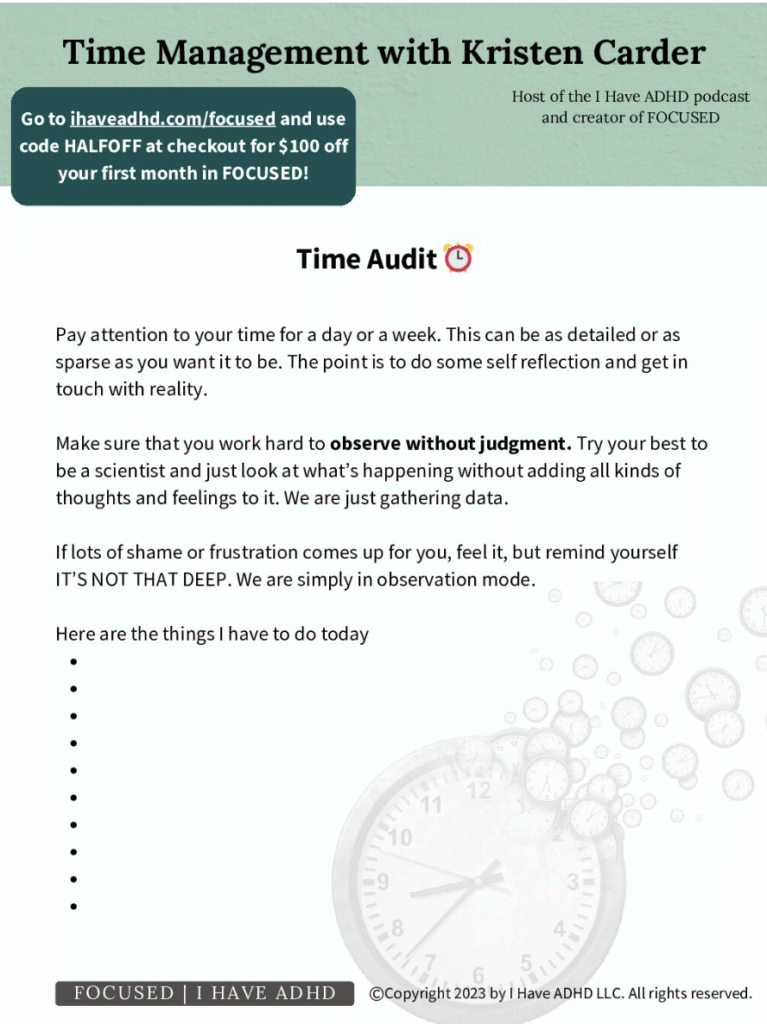
That’s awesome. We will link all of these things in the show notes, so if you’re listening and you’re interested, you can go check out the show notes. Jenna, it has been a pleasure. Thank you for your time, and just the just the well of wisdom that you have to offer to the ADHD community. I just appreciate you so much. I appreciate you. Thank you so much for having me. A few years ago, I went looking for help. I wanted to find someone to teach me how to feel better about myself and to help me improve my organization, productivity, time management, emotional regulation, you know, all the things that we adults with ADHD struggle with. I couldn’t find anything, so I researched and I studied, and I hired coaches, and I figured it out. Then I created Focused for You. Focused is my monthly coaching membership, where I teach educated professional adults how to accept their ADHD brain and hijack their ability to get stuff done. Hundreds of people from all over the world are already benefiting from this program, and I’m confident that you will too. Go to Ihaveadhd.com/focused for all details.