



Kristen Carder 0:05
Welcome to the I Have ADHD podcast, where it’s all about education, encouragement, and coaching for adults with ADHD. I’m your host, Kristin Carter, and I have ADHD. Let’s chat about the frustrations, humor, and challenges of adulting relationships working and achieving with this neurodevelopmental disorder. I’ll help you understand your unique brain, unlock your potential, and move from point A to point B. Hey, what’s up? This is Kristen Carter, and you’ve tuned into the I Have ADHD podcast. I am medicated, caffeinated, regulated, and ready to roll.
Welcome on in everybody. How you doing? How you doing? I hope that it is a beautiful spring day, wherever you are in the world. I am enjoying the sun and the warmth and all of the things that come with spring. I will tell you that I am just hanging on by a teeny tiny thread right now as I am trying to drag my senior son across the graduation finish line. We are so close, we are so close, and I’m tired, y’all. I’m tired. I’m finishing up my book. It is almost all the way done. I’m so grateful to have done this whole process, but, like, it is – it is not for the week, and I am – I’m feeling weak, I really am. But that’s fine. And, like, I said, we’re in graduation season right now, so I don’t really know when this episode’s coming out, but by the time it comes out, I think you will probably be graduating very, very soon, and so say a little prayer for me, because, oh my goodness, if you have a neurodivergent child that you have also had to drag across the finish line of high school, it’s like, oh my gosh, by the time I remember feeling like I don’t care about high school anymore. By the time I got to my senior year, I was like, Who cares? I do not care, and he’s there, that’s where he is. So we’re just trying to get through it. We’re just gonna, you know, sing the graduation song. It’s playing in my head, but I will not hum it for you. And it’s been an interesting experience, because instead of feeling really sad, like my friends are feeling very, very sad that their kids are graduating, I am feeling so much relief, because I know how much he hates school, I know how hard it’s been to get him to go to school and participate. I know that he’s just over it, and he feels like school is so fake, and you just have to pretend, which I agree.
And how many of us neurodivergent folks feel that way, where it’s just like this is so fake, and the system is so annoying, and I hate playing the game. And I’m sure if he were to go out into the corporate world, which he is not, thank God, but if he were, he would probably feel the same way, where it’s just like this is so fake, and I just have to like pretend all the time. He’s actually planning to be an EMT, and eventually a paramedic or an ER nurse, which I think is the absolute perfect career path for him right now. So that’s actually really exciting to be able to help him navigate that process, because he said to me the other day, “Do you know how many of my friends are going into finance? Finance is so boring, Mom, they’re gonna have to sit at a desk all day long. Why are they doing that? And I was like, “You’re right, dude, like, I’m so glad that that’s not the path you chose, because clearly that’s not the path for you. He’s like, I’m gonna be saving people’s lives. I’m like, I know it’s so great. I’m so, so, so excited for him. Sorry for the clapping, that probably doesn’t translate very well via audio, but I am just at the same time of being like, let’s just cross this finish line, let’s just like let it please, let us just get this done at the same time. I’m so excited for him to launch into the real world and be able to do things that he wants to do. So he did an ambulance ride along, he’s done a couple of them, and it’s just so fun to like hear his experiences, and he just has the best time, and he comes back, and he’s so pumped, and it’s just really that part is so fun. So, anyway, that was just a snippet into my life that I wasn’t planning to share today. What we’re talking about is how I would treat my ADHD if I did not choose to be medicated, or if I didn’t have access to medication, which I think is in 400 plus episodes, I’ve never actually talked about how would I do it if I did not lean on medication, because I know a lot of you listening either don’t want to medicate or you don’t have access to medication or you. Have access, but you’ve tried medications, and they just like the benefits don’t outweigh the side effects, so some of our bodies, right, just do not do well with the side effects of medication, and I think the statistic is that about 10% of us really do not do well with ADHD medication. It’s low, but still, there are those of you out there who have tried medications, and it’s just like it has not worked well for you at all, and the side effects have just been so extreme that it hasn’t been worth it for you to take it, which is totally valid.
So today’s episode is all about how would I treat it, how would I go about navigating my ADHD and supporting my ADHD if medication was totally off the table. So that’s where we’re going today, but before we get there, I want to let you know that if you are learning about ADHD, if you’re curious about ADHD, if you were just diagnosed or you were diagnosed years ago, but nobody really ever told you about ADHD. I have a resource for you called 10 Things I Wish My Doctor Had Told Me About ADHD When I Was Diagnosed. 10 Things I Wish My Doctor Had Told Me When I Was Diagnosed with ADHD. So you can find that resource at I Have adhd.com/10 things. It’s totally free to you, tons of information in there, like I said. If you’re new to this journey, if you’re curious about, like, ADHD, or maybe you were diagnosed, you know, as a kid, or as a teen, but nobody really explained what the implications are of having ADHD, beyond, like, yep, you struggle to focus, here’s some medication, which was exactly my experience, and I know a lot of you have the same experience. So, grab that resource, you can go to I have adhd.com/ten things to get it. Okay, so let’s talk today about how we can treat ADHD without medication. What would I do if medication was not an option for me? Either I don’t have access to care, I may be waiting for a diagnosis, I may be waiting, like I don’t have insurance, I can’t afford the medication, or I don’t want to take medication. Some of you are just like, I don’t want to put anything in my body, I don’t want to take medication, valid, or some of you have tried medication, but it doesn’t really feel good in your body, and so you’re like, nah, I don’t want to do it.
I do want to be really clear, obviously I’m a medication girlie, I, it has worked for me for years. I was on a stimulant for about 10 years, then I took a break while I was having my babies, and now I’m on a non-stimulant, I absolutely love being medicated. So, this is not anti-medication content, but you know we need to talk about if it’s not an option for you. What can we do? If medication is like putting on a pair of glasses for your brain, today we’re talking about how to function without glasses. Okay, I either can’t afford glasses, I don’t have access to glasses, I don’t want to wear glasses. How can I navigate my ADHD life without them? And I’m splitting up this episode into two separate parts, because we have to be really honest. We have to be really honest. Part one is, how would I treat my ADHD without medication if I had money to spend, because we have to be really honest about if you do have money, you’re going to have access to so much more help, so much more support, so much more scaffolding than if you don’t have money to spend, and in this economy, let us be honest, gas this morning when I filled up my tank was $5 a gallon, and I know it’s so much more than just gas prices, but like we are all feeling the pinch in the economy, some of us more than others, and so I just want to be really clear that I understand not everyone has access to additional cash to spend on supporting their ADHD lives, so that’s why I’m splitting this episode up into two completely separate parts. Part one, if I had money, here’s how I would treat my ADHD part two, if I didn’t have money. Here’s how I would treat my ADHD. So, if you’re, if you’re like, I do not have a single penny to spare on spending, you know, to support my ADHD, do not be frustrated with this first part. You can even skip it if you want to, but you know, maybe someday you’ll have money, so you want to listen to it, and, like, okay, in five years, in 10 years, here’s what I’ll work toward doing, but yeah, like, a lot of people are struggling right now financially, so many people, and so I want to be very, very, very clear that this is like a. Um, part one, if we have money, if we have additional money to spend, here’s how we can do it. And part two, if we don’t, it’s totally fine. There are still things that you can do to make your life better. Okay, so the number one thing I want to say, this is part one. If I had money to spend, if I had the resources, 100% I would stop trying to be my own executive function. I would start buying executive function support. I would hire a frontal lobe.
So, this is for those of you who have funds resources, start spending your money to support your frontal lobe. Okay, so this could look like hiring a cleaning service, hiring a laundry service, hiring a mill meal delivery service, like Factor or some other, some other service, hiring a personal assistant for, you know, opening your mail, paying your bills, making returns, helping you with your schedule, all of the admin tasks of life, going into your email, and making sure that you’re not missing graduation emails for your son, who is graduating in like two weeks, right? Okay. Additionally, a bookkeeper, a bill paying service, a professional organizer who’s ADHD informed, and I just want to speak to the thought, might be, yeah, but that’s all stuff I could do myself, that’s all stuff I should do myself, and a big part of this episode is going to be dealing with that shame that we bump up against when we are offering ourselves support for something that for decades we’ve told ourselves that we should be able to do, if you are diagnosed with ADHD, you should not be able to easily clean, do laundry, prep meals, do your mail, your returns, your bookkeeping, your organizing. No, you should not be able to do that easily with ADHD, or maybe at all, depending on how severe your ADHD is. So, if medication is not an option that’s on the table, and you have money, I beg you to spend it to outsource your frontal lobe, and if you need to send this podcast episode to your partner, who maybe doesn’t want to spend that money, and says, like, well, you are at home, why can’t you just clean, or you are at home, why can’t you just do the laundry, or we both work, and we should both be able to contribute to the bookkeeping and the, and the meals, etc. etc. You can send them this podcast episode. Listen, listen, this is significantly harder for someone with ADHD. The amount of executive function that it takes to clean, do laundry, prep, and like provide meals, even just groceries, stocking the pantry, having the right things in the fridge, being able to open mail, make returns, schedule things, go into emails, be on top. The amount of executive function that it takes is far greater than an ADHD or naturally possesses, and if you have the money, spend it on supporting yourself in these ways. Please, I beg you, it’ll change your life. It will change your life. Okay, in addition to hiring out your frontal lobe, we already know that exercise is a huge, huge, huge way to improve your ADHD symptoms. Okay, so exercise improves the brain’s functioning. I did an entire episode on this.
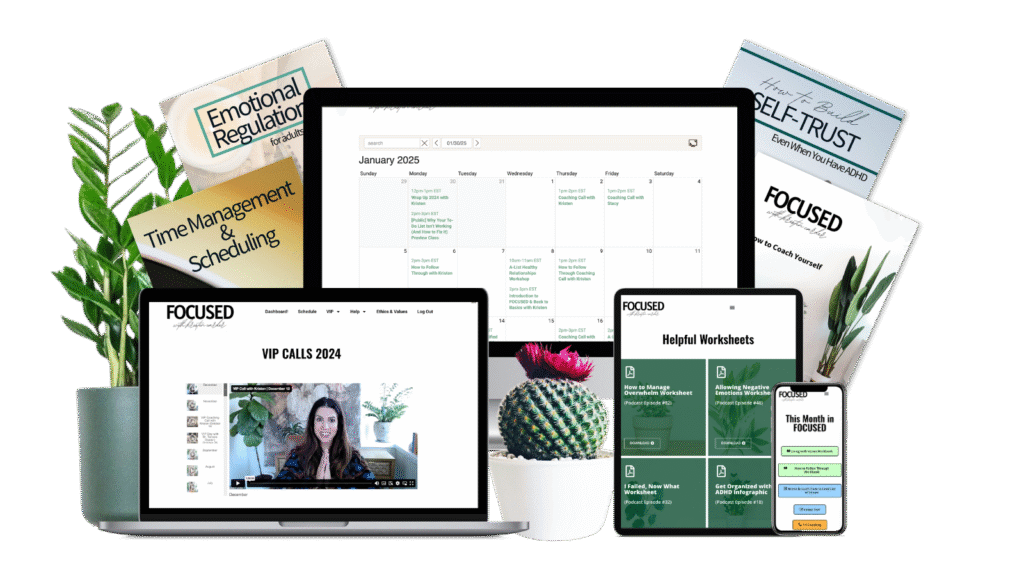
I don’t remember all of it, but I’m just referencing it here. That exercise is really, really important. What’s hard, though, for people with ADHD is to actually like do it right, we know in our brains that we should, that it’s helpful, that it’s going to minimize our symptoms, and yet it’s, it’s very hard to take the action to do it, and so this is where you are also going to spend your money, if you have it, hire a personal trainer, join like a gym that has scheduled fitness classes. Make sure that you have kind of like an appointment for your exercise. I’m not doing yoga anymore, because I think it’s given me actually a lot of neck pain, which is very strange. But when I would go to the yoga studio, and twice a week I knew, like, Mondays and Thursdays at 7pm this was my class time, and I would always go. I absolutely loved it. It changed my life. This summer I’m gonna join Orange Theory Fitness. I’ve already told.. I’m just so excited right now, my mornings like. My schedule is just surround, not surrounded. My schedule is taken over by my children. I have three school-aged children, 1716, and 12, and it’s just a lot. It’s a lot, and they’re all in activities, etc. You get it if you’re a parent, you get it. And so, like, going to the gym is very difficult for me, but in the summer I’m going to be joining Orange Theory Fitness. I’m going to be like going to certain classes, I’m going to be having a friend come with me. I’m very excited about this. So, external accountability are things that you can also pay for that are going to be really, really helpful, and a personal trainer or a gym with fitness classes is going to be huge in that way. Additionally, co-working memberships, or body doubling spaces, or standing appointments, like with a personal assistant, like, hey, every Monday at 10am let’s hop on Zoom, and we’ll go through my email inbox, like stuff like that, is going to be so helpful. ADHD coaching, com join focus.
If you have money to spend, com join focus, you will absolutely love it. Group coaching communities, accountability partners that maybe you will even like have some sort of agreement with, or maybe it’s just like actually an assistant that you’re paying. Either way, so incredibly helpful that external accountability is going to be everything for someone with ADHD. Okay, number three, this is again, if you have money to spend, you’re going to want to engage in services that will help you to learn how to regulate your nervous system and improve your relationships, but let’s talk about, let’s talk about regulating your nervous system first. So that’s things like engaging in therapy, engaging in some sort of nervous system regulation support, like breath work, yoga, meditation, massage, acupuncture, etc. etc. Okay, those kinds of things that you can pay for, breath work classes, guided medic meditation classes, like the things that are really going to help you to regulate that again. If you are a person of privilege, absolutely spend your money on this. This is the perfect way to spend your money if you are someone with ADHD. Additionally, we know that food, while it doesn’t cure ADHD in any way, supporting your body with nutrition can help to alleviate some symptoms, it doesn’t get rid of ADHD, but it can certainly improve and kind of minimize the the appearance of symptoms, and so working with a nutritionist who’s ADHD informed, making sure you’re on top of your medical care, if you’re in perimenopause, that you’re doing that, you’re working with someone, right? So something like MIDI Health, who’s not a sponsor of this podcast, but probably should be. Let’s just just put it out there, so that you are supporting your hormones in whatever phase of life that you’re in. You could also, like, hire a sleep coach, etc. etc. Okay, so like those are the things that you could really, really, really spend your money on to make your ADHD life so much better. Additionally, like hiring someone to come in and declutter and simplify your home, that is absolutely huge, because your environment does matter, and we carry so much shame about, like, our stuff, and um, just so to, so, like, have someone come in and help you, my goodness. And then, additionally, and a lot of this is free, and we’re going to be talking about it in the next part, but let’s say that your marriage is a real trigger point for your ADHD symptoms, so like you’re very overwhelmed by the relationship, and so you notice that you’re so much more dysregulated, or your ADHD symptoms really present themselves when your spouse is around, go to couples counseling, pay someone to help you improve your relationship, whether it’s with your partner, or maybe you do personal therapy, so that you can improve the relationship that you have with yourself, or maybe you do family therapy with your extended family, because you know that there’s a lot of trigger points there as well, so those are all the things that we could pay for to help us to manage our ADHD, and again, I know in this economy we’re having this conversation, but not everyone is struggling, not every single human is struggling, a lot of us are, but not everyone is.
And so I thought this would be a really great place to start, if you have money to spend. Let me write you a permission slip. Spend it, spend it on supporting your brain, spend it on supporting your nervous system, spend it on learning how to regulate, on on having scaffolding in your life that is going to help you to alleviate your ADHD symptoms, so let’s just review really quick. Hire out your frontal lobe, so that you’re not having to lean on your own executive function. Higher external accountability, like for fitness, or for your job, or for like some sort of assistant, or some sort of coach to help you. Okay, hire that accountability. Number three, hire someone to help you to regulate your nervous system. Regulating your nervous system will significantly decrease the presentation of symptoms of ADHD, so therapy, coaching, massage, etc. yoga, which I really miss. I miss doing yoga, and then hiring someone to help you to build a brain-friendly body, so nutritionists, medical professionals, someone that helps you with sleep support, etc. Okay, so these are the ways that we can spend our money if we have it to improve our ADHD, but what if what if we don’t have money? Well, if you’re listening, you’re like cool, cool, cool, cool, cool. That sounds great. I would love to get there someday, but I’m certainly not there right now, like I’m barely paying the bills, which I think is probably the majority. I think that’s probably the majority.
The majority of people right now, from what I can tell, are struggling, right? And it’s just like, okay, that sounds great, but like, how in the world am I supposed to do this? This I want to let you know that, like, it might not be as easy if you can’t just like hire a bunch of people to help you, okay? It’s not going to be as easy, but we are going to talk about foundational things in this part two. So we are in part two, we’re going to talk about foundational things that you can do for free to help you to regulate and lessen the impact of your symptoms. Okay, things that you can do for free, because not all of us have extra money to spend, and we still have ADHD, and we might not have access to medication, or we may choose not to be medicated. And so, how, how, how can I improve my ADHD? How can I improve my symptoms and build a better life for myself, but not spend money on it? Okay, so the first thing that I think is absolutely foundational, and it is free as far as money is concerned, but it’s not free, it’s not totally free, that it comes with the cost, and here it is. Improve your relationships, surround yourself with nice people, people who do not see you as the problem all of the time, people who are not going to blame you for everything that goes wrong in your home or at work, this I cannot overstate, is so important because ADHD is so closely connected to our dysregulated nervous system, where we feel unsafe constantly. We feel like we’re always going to be getting in trouble, that we’re always the problem, that somebody is, we’re just one misstep away from getting yelled at or getting punished, or etc. It’s getting rejected. So I’m just like pausing here. It’s just like I’m so overwhelmed with how important this is. This is the foundation of the book that I am writing. It will be out in October, but it’s not out yet. So, let me just say that this is so important, and it is monetarily free. Make sure you are around safe people, and by safe I mean kind, I mean consistent, I mean they’ll hold you accountable without shame, because you’re not a perfect person, obviously, you’re going to need to be held accountable sometimes, but they’re not going to shame you when they hold you accountable, they’re going to see the good in you, they’re going to, they’re going to make sure that you know that you are loved no matter what, and from those people you’re going to ask for help, okay, that’s also free, but again, it’s monetarily free, but it comes at a cost, right? Because we have to be vulnerable, and we have to say, ‘Hey, I can’t do this on my own. Hey, I need to set a limit here. I’m not.. I can’t actually be in charge of the food. For the home, because it takes too much executive function from me, and I’m drowning, so I’m gonna need to ask you for help, partner. We’re, we’re gonna need to work on this together, because I can no longer be solely responsible for this. I mean, imagine, and guess how much money? That costs zero. It costs nothing. I know it’s costly, but it costs no money.
And then let yourself receive the help I deserve help. I am a great person. I have a lot to offer this family, I have a lot to offer this relationship, I have a lot to offer this workplace, and I will need some specific help. I want to encourage you to reduce the time that you spend with people who drain you and dysregulate you. If you notice that when you spend time with a person, and then you need to recover afterwards, giant red flag, reduce the time you spend with them. Again, weigh the cost of how much the relationship is taking from you, how distracting it is, how much energy and brain space it takes from you. That kind of steals the little attention that you have that you could be using to move your life forward. Notice if it’s stealing that from you. Okay, learn your needs and communicate them clearly. Again, this is like a whole chapter in my book. I’ve talked about it on this podcast before, but understanding what your needs are, like, hey, I’m not really good at xyz, I need you to step in here. When you’re in a partnership, that should be a safe place to communicate needs when you’re in a best friendship. That should be a safe place to communicate needs with a parent. Hey, parent, I need your help. Do you have the capacity to help me?
That should be a safe place to communicate needs. If it’s not, why isn’t it safe? I can’t answer that question for you, but that’s something that needs to be kind of unraveled. There some other free things that you can do: make sure that you get sunlight every day, preferably in the morning. Getting outside in the morning is going to reset your circadian rhythm, which for many of us ADHD years is completely off. It will help you to sleep better at night. Guess what is free? Sunshine. Make sure you’re getting it every single day. Make sure number three, you’re moving. This is non-negotiable. You’re moving every day. Guess what’s free? Moving your body. You can go for a walk, you can do a YouTube workout, you can dance in your kitchen, you can go for a bike ride, you can go swim in wherever, go swim, like do something that moves your body in a way that you enjoy, but move your body every day. We’re not chasing fitness, we’re not chasing a body that looks a certain way, we’re chasing dopamine and regulation. Okay, we’re looking for those endorphins, and we need them every single day, especially if medication is not an option for you. Guess what else is free? Nature, and it is so regulating to your nervous system when you get your body into nature. This is free medicine. Going for a walk in the woods, putting your toes in the grass, laying on the ground, hugging a tree, sitting outside on the porch, any way that you can get into nature is a great natural free way to begin to regulate and calm down your nervous system. Bonus points if you’re not on your phone, like, major bonus points if you’re not in your phone. Bonus points if maybe you stack these habits. I’m doing, like, I’m crossing my fingers there. I’m like, if you connect the habit of, like, okay, I want to move my body and I want to get out in nature, guess what I can do? I can go for a hike in the woods for free, okay, I love doing that. I love kind of killing two birds with one stone, so to speak, and moving my body and getting into nature at the same time. I think it’s extremely grounding and resetting and absolutely wonderful. Another thing that I highly recommend is journaling your thoughts totally free. If every day, which I know is like impossible, when I say every day, you’re like, Kristen, don’t say that. Okay, I’m sorry. As often as you can, preferably every day. If you could dump out the contents of your brain onto paper, and it doesn’t need to be precious, it doesn’t need to be cute. You don’t need to save it. This is not a memento. This is just slowing yourself down with the action of writing out your thoughts and just dumping out the contents, clearing all of the clutter from your brain every day, clearing it out, out, out, out, out. And then doing a little bit of self inquiry. How do I feel? Why am I feeling that way? What’s one thing I can do to support myself today? Just simple, simple, simple, and totally free will change your life. Another great question, what am I avoiding? Great question to just write, write, write, journal, journal, journal. What am I avoiding? And then maybe a follow-up. Why am I avoiding it? What am I scared of? What do I think will happen if I do this? Why? Why am I avoiding it? This will change your life. Like I said, this is not like the lesser version. It may be a little harder, but it’s not the lesser version. You can change your life without spending money. You absolutely can. Another thing that I am realizing.
Okay, I’m 45 I’m realizing how important it is for our bodies to have food and water regularly, like very regularly: breakfast, morning snack, lunch, afternoon snack, dinner, evening snack, like, so important, and our brain needs the fuel of food, so it’s not just for your body, it is for your brain. I want you to think about eating for your brain. That doesn’t necessarily mean you have to eat healthy, you don’t have to go eat a salad, but you do have to eat something. Fed is best. Food is not moral. There are no good foods or bad foods. You just need food. Right before recording this podcast, I ordered a pizza. It’ll be here in 15 minutes, and, and I had a delicious combination of orange juice and nerd gummy clusters, because I was feeling it had been like four, almost four hours since I’d eaten last. That’s really my max. Um, I’m learning that that’s my max, like the longest time that I can go without food before I start to get shaky, distracted, dysregulated, hangry, and eventually I get a headache. Interesting, right? But if I can just get myself to eat regularly, I really like to eat every three hours, but today that did not work out, so it was four hours for me this morning. If I can get myself to eat regularly, then I don’t deal with that distraction, that sugar crash, that shakiness, that distract.. I already said distraction, sorry, headache, all of that. Okay, so eat regularly, drink water or lemonade or something that’s going to fuel your body, and if you need to set alarms to eat, do it, do it, set the alarm, set the reminders. What I will often do, especially on a weekend, when there’s like not a set schedule, is I just use my husband as a body double, so whenever Greg eats, I eat. It doesn’t matter if I’m hungry or not. He’s a relatively healthy guy. I know that he’s eating like he’s just very systematic, and he just eats at regular times every day, so when he eats, I eat, no matter what, because I want to make sure that I’m fueling my brain and that I have access to all of my resources. Okay, you, a big thing with this is, like, you can’t hate yourself into functioning better, you just can’t, so so much of these recommendations that I’m making is really about liking yourself and giving yourself the fuel and the support that you need to function well, so often we blame and shame and judge ourselves, and we withhold the very things that are going to be helpful to us to minimize our symptoms. Can we stop? Can we just not? Can we just actually start enjoying ourselves? Maybe not. Okay, maybe enjoying is being it’s taking it too far. Could we just maybe start with something neutral, like I’m a person and people need food, I’m a person and people need sleep, I’m a person and people need sunshine, like just because I’m a person, not because I’m special, but I’m just a person.
Can we start with, like, very neutral. I don’t hate myself, I’m just a human, and humans need food every couple hours, so I’m going to eat every couple hours. Okay, we’re not going to hate ourselves into functioning better. We actually just need to accept our humanity and the things that are going to help us to live the lives that we want to lie. Let’s try that again. Live the lives that we want to live. All right, these like this you’ve heard a million times in a million different places, but like structuring your day, doing your best to structure your day is going to be helpful, and it is free alarms, timers, written plans, visual schedules, etc. etc. I know we suck at that stuff most of the time, but like, could you get creative with it? Could you have a huge calendar? Could you do it with sticky notes? Could you bedazzle your planner and make it pretty? Like, how can you do this for you, so that you can structure your day in a way that makes sense for your brain, not for a neurotypical, but for your brain. Okay. And lastly, well, not lastly, lastly, almost lastly. How about that? Number eight, we gotta get more sleep, we just do, and this is a pain point for a lot of us, but lack of sleep will significantly increase the presentation of our ADHD symptoms, and getting enough sleep will help to decrease the presentation of symptoms. It doesn’t mean it cures ADHD, but you all know that you have days where your symptoms are just off the chain, and then you have other days where your symptoms are just like, okay, like I have ADHD, but I’m getting the things done. Sleep has a lot to do with that. Okay, so what we’re looking for, the ideal would be like same bedtime, wake time every day. This would be ideal, something to work toward reducing stimulation at night, figuring out some sort of like winding down routine that works well for you. So, for me, it’s like when my son gets ready for bed, I get ready for bed, and then I’m already all, I call it jammed up, I’m already in my jammies, faces already washed, contacts are out, glasses are on, teeth are brushed, everything is done. So that when 10 o’clock comes, I don’t have to go, “Oh, I don’t feel like changing my clothes, I don’t feel like brushing my teeth. It’s just like it’s already done. I go to my bed, I listen to little podcasts while I play Block Blast. Or right now I’m listening to an audio book. I’m listening to Matthew Perry’s audiobook, which I’ve already read, but I need something to fall asleep to. And then after about 30 minutes of just like listening to an audio book and playing Block Blast on my phone, then I roll over. Podcast still going, because I don’t really like to be with my thoughts. I mean, I do, but not at night. Do you know I’m saying I need something to distract me, and I fall asleep listening to an audiobook.
It’s so beautiful. Oh, I do take two milligrams of melatonin as well, as well. Okay, I’m gonna.. those are all amazing, wonderful free things that we can do. Okay, the last thing that I’m going to talk about is something that I’ve been thinking about. I want to do a whole podcast episode on. I’m really scared that people are going to be angry at me for it, so I’m just going to tuck it away in the very last couple minutes of this podcast episode, and hopefully we’re not going to make anybody angry, and if we do, say lovey sometimes, that happens, but I do want to talk about stimulants that are over the counter that can be helpful for people with ADHD. Obviously, we know caffeine is very helpful, and does it come with some risks? It does. Is drinking too much probably not good for us, sure, but is it helpful? Yeah, it is. Caffeine can be really helpful. So, if you are someone who is not treating your ADHD with medication, it’s okay to lean on something like caffeine to act as a stimulant at different points of the day to get your brain activated. Another thing that I have been looking into is using nicotine, and a lot of people have mixed feelings about this. Some people think nicotine is amazing. It is something that indigenous people have been using for 1000s of years, it’s medicinal, etc. etc. Other people are like, it’s so addictive, it’s going to cause cancer, etc. etc. I’m just going to say this, the delivery system of nicotine matters, obviously. If you are smoking cigarettes or vaping, that is extremely destructive. Obviously, however, if maybe you were to wear a nicotine patch, if just a very slow delivery system, it’s possible that you might feel the stimulant effect without the addictive effect. There’s differing things out there online, of course. Everything is like nicotine addictive, nicotine is addictive. What’s very interesting is that the delivery.
Delivery system does matter, so when it is slow released through a patch, it is a very different delivery system than, for example, smoking, vaping, gum pouches. I’m just going to throw this out there as a very, very cost-effective way to use a stimulant without a prescription, you can think for yourself as an adult and decide what you think is best. I do want to do an entire episode on nicotine eventually. Some people will say, like, it’s so addictive, it’s so addictive, like, don’t do it. In my opinion, especially in patch form, what I have observed is that it can deliver nicotine at a slower rate. It is much less addictive, if at all, and it is not like causing cancer, and again, you can do your own research on this, but it’s not causing like severe addiction, of course. We know that, like, cigarettes, vaping, highly, highly addictive, even pouches and gum can be addictive as well. But I just want to throw out nicotine as, like, if you are floundering, if your symptoms are just making it so that you can’t live, you can’t function, you can’t work, you can’t get anything done. Is it possible that a simple nicotine patch that maybe you just wear for like 12 hours a day and not overnight could be something that would be helpful? Question mark, just something to consider, something to research, something to go into forums and look at, something to look online. I’m just throwing it out there as an idea. Eventually, I will get brave enough to do an entire episode on it, because I do think that, especially for people who don’t have access to stimulant medication, it may be a useful tool. It may be a useful tool. Talk to your doctor if you want to talk to your doctor about, talk to your doctor about it. This is not medical advice.
This is just like throwing it out there as, hey, people have been using this for 1000s of years, it might be something worth looking into. Okay, so for those of you who are like, girl, you talk about medication in every single episode, medication is not an option for me, I’m annoyed. This episode is for you. I hope you found it extremely helpful. What to do when you have money, what to do if you don’t have money? Maybe you, maybe you do a combination of both. I love that for you. Let me know what you think. Leave me a comment. Tell me the things. I love engaging with you guys, and I cannot wait to talk to you next week. Bye bye. A few years ago, I went looking for help. I wanted to find someone to teach me how to feel better about myself, and to help me improve my organization, productivity, time management, emotional regulation, you know, all the things that we adults with ADHD struggle with. I couldn’t find anything, so I researched, and I studied, and I hired coaches, and I figured it out. Then I created Focused for You. Focused is my monthly coaching membership, where I teach educated professional adults how to accept their ADHD brain and hijack their ability to get stuff done. Hundreds of people from all over the world are already benefiting from this program, and I’m confident that you will too. Go to Ihaveadhd.com/focused for all details.