

Kristen Carder
Welcome to the I Have ADHD podcast, where it’s all about education, encouragement, and coaching for adults with ADHD. I’m your host, Kristin Carter, and I Have ADHD. Let’s chat about the frustrations, humor, and challenges of adulting relationships working and achieving with this neurodevelopmental disorder. I’ll help you understand your unique brain, unlock your potential, and move from point A to point B. Hey, what’s up? This is Kristen Carter, and you’ve tuned into the I Have ADHD podcast. I am medicated, caffeinated, regulated, and ready to roll. How are you? How are you? Get in here, get cozy, grab a snack, grab a drink. I know that you’re multitasking right now, that’s totally fine.
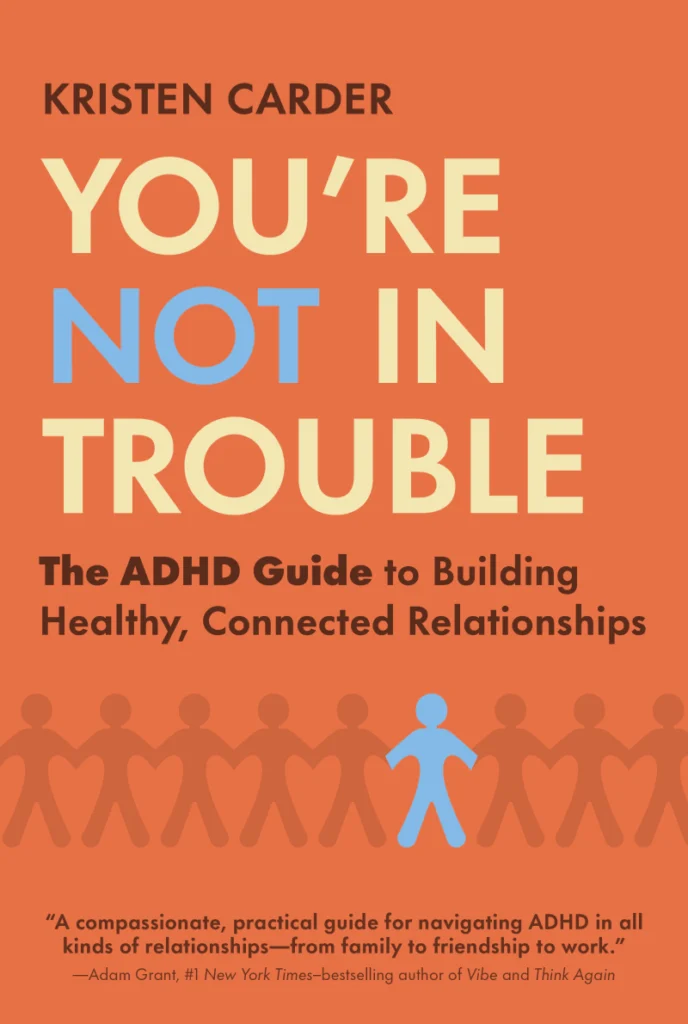
I am so glad that you press play on this podcast. We are going to have a time today, that’s where we are gonna have a time together. ADHD, ers unite. I have so much information to share with you, and I’m really looking forward to this discussion, because, as you know, I’m writing a book, and I’m almost done, guys. In like two or three weeks, I will be announcing the title. It will be ready for pre-order. We are in the copy editing phase right now. I’m sending out and requesting endorsements. And can I tell you, the people who are saying yes to endorse the book, which means they get an advanced copy of the book, they read it or skim it, and then they write a little blurb that’s like, this book is amazing, you should definitely read it, or whatever. The people that I’ve asked are all saying yes, and these people are giants, giants in the ADHD field, giants in the psychology field. I am just blown away. I just feel like, how is this happening? I’m so excited and so nervous, and it’s such a mixed bag of emotions, because on one hand, I’m just like, yes, this is exactly what’s supposed to happen. I know this book is going to change so many lives. If you don’t know, if you’re just like tuning into the podcast for the first time, you’re like, what the hell are you talking about? Forgive me. Let me give you just like a 15 second explanation. So, for the last year, I’ve been writing a book on how to help ADHD adults improve their relationships. What we’re looking for are healthier and more connected relationships, and I know from coaching 1000s of people with ADHD that relationships are one of the biggest pain points for people with ADHD.
They just are. We struggle in our relationships, we struggle to feel seen and valued and heard. We always feel like we’re getting in trouble, we’re walking on eggshells, we’re always the problem. And I want to make a difference in this area of the ADHD experience, and so for the last year or so I’ve been writing a book. I’ve reached out for endorsements, and people are saying yes. Like, when you eventually find out who is saying yes, you’re gonna be like Kristen, how are people of this caliber willing to endorse the book. Great question, great question. I’m just like, wait, what? Let’s just say, like, people whose books that I’ve read that led to first my dad’s diagnosis and then my diagnosis, like the people whose work I’ve studied over the last 15 years to gain experience and authority in the field of ADHD. Those are the people that are saying, ‘Sure, yeah, send me a copy, I’d love to read it and endorse it for you. Oh my gosh, this is not a drill, people. This is actually happening. So, like I said, it’s early June right now, when you’re listening to this episode, and around mid-June, we’re going to be able to announce, and that means title, cover, pre-orders, all of the thing, and then the book will be out first week of October. So, get ready, y’all, buckle up for an emotional roller coaster with your BFF, Kristen Carter, because I am freaking out. Like, I, it’s one thing to write the book, it’s another thing to have it in people’s hands and have them actually read it. I have shared within this book so many personal stories, so many personal moments, so much of my own vulnerability, and I know I’m not doing a YouTube right now, so nobody can see me, but I am. I’m literally covering my entire face just at the thought of this being in your hands and you reading it or listening to the audiobook, which I will be recording. I just can’t, I cannot. So it’s gonna be a very interesting point of growth for me, because y’all, this is happening, it’s. So for the book, because I wanted to make sure that it was a really robust experience, a really robust read, and that I wasn’t just pulling things out of thin air, like I’m not just like pretending to know things that I don’t know. I wanted to conduct a research survey. The reason that I wanted to do this was because after coaching so many people with ADHD and hearing their stories over and over and over and over, it felt very much to me like we all share a similar experience in childhood. That’s what it feels like. It feels like, like, did we all grow up in the same household? Did we all have, like, such a similar experience is so interesting, and so I developed this working theory of, like, I feel like people with ADHD were really misunderstood in childhood. I feel like people with ADHD were rejected a lot, and there’s already research on the rejection piece.
I feel like people with ADHD never really had their needs met or just really felt like they weren’t heard, and that, like, emotional regulation within families wasn’t really a thing, and so I just, I wanted to gather more information, because what we know about relationships is that we are handed a relational blueprint from our community and family, when we’re a child, like our caregivers are who create this emotional relational blueprint for us that we then bring into our adult relationships, and so my working theory has been that the blueprint that we’ve been handed, I think in the book I say, like my blueprint was created by what did I say, something like architects on an acid trip or something like that, like my little relational blueprint is a little bit effed up, and I wonder if you feel like yours is too, like yeah, I don’t really know if I got what I needed, and that doesn’t mean that we want to blame our parents or that we want to shame anybody, or that we want to, like, I’m going to call them up right now and tell them that they didn’t give me what I needed. That’s not it at all, but I think I don’t think I know that understanding your own wiring and how you were put together and how your relational patterns were created is going to be so helpful for you in adulthood to like take a look under the hood, understand your wiring, and then be able to kind of recreate that wiring in a more healthy manner. That’s what the entire book is about. If it feels heavy, it is a fun read, I promise.
It’s not all heavy, there is heavy stuff in there, but it’s a fun read too. So, in writing the book, in prepping for the book, in just kind of trying to figure out, like, how can I speak with authority about our childhood experience without really serving adults with ADHD, I didn’t feel like I could, and so that’s what I did. I worked with a former client who had been in focus for years and years, and I knew that she was a researcher, she’s a psychologist and a researcher and a professor, and so I hired her as a research assistant, and she’s been helping me so much throughout the book. When you read the book, all of the footnotes, all of the research, every every single footnote, and there are a lot, or thanks to my research assistant, Jacoba Lilias. So, shout out to Jacoba. Love you, appreciate you, appreciate the contributions you made to the book, and she helped me design this survey in a way that would be ethical and understandable, and really a robust reflection of, you know what the survey responders said, so if you listened last summer, you probably heard my pleas, for like, hey, could you take the survey, could you take the survey. We ended up having 2174 adults with ADHD respond to the survey, so that’s incredible. That is like a large, that is a, that’s a large group of people. I feel really proud about that, because we’re not just like, hey, here’s what 20 people said about their childhood. No, there’s over 2000 adults with ADHD who responded, and I want to walk you through the survey. I just thought it would be really interesting, not all of it made it into the book, because do you know that they make you only write a certain number of words, so I submitted 86,000 words. When I sent in the first draft of the manuscript, I had 86,000 words, and they, my editor, came back to me and said, this is great, but we need to get you down to 75,000 words, so I did cut 11,000 words. I think actually we may be more at like 77,000 but like still they made me cut a ton, so not every single part of the survey was able to be included in the book itself, so I thought it would be. Really fun to go through it with you here. If you’re listening to this episode a couple weeks or a couple months or a couple years after its original publication date, you can go to I Have adhd.com/book to purchase the book, learn more about the book, etc. So I have adhd.com/book I can’t even say the title yet.
I can’t even say the title yet. Two weeks, guys, two or three, two or three weeks. We are waiting. You’re getting such an ADHD version of me today. Let me tell you, when I am in the studio recording like a professional, I am so much more put together. But today I’m in sweatpants, no makeup, chilling in my bedroom, and just like yapping away with you. So, hopefully you love this version of me. What I was saying is that we are waiting on the cover design, so once we have the cover design, then we can finally announce and do all the things. So, I have adhd.com/book if you’re listening after the fact and want to go find it. Okay, so I wanted to take you through this survey. I thought it would be really fun to chat about the results and let you know kind of like what the responses were. I’m curious to hear from you if you resonate, how you would have responded to the questions. It’s really fascinating, and some of it is just a little bit sad, or actually a lot sad. I think that our childhood experiences were tough, and so I just want to like hold you in that, give you a big hug in that.
If you are kind of waking up to the fact that, like, your childhood experiences, which shape your adult relationships, they were really tough. They, you probably didn’t really get what you needed, and neither did I, and that’s okay. That’s okay. We can make changes now, but I just kind of want to warn you that it might be a little bit hard to hear. Okay, so let me tell you a little bit about who took the survey, just so that you can get a feel. I’m going to breeze through this part as fast as I can. Everybody was over the age of 18. Most people sat between the ages of 25 and 54 and then there were a handful of older adults, which was wonderful. As far as gender in the responses, it was predominantly a female audience. I’m not sure why I assume that probably my listenership I’ve always estimated is about two thirds female, 1/3 male, and that’s the same and focused as well. But additionally, I think that women are just maybe more inclined to take a survey like this, so we had about 18% male, and then the rest were female, and most were formally diagnosed with ADHD. So, 75% were formally diagnosed somewhere in the process, and then about 17% were self-diagnosed. But everyone identified as being ADHD. I did ask when they got diagnosed, and just one little snippet that I wanted to share is that only four and a half percent were diagnosed under the age of 12. Most of us in the world right now are being diagnosed as adults, so we’re not having the luxury of having our symptoms understood as children, and that is a really key point, and it’s a key point in the book too, is that, like, we go through our childhood, most of us being misunderstood, partially because we are not diagnosed, and so nobody understands where these symptoms are coming from. Okay, so let’s get into the results of the survey. I’m going to share with you the questions I ask, I’m going to just percentages and all of that, like responses can feel annoying, but I just, I do think that this is going to be really important information. I will try to make this as listener-friendly as possible. The first question that I asked was, as a child at home, and listen, these aren’t questions, these are statements, and then people are responding with I never felt like this, I felt like this, but rarely. I felt like this somewhat frequently, or I felt like this very frequently. Okay, so I present a statement, and then the responder reacts with how they felt at the time. Okay, so I wanted to get a snapshot of our childhood as a child at home, I struggled to ask for what I needed, and I wonder how you would answer that question. I struggled to ask for what I needed. Let me tell you that 49% said I felt like this very frequently. 49% I struggled to ask for what I needed. Oh my god, and 31% said I felt like this, like somewhat frequently. So either very or somewhat frequently is like 80% of people. Isn’t that wild, that to me? Even just right there, I could do a whole podcast on the fact that. We struggled to ask for what we needed. Now let’s ask why. Why did we struggle to ask for what we needed? I have a question for you. Did your parents ever ask you, “Hey, what do you need? Is there anything you need right now? Because mine didn’t, and as a matter of fact, it was really the opposite for me. It was more like, what do you need? Why do you need me? What is going on?
You’re so needy, right? I have a whole chapter in the book on needs, on our needs, because I’ve seen this in my coaching clients, I’ve seen this in myself, and actually it’s one of the things that Greg and I have fought about a lot, is that I struggle to identify my needs and ask for them to be met. I will always default to being hyper independent, which is not super great in a marriage. It’s not super great, and keep in mind the way that our childhood relationships are in our past, they either form or deform our current relationships, right. So, as a child at home, I struggled to ask for what I need. Almost 80% said yup, either always or frequently I struggled to ask for what I needed. Okay, next statement. As a child at home, I felt like I could be myself without worry of judgment or punishment. How would you answer that? As a child at home, I felt like I could be myself without worry of judgment or punishment. Woo, so the survey responders, about 60% said I either never or rarely felt like I could be myself at home without worry of judgment or punishment. So I want you to think about 60% of us growing up in a home where we were likely walking on eggshells, worrying that I was going to be judged or punished for the way I acted, for resting when I maybe my parent thought I shouldn’t, for just like existing in my own home. 60% said I never or rarely felt like I could be myself without worry of judgment or punishment, and I wonder how you might kind of make the connection now to your adult relationships. Okay, if I felt like that in childhood, is that informing the way I show up now in my adult relationships? Next statement, as a child at home, I felt like my voice was heard and valued, I felt like my voice was heard and valued. 69% said nope, nope. I never or rarely felt like my voice was heard and valued. So, how hard does that make it now for us to show up in our adult relationships feeling like we have a voice, feeling like we have something to say, feeling like we should be heard and understood. Whoo!
Okay. Speaking of being understood, next statement. As a child at home, I felt like the people around me didn’t know me or didn’t understand me. This one gets me. This one really gets me. Almost 80% almost 80% of survey responders remember 2174 adults with ADHD took this survey. 80% said I either frequently or somewhat frequently felt like they don’t understand me in my own home, I’m not understood, and the neurodivergent experience of being misunderstood is excruciating, and I know that you feel that now I know you do, because I’ve coached you, I’ve talked to you. I feel like our experiences, while very unique within our own ADHD worlds, we share so much as a neurodivergent community, and part of what we share is the absolute loathing of being misunderstood, and I wonder now, in your adult relationships, how that might feel for you. Do you feel understood by the people closest to you, or are you still in relationships as you were in childhood? And I’m making an assumption here, so maybe you’re like, no, I’m part of the 21% that did feel understood at home. Okay, that’s great. I love that for you. I’m so happy, so happy. But if you’re part of the majority who’s like, “No, I don’t feel understood. Do you feel misunderstood now? Are you still kind of living out that type of relationship dynamic now? Now, in your adulthood, this is what I want my book to solve. I want us all to feel understood in our relationships. That doesn’t mean that we’re perfect, it doesn’t mean that we’re never held accountable, it doesn’t mean that you know when we mess up, we don’t take ownership for it. But do you feel understood? My gosh, okay. One of the things that I learned in writing this book, and I didn’t know it, but I had never read the research behind it, is that one of the primary jobs of a parent is to help their child learn how to emotionally regulate. Did you know that? Did you know that it’s actually a primary job of a parent to co-regulate with their child, so that the child learns how to emotionally regulate themselves. So, I wanted to ask this question, as, or actually, again, it’s a statement, but to see if people agreed or disagreed. As a child at home, my caregivers made space for my emotions.
How would you answer that question? I will tell you that 75% of responders said I never or rarely had this experience with my parents, that they made space for my emotions. I never or rarely felt like my parents made space for my emotions. The beautiful 5% of people that responded to say, like, yeah, that was something I experienced. I’m so jealous of you. That’s 120 people out of 2167 responses for this, for this particular question, amazing. If you’re in that 5% minority, I am so jealous. That’s amazing. Amazing. Next one is about emotional regulation again. As a child at home, like I just wanted to say it, like point blank, my caregivers helped me to regulate my emotions. 57% said no. never, never, they never helped me to regulate my emotions. So I want you to think about the fact that ADHD travels in families, that most of our parents are neurodivergent of some kind, they probably never learned to regulate their own emotions, and then they were never able to help us regulate our emotions. An additional 31% said I rarely experienced it. So 88% of us never or rarely were helped to regulate our emotions in childhood, and that is one of the primary roles of a parent. Y’all, I just cannot with these findings. Like, I knew it again. It’s like I wanted to do this survey to kind of prove what I already knew. And then I was kind of like, oh gosh, maybe it’s going to disprove everything that I suspected, all of my theories about our childhood. It’s very possible that this research survey is going to disprove everything I thought, right? Because I’m talking to all of you, I’m hearing from you on Instagram, I am hearing from you in podcast reviews and comments, I’m coaching you and focused, and I’m hearing over and over in these conversations that I have with ADHD, or on the daily, that you know, emotional regulation is a big issue, like all of these issues that we have, and then we chat about your childhood, and I hear how you were treated in childhood, and I’m like, gosh, this is extreme, this is extreme, and to be able to see in black and white that 88% of us rarely or never were helped to regulate our emotions. I mean, no wonder emotional regulation is a huge thing in the ADHD community.
No wonder it’s absolutely wild. All right, do you need to take a deep breath, because I know that this can be heavy. This can be heavy. I also wanted to ask questions about people’s experience at school, and I’m not going to go through all of them, because this can get a little like laborious. But one question that I thought was really interesting was, as a child, I felt like I could be myself without fear of judgment or rejection from my peers, so I was interested in the home experience, but I was also interested in, like, the social school relational experience for us as kiddos, and 75% said I never or rarely felt like I could be myself without judgment or rejection, so like again making the connection our childhood relationships form or deform our current relationships. Okay, wow, wow. If 75% of us felt like we were always on high alert for judgment and rejection. How is that playing out in our current relationships, and how do we fix it? That’s the, that’s the question, that’s the question that I want my book to solve, right? How do we fix this, because our wiring, our relational blueprint, the way that we were brought up and raised and shaped relationally is obviously playing a role, playing a part, having an influence on how we are relating to each other, to other adults, to our peers and our coworkers and our spouses and our even like our kids or our parents, like how do we take that wiring and heal it? How do we make it so that we can have healthy and connected relationships moving forward? Oh my gosh. Okay, I did a couple questions about rejection. None of them are going to surprise you. Most people felt rejection more often than their peers. Let’s see, 60% of us felt like we were rejected more often than our peers. That is not surprising. And there is already research on that, which I included in my book.
There’s, there’s a pretty robust body of research on the rejection experience of ADHD kids in childhood, which is I am so appreciative of, and like more, please, more research, more research on our childhood experiences. Por favor. Okay, so let’s move from the childhood experience to like the adult experience now. How are we experiencing things now as adults? So I love this question because it directly correlates with the childhood question, and again, it’s not a question, it’s a statement. I keep calling them questions. Please forgive me. Okay, this statement is, I struggle to identify my needs in relationships. What’s your answer to that? What’s your answer? I struggle to identify my needs in relationships. I will tell you that 75% of people said yup. I either somewhat or very frequently struggle to identify my needs, and I will raise my hand and like so high in the air right now and say same. This is something that I worked on very intentionally to be able to understand what are my needs, who’s good at meeting my needs, how can I meet my own needs, how can I connect with people who are willing to meet my needs. This is a big part of improving our relationships, is understanding who has the capacity to meet our needs, and who doesn’t, and can we please stop going back over and over and over to the people who are just unwilling or unable to meet our needs. It doesn’t mean we can’t be in relationship with them, but we need to shift our expectations. You know, I’m saying a big part of being healthy and connected in relationships is knowing how to set reasonable limits and boundaries. I have a whole chapter in the book on boundaries and limits, and this is one of the hardest things. This is one of the hardest things, and I know it is because we feel guilty, and this is something that we can talk about, absolutely, but one of the hardest things in our relationships as adults, like, we still feel like kids, like we’re not allowed to say no, like we’re not allowed to set a limit, like we’re not allowed to say, like, yeah, that doesn’t work for me, we have to be people pleasing, and we have to be saying yes, and we have to be saying, like, sure, I’d love to do that, when, like, we’re dying inside.
This is a big reason why we over promise and under deliver, is because we want to say yes, and we want to be agreeable, and we usually genuinely like the person, and we want to help, and we want to make them happy, but we forget that we’re just a person, we forget that we’re human, we forget that we have limits, that we don’t have endless capacity, and so we often really struggle to set limits, but the people that we love the most, only 8% said no. I never, I never struggled to set limits with people in my closest relationships, without fear of rejection, I never struggle with it. 8% of us, on the contrary, 70% said yup. I absolutely struggle to set reasonable limits with the people in my closest circle without fear of rejection. And let me, let me just hone in on this point, the people in my closest circle, the people who know me best, who love me, maybe with my partner who’s like committed their life to me, or with my parents, who you know I love. Actually, I have a question specifically on setting limits with parents, and we’ll get there in a second, but I struggle to set. Limits with the people in my closest circle without fear of rejection. Yeah, most people said yes. Most people said yes. Isn’t that wild? Oh man, wonder why we’re struggling in our relationships. We can’t set any limits. We can’t say no. Here’s the next one. When there’s friction in my relationships, my default is to feel like I’m the problem. Listener, I want you to sit with that for a second. When there’s friction in my relationships, my default is to feel like I’m the problem. This is one of the like the highest numbers here, 50% said very frequently, absolutely raising my hand in the air, waving it like I just don’t care. Yes, I feel like I’m the problem when there’s friction, it’s my fault. An additional 33% said I feel like this somewhat frequently, so that’s 83% of people saying, yup, that’s usually what happens. There’s friction in the relationship, and I, my brain goes, this is your fault, this is your fault, you’re the problem here, you need to fix it, you’re going to get rejected.
Gosh. I just hate this for us. I don’t know if you’re feeling big feelings. Maybe it’s just because it’s my special interest. Maybe it’s because of, like, the relationships that I’ve built with all of you. Maybe it’s because I just.. I feel like.. I mean, I’m only 45 so you may even be older than me, but I feel this like massive mama bear energy. When I read through this survey, I want to come in and just protect all of you. I want to be like, give me your friend’s phone number, give me your partner’s phone number, like I will call them and defend you to them, like that is the energy that I’m bringing, and by the way, that’s the energy with which I wrote the book, is like y’all are good. Okay, we need to stop defaulting to thinking that we are the problem. Are you a problem sometimes? Yeah, of course you are. You’re probably annoying sometimes, you probably cross boundaries sometimes. You probably mess things up, like the schedule or the plan. You probably forget important things. So, are you a problem sometimes? Yeah, you are. But are you the problem in the relationship? No. Get out of here with that. Oh no, you’re not the problem. No, you’re not. Every friction we’re feeling like it’s our fault. I hate this for us. It needs to change. I want it to stop right this second. Okay, one of the reasons that I wrote this book is because I’ve gotten the vibe that people feel really lonely, that adults with ADHD are feeling really lonely. I wanted to test that through this survey, and so I asked the question, and it’s just a blanket statement. I feel lonely, and like most of you all said yes, 70% very frequently, or somewhat frequently feel lonely. Only 6% said, “Nah, I never feel that way. Another 20-4% said, “Well, sometimes I feel like this, but rarely. Rarely, 70% said I very frequently or somewhat frequently feel lonely. That makes me so sad. I hope, I hope, and pray that this book is a solution to that problem, because relationships are so important. I don’t want you to feel lonely. I don’t want you to feel like no one understands you. I don’t want you to feel like you are the problem, I want to solve that for you. I want to bring my mama bear energy and say, no, this is not what we’re going for. This is not it. This is not it.
Shifting here to the relationship that we have with our parents, because that is a topic that comes up and focused a ton, so many adults with ADHD are navigating relationships with parents who maybe have been diagnosed, maybe are undiagnosed, like we suspect there’s something going on there, but they’ve never really sought treatment, and the relationship that we have with our parents is often really weighing heavily on us. I wonder if you relate to that experience. What I find maybe it’s just the people that I attract into focused, but I coach a lot on improving relationship with parents, and I wanted to get a feel for how. How the childhood relationship dynamic translates into adult relationship dynamics with parents, and so I’m going to take you through a couple questions here about adult relationships with parents. So, this is like your current relationship with your parents. 64% of survey responders said they struggle to set reasonable limits with their parents. I think that’s a big deal. 64% said very frequently, or somewhat frequently, they struggle to set reasonable limits with parents. This one really made my heart sad. 68% said I feel drained after interacting with my parents, I’m wondering, how you would have responded. I feel drained after interacting with my parents. Only 8% said, “Nah, I never feel that way. Another 23% said rarely, but 68% said I feel drained after interacting with my parents, that is a really big deal, because parents like the role of the parent is to nurture and serve and protect and care for you from the cradle to the grave, and so to think that so many of us are actually being it’s like opposite, it’s flipped. We’re being drained by our parents instead of being invested in and supported and cared for. That’s really sad. That’s really, really sad. The next statement regarding parents, I feel like I can be my authentic self with my parents. About 60% said no, I can’t. I can’t be my authentic self with my parents. About 40% said yeah, pretty much. I either very frequently or maybe somewhat frequently can be my authentic self with my parents. It’s interesting to me that, like, those two are very similar statistics, like the people who can’t really be authentic.
I wonder if they also answered that they can’t set reasonable limits. All right. Last kind of section that we’re going to talk about is romantic partnerships, and the statement here is, I worry that I’m not a good enough partner, and 72% said yes, I do. I worry that I’m not a good enough partner, and I think this makes sense. Like, we don’t really feel understood. We’re not walking into these relationships feeling like we can set limits and reasonable boundaries. We are defaulting to feeling like we’re the problem all of the time, and so, of course, we’re going to worry that we’re not a good enough partner. More than half said, I don’t feel like I am understood by my partner. It was pretty evenly split, 5545 but to think that in half of our marriages or romantic partnerships that we’re not feeling understood in a relationship where we want to be the most understood in the relationship where we should feel the very, very, very safest, that makes my heart so sad. About 40% are feeling lonely within their partnership. My gosh, this makes me so sad. I don’t want us to be lonely ever, but especially in our most intimate relationships. I, it makes me sad. Oh my gosh. Okay, I’m just curious, like, what your response is to these survey results. Do you resonate? Are you feeling like, yeah, I.. I feel like this is really validating. One of the things that I find really sad, but most helpful, is like, it’s not just me, it’s not just me, not just me feeling like I didn’t get what I needed in childhood. It’s not just me feeling like the relational blueprint that I was handed is being played out now in my adult relationships, like, and I’m watching it happen, and I don’t know how to stop it. It’s not just me, so if you are in the majority of these responses, I just want to, like, give you the biggest hug and say same, same. I’m in the majority here of all of these responses.
I would have answered very, very similarly, and that’s not easy. It’s not easy to recognize in myself. It’s not easy for me to look across the community and say, like, wow, we have it pretty hard, we have a pretty tough in our relationships, and I hope that you don’t feel defeated, or that there’s no changing it, because we can always make improvements. One of the things my. And had been dating someone for a while, and she’s just the sweetest thing, and one of the things that we talked about recently was renegotiating the relationship. There’s always space in a relationship to renegotiate in a healthy enough relationship, there’s always room to renegotiate, and so many of our relationships are relationships that we’ve had for decades that we’ve never renegotiated, and I hope that through this podcast, through my upcoming book, that you will have a very easy roadmap, a clear pathway to beginning to renegotiate your relationships. What do I mean by that? Instead of living in old patterns from your old self that now you have a diagnosis, maybe you’re seeking treatment, maybe you’re listening to self development podcasts like this, maybe you’re in the therapy, maybe like you’re doing work to evolve. Are you also evolving your relationships? Are you renegotiating the terms? Are you saying, hey, I know this used to work for me, but it doesn’t anymore. Hey, I know I used to show up this way, but I’m going to start showing up this way.
How can we, how can we collaborate on this? How can we navigate this together? The point is to be more connected. At no point do I want to create disconnection in relationships, not for myself, not for you, but renegotiating in a healthy enough relationship is always possible. And then that begs the question, what if the relationship is not healthy enough? What if I tried to renegotiate and the person on the other end does not consent, and that’s when disconnection happens. That’s when we say, hey, if this relationship only works if I self-abandoned and pretend that I don’t have limits, then I’m not sure this relationship works for me. If this relationship only works if I’m the problem, like, if that’s the premise of the relationship, and we’ve just kind of always both agreed that I’m the problem, and now I’m starting to see, like, sure, I’m a problem sometimes, but I’m not always the problem, and you don’t consent to that renegotiation, that’s going to cause disruption here, that’s going to cause disconnection, that that may not work for me, because listen, sure, I acknowledge that there are times when I’m a problem, but I refuse to be the problem. Do you see the difference? Sure, I’m a problem sometimes, and when I am, I want to own it, I want to change, I want to apologize, I want to repair, etc. But I don’t consent to being the problem all the time, defaulting to, well, it’s you, it’s your ADHD, you never change blah blah blah blah. No, I’m not living in that narrative anymore. And so my hope, my prayer is that we can begin to renegotiate our relationships, that we can begin to renegotiate within our safest relationships, within our closest relationships, within the people like within the context of the relationships that we care the most about. Can we begin to renegotiate and say, like, hey, I know we’ve always done it this way, but I’d like to start changing the dynamic a little bit. And let me tell you, in healthy enough relationships, the dynamic can always be renegotiated. It can. I’ve seen, like, because I’m on the side of Instagram that’s like self development, difficult parent child relationships, you know, I get a lot of therapist content, I see a lot of content about boundaries, and boundaries is like just a buzzword, and it’s kind of annoying, and I roll my eyes, but the truth is that setting a limit, having limits, setting boundaries? It doesn’t destroy a relationship, it reveals a relationship doesn’t destroy it.
Like you setting a limit with someone and saying, like, I’m not willing to talk about that, or I’m not willing to carry that for you, or I’m not willing to do that, that doesn’t destroy the relationship, they might blame you, shame you, judge you, tell you you’re wrong, blah blah blah. That’s fine, they can do that, but what that is doing then is just revealing the relationship. It’s revealing it, it’s saying here’s how the relationship has been established, and you’re disrupting that a little bit, and the other person is not consenting to that disruption, and that is a wild experience. Ask me, how I know it’s not fun at all. But if you can’t have any limits within a within a relationship, that’s not safe, that’s not healthy, that’s not going to work long term. I promise you, that’s going to lead to burnout, to isolation. Action to resentment to you going into the cave and canceling everything and having to hide in your bed for four days again. Ask me, how I know. So, in closing, I want to give an encouragement, like, yes, some of this research, it’s sad, and I think we can have a collective cry, but also I think it’s an invitation for us to begin to learn healthier patterns and to renegotiate the relationships that we have with our closest people, so that we can live more fully connected and in healthy ways to the people who matter most to us. I love you. I adore you. I’m so glad you listened. Thank you for being on this journey with me today, and also just like over the last couple months, years with this book, I really think it’s going to help so many people. Again, you can go to I have adhd.com/book if you’re listening to this a couple weeks or a couple months after the publication date.
The website’s not up yet, so if you’re listening on the pub date, it’s not up yet. Okay, my friend, but if you’re listening after the fact, you can go and find the book there. And I cannot wait to talk to you next week. I will see you then. Bye bye. A few years ago, I went looking for help. I wanted to find someone to teach me how to feel better about myself, and to help me improve my organization, productivity, time management, emotional regulation, you know, all the things that we adults with ADHD struggle with. I couldn’t find anything, so I researched and I studied, and I hired coaches, and I figured it out. Then I created Focused for You. Focused is my monthly coaching membership, where I teach educated professional adults how to accept their ADHD brain and hijack their ability to get stuff done. Hundreds of people from all over the world are already benefiting from this program, and I’m confident that you will too. Go to Ihaveadhd.com/focused for all details.