Kristen Carder 0:05
Welcome to the I Have ADHD podcast, where it’s all about education, encouragement, and coaching for adults with ADHD. I’m your host, Kristen Carter, and I Have ADHD. Let’s chat about the frustrations, humor, and challenges of adulting relationships, working, and achieving with this neurodevelopmental disorder. I’ll help you understand your unique brain, unlock your potential, and move from point A to point B.
Hey, what’s up? This is Kristen Carter, and you’ve tuned into the I Have ADHD podcast. I am medicated, caffeinated, regulated, and ready to roll. What is up? What is up? How are you? Get in here. This is an audio only episode of the podcast. So those of you listening on Apple, Spotify, wherever it is that you find your podcasts, I know you’re my OGs. I know you’re the ones that have been listening for years and years and years. I appreciate you. And maybe you’re brand new. Maybe you’re like, I’m excuse me, I just got here. Well, welcome. I’m so glad you’re here. You you’re in the right spot. You found your people. I hope that you feel so supported and seen by listening to this podcast, I’ve been doing weekly podcasts since 2019, which feels like 37 years ago. Like, oh my gosh, so much has changed in my life, and I’m sure your life as well since 2019. But here we are, still together, listening me me here with you, you here with me, and I love it. I am obsessed. I want to give a huge shout out to those of you who answered my call for additional Apple Podcast reviews. I don’t know what happened, but I I asked a couple weeks ago, like, hey, um, kind of awkward, but like, if you listen on Apple, would you mind leaving a rating, leaving a review, if you’re comfortable with that? And my goodness, did you deliver? I appreciate you so much. I am obsessed with this this person, M. Reedy. They say I understood the assignment. I understood the assignment. You asked for Apple reviews, great pod. Your topics are spot on with my experience as a 50 plus adult that grew up before all the testing in school. I think it would have helped me if I had had accommodations back then. Yeah, you think 100% Anyway, they continue to say, keep at it and use everything that is available to help along the way. Thanks, Kristen, for the pod.
You are so welcome. I loved it. I understood the assignment. Okay, but then I also have to read this one from J G D Lewis. They say, first of all, this is one star rating. If you hate it, just like skip it. You don’t have to give me the one star, but like, okay, fine. They say irritating. That’s the headline. That’s their. That’s the topic of their review. Irritating, highly repetitious, and somewhat hysterical. Okay, J G D Lewis. I mean, sorry if I get a little hysterical once in a while. We’re talking about some deep stuff over here, and yeah, I I mean fair, fair. You think I’m irritating? Fair. I wouldn’t disagree with you. I truly, I would not dare to disagree with you. And do I get a little hysterical? I mean, don’t we all? Is there not reason to be hysterical once in a while, sorry. I mean, fair, but like, yeah, I appreciate you. I do. Even the negative reviews. I mean, no, I don’t appreciate those. But for those of you who are like, hey, I understood the assignment. You ask for reviews. Here you go. I am obsessed. You guys are the best. Thank you so much. I have a class to share with you today on internal boundaries. The reason that I’m sharing it with you is that it was so effective within the focus community, and people were obsessed with it. And I thought that I needed to share it with the world because it is an important topic that I have not yet discussed on the podcast. Internal boundaries-the boundaries that are like, I want to go to bed at a certain time, or I want to eat certain foods, or I want to stop drinking as much alcohol as I’m drinking, or whatever it is, the boundaries that we set with ourselves, those are internal boundaries, and they are the hardest for us to honor.
And so we’re talking about them today: internal boundaries. This class has the potential to change your whole life. The reason that I know that is that I taught it with 60 people in the room, 60 ADHDers in the room, and many, many other ADHDers have listened to the replay. And I’ve gotten a lot of feedback from focused members that this is a really important topic, and it was very helpful to the members on understanding their own internal boundaries and having a bridge from like I don’t do anything that I tell myself to do, and I always break the promises that I make to myself. Having a bridge from that to okay, I can support myself enough to honor what I say I’m going to do, I can set an intention for myself and actually follow through on it. So I really do believe that this is going to change your life. You’ll notice, like I said, it is a focused class. So focused is my ADHD coaching membership. You’ll notice that it’s very interactive, very collaborative. It’s just me talking, but then there’s like people. I say in the room. It’s like in the Zoom room, and people in the chat chit chatting with one another and with me. I’ll answer questions. I I say people’s names. I I love how interactive and collaborative our classes are. So I hope you really enjoy that. But the topic itself is one that’s going to change your life.
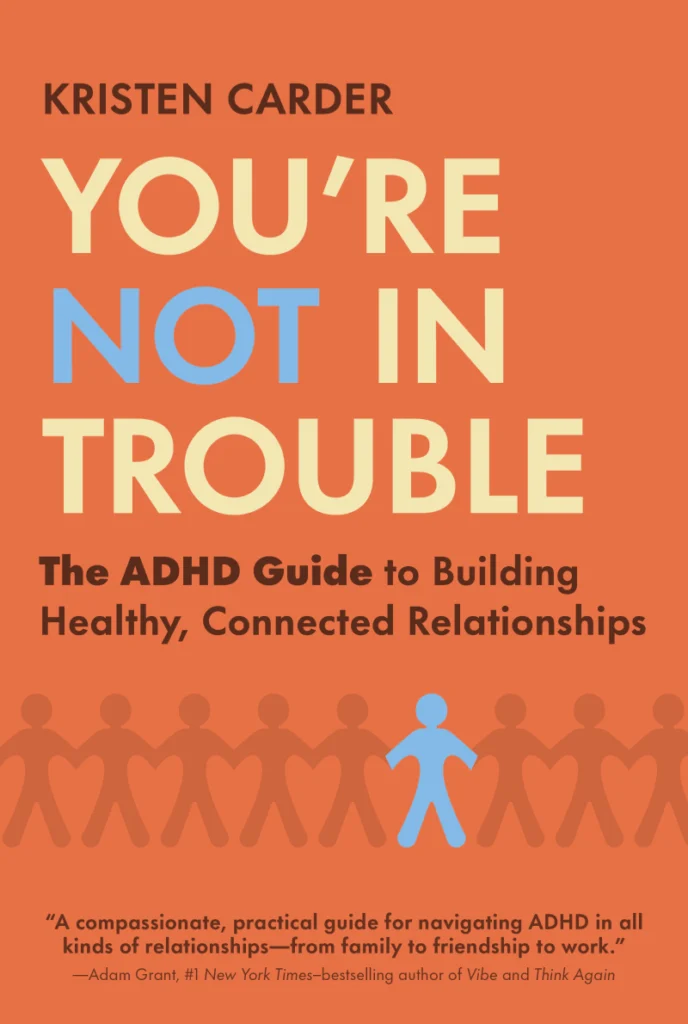
Before we get to it, I just want to remind you that my book, “You’re Not in Trouble: The ADHD Guide to Building Healthy Connected Relationships, is available now for pre-order. And if you want to get some special pre-order goodies, some incentives, some some things right away, some immediate gratification. You could go to ihaveadhd.com/book to find all of that good stuff. Find all of the good immediate gratification ADHD dopamine-inducing things at ihaveadhd.com/book. But in the meantime, please enjoy this class on internal boundaries. Boundaries are so interesting, and I just wonder if we can take a moment to discuss how we feel, what comes up for us when we discuss the idea of boundaries. And I’ll start. I’ll let you know that boundaries are something that I think I rebel against, and I wonder if it’s because they were kind of weaponized, used as control and punishment in my youth.
And I was always like, I can’t just wait, I can’t wait to be a grown up and like be in charge of myself and not have all of these stupid rules. I have a lot of compassion for that part of me, and like I totally understand that. But also, also, boundaries are so protective of the things that we care about, and I think that when we struggle with internal boundaries, which we’ll discuss at length, obviously that’s what this class is about when we struggle with internal boundaries. A lot of the times, it’s like this old resentment and rebellion coming through and being like, “You can’t tell me what to do. I don’t trust you. I don’t trust your authority over me. This is a stupid rule. You’re just trying to stop me from having fun. You’re just trying to stop me from having freedom. You’re not the boss of me, etc. etc. I I would like to submit to you that that’s like probably old stuff coming up for us. That’s probably childhood, teenager stuff coming up for us. Every adult knows that boundaries are really important, and I just want you to sink into that. Boundaries are so important because they protect what matters most. Boundaries protect what matters most. Boundaries protect your values. They protect your body, your peace, your relationships, your health, etc. etc. etc. Boundaries are so protective, and in healthy, supportive, warm, loving families, boundaries are used as protection and love and like guardrails to keep you on a path, a path that is-I don’t want to say correct. That’s not the word I’m looking for. Like supportive and moving in the right direction. So just like these guardrails that say, “Hey, stay between these lines so that you can be safe. But a lot of us grew up in cultures, in families, in systems where like rules were just dumb. They’re just stupid. Like why? Why is this even a rule?
Why are you telling me that I can’t do this when I see you doing it? Why won’t you tell me why this is important? Why do I just have to follow? This blindly, without having any explanation, and if we can take a moment to just see our difficulty with that, perhaps from our past, perhaps, and understand as Dee is saying, you know, when you get an answer like “because I said so, that is not good enough. That is not good enough. “Because I said so” is not good enough, and so many of us were told “because I said so” as kids, and especially for the neurodivergent, like “get out of here with that. It’s not good enough, and so I believe our difficulty with internal boundaries comes from a rebellion and a resentment from the boundaries that were given to us in our childhood and teenage years. I’m just gonna just throw that out there. That’s my guess. So now when I go to set like a reasonable boundary with myself, and I want to say, like for example, I’m going to go to bed at 10, and I’m not going to stay up until two a.m. What often happens is you can’t tell me what to do. Why do I have to do that? That’s a stupid rule. I’m going to miss out. You just want to stop me from having fun. This makes no sense, right? Debbie says you are reading my mail.
Okay, so I think a big part of this is really understanding if you come from a family that used boundaries as control, domination, and weapons. I think that you should probably note that for yourself. Oh, oh. I come from a family or a system or a religious culture or whatever the case may be. Maybe an old toxic relationship. I come from a like I’m bringing along this past, where boundaries were used to control me, to dominate me, and to, yeah, maybe coerce me into doing being obedient for the sake of obedience. Yes, weapon. Thank you. It’s used as a weapon against me. It’s used as like you’re not your own person. I’m in charge of you, and I think I think that a lot of us are rebelling against that. Obey and comply. Like who here or listening to the replay resonates with in the past boundaries were used toward me in an effort to get me to obey and comply, often just to make someone else happy, not necessarily for my own good. Not necessary. Like I didn’t even, I didn’t even see it for my own good. I saw it for their good. They wanted this for me, so that I would obey and comply.
That I’d be under their control, so that they could live the life that they wanted, but not so that I could live the life that I wanted, like this, was for the good of either the parent or the teacher or the coach or my partner that was toxic, etc. Okay, so if you notice that, if you realize that, it makes sense. It makes so much sense that when you want to set a reasonable internal boundary that your entire body rebels against it. You can’t tell me what to do. Get out of here. You’re not in. You’re not the boss of me. You don’t have my best interest in mind. I don’t trust you. And so, internal boundaries are very much about rebuilding the relationship that we have with ourselves, reparenting that younger version of ourselves, and building a new relationship that says, “Hey, in my executive brain, I actually do know what’s best for us. I actually do know that eight hours of sleep sets us up to have a great day the next day. It does, and because I love you and because I like you, I want to make sure that you get what you need. And so we need to be for me personally. I want to be in my bed at 10 o’clock. Is it 10 o’clock on the dot? Sometimes it’s a little earlier. Sometimes it’s a little later. But I want to be in my bed at 10. I want to be lights out at 1030. I want to be asleep by 11. For me personally, I’ve noticed that that makes my life so much better.
And if I can self-soothe that part that says you’re not the boss of me, you just want me to miss out on fun. This is a stupid rule, and I can say no, no, no, sweetheart, come here, come here, come here. Let me tell you everything. Let me explain to you again why this matters so much. Your sleep really has an impact on how you feel, on your capacity to function, on whether or not your ADHD symptoms are really, really loud or a little bit quieter. And so, if we can get you some good sleep, that’s the best way I can take care of you. Another internal boundary for me. Is I don’t skip meals anymore. I used to skip meals all the time. I don’t skip meals anymore, even if I don’t feel like eating, even if it’s inconvenient, even if I don’t want to, even if the only thing that’s available are Oreos. I’m going to eat because eating anything is way better than skipping a meal, and so for me, that’s another internal boundary that I have, and that’s a fairly new one. We don’t skip meals anymore, no matter what. Even if I’m spending extra money, even if it means that I’m showing up late, I’m going to be eating because I don’t skip meals anymore. Another internal boundary I have is I’ve cut out alcohol mostly, almost entirely. Nobody told me to do that. Nobody’s forcing me to do that. It’s an internal boundary.
Why? Because it had a lot more control over me than I was comfortable with, and it made me feel really terrible. It made me feel really terrible when I drink, I get a headache. I have trouble sleeping. I wake up groggy, and I feel hungover-not like actual hungover, but like just like whoa. I just feel terrible. So my internal boundary is: we’re not going to drink alcohol, even when we miss it, even when we crave it. It’s just not a. It’s not a good fit for us, not because I don’t like you, because I do like you. Does this make sense? Those are like protective of my health. Other internal boundaries that I have, some are like protective of my relationship. So I don’t hang out with men without Greg present. That’s a that’s a boundary, an internal boundary that I have because I want to protect what’s important to me. Another boundary that I have is I don’t work after 4p.m. Every once in a while, you know, like last night we got some new book covers in, and I sent them over to Felicia, and I was like, “Ooh, new book covers, like I wasn’t working. I was sitting on my back porch, like texting, right?
So my internal boundary is: I know that if I overwork, I borrow from tomorrow’s energy and I steal from tomorrow for today, right? And so I I’ve seen over and over and over and over that if I protect my energy, if I stop work at a certain time, and I’ve played with it, I’ve so often we don’t know that we’ve crossed a boundary, or we don’t even know that we need a boundary until we’ve taken it too far. So, for example, with drinking, I didn’t think I needed a boundary. I didn’t know I needed a boundary until I realized, like I am 100% addicted to alcohol, I need to make a change here. So I had like gone far over the line, and then I had to bring it back. What’s another example with that? Like overworking and and like borrowing from tomorrow’s energy, right? I did that 700,000 times before, I really drew a line in the sand and said, “I just am not going to do that to myself anymore, because I I just like myself, I just like me, and I like tomorrow me, and I want to be nice to her, like she’s pretty cool, and I want to make sure she is set up to succeed. Internal boundaries are the limits that we intentionally set with ourselves to protect our health, our peace, our values, and our relationships. I’m going to read that again. Internal boundaries are the limits that we intentionally, lovingly, gently set with ourselves to protect our health, peace, values, and Relationships, okay.
Now, why do we struggle to follow through on the boundaries and limits that we’ve set with ourselves? First of all, sometimes we set really unreasonable limits, like I’m never going to eat sugar again. Sometimes we make these like fantasy limits with ourselves. Can you guys name some that you’ve set recently? I’m going to work out every single day. No, you’re not. No, you’re not. Yeah, I’m going to go to Pilates every day. No, you’re not. I’m never ordering Uber Eats again. Get out of here. Yes, you are, and you should, because it’s easy, right? Yeah, I will. eat an edible for this whole week. Yeah, and if that doesn’t, if that feels like a fantasy, maybe we just like think through. Okay, that’s a fantasy limit. How can I play with this to make it more reasonable? I’m going to do it for one day. Yeah, realistic is one day exactly. Love that.
So here are some examples, like with your health. I don’t skip medication, or I eat at every meal, even if it’s easy and simple. Or I’m not going to drink caffeine after a certain time because I know it’s going to keep me up. That’s one for me. I’m going to go to bed at X time or close to X time because I. I know that that’s what’s best for me. Maybe it’s more like regarding social media. Like I’m not going to get into the comments and like fight with random strangers, or I’m not going to open my news app before bed, or I’m not going to look at work texts after dinner, or I’m not going to let myself doom scroll for a long time, right? Like I’m going to set a limit for myself with your relationships, like I don’t, I’m not gonna have like one-on-one time with men that are not my husband, or I’m not gonna flirt outside of my marriage, or I’m not gonna vent about my spouse to my friends, right? Or I’m gonna, I’m gonna put my phone away when my kids are in the room so that I can look them in the eye. So many of us feel and worry, and this again like circles back to the past. Like boundaries are going to take away our freedom, but honestly, boundaries are what give us freedom. Boundaries give us freedom. Boundaries allow us to be the people that we want to be.
If I am just like I can drink any time, any day, I can have a drink whenever I want it. It doesn’t matter. There are no limits. I don’t get to be the person that I want to be because I’m drinking, which I used to do a lot. Ayana says I don’t like setting boundaries because it feels like I will inevitably just Fail, right? So, like, if I know that going to bed, being in bed at 10, being asleep by 11 is what’s best for me, but it’s also hard. Depending on your season of life, it can be especially hard. And right now, my season of life is I have kids that stay up late, later than me, and so it’s it’s hard to like. Are you guys good? I’m going to bed. But I I am curious about the word fail. What does it mean to fail at a boundary, right? So if I choose to drink, does that not mean that I can just like the next day be like, okay, I’m just not like I drink, okay. I’m a grown up. I do get to do what I want to do, and yet I still know that I really think that this boundary is the best for me. So I’m just going to go back to not drinking. How much perfectionism is showing up here for you in your internal boundaries? Yeah, this is this is an issue. Like, if I stay up late one night and then it’s like, ah, I knew that I just couldn’t do it. Blah blah blah blah blah blah blah. Or I’m just like, well, that sucked. In bed by 10 tonight. Haley says, if I’m a perfectionist, I can just fail faster and give up, and then say, “Yeah, boundaries don’t work for me. I get to do whatever I want whenever I want to. So good, not perfectionism, but being controlled or tracked.
Yeah, Amy, I wonder if that goes back to the past for you, and if you need to give that part of you like a lot, a lot of love and freedom, and a lot of like you don’t have to go to bed. You can do whatever you want. You don’t have to, but we both know that we feel better when we do. So how about Raboa? Like I can drink any time I want. I can. I could go get alcohol right now, but I also looked like I just know that it’s like not great. So just because I can, and I do think that’s a good point. Feeling controlled or trapped, so then we’re constantly rebelling against our own boundaries. And again, like maybe this is something that you want to go to therapy for because a truly like this might run very, very, very, very deep. This might be a window into some complex PTSD, where you were so controlled and so dominated in your childhood and adolescence that now just even having like a simple like, “Hey, lady, let’s get you to bed so that you could feel really good tomorrow” feels like constricting and trapped and really difficult. Chronic self deprivation leads to explosions of indulgence. Yes, and here’s the thing: Are your internal boundaries geared to deprive you of something? Can you sit with that question? Thinking through your own internal boundaries, are they set up to deprive you?
Because if so, you you need to do some tweaking. If your internal boundaries are set up to deprive you, that’s a big problem. So, for example, I am in bed at 10, asleep by 11. I do not feel deprived. I feel so happy. What am I being deprived of? Nothing. I get to go to bed. I get to like snuggle into the. Safest place in the whole world. I had to pop in an audio book into my right ear and just fall asleep. It’s the bet. Like, what am I? I get to have a full night’s sleep. What? What am I depriving myself of? Nothing. We’re saving for retirement and our kids’ college, and that means that we don’t have access to all of our money because some of the money that’s coming in is being set aside for retirement and college. Am I depriving myself of my own money? No, I’m just setting it aside for later for things that matter to to me that are really connected to my values. Yeah, this is an interesting time to maybe think about your future self, and and start to think through who is tomorrow Meg, who is tomorrow, Beth? Who is tomorrow, Carrie? Who is tomorrow, JD? What does tomorrow, David need and want? What does tomorrow, Tamra, feel like? What does she care about? Like thinking about yourself tomorrow. Do you ever do that? Do you ever think about the future version of you, the version of you who’s going to wake up after seven full hours of sleep? Imagine the version of you who’s going to stop shaking after you have a meal.
The version of you, maybe even like in a year, who’s so happy that you put money aside. Yep. Carmen has worked hard to build a relationship with her future self. Yep. Yep. Yep. Yep. So good. Clayton says, “Future me can get through the boredom for a better tomorrow. Yeah. So good. Now, of course, our ADHD impacts our ability to have and follow through on internal boundaries-we can struggle to even remember them. We can lose track of time, and all of a sudden, it’s like one a.m. and it’s like, oh my gosh, I’m still awake! Right? We struggle to inhibit our impulses. Obviously, we struggle to tolerate discomfort. We do struggle to connect with the future. So that’s something that you might want to journal about and really make an intentional effort toward is connecting with your future self. We can struggle to delay gratification, and again, that that can really go toward connecting to your future self. What does your future self want? What do they need? How can I figure out how to give that version of me what they want and need, right? So yes, ADHD is going to impact this for sure.
And then when we inevitably, you know, don’t follow through on every single boundary that we set, what I hate is the failure that we feel. I just hate that part. I just really wish we could not feel failure, but rather just like, oh well, what went wrong? What do I need to tweak? How did this happen again? I need to. I need like clearly something I’m doing isn’t really working. So like, how do I need to tweak this? Right. So I just know that I need access to about an hour on my phone in my bed. Not that I’m always going to take the full hour, but I need to like a lot an hour for myself on my phone. I need that freedom. So even like last week, I took Charlie to a water polo practice at the Naval Academy. We didn’t get home until like 12 a.m. and I was still like, I need to go on my phone to relax. And I was like, okay, like we’re already late, and you get to have that hour on your phone. I didn’t take the full hour; I took like 15 minutes. But I, I know that that’s something that I need and want. That’s that’s one of the ways that I like power down in bed. I pop a podcast in and I play Block Blast every night, and it’s the best. It’s the best, and I give that to myself. Like you’re allowed to do this. We’re making bedtime fun. Pop a podcast in, play Block Blast.
Now I try to get to the point where I’m in bed at 10, but even when I’m in bed at 12, I still let myself do that. Who cares? Makes me so cozy and tired. But when we can’t stop at the reasonable boundary, yeah. For me, I just get tired enough to fall asleep, which is new for me in the last couple years. Kristen, I love that you know what you need and you unapologetically give it to yourself, and I bet that’s a big reason why you maintain your internal boundaries. I agree with you that internal boundaries are so much about meeting your own needs. Do y’all know what you need, and how do you feel about taking care of yourself and being gentle and warm? Nurturing to yourself with what you need. Trying to teach my son how to do this, and it is so hard. I was really frustrated about it today, really frustrated. And you know, he’s a kid, but it is hard to teach someone else. Like, hey, here’s what you need. So we’re working with two of my kids on eating, not just one now, two, and meeting their needs for food. And right now, it’s like my job to feed them and to like make sure they’re eating. And I am like trying to help them to see. Like, don’t you like you? This is what your body needs. We need to give your body what it needs. Don’t don’t you love you? Because I do. I’m here to give this to you because I know that’s what you need. Don’t you like you? I haven’t said those exact words, but that’s kind of where my brain is at right now, and I’m trying to figure out like how. I also am just going to relate this back to our childhoods. Sorry, I’m just always going to do that. Where I don’t think that our needs were met. I think so many of us, and let me know if you resonate. Not all of you will, but so many of us were neglected. So many of us were left to fend for ourselves. So many of us were punished when we had needs, or like mocked or scoffed at, or just like, “Oh, you’re so annoying, when we had needs. And so now, now, when we have needs, we struggle to meet them for ourselves. And I see this in my, especially my oldest, because I resented him for having needs when he was a kid. Just like I literally said to him, “I’m not here to meet your needs, which is wrong, absolutely wrong. And so now the pendulum is swinging like way the other way, and I’m like meeting every single need for him while I can. And I’m just like, “You deserve it.
I’m here to meet your needs so that you know that your needs matter. So I wonder if part of our struggle with internal boundaries is like a resentment toward ourselves for our own needs. Like I have the need for sleep, I have the need for food, I have the need for rest, and are we withholding from ourselves because we were never really validated in our own needs. We were never really allowed to have needs. We were never shown how to meet our own needs, because so many of our internal boundaries, like I have the need for money in my account, or I have the need for retirement, or I have the need to send my kids to college, like those, are needs that our internal boundaries help to meet. I have the need for a healthy marriage, so my internal boundaries protect that. Where I say, okay, I’m not going to flirt with anybody else. I’m not going to have like alone time with other men, because it actually protects what I need. What I need is a safe marriage. How do I protect that with my own internal boundaries? What I need is a good night’s sleep. How do I protect that with my own internal boundaries? Do we care enough about our own needs and meeting our needs and like connecting with what we need.
This is from Beth. She says, “So, like, we have a need to have a certain amount of money in our bank account, but we sabotage it by overspending. Exactly. I know I need X amount to have in my account to pay bills and to live a relatively simple life, but I often sabotage that with overspending. Why? Because I resent having needs. I don’t feel like I should have needs. I don’t want to meet my own needs. Okay, so we often have so much rebellion. I think we also have resentment. We have this like our needs don’t actually matter. Our needs are kind of gross, or other people’s needs matter more than mine. Get out of here with that. Get out of here with that. So this is where reparenting comes in. Have you all heard that term reparenting? It’s kind of connected to like, not kind of. It’s connected to our inner child. Some people roll their eyes at the idea of inner child. Whatever. It’s like the younger part of ourselves that often shows up unannounced, and sometimes unbeknownst to us. Right, where it’s just like I didn’t even know that little me was showing up, but she thrown a whole temper tantrum. If we can connect to that part of ourselves, we can begin to firmly but kindly create boundaries that make sense-not out of fantasy, not out of control, not out of perfectionism-but by. That makes sense. Hey, it makes sense for me to be in bed at a certain time. That just makes sense. So I think that I need X amount of sleep. It makes sense to lovingly, kindly, gently get me into bed and asleep by a certain amount of time, and set up guardrails so that that can happen. So, for example, with my kids-not my oldest, but my other two-they have screen time limits, and at a certain time, the screen time goes off. My middle guy struggles to regulate himself with his computer. He has a computer. He’s like a gamer, and he struggles to regulate himself. So, when I go to bed, I take his keyboard. That’s a loving boundary, not because he’s in trouble, not because he does anything wrong, and we have conversations about this. And I say to him, “Bub, every successful grown-up sets limits for themselves. Every successful grown-up sets limits for themselves, so I’m setting limits for you so that you can see where healthy limits are, right? And so, it’s not horrible that you stay up until two to play video games, but it doesn’t set you up for a good tomorrow. So, bring in your keyboard before you go to bed. We’re not really doing that in the summer, but that’s what was happening in the school year. Yeah, it takes the pressure off for him. It makes it so that he’s not crossing boundaries. It’s just like not available to him. Meg, ugh, the truth hurts. Every successful grown-up sets limits for themselves. Every successful grown-up sets limits for themselves. Every single one.
Like, look at the people in your life who you consider successful. They all have certain limits that they’ve set, yeah. The message to your son is so much better than when you’re an adult. You can do what you want. Oh, that’s so interesting. Yes, how many of us heard that? Well, when you’re an adult, you can set the rules, but you live in my house now, so you’re going to play by my rules. No, that’s so toxic. No, no. When you’re an adult, you’re going to set limits because every healthy adult sets limits. It’s not like oh, when you get out of here, you get to do whatever you want. No, when you get out of here, you’re going to have to be self-policing. You’re going to have to know where your lines are. You’re going to have to know what’s best for you and how to manage that, right? So, how about we say to our kids, these are the limits that I think are reasonable, and when you’re an adult, you get to set limits for yourself that you think are reasonable. Maggie, seriously, why the actual weren’t we not taught this? I just, I don’t know that our parents are even good at setting limits for themselves. I think that it’s been generations upon generations of dominance and control and trauma, and so we’re trying to like right the ship. So much survival mode, yes, exactly.
So much survival mode. So I mean, like think about our grandparents, depression, war. I mean, it’s just like we’ve been through some stuff, generations upon generations of being through some stuff, and so many of us will identify as being like cycle breakers in our own families. Absolutely. So like we’re the ones learning this for the first time. It is heartbreaking. It is heartbreaking. Cycle breakers unite, Elise. Cycle breakers unite. Okay, so ways that you can talk to yourself. Hey, time for bed. How? What do you need help with? How can I help you get to bed? I know you want to keep scrolling. This is not going to set you up for a good tomorrow. So, what do you need? Do we need to plug the phone in downstairs? Would that be the most helpful? When we were working with my middle guy on like resisting his computer, because we like caught him at like one a.m. playing his computer a couple times. At first, we were like, “Dude, what are you doing? Right, but then the conversation became, “Okay, what do you need to be successful with this? What would be most helpful to you? Because this is not healthy. We’re your parents. We want to help you to know what’s healthy. We want to show you the guardrails, and we’re here to support you in that, not to punish you, but to support you. So, what do you need? And we decided together that having his keyboard out of his room would be the most helpful. And what I had said to him is, “Great, we’re going to start there. If that doesn’t work, we’re moving your computer to the loft where it’s like in the middle of everything. But we’ll start with your keyboard. We’ll see if that works, and if that doesn’t work, we’re going to take a more severe step because we care about you. We care about your sleep. We care about your mental health. We care about your ability to self-regulate.
And we want you to care about that too, right? So, like, I want him to say, “Okay, I need something drastic here. Maybe I need to move my computer, right? Like, in the future, let’s say he has a family and he’s noticing that, like, he’s spending all of his time on his computer. I want him to remember, like, “Okay, I can take some drastic measures here if I need to. I can move my computer. I can like put the keyboard X Y Z somewhere. Do you know what I’m saying? Like, I want him to know that he can do that for himself. Okay, the whole point here is to protect the life that you want. That’s the whole point of internal boundaries: is protecting the life that you want. So I know that I don’t want to wake up in an alcohol fog with an alcohol headache? That is not the life that I want.
So I have an internal boundary of we’re not going to drink, not because I don’t like me, but because I do like me. That protects the life that I want. I know that I want to have money in retirement, and that for 40 years we saved exactly $0 for our retirement. Exactly zero, and so I know that now I’m playing catch up, and that’s fine. My coach does not like that thought, but I don’t care. I don’t care. It’s my thought, and I’m sticking with it. I am playing catch up. I don’t care. That thought actually helps me because it allows me to put more money away into retirement and live on less. Does that make sense? It protects the life that I want. So I want to be able to not lean on my kids to take care of me when I’m old. I want to be able to have freedom. I want to be able to, if my kids are in different parts of the world, travel to them. It protects the life that I want. I want to have a marriage that is safe and healthy, so I don’t hang out with guys outside of like Greg. It protects the life that I want because I know that I want to stay married. I go to bed at 10. It protects the life that I want. What internal boundaries are you wanting to instill in order to protect the life that you want? What internal boundaries make sense for you in light of the life that you want. Oh, Meg says I feel better about being way behind in retirement savings, $0 at 34. Totally get it, but also in a season of financial insecurity, so that doesn’t help.
Okay, I’m not laughing about that. You can’t save money when you can’t pay your bills, and that’s. I mean, Greg and I talked about that all of the time, like we heard from everybody, it’s got to be putting money away, and we’re like, what money exactly do you want us to be putting away? But when you do eventually have money, living on less and putting money away is a good is a good idea. I would like to order Uber Eats less to save more for a house down payment, and so in the moments of just wanting to order, you have to reconnect to the value of I want to save for a house. Not ordering Uber Eats protects the life that I want. I need to set internal boundaries about moving my body more. You know what’s interesting about that, Mary, is I wonder if some of those boundaries will be external, like I have to say no to other people, I have to say no to being the sole provider for my infant child during these hours, so that I can move my body more. I want to curb impulse spending, but allow myself a budget so I don’t deprive myself. I love that. So an internal boundary could be, I’m going to wait 48 hours before I click purchase.
So I will like save the item, but I’m going to wait 48 hours and I’m going to really sit with it. Specific work hours, yes, huge. Follow a budget, follow a schedule, eat mindfully. That’s a lot all at once. I would recommend starting with one at a time because the work that you do with one is going to impact the other two. No rumination about personal life during work hours. I’m obsessed with this, and you’re not always going to be able to honor that boundary, and that’s okay. But if that’s the standard that we’re working toward and kind of like coaching and nurturing ourselves around-that’s going to be so, so impactful. Be kind to myself and my brain. My nephew’s famous line is “But why? So when I hear my own brain asking “But why, I’m going to give it the answer to protect the life that I want. Yes, what life vision is compelling enough to protect. Now that is important work. That sounds like your work. Love it, Carmen said. I made a menu of instead of smoking a cigarette, I can dot dot dot insert dopamine transition tasks here to curb cigarette smoking to eventually quit. Downloaded an app that tells me how much I am saving and.
And of course, for my health, yes, love that journal prompt. Define what is the life that I want. Get specific, vivid details. Obsessed. Okay, let me answer some of your questions. What do you think about the thought? Well, they were doing the best that they could with what they had. I believe you’re referring to our parents. I feel a sense of guilt as we’re talking about this. So, knowing what I know about your family, specifically your mother, it makes sense to me that you would feel guilt any time you tell the truth about your experience with your mother. And this is for everyone, but this is specifically for Beth. But this is for everyone. Those of us who grew up in toxic, maybe narcissistic families will feel a lot of guilt around naming what is true. But what I will tell you is that there are two different kinds of guilt. There is moral guilt when you’re crossing a boundary, you’re telling a lie, you are demeaning or diminishing someone intentionally to harm them. That is moral guilt is useful and good, and it keeps you in line with your values. But then there is toxic guilt, and toxic guilt is meant to keep you quiet and compliant. And so many of us grew up in families where toxic guilt was weaponized, where toxic guilt was used to keep us quiet and compliant, and feeling like we had to take care of our parents, and that our parents were the victims, and actually we were the perpetrators because we were just a bad kid. We were just a bad kid, and they were just doing their best, and we were just really hard to raise and parent. And all of that is all of that is it’s BS. You were not hard to raise, you were easy, you were, you were just a kid, you were just a kid, and so to name the control, the domination, the boundaries used to coerce and to keep you compliant, to name those honestly is actually healthy, and even though you feel toxic guilt, that’s okay.
That’s okay. It’s still important to name what’s true. Yeah, just wait till you have a just wait till you have a kid just like you. I was I was told that many times, and I did. And he’s so easy to love. He’s the best. Okay, I remember you said you switched to stimulant from stimulants to non-stimulant medication. Was there a correlation with alcohol there? I couldn’t stop drinking on Adderall. Switched to Straterra and have been much much healthier. Anybody experienced something similar? That’s interesting. That would be something interesting to post in Slack. I’ve been on a non-stimulant for many many years since I started drinking heavily, so no, for me it wasn’t a medication issue. My parents did not set many boundaries for me or my sisters. We were encouraged to make our own decisions. Sometimes they would talk to us about options and things to consider, but they didn’t specifically teach us about internal boundaries. How might that contribute to my struggle with setting and following through with some boundaries as my for myself as an adult, this is a really great question because when you’re not used to boundaries, why would you ever set them? When boundaries are just like ah whatever, do whatever, like you get to decide, it makes it really really really hard to see where your edges are, where the where the lines are. Right? Yeah, it’s two sides of the same coin, Meg. That’s such a good point. Such a good point, right? Like those of us who had so many authoritarian boundaries, and then those of us whose parents were just like, “It’s up to you. Do whatever you want. It’s like it’s so similar, so similar. What about when we set the boundary because we know what’s best for us, but we continue to override that boundary and still do the thing. That’s when we check in with why. Is this even a boundary that is helpful? Why do I keep overriding it? And what support do I need to make sure that I can follow through? Katie says, anyone else wondering why they’re just realizing that rules are boundaries. Yeah, and as adults, we do have rules. Like as a kid, I was just like, I can’t wait to be an adult.
No rules, and now I’m just like, there are so many rules as an adult, right? And they’re protective, and I don’t have to follow rules that I think are stupid, which is what separates me from a child. I get to decide what rules I submit to. I get to, I get to decide where I work. I get to decide, like where I give my time. I get to decide whether or not I go to bed. But like also, I impose rules on myself in a kind and gentle way to make sure that I am living the life that I want to live. My kids went to a Waldorf school, and the teachers talked about kids need to have boundaries to push against, but also to know that the boundaries are there because it can make them feel safe and held. I love that, Katie. All right, y’all. What is your biggest takeaway? From today’s class, where where are you sitting with all of this information and discussion on internal boundaries? Internal boundaries build self trust. What am I doing that protects the life that I want tomorrow and when I’m old? I need to explore the block that I have with resenting my own needs. I need to take a hard look at what I’m doing as I think I’m lying to myself, and I would add to that, Claire. What is that lie protecting you from? Whatever it is about, like what is the lie protecting you from? Because it’s probably self-protective. This is a class to listen to repeatedly. Oh, Diane, that’s great. Reconnect with your own personal why when you feel internal resistance. Yes, I can choose the healthier choice because I actually want to. When I take a step back from the moment. Yes, yes, yes, yes. The life that I want is protecting me from stepping up and being an adult. I think if that makes sense.
Yeah, of course. I need sleep boundaries for myself. My mind just won’t turn off. This call was much needed. Oh, that’s beautiful. Got to remind myself that internal boundaries protect the future life that I want. Yes, they are for my good. They are not to ruin my fun. They’re for my good. They’re for me. They’re not for anyone else. My internal boundaries are not for anyone else. They’re for me. They belong to me. They are to protect me. They’re to ensure that I get to live the life that I want to live. They’re they’re actually it’s just like so much control there. You have so much control. What’s so funny is that we have this like pathological demand, avoidance, resistance, resentment. Just this like you can’t be the boss of me. But the internal boundaries are actually the control that we have, like that’s how we exert control over our own lives, and I don’t mean control in a negative way. I mean control in like a very positive, forward-moving way. Internal boundaries equal freedom. Yes, I need to reframe that I’m doing what is good for me, not just what I’m supposed to do exactly, it’s kind of insurance to have boundaries. Yes, I need to talk lovingly to myself when I want to uphold my boundary. Yes, it’s okay to have needs. Yes, I’m obsessed. Okay, go, go do it. Go do some journaling. Go do some thinking. Go do some connecting to future you. You got it. Talk so soon. See ya. A few years ago, I went looking for help. I wanted to find someone to teach me how to feel better about myself and to help me improve my organization, productivity, time management, emotional regulation-you know, all the things that we adults with ADHD struggle with. I couldn’t find anything, so I researched and I studied and I hired coaches and I figured it out. And then I created Focused for You. Focused is my monthly coaching membership where I teach educated professional adults how to accept their ADHD brain and hijack their ability to get stuff done. Hundreds of people from all over the world are already benefiting from this program, and I’m confident that you will too. Go to ihaveadhd.com/focused for all details.