Kristen Carder 0:05
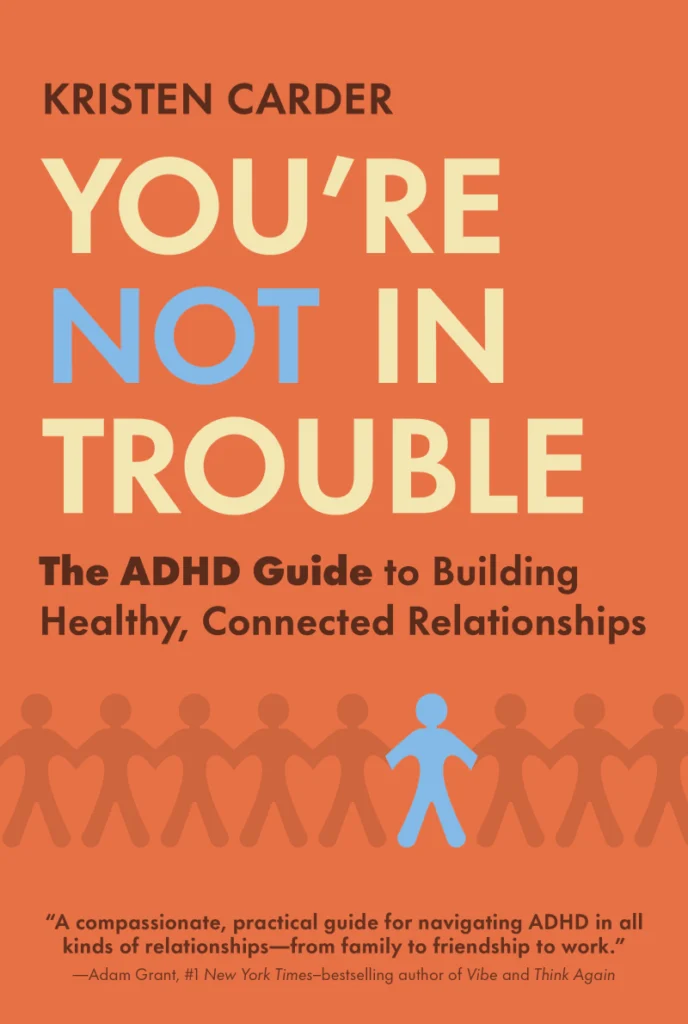
Welcome to the I Have ADHD podcast, where it’s all about education, encouragement, and coaching for adults with ADHD. I’m your host, Kristen Carter, and I Have ADHD. Let’s chat about the frustrations, humor, and challenges of adulting relationships, working, and achieving with this neurodevelopmental disorder. I’ll help you understand your unique brain, unlock your potential, and move from point A to point B. Hey, what’s up? This is Kristen Carter, and you’ve tuned in to the I Have ADHD podcast. I am medicated, caffeinated, regulated, and ready to roll. Get in here. We have much to discuss. Thank you so much for pressing play on this podcast. First and foremost, I am so grateful that you are here, that you are listening. I always think about the community of ADHDers all across the world that are doing their thing and using this pod as a body double. I adore you. I appreciate you. I’m so glad that you’re here. I’m so glad that I’m not alone because, dang, it feels isolating to be neurodivergent in this neurotypical world. It is just so hard. When I said I was regulated, it was a little bit of a lie. I’m not actually very regulated today, but that’s okay because we can still do things while we are in dysregulation. I found out today that my book release date is going to be pushed out a little bit, and the way that I found out. Let me tell you how I found out. The way that I found out was that I woke up this morning, and like one of the first things I did. I’m not sure why I don’t always do this, but one of the first things I did was open my email, and I had an email from Amazon that was like your delivery is delayed, and I opened that email. I ordered some stuff for my kids, and I need it to come today. It said it was coming today, and I was like, “Oh shoot, it’s going to be delayed. And I was like, I started to freak out. Turns out, no, it’s my book that’s going to be delayed. If you’ve pre-ordered the book, you may have gotten a similar email, your delivery is going to be delayed, and I was like, “Excuse me, what? I’m the author. I didn’t know that it was going to be delayed. Nobody told me. No, nobody told me. So let me have just like a minor freak out. By the time you listen to this, it’s gonna. I’m going to have processed it, but this happened literally today, and I found out through an Amazon email, not from my publisher, not from my editor, not from my agent, from an Amazon email. Turns out nobody knew the U.S. publisher that prints all of the books for Penguin is backlogged, and because of that, it just like triggered this delay, and that’s understandable. I I would have loved to know about it, but when we reached out to the editors, like my agent didn’t know, the editors didn’t know, like no nobody knew. It’s just an unfortunate way to find out. Like um hello. So anyway, if you have pre-ordered and you got that email. I apologize, and I’m sorry you didn’t hear it from me. But I also want to let you know I didn’t know either. I truly, I truly did not know. I appreciate you pre-ordering. If you’re listening to to this and you’re like, “What are you even talking about? I didn’t know you wrote a book. I wrote a book. I wrote a book for people with ADHD who want to improve their relationships, and it’s called “You Are Not in Trouble. You’re not in trouble, which I hope just gives you like such a beautiful sense of relief. And the entire book is about understanding relationships and living within your relationships as if you are not in trouble because you’re not. You’re a grown-up. Grown-ups don’t get in trouble unless you’re like breaking the law, which I don’t recommend. But so many of us are existing within our relationships as if we’re in trouble, and I really hope that this book changes that. I hope it changes our entire existence within our relationships. So it is available for pre-order now on Amazon, Barnes and Noble Bookshop, wherever you get your books.
Kristen Carder 4:34
The Audible, the audiobook version, which I just recorded, finished recording last week, ebook or hard copy. You can pre-order any of those, and it will be out end of October. Apparently, because I literally just found that out today, we can take like a collective moment to self soothe because I am sad. I’m just like, wait, what? I am so shocked. I. To my agent, who is basically like my advocate in this process, and I said to her, like I don’t have the cognitive flexibility to handle this delay. I know it’s very typical in the publishing industry. This is just another Tuesday for someone who’s in publishing. It’s very, very normal, but for me, as a little neurodivergent baddie. This is not typical for me. I’ve been prepping. I have been just like getting my brain and my body ready for October six, October six, October six, and now it’s going to be later. So this process is not for the faint of heart. I don’t really recommend it. Not loving it. I’m not loving it. But I’m glad I wrote a book. I cannot wait to get it in your hands. I think it is going to change the world. I do think it will have a huge impact on the community and on our ability to show up as grown-ups in our relationships as grounded, secure, solid, capable humans within our relationships, and that’s what I want for myself. It’s what I want for you. It’s why I wrote the gosh darn book. So, yeah, regulated ish. I would say if you are new to ADHD and you’re listening to this podcast because you’re like, just trying to figure out what does it even mean to have ADHD. Do I even have ADHD? I do have a freebie for you if you want it. It’s called the 10 Things I Wish My Doctor Told Me When I Was Diagnosed. You can find that at ihaveadhd.com/slash 10 things. It’s good. It’s it’s like a mini ebook. It’s very comprehensive. And let me tell you, when I was diagnosed, I was handed a prescription and sent on my way. I knew nothing about ADHD until about 15 years later, when I started researching and reading, and was like, “Wait, what? I had no idea that ADHD was more than just an inability to pay attention, and it is, and it is. It affects every part of your life, from the boardroom to the bedroom, every single aspect of your life and my life. And when I found that out, when I realized that like most of the things that I hated about myself were actually related to symptoms of ADHD, I was able to let go of a lot of shame. And I hope that the 400 plus episodes of this podcast do that for you. That they help you to release a lot of shame. That’s what I want because I think that we exist within the context of like not doing it right, not showing up right, not doing our work right, not being in relationships right. We’re just like not doing it the same as everybody else, and there can be so much shame attached to that, and I hope that my role in all of this in our ADHD community is to just like peel off the shame from all of the neurodivergent friends. I just want to peel off the shame. I just, if you can just picture me like plucking the shame off of you, that literally I’m doing that motion right now. I’m plucking the shame off of you. I really hope that this podcast does that for you. And if you’re wanting to learn about ADHD and kind of like the ways that it impacts you, that freebie will do it for you too. You can grab it at ihaveadhd.com/slash 10 things. Today’s episode usually when I do this, this is the preface, the preamble. Usually, when I do this, is because I’m exhausted, burnt out, or going on vacation. None of those things are true today. I’m not exhausted. I am not burnt out. I am happy to report. I am happy to report. I am no longer in the burnout phase. I’m feeling good, and I’m not going on vacation, which I guess I’m sad to report. I’m sad to report that I’m not going on vacation, but I am sharing a coaching call today.
Kristen Carder 8:48
I’m going to set it up for you, and I’m going to come back and talk to you afterwards as well. I’m sharing this coaching call because even during the coaching call, I was like, the world needs to hear this within my ADHD coaching program, which is called Focused, I coached a woman named Claire, and we talked about limits and boundaries and self trust and breaking agreements that we have made with our family of origin. And it was such an impactful conversation for me and for the community that I was like, the world needs to hear this. So I actually reached out. I said, Claire, I think this conversation needs to be heard by the ADHD community at large. I think this is a conversation that’s not just for our focused crew, but actually for the broader ADHD audience because it was so important and impactful, especially within the context of me sharing two classes recently on internal boundaries. And if you go back and look for those episodes, they just came out very, very recently. There were two classes that I taught and focused on internal boundaries, on the boundaries that we set with ourselves and the way that we talk to ourselves. The way we treat ourselves with the limits that we try to set with ourselves, and I know that’s such a huge issue for us as it each dears. And one of the reasons why we struggle so much is because we set these high expectations for ourselves, and then we don’t meet them, and we we break our own rules constantly, and we’re just kind of like in this loop of feeling like I never do what I say I’m going to do, and I’m so frustrated about it. And the conversation with Claire really highlights so much of this, and so much of the growth that she’s gone through. I believe she’s been in focus for at least two years. I’ve had many conversations with her over the years, and by many I mean like probably three to five. So she’s been in focus for a while, and she has made so much progress. But this call specifically, she goes through a process of understanding that she doesn’t actually need to set boundaries. She needs to think about her limits, and a big part of that is trusting herself, building trust with herself. I want you to listen to this conversation that we have, and I want you to mine the gold for you. Where do you see yourself in Claire? Where do you see? I mean, you’re not Claire, like she’s in the UK. She is an illustrator. Like you’re not living the same life as she is, but you are very similar for a couple reasons. Number one, you are human. Number two, you have an ADHD brain. Number three, I’m going to guess that you also struggle with limits, especially boundaries and limits around your work, and that’s what we’re talking about today. I am so convinced that coaching changes lives. Why am I convinced of that? Number one, it changed my life. Number two, I see it change the lives of my clients. It is such a beautiful thing. Number three, when I share these calls with you, when I get permission from Focus members and say, “Hey, do you mind if I share this? and I do, I share it with you on this podcast. I hear from you, and you say those coaching calls changed my life, and I’m just so convinced that we need wise people to speak into our lives. I was saying to the community, to the focus community, a couple weeks ago, it’s a little bit hard to be an adult in the world who pays people to nurture them and to essentially like parent them. And here’s what I mean by that? If you don’t come from a really supportive family, you might find that you need to actually pay for that kind of support. And I’m going to raise my hand in the air and wave it like I just don’t care and say that’s me. I have to pay a therapist and multiple coaches to give me wisdom and insight and support that maybe people in really healthy families get from from their actual family unit. I think that’s the way that it’s supposed to work for me.
Kristen Carder 13:16
I don’t come from a lot of relational privilege in that way, and so instead of having it for free, I have to pay for it. I don’t love that about my situation, but it kind of just is what it is. And I want to let you know that if you feel under supported, it is okay to pay for support. I’m not even necessarily talking about Focus. Like I would love for you to join focused, but it could be from a therapist, it could be from a personal trainer, it could be from like a massage therapist, or somebody that’s going to be investing in you-a coach, a therapist, someone who is going to be offering you wisdom and support. It’s okay to pay for that. Anyway, that was kind of a tangent that I didn’t expect to get on, but I do think it’s important because for those of us who are under supported, it can kind of feel embarrassing, like we should be able to do it alone. But I just want you to know that I’m not doing it alone. I need a coach. I need a therapist. I need a cheerleader. I need people in my lives that are offering me wisdom, and I pay them to do that. It’s kind of annoying, but it is true. Anyway, I know that you are going to get so much out of this conversation. I’m going to come back on when I’m done sharing this call with you. It’s about 30 minutes, and then I will wrap up with you when it’s done. So please enjoy this conversation with Claire. Again, we’re talking about limits. We’re talking about self trust. We’re talking about scarcity mindset. We’re talking about differentiating from our family of origin and breaking the agreements that we’ve unknowingly been incorporating into our own lives. And I think it’s going to be life changing for you. Please enjoy.
Claire 14:57
So this has been like a. Occurring theme in my freelance life, which is I am hugely struggling to set internal boundaries around workouts. Major issue from freelancing day one. So I went freelancing in 2016, and as you know, I’m a children’s book illustrator, so you’ve just been through the whole publishing experience. Like it’s wild. Nothing stays on schedule. I’ve been really lucky in the fact that I’ve been busy almost from day one. Context would be two things: one, I was only diagnosed with ADHD two years ago, and so for the first sort of eight or nine years of me freelancing, I said yes to everything, which got me a profile. But then very quickly became me having a schedule that was seven books at a time simultaneously.
Kristen Carder 16:03
Sustainable. That is not absolutely.
Kristen Carder 16:06
Yeah.
Claire 16:06
Obviously, now I know I had no executive function to make decisions and no internal boundaries. So basically, I would have a full schedule and an amazing project would be offered to me, and my brain, my internal critic would be like, “Oh my god, this is gonna this is gonna make you. You have to do this project. And then I didn’t have any internal boundaries about the fact that your schedule’s already over full. Right. I would say yes, and so I’ve burnt out four times. And last year was really serious. I took four months off work, and I’m back almost where I was. So, like the project that I’m working on at the moment is my own book, and it’s not all my fault in the sense that it’s a complicated system. In the sense that if you’re doing a series of books, you get signed to do maybe one. It does well. Then they want three. Then they want five, and you’re like, “Oh my god! But I only said yes to one, and now I’m locked in. Like, or you have to make a difficult decision, which is to walk away, which is something that I’m dealing with at the moment. And so I’m in a position now where I’m actually about to finish, like in the next day, like I’ve done the project. But whilst I’ve been doing the project, I’ve been sitting here thinking, and I’m going to swear, okay? I’ve been sitting here being like, I’m not doing this anymore, and I need to get coached on this because it’s got to the point where basically the the rhythm is, I think. Say I’ve got eight months on a project. I do work, but I think I have no plan. So there’s a whole time blindness thing going on. I’m like, yeah, yeah, yeah. I’ve got plenty of time, plenty of time. But then maybe another project I’m working on will slip and slide a bit, or as happened with this one, I got asked to do another project in a series, and it was impossible to say no to really because it was for the same publisher, and then that impacted on my schedule for my book, and then basically instead of having three months to artwork, which I do by hand, 160 pages of a book, six weeks. Oh God! And so I’ve basically been working 12-hour days, and what happens is, I now know I completely hyperfocus, but it’s almost like survival mode. Yeah, everything stops. I don’t see people. I don’t see friends. I don’t see family. I don’t pay bills. I don’t eat. I don’t exercise. I give my dog to other people. Nothing happens other than I get up. I come to my desk. I work. I go to bed, and then obviously, I hate my job. I become really resentful. I end up burning out. I get heart palpitations sometimes because I’m getting so stressed and exhausted, and it just is like I’ve been doing this for a decade. Yeah. And other context is my parents have no internal boundaries. They were both workaholics. My dad had his own business. He used to get to his factory at four. He was a printer, leave at eight. Like a client will email him on a weekend. Even now, he’s meant to be semi-retired, and a client will email him on a Saturday. And instead of just being like, “Okay, I’ll deal with that Monday. He gets really angry because he knows he’s going to deal with it, and he was enjoying what he was doing. And then instead of just ignoring it, he gets mad. He bitches about them, but then he replies to the email, and he may even do what they want him to do. Like straight away, very impulsive. My whole family is probably ADHD, but we’re very like reactionary, and so I’ve been thinking about it because I was actually listening to the internal boundaries session that you did like not that long ago. I was re-listening, and when you were talking about sort of the fact that boundaries may have been used to me as a form of control, I didn’t experience that. But what I experienced, I think, was mom and dad setting about setting a boundary, and then at the first moment breaking it. Yep.
Claire 20:41
So I have no trust that actually that boundary that you set is meant to be honored. Because my parents consistently, even to this day, they’ll be like, “We’re going to go away every single weekend. Um, they set ridiculous boundaries, you know. But it’s like they will set them because they’re like our life is-it’s become too small. We’re going to do more. We’re going to go out. The first hurdle-it’s all out the window.
Kristen Carder 21:08
Yeah,
Claire 21:08
not doing it, and that’s what I’ve grown up with. Workaholic parents that broke their own promises, basically. So now I am doing it to myself over and over again. But it just means that my life is on this constant roller coaster, and then other areas. So to friends and family, I look like chaotic because I’m like I’ll be all in with them for a month, like trying to catch up, you know, and make up for lost time. But then all of a sudden, my work schedule will go to shit again, and then I’ll disappear. I literally disappear, and it’s the same with other projects. So, like Instagram, Substack, like Shop, everything. It’s like I’m all in for a month, and then I’m able. People even message me, and they’re like, “Are you okay? You disappeared, and I’m like, so please, what are we going to do with this? Because on one level, I know my agents even said like agents’ orders. She was like, I only want you to work like say nine till six, 630. But then on this particular project, I was like, well, I did it for a week, but then I was like, now I’ve missed my deadline, and they’ve given me an extension. And the only way I’m going to get it done is if I work 14-hour days. So then I sit here and I’m like, well, that’s all very well, but it’s not going to get done.
Kristen Carder 22:41
Yep.
Claire 22:42
So then I’m caught in this weird situation where I’m like, “Yeah, fine, but also not fun.
Kristen Carder 22:51
Totally,
Claire 22:52
because I’m a bit like maybe I’m doing something wrong. I must be doing something wrong. And then I’m like, “Well, I think the thing you’re doing wrong is that when clients come to you with these extra projects or whatever? That’s when I need to be like, no, no, no, no, no, no, no, no, no, no, we can’t do it. Is that it?
Kristen Carder 23:14
Yeah, you don’t even need me.
Claire 23:16
No, I do need you because
Kristen Carder 23:18
that’s when
Claire 23:18
I’m going to need to Re-listen to this and be like, oh yeah, okay. And I’ve actually only just thought of that right this second, so I did need you. I did. This
Kristen Carder 23:30
is why we have coaches,
Claire 23:32
exactly.
Kristen Carder 23:33
This is why there’s so much happening here, but I just want to honor you for your self-awareness, your family awareness, and your ability, which has taken a long time, but you’re finally in the place where you are able to kind of step back and look at what’s happening from a distance.
Claire 23:55
Yeah,
Kristen Carder 23:56
which wasn’t available to you five years ago. You would just be in it, in it, in it, in it. And right now, what you’re doing is a higher level skill, which is you’re stepping back and looking at the whole of the issue and starting to observe the pattern. And so that’s huge. So I want I want to give you props for that, and I want you to feel really good about the fact that you’re doing that.
Claire 24:27
And I think I’m able to do that because this is the first sort of like mini break in my schedule where it’s almost like the the knock on effect, basically, of having ADHD, not knowing I had ADHD, and everything that went at the very beginning when I was trying to build a career, which I did age 37. So I was like late to the party. So there was a lot of like, oh my god, this has got to work, you know. The knock-on effect of that has actually taken about seven years. Now, delivering this project, which I’m going to do tomorrow, is we’ve caught up basically because there’s no more series that I’m actually contracted to do. Like there is another one they want another book, but actually I could be like, you know what? No, I’m not doing
Kristen Carder 25:19
it.
Claire 25:19
So I feel like now all of the learning that I’ve had over the last five years, I’ve had the insight, but I’ve actually not been in a position to do anything about it unless I started canceling contracts and paying the money back, which I couldn’t do because I’d spent it. I have ADHD and I’m an impulsive shopper, so I was like, “Well, we can’t do that, so we just need to get to like August 2026, and then we can deal with it.
Kristen Carder 25:48
Totally,
Claire 25:48
yeah,
Kristen Carder 25:48
totally. But
Claire 25:49
now I’m in this position where I’m like, whoa, we need to tread, and I don’t want to put too much pressure on myself. But I’m also like, you do need to do this a bit carefully because in a couple of months, you could be right back where you were.
Kristen Carder 26:04
Okay, so a couple things that I just want to highlight. Okay, for anyone that says that ADHD is a superpower because we can hyperfocus, I want you to take Claire’s story into account because the hyper focus is so costly.
Claire 26:24
Yeah. Okay.
Kristen Carder 26:26
So I just like would just want to file this in the like another reason why ADHD truly is disabling in so many ways that even the hyper focus that other people look at and they say, “My gosh! But look at you, Claire! Like, look at all that you’ve accomplished, and look at the the question is always, “At what cost? Yeah, at what cost did this happen? Right? At what cost did I hyper focus? At the cost of my health, my relationships, literally, my heart palpitating. Yeah, like this is not nothing. So I just want to like bring everyone’s awareness to that. Okay.
Claire 27:12
Yes. The
Kristen Carder 27:13
other thing I’m just so happy that you’re observing. Not that we can like blame our parents for everything, but like, hello, we learn these patterns somewhere, right? So we hold compassion for our parents. Thank you so much for giving me life, blah blah blah, right? And also, okay, I see what you’re doing, and I see how I do the same thing. I want to make a different choice, and you’re in this place where you’re now able to observe it in them. You’re observing it in yourself, and you’re saying, “How do I take the road less traveled here? Yeah, how do I do that? And that’s the part that’s going to be so hard because it will require so much discomfort. I’m sorry.
Claire 28:01
Yeah, because even last week, when my agent was like, “I want she she actually said I want you to send me a photo of you in the garden at 830 in the morning and at 6p.m. at night, she was like, “I just need you to leave the desk at 6p.m. So hard,
Kristen Carder 28:20
yeah. I really like what you said, where it’s like that’s all well and good, but it’s almost too late.
Claire 28:28
Yeah, and I guess on this project is way it was way too late. Like I just said, like you know what, I’m just going to keep going, get it delivered a week early because then we just need to reset because it was too late,
Kristen Carder 28:41
and I want to say to people that that’s not a cop out. That it like sometimes that is just reality, where it’s like, okay, I mean, yes, ideally, but at this point, it’s too late. What I really need you to do, agent, is help me set better boundaries. Is to make sure that I’m not saying yes to too much on the front end because what you keep doing, Claire, is overloading yourself on the front end and then paying for it on the back end.
Claire 29:13
Yes, so you don’t need her for that. Okay, yeah, she is aware, and we actually have a meeting next Monday, which is great timing, and she’s moving a project for me because I basically have got another one that I’m meant to deliver by the end of September, but we’re going on holiday, and I was like, “This isn’t. I’m not going to get this done. Good. And actually, I was like, and also I’ve taken it on as a portfolio project. Well, there’s no point doing it, and I have learned my lesson because I’m like, there’s no point taking on projects that you’re meant to be evolving as an artist if you end up having to do them in a week worse than any project you’ve ever done. Like that’s just I would rather give them the money back. Actually, unluckily, it’s it’s. A publisher that doesn’t pay very well, so that wouldn’t actually be a lot of money. So that would be a fine one, you know. But I was like, actually, I’m going to set a boundary, which is that project either needs to be moved, or we have to walk away from it because I’m not going to do that in
Kristen Carder 30:16
that. So that
Claire 30:17
was my first little boundary.
Kristen Carder 30:19
Good girl. How did that feel?
Claire 30:21
Really good, and actually, I sent the email last Saturday morning because I woke up in a panic because I was like, “Oh my god, how am I going to go from deliver it working like this to doing it again on a different project? And then my best friend was like, “Well, you have a choice. Actually, you could say I’m not doing it, and I was like, I mean, actually, it felt really easy to do it because it it was a Saturday, and I don’t know why that made a difference. But I was like, nobody’s working, so it’s almost like nobody’s going to see this email. And it was a bank holiday in the UK, so I was like, I’m good for three days. It’s like I’ve done it, but the repercussions aren’t going to come for maybe. I’m
Kristen Carder 31:01
obsessed. I’m obsessed. Yeah, and actually,
Claire 31:04
I’m like, I can’t work like that. So they either do have to just move it, and I think my agent was like, “You need to get used to the idea that that’s okay. That was what she said. She was like, “Things get moved in publishing all the time, but I guess I’ve come from a background, a my parents, who delivered everything on time, even if it broke them, and also from a TV background where you did not miss deadlines because you got fined. So in my head, missing a deadline is like fight or flight. It’s not. I might die. Basically,
Kristen Carder 31:47
yes. Okay, so that’s really important to know that, like, I’ve given too much weight to these deadlines.
Claire 31:55
Yeah,
Kristen Carder 31:56
I’ve given too much weight to them. What I want you to actually be thinking about is not necessarily boundaries, but limits.
Claire 32:07
Okay,
Kristen Carder 32:09
you’re saying yes and committing as if you have no limits.
Claire 32:16
Ooh,
Kristen Carder 32:18
you have limitless time. You have limitless energy. You have limitless capacity to work.
Claire 32:26
Yeah, the
Kristen Carder 32:27
boundary is protective of the limit.
Claire 32:32
Okay,
Kristen Carder 32:34
okay, but but what I want it’s actually like what you need to be thinking through are what are my limits?
Claire 32:44
Okay,
Kristen Carder 32:46
and then the boundaries come in to protect those limits.
Claire 32:49
Okay,
Kristen Carder 32:50
but yeah, what you need to be thinking through is how much time do I want to be working? What do I want my hours to be? What do I want my workload to look like you’re in a position now that you get to be pretty choosy, which is incredible. Not everyone has that luxury, but you do. You do. You’ve established yourself in this industry. You’re a sought-after illustrator. I mean, this is incredible. So now you get to you’ve kind of like done the hustle. Yeah, you can put that version of yourself behind you. You don’t have to hustle anymore.
Claire 33:31
That version used to use the hyper focus as a business strategy.
Kristen Carder 33:38
We’re not doing that anymore.
Claire 33:40
So I’d be like, well, I’ll say yes, and I’ll just do it over the weekend.
Kristen Carder 33:45
That’s not very nice to you.
Claire 33:47
No, I know
Kristen Carder 33:48
that’s not nice.
Claire 33:50
And then the weekend would come, and I’d be like, I don’t want to do this. Of
Speaker 2 33:53
course, why
Speaker 3 33:54
did I say
Claire 33:55
yes to this? But
Kristen Carder 33:56
that version of you also did not have a relationship with her future self because you didn’t have the ability to imagine yourself in the future. Again, this is a higher level skill for those of us with ADHD. It takes some treatment. It takes some self development. It takes some work for us to be able to imagine what will this feel like for me in three weeks? What will this feel like for me in six weeks? If I commit to this this weekend, am I going to be happy about it? How am I going to feel when I started making decisions with my future self in mind, and really put myself in the state of what is this going to feel like? I started saying no to a lot more.
Claire 34:52
Yeah,
Kristen Carder 34:52
I started tightening up those limits and just being like, wait a second, I don’t, I don’t want to work on the weekend. I don’t want to. Whatever you fill in the blank. I don’t want to have this for you. I don’t want to have this hanging over my head while I go on holiday.
Claire 35:08
Yeah, and I think I’ve made a lot of decisions in the past based on finances, and so it feels really scary because I’ve scaled my business back a lot since I was ill last year. So it feels very scary to downsize in that way. So to go from sort of having a schedule across 12 months that say got seven books in to just one or two, but I also know now that really my limits, like I’m 40, I’m 48 next April. So you know, only like actually, the life that I want to be living is not what I’m currently living. 1,000,000% It feels really weird, though. Like there’s a part of me that’s massively resisting the fact that I have weekends completely free and I am not working. There’s something weird going on there where I’m really resisting that life. So one part of me, like that’s almost like the soul part of me, wants the life where I can finish work at six and go into the garden in the summer and do some gardening, and have the weekends free. There’s another part of me that’s like, whoa, no, what even is that? That’s, and I think it’s a part of me that feels like, how can you be a success if you have your evenings and weekends free? And that’s because my dad has sort of taught me that in order to be successful, you have to work hard, as in to the point where you’re literally working yourself to the bone. So I’ve grown up with that that myth that if I’m going to be successful, I have to be constantly working, and now the two sides are in opposition because actually, what I realized, and we’ve spoken about this before on coaching, that my dad always rushed me, and actually, I’ve realized hate being rushed. Yeah, hate it. My creativity hates being rushed. So actually, my I work quite quickly, but under my own terms. I don’t want to be constantly under pressure because then the work I’m producing I hate, which then means that I don’t share it, which then means I’m not promoting anything, which then means I’m falling off the radar. Whereas if I just gave everything a bit more space, it might actually bring in better paid jobs that give me a better profile, etc. etc. But there’s a part of me that’s like, what? No way! That’s not how I’ve been brought up to think. I’ve been brought up to think I need to have so much work that I’m permanently overwhelmed. So it’s also there’s that transition that I’m trying to make,
Kristen Carder 38:03
yeah,
Claire 38:03
which is weird and hard and feels quite deep.
Kristen Carder 38:09
It is actually very deep,
Speaker 4 38:11
yeah, because it is
Kristen Carder 38:12
like in your lineage,
Claire 38:15
yeah,
Kristen Carder 38:17
it’s really deep. Here’s what we do as kids, our parents teach us how the world is, what the world is like, how to interact with the world, and we agree with them because, of course, we do. We’re kids, and as adults, it’s our job to keep the agreements that we still align with, and break the agreements that we no longer want to be associated with. I I don’t agree that I need to work nights and weekends to be successful. I break that agreement, and that is like a retraining of the brain and body. And this is for everybody thinking about their own upbringing and like, like why am I turning into my mother? Right, like part of that is as kids, our parents truly do shape our worldview, how we interact with the world, with work, with humans, with different cultures, races. I mean, our parents shape all of that. They really do, and it’s never all bad, but it’s also never all good. And it’s our job as adults to notice the good and keep it, and then break the agreements with what we no longer agree. I don’t agree. Like my brain and body are programmed this way, and I, I. Am consciously uncoupling from this belief.
Claire 40:04
Okay,
Kristen Carder 40:05
I don’t agree. Now it’s going to be like super uncomfy, and then it’s kind of like, well, if I’m not working, who am I? And like that’s going to open a whole can of worms, of course. But I think fundamentally we have to break away from what was taught to you, which was you have to work 24/7, and you have to be available all of the time, and you have to say yes to things that you don’t want to say yes to. If you’re going to be a success, this is what it looks like. The question is, like, when you look at your dad’s life. Is that what you want? Because he’s he has painted a picture of where this is going.
Claire 40:48
Yeah, and I think that’s actually what’s scaring me because their world is tiny, and they they’re very regretful of how they worked, and they have barely any friends. And they actually, like that, like financially, they’re okay, but they were actually better off like years and years before when they were not working 24/7. I can see the path that I’m on, and I’m like, oh no, like I don’t want that, and they don’t want it. But it’s too late for them. They’re in their 80s. They’re like, well, this
Kristen Carder 41:26
is where we are. Yeah, there is so much time for you to recalibrate and take a different course, but that will require you to be so conscious of it. I’m talking. Write it on stickies. Make art out of it. Like I, whatever it is that you can just over and over, I break this agreement. I am no longer agreeing that working 24/7 is what leads to success. I just don’t believe it. I don’t see the evidence for it, and I don’t want to do it. So that’s what we kind of have to use to combat the like. I should say, yeah. So it’s so weird that I stopped working. I don’t even want you working till till 630.
Claire 42:13
I know
Kristen Carder 42:14
that’s way too late. That’s way too late.
Claire 42:18
Yeah,
Kristen Carder 42:19
I’m not talking about busy seasons or when you have a project due, but I’m talking about like on a normal day. No way, 639 to 630. What? Stop it. Okay, do you have a sense of where your limits are?
Claire 42:34
I think so. I think I just override it. I actually don’t like working on more than one main project with very very small something else, like a big project with like maybe a cover, like but don’t like juggling two big projects side by side. I hate that, okay, because it it never works out. Like one won’t stick to schedule, and then they both end up needing to be delivered at exactly the same time. So I don’t love that. I certainly don’t love working weekends and evenings.
Kristen Carder 43:17
Yeah, but that’s that’s the other end. I’m talking about on the upfront when it comes to committing, when it comes to your workload, when it comes like even just saying, “I’m going to do one big project at a time.
Claire 43:34
Done. I think that would be it. Like I think
Kristen Carder 43:37
that’s a great place to start because what you probably want is like an entire life overhaul and like an extreme makeover. Like, let’s just start with talking to your agent and saying one big project, potentially one minor project, but like tiny.
Claire 43:57
Yeah, I think so.
Kristen Carder 43:59
And that’s like that’s a maybe.
Claire 44:02
Yeah.
Kristen Carder 44:03
So when you have one big project and you’re, you know, I’m gonna do one big project. Think of how selective you’re gonna be. Think about what you’re gonna charge. Think about what you can say to people. Like, no. Like I’m waiting for I’m waiting for the big boy to come. This is
Claire 44:25
not the idea was that I was meant to be writing more of my own, which is where the money
Kristen Carder 44:31
is. Oh,
Claire 44:32
and obviously, if I have one big project on, then that creates space for me to dedicate to my own writing and development of ideas.
Kristen Carder 44:44
Okay, then no small project on
Claire 44:46
board.
Kristen Carder 44:47
No small project, just one big project.
Claire 44:52
I think that’s that. Ideally, is what I would like to do, which would probably mean two big projects a year. Which actually, a lot of friends that I’ve got that are sort of ahead of me-that’s pretty much what they end up doing. It’s just whether I can financially do it, and I think that’s the issue because one big project may not give me enough money at the moment to sustain the life that we’ve got, which is even like bare minimum. You know, like it’s not like I’ve got a yacht or something that I want to buy.
Kristen Carder 45:33
Oh, you got a yacht? That’s so sad because I have three.
Claire 45:38
I just mean like that would probably be maybe a bit, but then, but then, one big project would also give me time and space to do other things, like have my shop going. Which there’s no such thing as passive income, but that isn’t stressful. It’s fun. I get to create work and products and sell them and whatever. That’s what
Kristen Carder 46:03
I was going to say. Is that like you could you can make up for that with the things that you have going on your own,
Kristen Carder 46:11
but there’s no way you can keep those things going on your own if you have multiple projects going at one time. No, this is a conversation about limits,
Claire 46:23
yeah,
Kristen Carder 46:24
and a conversation about self trust.
Claire 46:27
Okay, yeah, I think I only got. You know what? I think I only got halfway through the self trust course, and then I didn’t finish it.
Kristen Carder 46:39
I mean, yeah,
Speaker 5 46:40
just
Kristen Carder 46:40
that’s what we do. That’s what we do. Maybe you might want to reengage with it with this in mind.
Claire 46:48
I think so. Do
Kristen Carder 46:50
I trust myself to take care of myself?
Claire 46:53
Yeah.
Kristen Carder 46:55
Do I trust myself to sustain myself?
Claire 47:04
Yeah, because I know alongside the working 24/7 thing is a family scarcity mindset. So it’s all like, oh my god, if we’re not working 24/7, we’re not going to have enough money to survive.
Kristen Carder 47:17
Yes, have you heard our friend Bill, in the in the group, he talks about collecting potatoes.
Claire 47:26
No,
Kristen Carder 47:26
I think his ancestors are Irish, and he’s like, I just have it in my blood that I just always have to be collecting potatoes. Like that, just like I’m just always having to like go and like find the potatoes, find the potatoes, find the potatoes, and it’s just such a great like image of kind of how we’re wired. I’m not okay if I’m just if I’m just being.
Claire 47:52
Yeah, there’s
Kristen Carder 47:52
always that underlying like get the potatoes. I know it’s so silly, Bill. I hope you’re listening.
Claire 48:01
I love that. I love that. Isn’t that
Kristen Carder 48:03
so such a good illustration for it? Though it’s just like this underlying buzz of like I’m not gonna be okay, and it is such a great illustration of intergenerational trauma, right? Where it’s just like passed on, like from our ancestors. It’s like you better work, or we’re gonna die, right? Just like, so you’re just trying to be in the garden on a Tuesday evening, and your body is like, oh, yeah, and so that’s where we have to not only break the agreement of like I have the potatoes, the potatoes are fine, like I don’t, I don’t need to collect it, but also just like I know how to take care of myself. If the shit hits the fan tomorrow, I’ll go get another job. Like I will,
Claire 48:49
yeah,
Kristen Carder 48:49
right. Like I’ll go. I’ll say yes to a job that I don’t want if I need to put food on the table, but that’s not where I am.
Claire 48:57
I know. Okay, so I need to think about my limits. Chat to my agent about that, and then I need to do maybe circle back to the self trust and break this agreement of working 24/7 and believing that if you’re not working 24/7, you’re going to die.
Kristen Carder 49:23
Yeah, part of that that scarcity is is hard to break because in some ways it separates us from our family.
Claire 49:32
In some
Kristen Carder 49:33
ways, in some ways it’s saying like, and not that you would say it to their face, but like, and it’s an internal separation, a differentiation from your family, and that that is hard. That’s grown up work, man. That is really hard.
Claire 49:50
I know, because also like the the thing that I’ve witnessed a lot is that dad, since he’s become Sammy retired. He actually got more abundance when he’d retired. I think because he stopped being so panicky, but then he didn’t believe that it was good enough to be true, so he almost like pushed it away. And I was just sat there thinking, “What are you doing? Like this makes perfect sense to me. Stop panicking. Stop grasping. Stop hustling so much, and then things can find you, and you’ve got the space and the capacity to say yes to them. So his whole mentality is just the flip side of what I believe and what I actually have evidence for. But yeah, that sort of like intergenerational trauma and teaching is really stomping on me at the moment because it’s so ingrained, and especially I think because I’m an only child, so there was a lot of time with it was just the three of us that dynamic, you know, there was nobody to.
Kristen Carder 50:57
God, that you were an only child. I know you’ve shared that before. The the so like all of it falls on you. It’s not like shared.
Claire 51:05
No, there’s nobody else that comes in and is like, Dad, you’re being ridiculous. It’s just me thinking it, but like not really saying it. You’ve got
Kristen Carder 51:15
this. You’ve got this. You know what to do. I want you to like paint some potatoes for yourself.
Claire 51:20
I actually. harvested the irony that you said that we harvested like 40 potatoes just today from our vegetable allotment. I’ve got so many of those. I don’t even know what to do with them. Well, getting them to bill. Just
Kristen Carder 51:38
to bill
Claire 51:39
potato mash until Christmas now. That is too many potatoes. That’s that is so
Kristen Carder 51:47
ironic. You literally have too many.
Claire 51:50
Yeah, I’ve got too many potatoes. Anyone want a potato? I’ll spell your song because I need the money because I’m only going to do one project at a time. Maybe that could be my side thing. I love it. I love. Okay,
Kristen Carder 52:06
so limits.
Claire 52:08
Okay, limits.
Kristen Carder 52:11
Break agreements. Self trust.
Claire 52:13
Yeah. Okay, I’m going to work on this. I’m
Kristen Carder 52:16
sending you back. You got this, lady.
Claire 52:18
Okay. Thanks, guys.
Kristen Carder 52:20
See ya. Well, I really hope that you enjoyed that conversation with Claire, and I’m so grateful to her for her willingness to share it with the world. Because, like I said, I think it was really important, and it was not just meant for the focus community, but for the ADHD community at large. And I’m curious, where did you see yourself in this conversation. What limits do you need to be thinking through? The edges of your capacity. Where where do you need to be understanding your limits at the forefront before the boundaries even come in? Because a boundary protects your limits, but if you don’t know what your limits are, if you’re living as if you don’t have any limits, boundaries are kind of useless. And we talked about that in the conversation, right? She was like, “My agent said I should only work from what did she say, like nine to 630. But like, if you have agreed to too much on the front end, that’s not going to be possible. So we have to think through: Am I living like I don’t have any limits? Am I keeping my future self in mind when I agree to things? Do I do I put myself like? Do I really think about what is this going to feel like for me if I say yes to it? What is it going to be like for me if I agree to do this? And then, how are you protecting those limits? And I think this is a really important question too. In what ways do you need to separate or differentiate from the ideas that your parents passed down from you. No parent is all good or all bad, but as an adult, it’s important that we take the good and we’re really grateful for the good that they’ve passed to us, and then we think through what don’t I agree with, what what do I want to let go of, what patterns of behavior do I want to say, you know what, I’m going to break that agreement? I don’t agree that that’s the right way to do it. I just don’t, and there may be some separation there, but I’m willing to have that separation because I’m a grown, autonomous adult, and I’m allowed to be my own person, and I don’t have to abide by all of these like invisible rules anymore. I can just go ahead and be able to create my own path forward. That’s what I want for you. It’s a huge reason why I wrote the book. It’s a huge part of my work in focus. Is helping you to get to know you and building self trust that you you’re always going to take care of yourself. You have I I know that a lot of us like collect this evidence of like I’m I always do it wrong and I’m a failure and I never follow through. But like, is that actually true? Because you’re still here, you’re still existing. There are ways that you have taken care of yourself, and I’m so proud of you for that. And you can lean into that, like I always do. Take care of myself. I do. I’m just like really feeling passionate right now about our community of adults with ADHD having enough support, and I encourage you. I’m so glad you’re listening to this podcast. It’s free. It’s for you. I hope it is changing your life. And if you want more support, come join me in focused. You can go to ihaveadhd.com/focus to learn more. But the conversation that I had with Claire, I have those conversations every day with Focus members. Like that is what we do inside of Focused, life changing, life changing support available to you if you want it. I am so glad that you tuned into this podcast, and I cannot wait to talk to you again next week. Bye bye. A few years ago, I went looking for help. I wanted to find someone to teach me how to feel better about myself and to help me improve my organization, productivity, time management, emotional regulation-you know, all the things that we adults with ADHD struggle with.
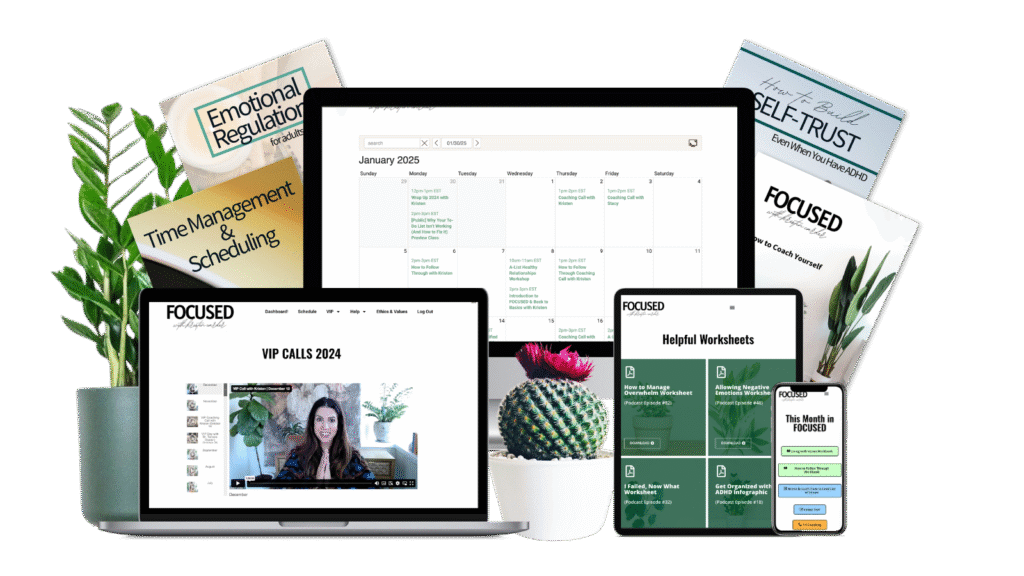
Kristen Carder 56:35
I couldn’t find anything, so I researched and I studied and I hired coaches and I figured it out. Then I created Focused for you. Focused is my monthly coaching membership where I teach educated professional adults how to accept their ADHD brain and hijack their ability to get stuff done. Hundreds of people from all over the world are already benefiting from this program, and I’m confident that you will too. Go to ihaveadhd.com/focused for all details.