

Episode #426: Your Dream Isn’t Too Big. You’re Just Avoiding This One Feeling.

Listen or Watch this episode on:
Kristen Carder

About This Episode

What if the biggest obstacle to your dream isn’t ADHD? What if it’s your unwillingness to feel uncomfortable?

In this episode, I share the behind-the-scenes story of writing You’re Not in Trouble and what it taught me about pursuing an “impossible goal” with ADHD. From years of waiting for the right season to months of writing through boredom, fear, vulnerability, and self-doubt, I learned that accomplishing meaningful goals isn’t about finding motivation. It’s about building enough support to tolerate discomfort.

We’ll explore the difference between waiting because you’re afraid and waiting because you genuinely don’t have the capacity yet, why immediate gratification gets in the way of long-term goals, and how self-compassion, not self-criticism, is what helps us follow through.

If you’ve been carrying a dream that feels impossible, this episode will help you identify what’s really standing in your way and encourage you to take one small step toward becoming the person who can accomplish it.

In this episode, you’ll learn:

  1. Why discomfort is the price of meaningful goals
  2. The difference between fear and lack of capacity
  3. How to support yourself instead of shaming yourself into action
  4. Why your impossible goal may be closer than you think

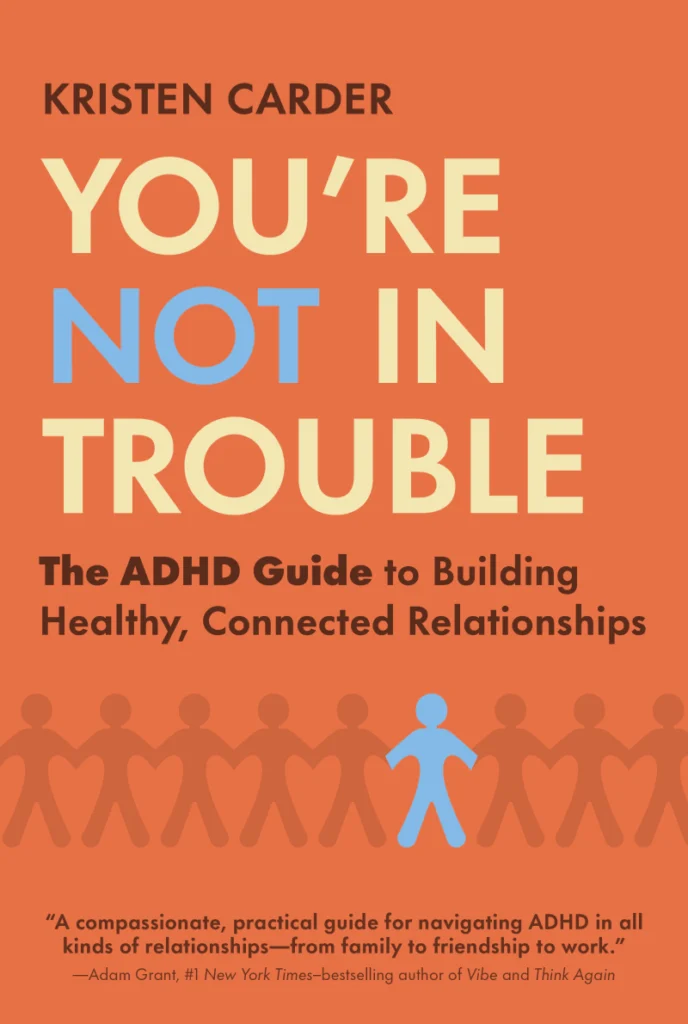
Preorder You’re Not in Trouble: USA or International

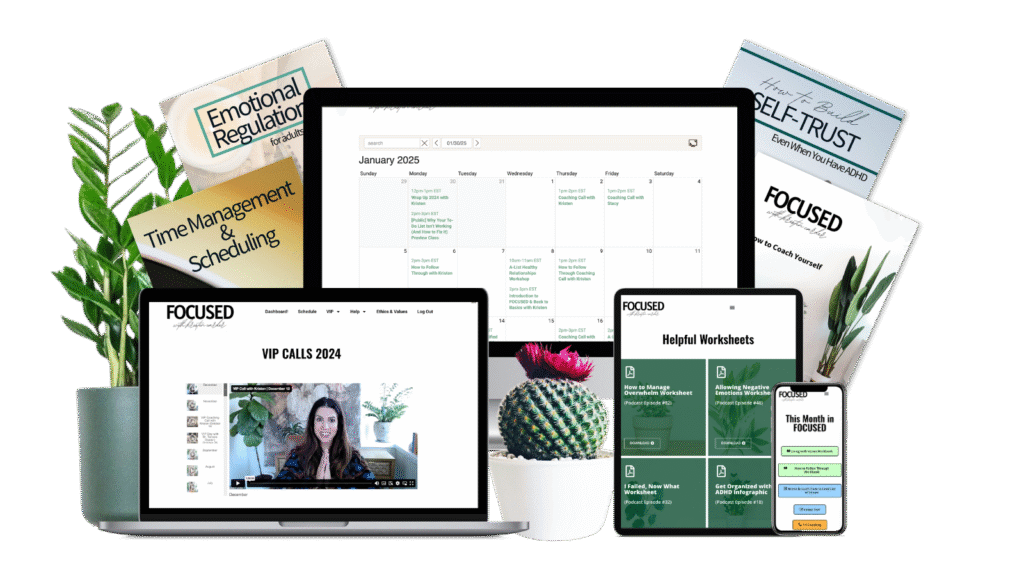
Want help with your ADHD? Join FOCUSED!

Have questions for Kristen? Call 1.833.281.2343
Episode Transcript

Kristen Carder 0:05
Welcome to the I Have ADHD podcast, where it’s all about education, encouragement, and coaching for adults with ADHD. I’m your host, Kristen Carter, and I Have ADHD. Let’s chat about the frustrations, humor, and challenges of adulting relationships, working, and achieving with this neurodevelopmental disorder. I’ll help you understand your unique brain, unlock your potential, and move from point A to point B. Hey, what’s up? This is Kristen Carter, and you’ve tuned into the I Have ADHD podcast. I am medicated, caffeinated, regulated, and ready to roll. Hello, get in here. How are you? We have so much to discuss. I am so glad that you press play on this podcast. Thank you for being here. Whether you have ADHD or you know someone with ADHD, you love someone with ADG. You’re curious about ADHD. I am so glad that you are here. What is up? We have been doing this together for quite some time. We are in the four hundreds of the episodes, which is wild. And I a couple weeks ago put out an APB for some podcast ratings. I was like, y’all, you know, not to be a weirdo, but our Apple ratings haven’t moved much recently. So, like, could you do a girl a solid? And you guys showed up. I just wanted to say thank you so much. Every once in a while, when I ask for something from you, you deliver, and it’s just so kind. At the time, when I was like, “Hey, could you click that rating button if you’re listening on Apple or Spotify, or you know, if you’re on YouTube or whatever? Like, please always hit like and subscribe.

But Apple and Spotify like hadn’t moved in a minute, and I was like, “Is anybody out? Is anybody listening? Is anyone out there? And when you click that rating button, it is your way of saying like, “I’m here, I’m with you. I’m listening. So I wanted to read some of the reviews that you left recently because a bunch of you all of the sudden wrote tons of reviews, and I was so delighted because I check them every day because I have ADHD and I need dopamine. So I go and look. I go in search of dopamine every day, as do you. I am sure in your own little way. Where do you go to find the dopamine? I go to my Apple and Spotify ratings and reviews. So here are a couple from Apple podcasts that I was just so delighted to receive. KP Lavender says stood the test of time. This is the only podcast I’m able to listen to every day without getting bored, I’m around 200 episodes in, and I’m still enjoying it. That’s amazing! Thank you so much. Still ADHD says so good, very helpful podcast for adults with ADHD. I learn so much each episode and walk away each time feeling far less alone in my struggles. Isn’t that why we’re here? That’s why I’m here. That’s why I started this podcast. I started this podcast. If you don’t know, the very end of 2018, I like recorded a podcast and threw it out into the darkness of the night, and was like, “I hope no one ever listens to this. But at the same time, I really hope everyone listens to this. And since then, we’ve grown a community of people who just feel so much less alone, and I appreciate it so much. Danu says favorite ADHD podcast, and I listen to multiple. Kristen keeps things fun and interesting, but also real. So many of her topics are relatable and helpful. That’s great because I hope today’s topic is very relatable and very helpful. We’re going to talk about doing the impossible. We’re going to talk about doing the impossible. And if you’ve listened to the episodes over the years, I have mentioned what I’ve called an impossible goal-the thing that we kind of aim for that we know is like a big reach goal. And and how does someone with ADHD do that? How does someone with ADHD set their sights on something really huge, really big, and slowly but surely kind of chip away at it? A lot of times, we definitely struggle with long-term goals. Obviously, I’m not telling you anything new. This is not brand new information. Obviously, we struggle with long-term goals.

There’s a lot of executive function required for long-term goals, so we need to have the working memory able to keep the goal in our mind’s eye for long enough to complete it. And often, we just forget. Honestly, our working memory is deficient, and to varying degrees, right? So, like some of us have extremely deficient working memory, some of us not so much. But in general, someone with ADHD is going to have deficient working memory, which means holding the goal in your mind over and over every day, day after day. And like continuing toward it can be very very difficult. In addition to that, and what I think is actually the biggest barrier to us reaching our goals is we struggle so much to feel uncomfortable, and we struggle so much to feel bored. Like, how much do you hate feeling bored? I recorded an episode maybe a year ago with Dr. Marcy Caldwell. It’s episode 348. If you want to check it out, it’s all about boredom and how we can sometimes feel boredom as actual pain, physical pain. And what’s so tough about long term goals is that we know that boredom is a big part of it. Yeah, we know that like it’s going to be fun for a minute, and then it’s going to suck. It’s going to suck. So how do we how do we tolerate everything that we have to feel in order to reach our long term goals? That’s what we’re talking about today.

But before we get started, I want to remind you that my book, “You’re Not in Trouble, is available for pre-order. And speaking of working memory and boredom and long-term goals, I just want to say something briefly, just very briefly. I understand how annoying it is to be asked to pre-order something. I get it because you’re not getting immediate gratification. You won’t receive the book until october 6 in the U.S. or october 8 in the U.K. and Canada, and that’s like, Kristen. Why am I going to do this in August if I’m not even going to get it until October, that’s boring. That’s boring, and I get it. What I want to say is, do your future self a favor. If you know you want to read the book, pre-order it. You can do it wherever you find your books. You can do it right now as you’re listening to this episode. It’s available on Amazon. It’s available on Barnes and Noble. It’s available, it’s available at all of the UK retailers, Waterstones, wherever you buy your books. And I’m asking you to do your future self a favor. If you know you want it, if you know you’re going to read it anyway, pre-order it. What that does for me is it is going to tell the publisher, hey, people care about this book. You should probably set up a book tour. Hey, people care about this book. We should probably get her on Good Morning America. Hey, people care about this book. ADHD is actually worth publishing because if this book does well, guess what? They’re going to want to print more books about ADHD. This is one of the ways that we get ADHD into the conversation of the general public. Are you annoyed that there’s just not enough knowledge out there about ADHD? Buy the book and tell people that it matters. Right. So wherever you buy your books, go pre-order. You’re not in trouble now. If you’re searching for it, don’t forget that there is an apostrophe in the word “your” because it’s you are. We’ve had a couple people email in and say I can’t find it. I can’t find your book. I can’t find it anywhere. And it turns out they’re using the wrong your. And listen, I don’t judge you for that. I don’t. So remember that there is an apostrophe in the word your. Go search for it. There’s also links in the show notes, of course, because we’re professionals around here. Pre-order your copy today. My impossible goal, and it is a disgustingly impossible goal. Disgustingly impossible. My impossible goal with these pre-orders is to land on a bestseller list. Now, I’m telling you, it’s impossible. Without a miracle, it is literally impossible. Or without every person listening to this podcast pre-ordering it, it really is impossible. There’s no way it would take 10,000 pre-orders.

Now, are there 10,000 people listening to this podcast? Yes, there are. There are. There are 10,000 views. So if everyone pre-ordered today, we could literally land on the New York Times bestsellers list and make ADHD impossible to ignore in October, which happens to be ADHD Awareness Month. If you’re inspired and if you’re like, yes, I want ADHD to be a part of the conversation. I want it to be impossible to ignore. I want this ADHD Awareness Month to blast across like the entire world, where people are like, I, I’m so sick of hearing about ADHD because it’s everywhere. You can be a part of that impossible goal if you pre-order. You’re not in trouble today. Link in the show notes or buy it wherever you find your books, okay, okay, okay, okay. So, doing the impossible, doing the impossible-that is what we’re talking about today. And I want you to think about for you what is the impossible thing that you’re dying to do, okay? Because five years ago, my impossible. Was to write a book, and I did that. But this episode isn’t about like how to write a book. It’s more about doing the thing that once felt impossible to you. Because I know that so many of you have something that is sitting quietly in your heart. Maybe it is writing a book, but maybe it’s starting a business or going back to school, or repairing your marriage, or finally getting diagnosed and treated for ADHD, or whatever it is that is ailing you. Maybe it’s getting physically healthy, leaving a job that no longer fits, or starting a family. Whatever it is, I know you have a dream that keeps visiting you, and maybe every once in a while, you think I could never, I could never, and I know that feeling. I know that feeling. How does someone with ADHD actually write a 300 page book? I could never.

That’s exactly how I felt, and I dreamed about writing this book for years and years and years-not weeks, not months, years. It wasn’t a passing thought. It wasn’t something that I impulsively decided to do. If you’ve been listening to this podcast for a minute, you know I’ve talked about it multiple times over the years. It was this little quiet dream that just stayed with me, and every once in a while, I’d think I’d really love to write a book someday. But then I’d put it on the back shelf, and here’s what is like really interesting about that. I never shamed myself for putting it on the back shelf because I knew that I was not procrastinating and I wasn’t avoiding. I wasn’t afraid. I wasn’t afraid, but I did know my life was too full for years. I was like, I want to write a book, but now’s not the time because I had the coaching business, and obviously I have this podcast and clients to take care of, and kids that were like in really busy seasons of their lives, and my marriage, of course. But I was also doing the relational work that the book would contain during those years of waiting. I was in tons of therapy. I was doing the hard work of differentiating from my family of origin, of learning how to create boundaries, of learning who I was, of learning the process of self trust, of learning that I was a full person on my own, and that I didn’t need the approval of my family of origin, which is a big theme in the book. Because if you feel like you’re in trouble all of the time, chances are that’s going to trace back to the way that you were raised. And for me, this I didn’t expect this podcast to go in this direction, but here here we are. Here we are. For me, there was a long period of time where I had to do some very deep work-the work that is the foundation of my book. I had to do the very deep work of figuring out my own relationships, figuring out my own relational wiring, figuring out why I was so shaky and insecure, and feeling like I was just one misstep away from rejection at every turn. So I didn’t know at the time, right? I was like, “Oh, my life is too full. I’m doing this deep work.

I just don’t have space to write the book. But now looking back, I see that that was actually building the foundation for what the book would become, and I want you to think about yourself too. If now is not the time for your impossible goal, are you in the process of becoming the person who can do it? Are you right now in the process of becoming the person who will eventually be able to do that impossible goal to achieve that impossible goal? Because that waiting period, that holding period, that growing period, that digging down deep period is so important. Don’t call it procrastination. Don’t shame yourself for like not starting. Just understand that you are in the process of becoming the person who can do the thing eventually. Okay. Sometimes we wait because we’re scared, but sometimes we wait because we’re wise, and that’s a really important distinction, especially for those of us with ADHD who have this procrastination story. Oh, I’m just procrastinating. I, I, I know I’ll never get there. I just I procrastinate so much. But like, instead of accusing ourselves of procrastinating, sometimes we’re not. Sometimes we’re accurately assessing our capacity. Sometimes we’re just truly understanding. Like I am not in a place to do it yet. So here’s the question that I want to ask yourself: Am I delaying my dream because I’m afraid, or am I delaying it because my life genuinely just doesn’t have room right now? Sometimes we are afraid. Sometimes we’re delaying because, like, there’s no reason not to do it. I’m just scared.

And listen, that’s. Valid, but you need to call it what it is. But other times, it’s like I know I’m going to do this someday, but I’m just not there yet. My life doesn’t have room. I don’t have the capacity. And those are two different things. A capacity issue is very different from a fear issue. So if it’s fear, work on that fear. What support do you need in order to overcome that fear? But if it’s capacity, which it was for me, I just didn’t have it. I did not have the capacity. You can honor that reality. Your dream can wait. It doesn’t expire. It believe me when I tell you it doesn’t go anywhere. Like the more you don’t do it, the more you want to do it? It doesn’t go anywhere. It’s not going to expire. Okay, and so for me, finally, I got to the point where I was like, I think I have room in my life to do this. And I mentioned on the podcast just casually, I think I’m ready to write a book. That’s it. Like that’s that’s pretty much all I said. I was like, I think I’m in a place now where I can do it, I said one sentence, and after that, like a beautiful, wonderful, quirky literary agent reached out to me. If you’re wondering what a literary agent is, I I had no idea. I had no idea. I didn’t know what they did. I didn’t even know that I needed one. I didn’t know anything. But we started chatting. I loved her. She shared with me what she did, which was help to write the proposal and essentially walk you along the way of finding a publisher, creating a deal, and she’s still by my side to this day. And I essentially signed the contract with her, not really knowing how much I would need her, how much she would do for me. She has done so much, and I thought, okay, we’ll just write a book proposal and like get it in publishers’ hands. I didn’t realize that that would take six months. Six months to write a book proposal-that’s not even the book. It’s it’s here. This the idea of the book, okay? But what she did was help me figure out what the book actually was and where it was going to go. And I remember her saying, “We don’t need another ADHD book. We already have ADHD books. We need to hone in on a specific aspect of ADHD that is really painful-a problem that you think you can solve. And at the time, I was like, “I mean, I’ve been solving this problem for myself and for my clients for years now, the problem of relationships.

Ugh, my gosh, our relationships are so painful, and we’re so desperate for authentic connection, and yet that connection is interrupted over and over and over. And like, how do we repair it? And how do we create connections where we get to be ourselves, and we don’t have to mask all of the time? And when we mess up, we don’t spiral in shame, and we can repair what we’ve broken. And so that’s where this book was birthed, and then we signed with a publisher, and that was a whole process, but it became real. Then there were contracts and deadlines and expectations, and I wasn’t dreaming anymore. Now it’s not a dream. It’s like get the f to work, and that’s the part where it becomes not fun anymore. And I think that one of the biggest parts about our impossible goals, about doing the impossible, is truly understanding how not fun it is to actually accomplish what you want to accomplish. How unfun it is to just show up every day and do the thing because you have the end goal in mind, and again, this is where our ADHD really bites us in the butt. Because we want immediate gratification, right? We want to be gratified immediately.

Well, there is literally no immediate gratification when it comes to writing a book, none. And I want you to think about your impossible goal as well, is there any immediate gratification? Probably not, because it’s an impossible goal. It’s a big goal. It’s the kind of goal. Like maybe it’s like I want to go back to school and get my master’s degree. Okay, well, where is the immediate gratification there? There’s none. It’s like applying to schools, and then you get into school, and you’re like, “Great! But now I actually have to go to school, and so then you like sign up for your classes, and you’re like, “Yay! I have the classes that I want, but now I actually have to take the classes and go to the classes and do the work of the classes and get the grades. And it’s like with our impossible goals, there is literally no immediate gratification, which is why it is so hard for us. We have to keep the end in mind the entire time. What is it that I want? We have to paint a picture for ourselves the whole time. What is it that I want? So, what I did was I thought of. You, just one person. You, this one listener, this one podcast listener, the the one person who has ADHD and they understand their ADHD and they’re doing some work with their ADHD and they’re feeling like they’re really growing and and making changes and like yeah this is this is going great.

I’m working on my productivity. I’m working on my time management. I’m working on like getting to work on time and getting out of bed when I want to and going to sleep when I want to. Like all of these ADHD things. But why are my relationships so hard? Why am I still a people pleaser? Why do I contort myself into all of these different versions of me that don’t feel authentic, just so that people that I don’t respect like me, like why? Why am I doing this to myself? And I thought about you this entire time that I wrote. You’re not in trouble because I didn’t have the immediate gratification of being able to talk to you face to face, give you wisdom, give you advice. I didn’t have that. I was like, someday you’re eventually going to read it. I don’t even have that gratification now. Nobody’s actually read the book. Like I still, can you understand this? I completed my impossible goal, and I still don’t have the gratification yet of anyone reading the book, other than like my agent, my editors, and the proofreaders. Which, by the way, the proofreaders, there were two or three different proofreaders, and they all sent the most wonderful notes. This book is amazing. This is going to change the world. Blah blah blah. Okay, that’s gratify. That’s gratifying for sure. But I don’t even know if they have ADHD. There’s probably not. They’re proofreaders, right? They’re attention to detail. People. Do they even have ADHD? Has this book actually changed anyone’s life yet?

No, I still have not had any immediate gratification, which is why I’m asking you to pre-order wherever you buy your books. Because listen, eventually that gratification will come. So you’re probably looking for like a productivity secret. Like, how did you do it, Kristen? How did you how did you get yourself to do it? I just let myself feel bored and uncomfortable for 14 straight months. It was horrible. I just embraced that writing a book is going to feel terrible all of the time, and it did. There was never a time where I was like, “I love this. This is the best. Working on a Saturday is my favorite. Missing out on my kids’ games because I have to sit at the dining room table and write this book is my favorite thing to do. No, it wasn’t like that. It was like I know that I am called to write this book. I know that there is a divine calling on my life to write this book, and so I am willing to feel the discomfort that it takes, the boredom, the frustration, the fear, the vulnerability. I am willing to feel that in order to make it happen, and I want you, dear listener, to consider whether or not your impossible goal is that aligned with yourself, with your values, that you are willing to feel whatever it takes to make it happen. Because if you’re not, then it’s not the right goal for you, and that doesn’t mean that you’re a failure, or that you’re a quitter.

It just means that you thought that this was the right goal, but it’s just not. Because if you don’t think about your goal and say to yourself, “Okay, this is the goal, and I am willing to feel fear, vulnerability, boredom, and frustration over and over and over and over until it’s complete, then it’s not a good enough goal. Sometimes we create goals for ourselves that we think are the right goals, and sometimes it’s just like because everybody else is doing it, because so and so said I they think I should do it because I’m I’m good at it, so I might as well do it. Those are not good enough reasons because the amount of discomfort that it takes to actually accomplish it is such a huge, huge, huge Everest mountain to summit that if your goal is not truly values aligned, if it doesn’t feel so connected to who you are and why you’re put on this planet, then just abandon it. Like, don’t do it. It’s not worth it. I’m telling you, it’s not worth the discomfort if you don’t feel that connected to it. And if you’re like, well, if I don’t do this, then what do I do? Start some real introspective work. Okay, who am I? Why am I here? What am I meant to do? Sometimes it is as simple as like I want to find a partner. I know that I don’t want to be single for the rest of my life, so I want to find a partner. Okay, are you willing? To feel fear, vulnerability, boredom, frustration over and over and over until you find your partner, because you’re gonna have to go in the apps, you’re gonna have to put yourself out there in person, you’re gonna have to go on dates that are just like disasters, over and over and over until you find the one. Right. So this applies to whatever it is the goal that you have, really. Okay, so my friend, writing wasn’t the hardest part. Feeling uncomfortable was the hardest part. So doing the work, whatever it is in your goal, for me it was writing, wasn’t the hardest part. It was the amount of discomfort that it took, right? And for you, it’s the same. So maybe your goal is to run a marathon, and the running part is probably not the hardest part. It’s like getting yourself out the door, setting boundaries around your time so that you have hours to run, and the discomfort of setting those boundaries with people who want your time and attention, like those are the hardest parts, right? The discomfort of what it takes to do the thing. So I felt uncomfortable writing it. I felt uncomfortable sending the chapters to my editor.

I felt uncomfortable getting the edits back, I felt uncomfortable deleting pages and pages and pages that I had worked so hard on. So originally, I turned in 86,000 words, and they were like, “We need you to cut 14,000. So I had to go through and cut 14,000 words. Work that I had already completed, hours of my time that I had already invested. They were like, “Yeah, we need you to cut. We need you to figure out where to cut. That was uncomfortable. I felt uncomfortable wondering if it was good enough. I felt uncomfortable when my editor continually said, “We need more of Kristin in this book. We need more of your vulnerability. We need more of your stories. Let me tell you, I share things in this book that I have never shared publicly. I share a medical emergency that I had that I’ve I’ve never talked about, never in focused, never on a coaching call, never on a podcast, never on an interview. Like some of the people in my life don’t even know this story, but I included it in the book because it was a visible representation. It’s in the chapter on feeling needy. The chapter is called “You’re Not Needy, You’re Human, and I share a story of a medical emergency where I ignored my own needs and it almost cost me my life. I’ve never shared that before publicly, ever, ever, ever, ever, and it’s contained in this book. Why? Because vulnerability changes lives. I know that it does. It’s so annoying. It’s so annoying. I know that the more vulnerable I am, the more lives will be changed. Okay, so that’s what it cost me. That’s what it cost me. What is it going to cost you to complete your impossible goal to do the thing that you are put here on this earth to do? What is it going to cost you? That’s an important question, and sometimes we don’t take the first step because we know what it’s going to cost, and we’re just not ready to pay the price. And I just want to validate that. Like that makes sense. That makes sense. You’re not a failure if you’re not yet willing to pay the price.

What I would ask though is, what support can I give myself so that I can become willing to pay that price? What support do I need in my life? Do I need to be medically treated for ADHD? Do I need a therapist? Do I need a coach? Do I need to form stronger connections in my life so I have real time support so that I can do the thing that I know I was put on the earth to do, because I’m not better at this than you are. I’m not better at life than you are. I’m not better at impossible goals than you are. I just, I’m. I’ve gotten really good at supporting myself. I’ve gotten really good at honoring what I need as a human. Of not saying you’re fine, Kristen. Just do it. What’s wrong with you? Just do it. I’ve gotten really good at saying this is super hard. How can I help you? So even for example, on writing days, I would be like, okay, what do we need? We need cozy jammies. We need a candle lit. We need some snacks. We probably need a little bit of nicotine. We need to call a friend. We need to scroll on social media. And so much of my writing time was spent getting myself to write. Does that make sense? And listen, I know you know what I. Mean, getting myself to the point where I’m finally willing to write. So, in my block of five hours, an hour at least was me just prepping myself. You can do it. What do you need? Oh, we need to go for a walk. Okay, now we need a snack. Okay, now we need a snuggle. Okay, you you’ve got it. That it was built into my work time, are you building in to your work time, to your impossible goal time, the prep that it takes to get your nervous system to a place of willingness to do the thing? Because I’m not smarter than you. I’m just willing to support myself. I’m willing to be nice to myself. I have so much compassion for myself.

I know how hard it is for me to do the things, and I give myself what I need in order to accomplish it. You can do that for you too. You can. I I was very keyed into how uncomfortable this was: boredom, frustration, vulnerability, fear. Those are the top emotions that I knew I was going to feel every time I had a writing block on the calendar. And I wrote about 10 hours every weekend, five hours on a Friday, five hours on a Saturday, and I knew that those were the four primary emotions that I was going to have to face, so I was very tender with myself. What do you need? How can I help you? What What do we need to bring in here to make this doable for you? I stopped making the discomfort mean you’re doing it wrong. Maybe we shouldn’t do this. Instead, it was like, yeah, this is just how it feels to do the thing that you’re meant to do, and I just I really want you to hear me. There is no way to fulfill the calling on your life without a hefty dose of discomfort. For me, it was fear, vulnerability, boredom, frustration. For you, it might be a different combination of emotions, but get clear on what those are. There is no way to fulfill the calling on your life without all of that discomfort. There’s just not. And once we fully accept that, like this is part of being human, this is part of the hero’s journey. This is part of just what it takes to have a meaningful contribution to the world. Once we fully accept that, we can stop shaming ourselves for it. We can stop saying, “Why are you so scared? Just do it. You know you’re supposed to do it. Why? I don’t even know why you’re scared.

No, that’s not how we’re going to talk to ourselves, my friends. It’s just not. Once you know what it takes to make it happen, which is all of those emotions that are so hard, then you can start solving for that. Okay, I know that I’m going to have to feel these emotions. How can I give myself support here? Do I need a therapist? I did. Do I need a coach? I did. Do I need supportive people in my life that I can text and say I don’t want to do this? Tell me to do it. Tell me. Tell me to do it. I did. I needed that. Do I need snacks? Lots and lots of crunchy snacks. I did. Do I need nerd gummy clusters? I did. Gosh, I can’t even tell you. I have them with me right here. These right here, nerds gummy clusters. Like they fueled me, and I just let myself eat them. I’m 45 years old, and I was like, I don’t care. You can have as many as you want. You can because you’re doing a really hard thing. So let me ask you, what is the impossible goal that you have been quietly carrying? Maybe it doesn’t sound impressive to anyone else, but it keeps whispering to you, and and you just can’t quite let go of it. It visits you in the middle of the night, or in the shower, or on long drives, or like when you finally get quiet, what is that thing that you know you’re meant to do? And then ask yourself, “Am I waiting to start? Because it’s just simply not time yet. My life is not in a place where I can do this. And if that’s the case, okay, do I see that changing? Am I becoming the person who will eventually be able to do this? Am I working on becoming that person, or so am I waiting because it’s not time yet, or am I waiting because I’m afraid? I’m trying to avoid feeling uncomfortable. I know it’s going to take so much work, and I just don’t feel like it. I don’t feel like it. Be honest with yourself. There’s no shame here, but live in the reality of what is, because if the answer is I’m just really scared, okay, that’s workable. Fear is not a character flaw. Fear is a part of the process. I had a coach once that repeatedly said, “Discomfort is the currency of your dreams.

You don’t get to live out your dreams without feeling uncomfortable. It is literally the price you pay to get what you want. And fear isn’t a character flaw. It’s just a natural, normal human experience. So, what support do you need? What support do you need right now in order to be able to accomplish your impossible goal? Maybe it’s medication or therapy or coaching or accountability or asking for help or developing better, more authentic relationships in your real life, so that you actually have friends who are supporting you during the process. Because there’s no such thing as becoming fearless. There’s just not. There’s no magical time where you’re like, “Oh my gosh, I’m not scared anymore. I’m just going to do it. I am still scared. I’ve already written the gosh darn book, and I am still scared. Actually, I’m more scared now because my part is complete and nobody’s read it yet. My part is complete, and it is not in your hands yet. And I am still so scared, and I’m doing it anyway. Oh. Let’s just take a moment. Let’s just take a moment here, so I can vomit real quick, okay? Because that is just a part of the process. It’s just a part of the process. You’re not put on this earth to live a small life. You have gifts that nobody else has. There are people whose lives will be different because you exist. Maybe in a huge way. Maybe maybe you’ll change the whole world. Maybe you’ll just have one tiny conversation and someone’s life will change. Maybe it’s the investment that you’re making in your children and your kids are going to change the world.

Maybe it’s your creativity and your art or your work, or through your kindness or through a book that you write. That the size of the goal doesn’t necessarily matter, but your willingness does, your courage does. So let yourself dream, and if now isn’t the time, don’t accuse yourself of procrastinating. It’s okay. Honor that you just don’t have the capacity yet, but please do not wait until you feel comfortable, because comfortable people don’t change the world. Comfortable people watch Netflix and eat ice cream, and that’s okay too. That’s fine, but comfortable people don’t change the world. People who are willing to feel uncomfortable do. So I hope, I hope that you feel inspired today to take one step toward becoming the person who can accomplish your impossible goal because you are capable of so much more than your fear wants you to believe. You are. Your fear wants to keep you small. Your vulnerability wants to to keep you hiding in the cave. And believe me, I know about the cave. The cave and I are good friends, but that’s not where we change the world. We don’t change the world in the cave. We just don’t1. day you’re going to look back as you put one foot in front of the other of becoming that person who is supported enough to accomplish the impossible. You’re gonna look back and be like, “I did it, and even when you get to that point, I have kind of bad news for you. It’s still going to be uncomfortable, even when you get to the point where you did the thing. There’s not this like magical like, oh my gosh, I now feel amazing. I now feel secure. I now feel confident.

No, it’s just uncomfortable the whole time. I’m sorry, I’m sorry, but you get to be uncomfortable knowing you did the thing that you were meant to do. You get to feel uncomfortable knowing that lives are going to be changed because of you. Maybe I keep having this thought of someone going back to school to be a nurse. Like, imagine that-that is your goal. That you’re just like, I feel called to be a nurse, but it-it feels impossible. And there’s so much like schooling and work and learning, and maybe I feel too old. But like, think of all the lives you’re going to change. Are you going to feel amazing when you’re a nurse? Probably not. It’s hard work, Long shifts, long shifts. People who are in distress, leaning on you constantly. Does that feel great? No, but does it feel good knowing that you’re doing what you were put here on the earth to do? Yes, yes, it does. That feels great.

Because life is uncomfortable either way, so you might as well be doing what you were put here on the earth to do. You might as well, if you’re gonna feel uncomfortable, you might as well feel uncomfortable doing the work that you’re called to do. Ah, I am just, I’m just ready to change the world with you, whatever that looks like. One evolved ADHDer at a time. One supported person with ADHD at a time. We’re not going to be able to change the world together if we don’t accept support, if we don’t acknowledge our needs if we don’t truly understand how much support we need in order to be the people that we’re called to be, in order to accomplish the impossible. And yes, it’s going to be hard. And no, it won’t feel good. Take it from me. I wrote a whole book. I wrote a whole effing book. Does it feel good? No, it doesn’t feel that good? It feels scary. It feels scary, and I’m still going to ask you to pre-order it because it’s the right thing to do. It’s how we change the world. Even though I feel afraid, even though I feel vulnerable, even though I feel like they’re going to be mad at me, they’re going to be mad at me for asking me to pre-order.

Even though I feel that way, I’m still going to do it because I know it’s the right thing. I know it’s how I change the world. I know it is. All right, go do it. Go do the thing that you’re meant to do. I can’t wait to talk to you next week. Bye bye. A few years ago, I went looking for help. I wanted to find someone to teach me how to feel better about myself and to help me improve my organization, productivity, time management, emotional regulation-you know all the things that we adults with ADHD struggle with. I couldn’t find anything, so I researched and I studied and I hired coaches and I figured it out. And then I created Focused for You. Focused is my monthly coaching membership, where I teach educated professional adults how to accept their ADHD brain and hijack their ability to get stuff done. Hundreds of people from all over the world are already benefiting from this program, and I’m confident that you will too. Go to ihaveadhd.com/focused for all the details.


Pre-Order Today

You're Not in Trouble

The ADHD Guide to Building Healthy, Connected Relationships

An empowering self-coaching guide to help ADHDers understand, repair, and build healthy relationships — with friends, romantic partners, family, and at work — from the creator of the I Have ADHD podcast.

Free ADHD Time Management Download

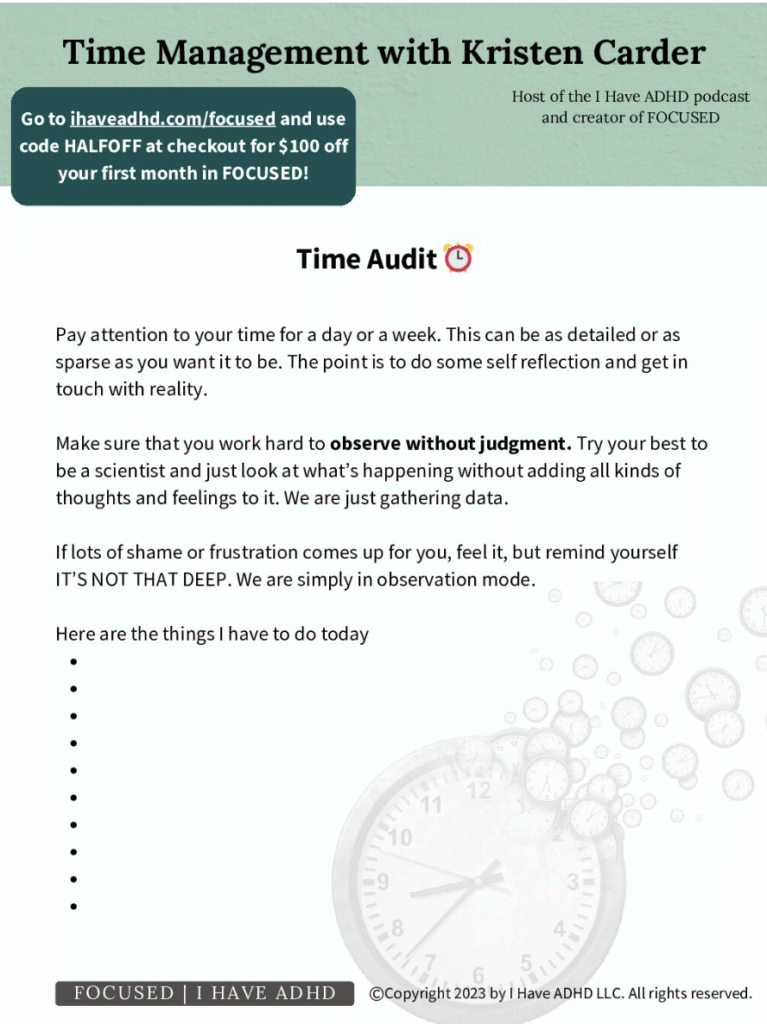
Get a practical, ADHD-friendly resource to start managing your time today—and unlock access to Kristen’s live masterclass, too.

Related Episodes

Kristen in the studio

Episode #424: The Best Episode I Never Planned (An ADHD Pivot)

Kristen and her new book

Episode #422: You’re Not In Trouble | Book Launch Party!!

Kristen Carder

Episode #420: I Cured My ADHD Revenge Bedtime Procrastination. Here’s Exactly How.

Stop Struggling Alone.
Start Thriving With FOCUSED.

A proven coaching program designed specifically for adults with ADHD who want to gain clarity, build confidence, and take control of their lives.

Join a community of hundreds of ADHDers

Learning About My Brain...

Changed Everything

Hi, I’m Kristen Carder—ADHD expert, podcast host, and certified coach who’s been exactly where you are. Diagnosed at 21, I spent years cycling through planners, courses, and systems that never quite worked. Everything changed when I discovered the power of understanding my ADHD brain and the transformative impact of community support.

Now, after 15+ years of research and experience, I’ve helped thousands of adults with ADHD thrive. I’m here to show you how understanding your brain can transform your life, just like it did for mine.

ADHD Tips That Actually Make Sense

Follow @i.have.adhd.podcast and join our Instagram community for daily strategies, relatable content, and real talk about ADHD

Pre-Order Today

You're Not in Trouble

“This book belongs in the hands of every adult with ADHD and the people who love them.”
–Dr. Ned Hallowell, NYT best-selling author of Driven to Distraction